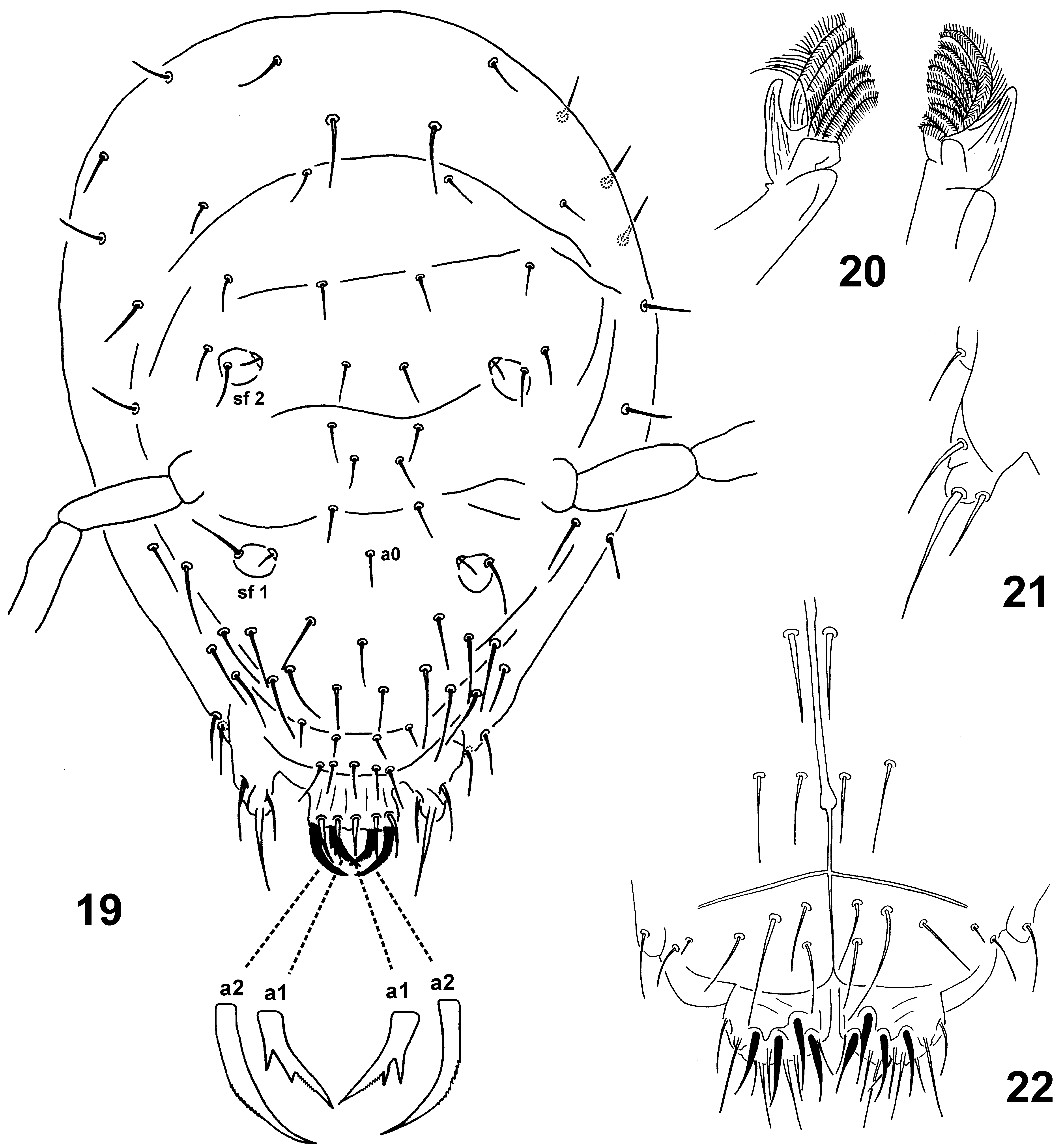
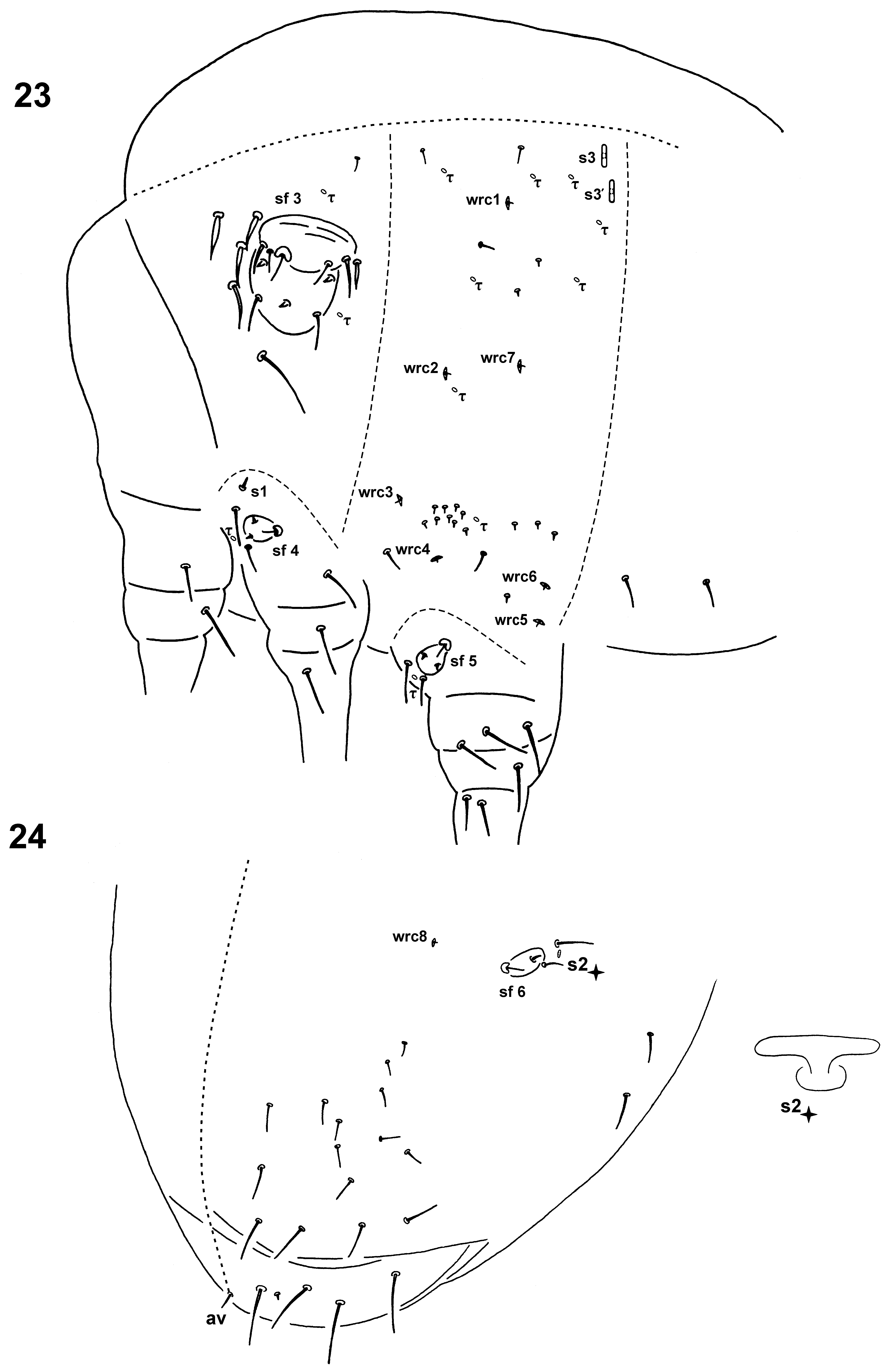
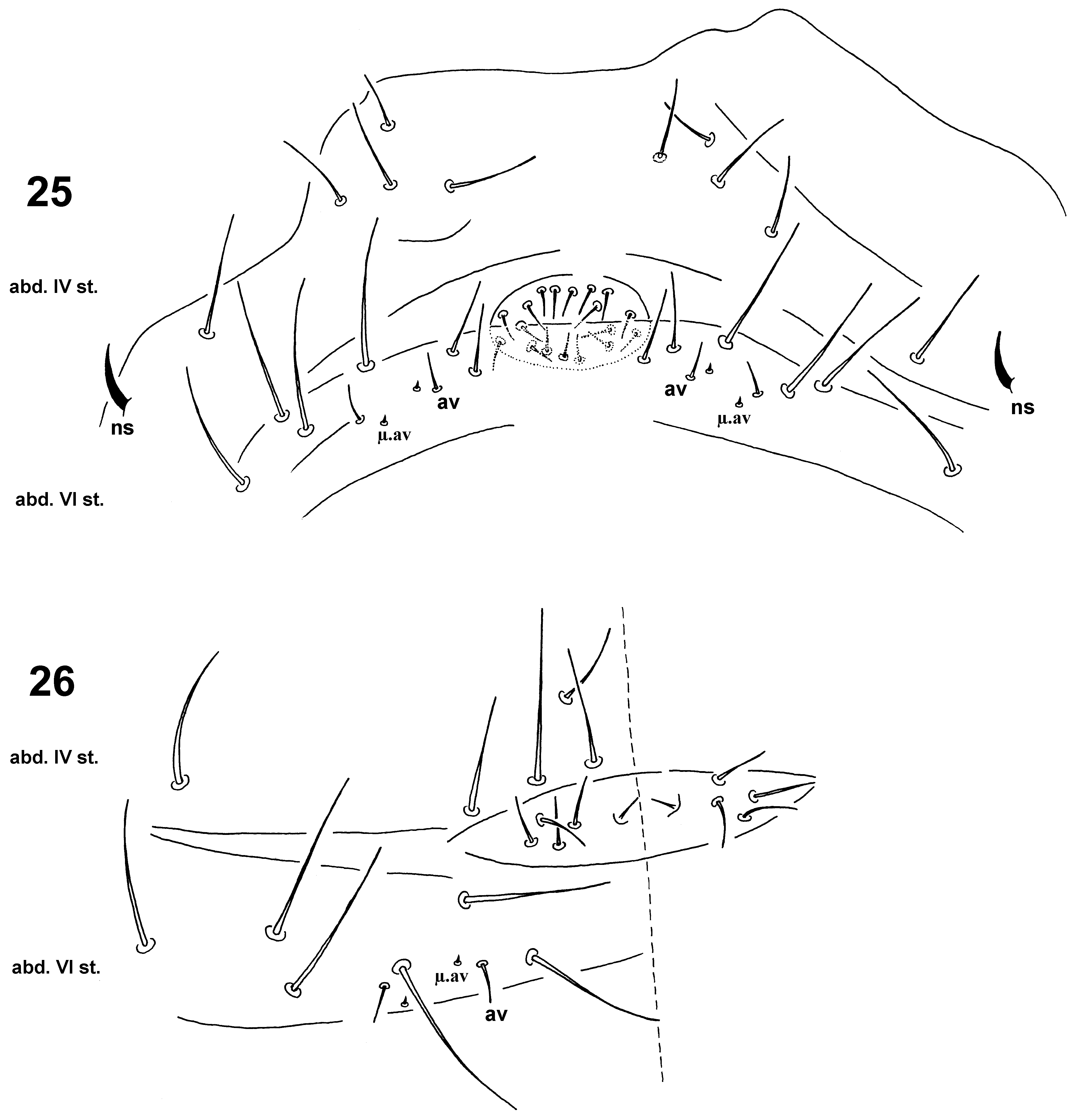
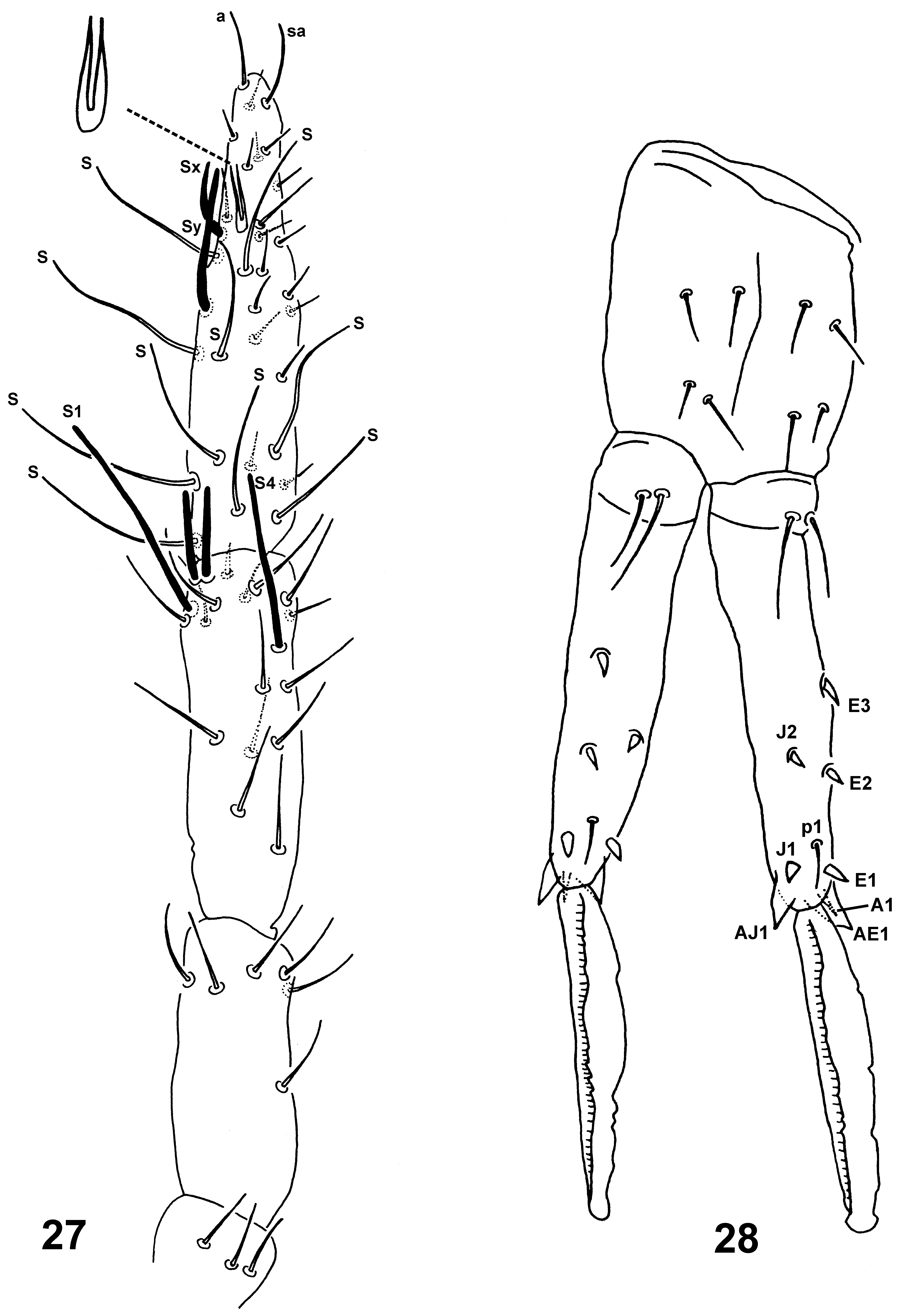
Description. Body length 0.9 – 1.2 mm, habitus typical of the genus. Colour of the body mostly whitish dorsally with reddish dots of pigmentation on head, thorax, abdomen and scx. Integumentary channels observed on head and thorax, connection of epicuticular channels with l. v. on head crossed. Head (Figs 19 – 22). Head length and width as 400 and 280 µm, respectively. Dorsal chaetae on head smooth and pointed, frontal chaetae longer (22 – 30 µm) than those posterior (16 – 22 µm). Antero-dorsal area with 8 + 8 chaetae (lateral ones longer than axial) and 2 unpaired chaetae. Antero-lateral area with 5 + 5 chaetae. Posterodorsal area with 11 chaetae (in postero-axial position 1 + 1 macrochaetae (28 µm). Postero-lateral area with 4 + 4 chaetae (Fig. 19). Labrum with 5,5,4 chaetae. Anterior labral chaetae a 1 and a 2 thick, curved; a 2 longer than a 1 (25 and 16 µm, respectively). Chaeta a 1 medially with 2 strong teeth and finely serrate in distal part, a 2 with external edge medially finely serrate. Medial chaetae (m-row) equal (24 µm), smooth, spine-like. Posterior chaetae (p-row) smooth, lateral ones longer than those axial (22 and 18 µm, respectively). Maxillary palp simple (Fig. 21), with 1 enlarged terminal chaeta (40 µm). Basomedian field of labium with 4 + 4 chaetae (Fig. 22), medial chaetae longer (38 µm) and thicker than others (24 µm); basolateral field with 2 + 2 chaetae and 1 + 1 chaetae on tubercle. Ventral side of head with 3 + 3 smooth postlabial chaetae: 2 + 2 anterior unequally long, lateral longer than axial (30 and 26 µm, respectively), 1 + 1 posterior thicker and longer (38 µm) than anterior ones. Mandible strong, with 5 apical teeth. Maxilla as in Fig. 20. Thorax and abdomen (Fig. 23, 24). Dorsal side of thorax and abdomen covered with ordinary chaetae, τchaetae, wax rods, swollen S-chaetae and tertiary rods. Dorso-lateral area of Th. II with: 13 + 13 ordinary chaetae and 2 + 2 τ-chaetae. Precoxal area of Th. II with 2 + 2 ordinary chaetae, 1 + 1 τ-chaetae and 1 + 1 flame-shaped Schaetae (s 1). Dorso-lateral area of Th. III-anterior abdomen not seen clearly, with 5 + 5 chaetae, 2 + 2 T-shaped Schaetae (s 3, s 3 ’), 7 + 7 wrc (wrc 1 – 7), 8 + 8 τ-chaetae and several tertiary rods arranged as in Fig. 23. Precoxal area of Th. III with 2 + 2 ordinary chaetae and 1 + 1 τ-chaetae. Posterior part of the abdomen with at least 19 + 19 ordinary meso- and macrochaetae (12 – 17 Μm and 28 – 30 Μm), 1 + 1 T-shaped S-chaetae (s 2), 1 + 1 wrc arranged as in Fig. 24. Their overall number not seen clearly. Abd. VI tergum with 4 + 4 chaetae (38 – 40 µm), 1 + 1 microchaetae (Μ. av) and 1 unpaired posterior mesochaeta of anal valve (av, 11 µm). Abd VI and V sterna cryptic. Ventral anal valves each with 2 + 2 microchaetae (Μ. av) and 1 + 1 mesochaetae (av). Abd. VI sternum with 1 + 1 mesochaetae (9 – 13 µm) and 6 + 6 macrochaetae, one more laterally (35 – 42 µm). Male genital plate with 9 + 9 microchaetae (6 µm) arranged in circle (Fig. 25). Female genital plate cryptic, with 4 + 4 chaetae (16 µm) and 1 + 1 axial microchaetae (8 µm) (Fig. 26). Abd. IV sternum with 4 + 4 chaetae in one row (26 – 35 Μm, 1 chaeta placed more laterally). and 1 + 1 distal chaeta (20 µm). Lateral part of Abd. IV sternum with 1 + 1 short, sharply pointed and curved neosminthuroid chaetae (13 µm) (Fig. 25). Appendages. Antennal segments III and IV distinctly separated (Fig. 27). Length of antennae 254 µm, ratio antenna / head = 0.6. Length of antennal segments I, II, III and IV as 15, 60, 77 and 102 µm. Ant. I segment furnished with 3 short chaetae (12 µm). Ant. II with 1 medial chaeta and 5 apical chaetae arranged in a whorl. Ant. III with 14 ordinary chaetae in four whorls (distribution from base to apex: 2, 3, 2, 7 chaetae); 5 apical S-chaetae (S 1 – S 5), S 1 and S 4 long and tubular (46 µm each), S 2 and S 3 short and tubular (22 µm), S 5 short and flameshaped (8 µm). Ant. IV segment with 17 ordinary chaetae, whorls unclear; 12 S-chaetae with round apex, 10 of them long (25 – 38 µm), Sx shorter and basally thick (18 µm), Sy thicker than other S-chaetae (32 µm); 2 rod-like curved chaetae in apical (a) and subapical position (sa) and subapical organite Or with two filaments (10 µm). Complete chaetotaxy of antenna provided in Table 2. Chaetae numbers of legs I – III (Figs 29 – 31): scx I: 1, 1, 3; scx II: 1, 1, 1; coxae: 1, 1, 2; trochantera: 4, 3, 4; femora: 10, 10, 10 and tibiotarsi: 15, 16, 17. Thin meso- or microchaetae in following numbers on leg I: coxa with 1, trochanter with 3, femur with 2; on leg II: trochanter with 2; on leg III: trochanter with 2, femur with 1. For complete chaetotaxy of legs see Table 3. Tibiotarsal tenent chaeta pointed. Unguis narrow and extremely elongated, both unguis and unguiculus unequally long in leg I, II and III: unguis 83, 78 and 59 µm, respectively, unguiculus 40, 40 and 43 µm, respectively. Ratio unguis length vs. tibiotarsus length on leg I – III respectively as 0.67, 0.72, 0.71. Ratio unguis length vs. pretarsus width on leg I – III respectively as 4, 3.54, 3.27. Main lamella of unguis furnished with 2 long proximal lamellae in external position la and lp and 1 median lamella Bp. Unguiculus untoothed without apical filament, with basal tubercule. Tubus ventralis with 2 + 2 distal chaetae and posterior lobe. Retinaculum with 3 + 3 teeth, chaeta on corpus absent. Furca well developed (Fig. 28), length of manubrium, dens (dp and dd) and mucro: 98, 39, 189 and 155 µm, respectively. Manubrium posteriorly with 4 + 4 chaetae, lateral (distal 17 µm, proximal 22 µm) shorter than axial (30 µm). Dens in proximal part (dp) with 2 + 2 posterior chaetae, lateral (34 µm) shorter than axial (43 µm); distal part (dd) with 1 basal postero-external spine (E 3), 2 median spines (postero-external E 2 and postero-internal J 2), 5 apical spines (anterior A 1, lateral AE 1, AJ 1, postero-external E 1 and postero-internal J 1) and 1 apical posterior chaeta (P 1, 20 µm). Mucro with posterior lamellae rather smooth and with irregularities, tip of mucro undivided, rounded. Sensory fields (Fig. 19, 23, 24, 30, 31). 6 + 6 s. f. placed in depressions each with secretory rod (13 – 15 µm), i. e. blunt, straight chaeta with basal part inserted in the cuticle and placed in upper margin of the field. The fields have following arrangement: (a) anterior and posterior field on head (s. f. 1, 2; 25 x 15 µm) each with secretory rod and 1 internal chaeta (on anterior field 32 µm, on posterior one 25 µm, respectively); (b) large thoracal field (s. f. 3; 65 x 75 µm) with secretory rod, 3 internal spines arranged in triangle (8 µm), 2 marginal chaetae (26 µm) and 1 strong macrochaeta (42 µm) on the lateral edge of the s. f.; axial edge of s. f. with 2 mesochaetae (14 µm) and 3 spine-like chaetae (26 µm); anteriorly with 4 lanceolate spines (axial shorter than lateral, 25 – 36 µm); (c) abdominal field (s. f. 6; 30 x 25 µm) with secretory rod, 1 curved internal spine (8 µm), 2 marginal chaetae (1 internal, 1 external; 12 µm and 25 µm respectively) and T-shaped S-chaetae (s 2); (d) fields in the precoxal area of Th. II and III (s. f. 4, 5; 25 x 20 µm) each with secretory rod, 2 curved spines (7 µm). Both s. f. with 2 marginal external chaetae (23 µm, respectively 35 µm). Both sexes known. Males are smaller than females, the only other difference between sexes is in shape and chaetotaxy of genital area (about 18 microchaetae in males vs. 10 in females).
Papáč, Vladimír, Lukić, Marko, Kováč, Ľubomír (2016): Genus Neelus Folsom, 1896 (Hexapoda, Collembola) reveals its diversity in cave habitats: two new species from Croatia. Zootaxa 4088 (1), DOI: 10.11646/zootaxa.4088.1.2