

Crotalus jimenezii
Duges, 1877
GBIF:117911838
ABOUT
Descriptions(1)
Crotalus jimenezii Dugès, 1877
In the original description of this taxon, Dugès (1876–1877) referred to more than one specimen, although he only gave measurements for one individual. There are two surviving specimens at the MADUG (HE 55, 356; Figs 8 D, 9A). The latter is the same one reported by Smith & Necker (1943). We think these specimens should be considered syntypes together with those from the US National Museum (USNM 24448, 26152 and 46508), designated by Smith & Necker (1943).
Both specimens were given to Dugès by Dr. Villalobos and have original tags with Dugès handwriting; HE 55 (Fig. 8 D) is from Guanajuato, and HE 356 (Fig. 9A), from “S. Ant. el Rico” (San Antonio el Rico, Guanajuato).
There are also two additional skulls, HE 1141, 1142 (Fig. 9 B–C) that also should be considered syntypes since Dugès (1876–1877) stated “Los palato-maxilares son de una cuarta parte más largos que la porción del terigoides comprendida entre la extremidad posterior del palato-maxilar y la articulación del terigoides con el hueso timpánico.” (The palato-maxillaries are one quarter longer than the portion of the pterygoid between the rear end of the palato-maxillary and pterygoid articulation with the tympanic bone.) Our measurements of this character are: HE 1141 (Fig. 9 B) palato-maxillary = 15.7 mm, last portion of pterygoid = 12.7 mm; HE 1142 (Fig. 9 C) palatomaxillary = 14.5 mm, last portion of pterygoid = 11.4 mm.
There are four additional specimens from “Guanajuato” that have been considered syntypes; USNM 24448 and USNM 26152, mentioned by Smith & Necker (1943) and MNHN 1883.284 and MNHN 1883.288, mentioned by Thireau (1991). The first two were not mentioned in the type catalogue of the Smithsonian by Cochran (1961) and the other two have a question mark as syntypes by Thireau (1991). All these specimens could be syntypes, although they do not have a more specific locality; Dugès mentioned in his description of this taxon, “He recibido este ofidio de Silao, Colima y Guadalajara…” (I have received this ophidian from Silao, Colima and Guadalajara…). It is clear that Dugès used a series of specimens in his description of this taxon, some of them may have been exchanged with other museums, like the Smithsonian and the Muséum National d’Histoire Naturelle in Paris.
Finally, regarding the publication date for this name, McDiarmid et al. (1999) discussed the correct date for the publication of this new taxon by Dugès. Since this paper was published over two years in different “entregas”, pages 23–25, were the description of Crotalus jimnezi appeared was part of “entregas” 3 and 4, but the name was published on page 23, belonging to 1877.
Current valid name: Crotalus polystictus (Cope, 1865) .
Export occurrence data
Darwin Core Archive (ZIP)

MULTIMEDIA
Media Files(2)
FIGURE 8. A, Holotype of Oreophis boulengeri (HE 103); B, Holotype of Rhinocheilus antonii (HE 1223); C, Neotype of Elaps diastema michoacanensis (HE 1); D, Syntype of Crotalus jimenezii (HE 55).
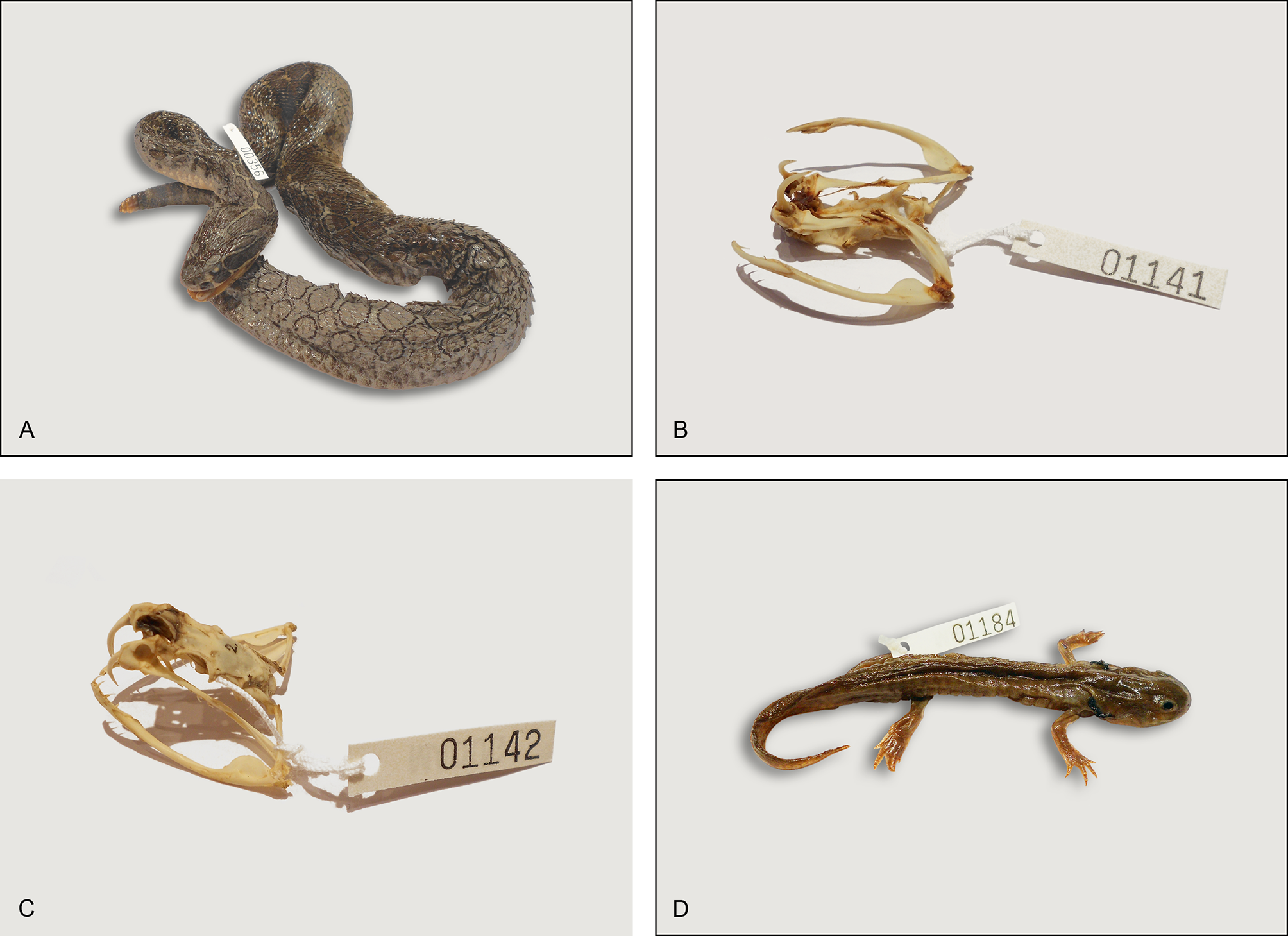
FIGURE 9. A, Syntype of Crotalus jimenezii (HE 356); B, Syntype of Crotalus jimenezii, skull, ventral view (HE 1141); C, Syntype of Crotalus jimenezii, skull, dorsal view (HE 1142). D, Specimen erroneously catalogued as Bathysiredon dumerilii queretarensis (HE 1184). Neither specimen coincides with Maldonado-Koerdell’s description (1948 b).
IMAGES