
Adelophis copei
Duges, 1879
GBIF:117911844
ABOUT
Descriptions(1)
Adelophis copei Dugès 1879 b
The original description for this taxon appeared in Cope (1879); Cope credited the description to Dugès in manuscript. Although Cope did not reproduce a verbatim translation of Dugès’ manuscript, published later by Dugès himself (1887), he did copy all of the measurements and scale counts as they are reported in Dugès (1887). In brief, Dugès’ (1887) description has a little more text than Cope’s translation. Additionally Duges’ justification for publishing the description in “La Naturaleza” was that “El sabio herpetólogo E. D. Cope…ha traducido una nota que le transmití sobre este ofidio, pero sin acompañarla con la debida lámina; por este motivo me ha parecido conveniente publicarla con las figuras necesarias, para poder reconocer á primera vista este reptil, raro…” (The wise herpetologist E. D. Cope…has translated a note that I conveyed him about this ophidian, but he did not accompany it with the proper plate; for this reason it is proper for me to publish it (referring to the description) with the necessary figures, in order that one might to be able to recognize this rare reptile at first sight …). The type locality was stated in both publications as Guadalajara. A caveat to this matter is that Dugès’ (1887) description, was dated as “Guanajuato, Octubre 22 de 1880”, and Cope’s (1879) appeared in the June 20 issue of the Proceedings of the American Philosophical Society. According to the requirements of the ICZN (1999) Article 5.1.1 regarding availability of the source, it is clear that Cope did not have a specimen available on which to base his description as there are no candidate type specimens of Adelophis at the ANSP (Malnate 1971) nor at the USNM (Cochran 1961); rather, he probably based it on a preliminary draft obtained from Dugès.
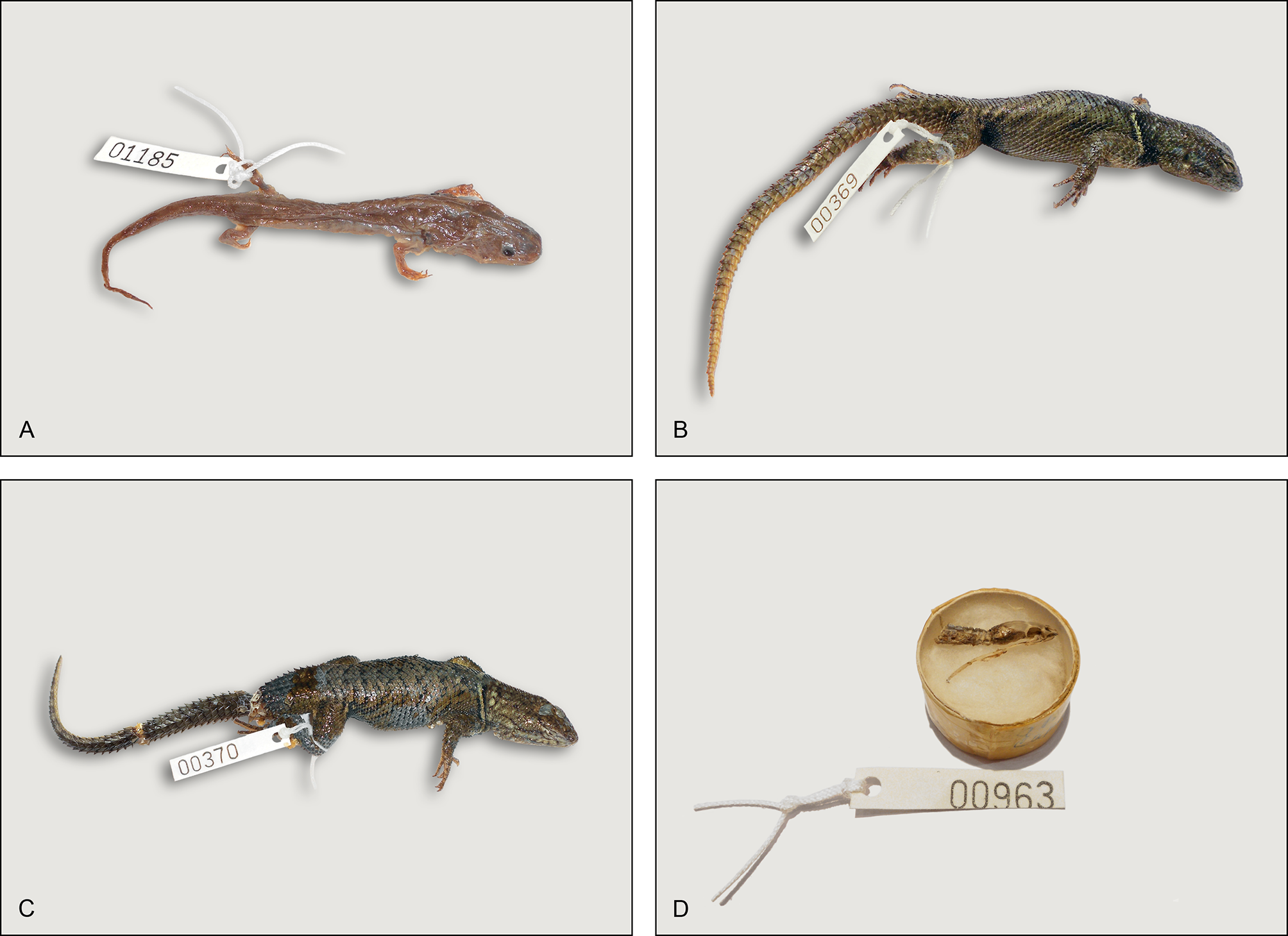
When Smith & Necker (1943) reviewed the types at MADUG, they found one specimen of this taxon, from “Cupátaro”, probably a typo for Tupátaro, Guanajuato; they decided to designate it a neotype, because Dugès (1887:20) stated that he did not have the specimen in his custody, and did not mention the whereabouts of the specimen used by him to describe this taxon. In that same publication (Dugès 1887), is also a mention of a well preserved skull of this species, that Dugès had in his possession; this skull is labeled HE 0 963 (Fig. 10 D). This specimen cannot be considered the type since there is no drawing of the skull in the publication, only a mention of its existence in the re-description of the taxon by Dugès (1887) in “La Naturaleza”. Unfortunately, there is no locality information accompanying this skull. Specimen HE 0 963 is of value since it is the only surviving specimen of this rare taxon in the MADUG. The type is the specimen, now lost or destroyed, figured in Plate III fig 1a-d in Dugès (1887) as this was the specimen used for the description published in Cope (1879) and Dugès (1887), and originating from the type locality of Guadalajara.
Current valid name: Adelophis copei Dugès in Cope, 1879
Export occurrence data
Darwin Core Archive (ZIP)

MULTIMEDIA
Media Files(1)
FIGURE 10. A, Specimen erroneously catalogued as Bathysiredon dumerilii queretarensis (HE 1185, see comment on Figure 9 D); B, C, Specimens of Sceloporus intermedius (HE 369, 370); D, Specimen of Adelophis copei (HE 963).
IMAGES