
AnimaliaNot EvaluatedacceptedspeciesAccepted
Amblystoma velasci

Amblystoma velasci

Duges, 1888

GBIF:117911919

0year

ABOUT

Descriptions(1)

Amblystoma velasci Dugès, 1888 c

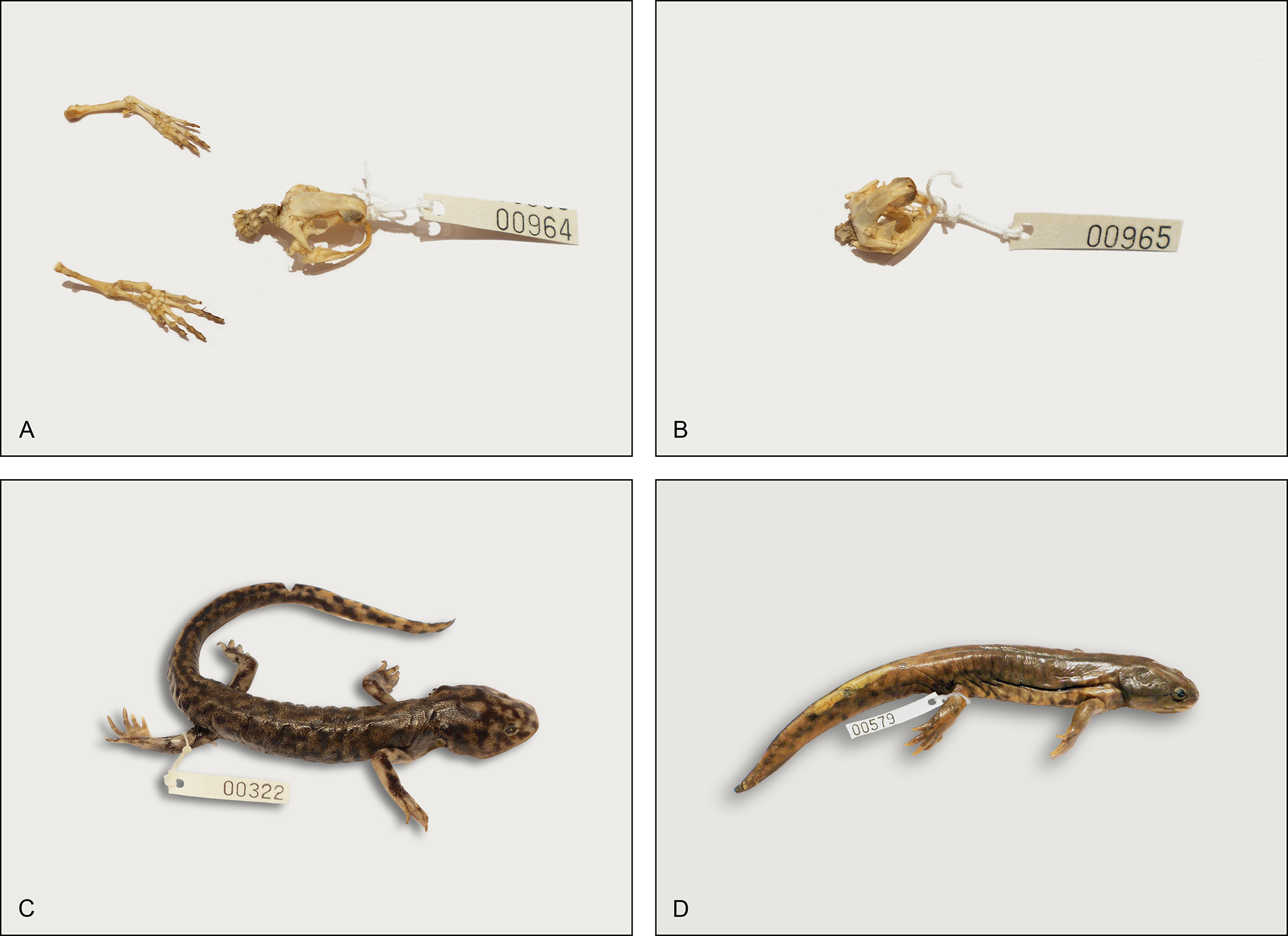
There are three syntypes in the MADUG (HE 579–581, Figs 3 D, 4A–B); two are metamorphosed and one (HE 581) is a larva. Smith & Necker (1943) did not find any specimens of this salamander; therefore they referred to the original description in “La Naturaleza” by Velasco (1879:216), who called it Siredon Tigrina . Since that name had already been used for another species (Smith & Necker 1943), Dugès (1888c) gave it a new name honoring J. M. Velasco, who had described it in detail based on several specimens from Lago de Santa Isabel, near Villa de Guadalupe Hidalgo, Valley of Mexico (Ciudad de Mexico). The type locality no longer exists as it has been completely urbanized by the growth of Mexico City (Ezcurra et al. 2006). The specimens in the MADUG were apparently sent by Manuel M. Villada, who was the sole editor of “La Naturaleza” from 1870 to 1914 (Cuevas Cardona 2002) (notes taken from Notebook No. 2 in the MADUG, fide GEMC). The type locality referred to by Dugès (1888c) in his description is given as: “Laguna de Santa Isabel, en la Villa de Guadalupe y en los pueblos de Santa Isabel y Zacatengo” (the last town now called Zacatenco, Ciudad de Mexico).

Current valid name: Ambystoma velasci (Dugès, 1888) .

Flores-Villela, Oscar, Ríos-Muñoz, César A., Magaña-Cota, Gloria E., Quezadas-Tapia, Néstor L. (2016): Alfredo Dugès’ type specimens of amphibians and reptiles revisited. Zootaxa 4092 (1), DOI: 10.11646/zootaxa.4092.1.2MagnoliaPress via PlaziNo known copyright restrictions apply. See Agosti, D., Egloff, W., 2009. Taxonomic information exchange and copyright: the Plazi approach. BMC Research Notes 2009, 2:53 for further explanation.

Export occurrence data

Darwin Core Archive (ZIP)

CLASSIFICATION

Taxonomic Classification Tree

MULTIMEDIA

Media Files(1)

FIGURE 3. A, B, Skeletons of Ambystoma altamirani (HE 964, 965); C, Syntype of Ambystoma altamirani (HE 322); D, Syntype of Amblystoma velasci, adult (HE 579).

Imageimage/png© Flores-Villela, Oscar;Ríos-Muñoz, César A.;Magaña-Cota, Gloria E.;Quezadas-Tapia, Néstor L.Flores-Villela, Oscar;Ríos-Muñoz, César A.;Magaña-Cota, Gloria E.;Quezadas-Tapia, Néstor L.

IMAGES

Gallery(1)

See Gallery

Occurrences with images

Source Information

Alfredo Dugès’ type specimens of amphibians and reptiles revisited

checklist

This dataset contains the digitized treatments in Plazi based on the original journal volume Flores-Villela, Oscar, Ríos-Muñoz, César A., Magaña-Cota, Gloria E., Quezadas-Tapia, Néstor L. (2016): Alfredo Dugès’ type specimens of amphibians and reptiles revisited. Zootaxa 4092 (1), DOI: 10.11646/zootaxa.4092.1.2

Abstract

The type specimens of amphibians and reptiles of the Museo de Historia Natural Alfredo Dugès, at the University of Guanajuato (MADUG) were reviewed following Smith & Necker’s (1943) summary. Owing to this collection’s eventful history and its historical importance as the oldest herpetological collection in Mexico, a review of its conservation status was needed. After many years, the collection has received proper recognition at the University of Guanajuato with a portion of the herpetological types considered “Precious Assets” of the university. We found 34 type specimens pertaining to 18 taxa; six are additional specimens to those previously reported; six herpetological types are missing, including the body of the type of Adelophis copei. All specimens are in good to reasonable condition except for the type of Rhinocheilus antonii, which has dried out completely. All specimens are illustrated to show their condition.

Key words: Amphibia, herpetological collection, Mexico, Reptilia

Flores-Villela O, Ríos-Muñoz C A, Magaña-Cota G E, Quezadas-Tapia N L, plazi (2016). Alfredo Dugès’ type specimens of amphibians and reptiles revisited. Plazi.org taxonomic treatments database. Checklist dataset https://doi.org/10.11646/zootaxa.4092.1.2 accessed via GBIF.org on 2026-06-14.

CC0Published 12/31/2016View dataset
GBIF Usage Key
117911919
Dataset Key
3702b49c-3e24-49d1-b3c7-7e46adb3c93f
Origin
source
Backbone Key
7385503
Taxon ID
252287953101FFD5A49CFEC75A3CB856.taxon
Last Crawled
6/4/2026
Last Interpreted
6/4/2026