
AnimaliaNot EvaluatedacceptedspeciesAccepted
Hyla ephemera
GBIF:119336935
ABOUT
Descriptions(6)
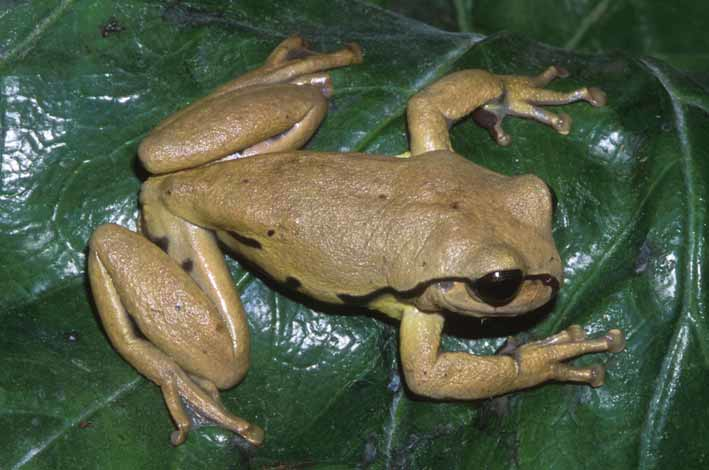
Description of holotype: Adult male (Fig. 2), measurements (in mm): SVL 59.2; tibia length 28.7; foot length, 25.9; head length, 18.8; head width, 23.4; snout length 4.5; diameter of tympanum, 3.0; diameter of eye, 5.9; distance between medial borders of external nares, 4.0; distance between eye and tympanum, 3.3; body robust; head wider than long and also wider than body; head length 31.8 % SVL; head width 39.5 % SVL; snout abrupt, truncate in profile, bluntly rounded in dorsal view, without rostral keel; canthus rostralis distinct, rounded; loreal region slightly concave; lips not flared; nostrils ovoid, barely protuberant, directed posterodorsally; internarial region concave. Top of head flat; diameter of eye 25.2 % head width. Supratympanic fold heavy, extending posteriorly from the edge of the orbit, obscuring upper edge of tympanum, becoming indistinct immediately above the insertion of the forelimb; tympanum distinct, round, slightly elevated above the surrounding skin; tympanic annulus uniformly distinct; diameter of tympanum 50.8 % diameter of eye; diameter of tympanum 90.9 % eye – tympanum distance. Axillary membrane absent; thoracic fold and dermal fold on wrist absent; forearm robust; fingers long, slender, with moderate lateral fringe, bearing large discs; relative lengths of fingers: I
Meik, Jesse M., Canseco-Márquez, Luis, Smith, Eric N., Campbell, Jonathan A. (2005): A new species of Hyla (Anura: Hylidae) from Cerro Las Flores, Oaxaca, Mexico. Zootaxa 1046: 17-27, DOI: 10.5281/zenodo.169900
Diagnosis: A large, robust treefrog tentatively referred to the Hyla bistincta group (sensu Duellman, 1970; see also Toal and Mendelson, 1995). Hyla ephemera is most similar to the large yellowish tan to pale brown frogs of this group, particularly H. pentheter Adler and H. calthula. All three species can be distinguished from the similar H. bistincta Cope by the absence of vocal slits in males and by having long, slender fingers (fingers relatively short in H. bistincta). Hyla ephemera has a SVL of 59.2 mm, which exceeds the maximum size reported for males of H. pentheter (51.1 mm), H. calthula (56.0 mm), and H. bistincta (53.8 mm). Hyla ephemera differs from H. pentheter by having more webbing on the feet (I 1 – 2 II 1 – 1 ½ III 1 – 2 IV 1 ½ – 1 V in H. ephemera versus I 2 – 2 ½ II 2 – 3 III 2 – 3 IV 3 – 2 V in H. pentheter), by having uniform black markings with distinct borders on flanks and posterior surface of thighs (versus markings on flanks and posterior surface of thighs with yellow spots; also, in H. pentheter flank markings are bordered dorsally by a thin pale yellow line, and ventrally fade into yellow coloration), and by having the snout rounded in dorsal view rather than truncate. In addition to its larger size, Hyla ephemera may be distinguished from H. calthula in aspects of form. The results of PCA demonstrated considerable morphometric differences between the specimen of H. ephemera and a series of adult male H. calthula (Fig. 1; Table 1). Values for H. ephemera exceeded the range of variation observed in adult male H. calthula (n = 16) for five out of eight standard measurement ratios: TL / SVL, 0.48 in H. ephemera versus 0.51 – 0.60 in H. calthula; FL / SVL, 0.44 in H. ephemera versus 0.45 – 0.50 in H. calthula; TYP / EYE, 0.51 in H. ephemera versus 0.32 – 0.44 in H. calthula; STL / HL, 0.24 in H. ephemera versus 0.25 – 0.31 in H. calthula; IN / STL, 0.89 in H. ephemera versus 0.65 – 0.84 in H. calthula. The lateral black markings are reduced in H. ephemera when compared to most of the known specimens of H. calthula. In H. ephemera, the tympanum is relatively large, round, and bordered by a uniformly distinct annulus, whereas in H. calthula the tympanum is small, black, and ovoid, with an annulus that is distinct on the anterior margin of the tympanum. There is, however, considerable variation in the condition of the tympanum and of the black lateral coloration in H. calthula, so an evaluation of the utility of these characters in distinguishing between the two species must await the collection of additional specimens of H. ephemera.
Meik, Jesse M., Canseco-Márquez, Luis, Smith, Eric N., Campbell, Jonathan A. (2005): A new species of Hyla (Anura: Hylidae) from Cerro Las Flores, Oaxaca, Mexico. Zootaxa 1046: 17-27, DOI: 10.5281/zenodo.169900
Remarks: Hyla calthula, the likely sister species of H. ephemera, has previously been reported only from cloud forest in the immediate vicinity of Totontopec, Oaxaca. Ustach et al. (2000) commented that cloud forests were virtually gone from this area, and that the species probably no longer persists there. On 21 September, 2001, we secured a series of tadpoles and a metamorph frog that we identified as H. calthula, west of Zacatepec (17.190 ° N 95.987 ° W), at an elevation of 1360 m (MZFC 17381; UTA A 56736 – 37). Unlike the tadpoles collected from Cerro Los Flores, all of the tadpoles from near Zacatepec appeared to possess complete mouthparts. Although this collection represents an additional locality for H. calthula (Fig. 5), we noted that forests were highly fragmented in this region and we suspect that these patches will soon be gone, as they now are from the vicinity of Totontopec. 98 ° 95 ° PUEBLA Gulf of Mexico 18 ° VERACRUZ 18 ° OAXACA Hyla ephemera Hyla calthula Area above 0 m Area above 1000 m Pacific Ocean Area above 2000 m 98 ° 95 ° In general, the Sierra Mixe has suffered from greater habitat destruction than have the majority of other mountain ranges in central Oaxaca; however, many forested areas of the southeastern Sierra Mixe (including the type locality of H. ephemera) appeared to be relatively intact at the time of our visit. Owing to the more limited spatial extent of highlands in the southeastern Sierra Mixe, montane habitats such as cloud forests may naturally occur in disjunct fragments, predisposing populations that are dependent on these habitats to impacts of disturbance. Perhaps a more immediate threat to H. ephemera could be infection by chytrid fungus, which was indicated by the observation that nearly half of the tadpoles we examined were missing mouthparts. It is possible that the only known population of H. ephemera may already be extinct. Duellman (2001) provided a hypothesis of relationships for species of the H. bistincta group based on morphology, and suggested that available data support the group’s monophyly. CansecoMárquez et al. (2002) considered this hypothesis preliminary and emphasized that relationships among species remain tenuous until additional data are obtained, and that the monophyly of the group has yet to be rigorously tested. Although Cerro Las Flores now represents the southeasternmost locality reported for members of the H. bistincta group, some of the smaller, isolated mountain ranges immediately west of the Isthmus of Tehuantepec remain poorly inventoried herpetologically, and it is possible that other species await description.
Meik, Jesse M., Canseco-Márquez, Luis, Smith, Eric N., Campbell, Jonathan A. (2005): A new species of Hyla (Anura: Hylidae) from Cerro Las Flores, Oaxaca, Mexico. Zootaxa 1046: 17-27, DOI: 10.5281/zenodo.169900
Distribution and Habitat: During 2003, the northern slopes of Cerro Las Flores were covered by a mosaic of cloud forest fragments and larger expanses of pineoak forests. Hyla ephemera has only been collected from cloud forests on these slopes between elevations of 1100 and 1220 m. The only adult specimen was obtained approximately 2.5 km east of the town of Lachidola. It was found clinging to a palm frond about 1.8 m above a small stream at 2100 hrs. This streambed coursed through numerous large, jumbled boulders at the bottom of a deep ravine. At the time of our visit, the stream had very little water flow and many small plunge pools were present along the streambed. Tadpoles that we refer to H. ephemera were taken from these pools, from two other streams between 2.0 – 2.5 km east of Lachidola, and from an additional stream located approximately 2.5 km west of Lachidola. Other amphibians collected by us in the immediate vicinity of Lachidola include Anotheca spinosa Steindachner, Ptychohyla zophodes Campbell & Duellman, and Eleutherodactylus pygmaeus Taylor. Tadpole: The following description is based on two tadpoles (UTA A 56745 and UTA A 56741) of a series collected from small pools in a stream at the type locality. We identified these tadpoles as belonging to the H. bistincta group on the basis of salient morphological features (continuous row of fringing papillae on the upper lip as well as submarginal papillae medial to the continuous row [Duellman and Campbell, 1992]), and tentatively assign them to H. ephemera as no other hylids of the H. bistincta group were collected from Cerro Las Flores. UTA A 56745 (Fig. 3 A) was preserved in developmental stage 36 (Gosner, 1960), UTA A 56741 (Fig. 3 B) was preserved in developmental stage 31. Measurements (mm): total length 57.40 – 53.98; body length 18.47 – 17.23; tail length 39.03 – 36.75; interorbital distance 4.58 – 4.14; internarial distance 5.13 – 4.23; oral disc diameter 5.94 – 5.56. Body ovoid in dorsal view; in lateral view higher posteriorly than anteriorly; snout rounded in dorsal and lateral view; eyes directed dorsolaterally; interorbital distance slightly less than internarial distance; nostrils small, ovoid; directed laterally. Spiracle sinistral; short, opening near midbody. Vent tube dextral. Caudal musculature robust, highest at junction with body, rounded at tip (pointed in UTA A 56741); dorsal fin slightly higher than ventral fin. Oral disc large, not emarginate, with a single row of conical marginal papillae above A 1 and two rows below P 3; a row of large rounded submarginal papillae above A 1 and below P 3. Numerous papillae present laterally. Labial tooth formula 2 (2) / 3, tooth row in A 1 slightly larger than A 2; A 2 gap present, narrow. Lower jaw wider than upper jaw; lateral processes taper abruptly posterolaterally, lower jaw shallowly Vshaped, more serrate than upper jaw. In preservative, dorsal coloration dark brown; venter transparent, gut visible; caudal musculature cream with large brown blotches, small brown blotches on dorsal fin, three widelyspaced small blotches on ventral fin (small, faint spots near posterior end of ventral fin in UTA A 56741), brown dorsolateral stripe extending along caudal musculature over half the length of the tail (small, faint spots on caudal musculature and dorsal fin in UTA A 56741); caudal fins translucent. Minor variation was observed in eleven additional tadpoles from stages 26 — 34: six specimens were missing all, or most, of the keratinized mouthparts (Fig. 4); two had bodies notably darker than remaining specimens; and the amount of blotching on the tail varied from few sparse, faint spots, to copious blotches of various sizes and pigment intensity. One tadpole (UTA A 56746) had two rows of marginal papillae above A 1, as opposed to one row in the remaining specimens. On comparing the tadpoles of H. ephemera with those of H. calthula, we noted that the presence and development of submarginal papillae on the anterior labium was variable in both species, and may be attributable to ontogenetic variation (for more detail on the ontogeny of H. calthula tadpoles see Ustach et al., 2000).
Meik, Jesse M., Canseco-Márquez, Luis, Smith, Eric N., Campbell, Jonathan A. (2005): A new species of Hyla (Anura: Hylidae) from Cerro Las Flores, Oaxaca, Mexico. Zootaxa 1046: 17-27, DOI: 10.5281/zenodo.169900
Etymology: The specific epithet is derived from the Greek ephemeros, meaning shortlived, and refers to the ominous observation that chytridiomycosis may be present in the only known population of this unique species.
Meik, Jesse M., Canseco-Márquez, Luis, Smith, Eric N., Campbell, Jonathan A. (2005): A new species of Hyla (Anura: Hylidae) from Cerro Las Flores, Oaxaca, Mexico. Zootaxa 1046: 17-27, DOI: 10.5281/zenodo.169900
Holotype: MZFC 17049 (original field no. JAC 22944), an adult male obtained between Santa Maria Guienagati and Lachidola, 1100 m, (16.759 ° N 95.461 ° W), north slope of Cerro Las Flores, Oaxaca, Mexico; obtained by E. N. Smith and L. CansecoMárquez on 7 April 2003. Referred specimens: All tadpoles from Oaxaca, Mexico: road between Santa Maria Guinagati and Lachidola, 1156 m [16.759 ° N 95.461 W] (MZFC 17382; UTA A 56739, 56741 – 42, 56745); road between Santa Maria Guinagati and Lachidola [16.751 ° N 95.460 ° W] (MZFC 17384; UTA A 56744); road between Santa Maria Guinagati and Lachidola, 1095 m [16.749 ° N 95.457 W] (MZFC 17386; UTA A 56743); road between Santa Maria Guinagati and Santiago Lachiguiri, 1220 m [16.756 N 95.500 W] (MZFC 17383, 17385; UTA A 56738, 56740, 56746).
Meik, Jesse M., Canseco-Márquez, Luis, Smith, Eric N., Campbell, Jonathan A. (2005): A new species of Hyla (Anura: Hylidae) from Cerro Las Flores, Oaxaca, Mexico. Zootaxa 1046: 17-27, DOI: 10.5281/zenodo.169900
Export occurrence data
Darwin Core Archive (ZIP)

MULTIMEDIA
Media Files(3)
FIGURE 2. Hyla ephemera new species, holotype (MZFC 17049), in life.
Imageimage/png© Meik, Jesse M.;Canseco-Márquez, Luis;Smith, Eric N.;Campbell, Jonathan A.Meik, Jesse M.;Canseco-Márquez, Luis;Smith, Eric N.;Campbell, Jonathan A.

FIGURE 3. Hyla ephemera tadpoles in life (A, UTA A 56745, Gosner stage 36; B, UTA A 56741, Gosner stage 31).
Imageimage/png© Meik, Jesse M.;Canseco-Márquez, Luis;Smith, Eric N.;Campbell, Jonathan A.Meik, Jesse M.;Canseco-Márquez, Luis;Smith, Eric N.;Campbell, Jonathan A.

FIGURE 4. Preserved tadpoles of Hyla ephemera demonstrating complete (A, UTA A 56745) and missing (B, UTA A 56746; C, UTA A 56738) mouthparts.
Imageimage/png© Meik, Jesse M.;Canseco-Márquez, Luis;Smith, Eric N.;Campbell, Jonathan A.Meik, Jesse M.;Canseco-Márquez, Luis;Smith, Eric N.;Campbell, Jonathan A.
IMAGES