
AnimaliaNot EvaluatedacceptedspeciesAccepted
Ophiomegistus spectabilis
Klompen & Austin
GBIF:119351760
0
Synonyms
ABOUT
Descriptions(6)
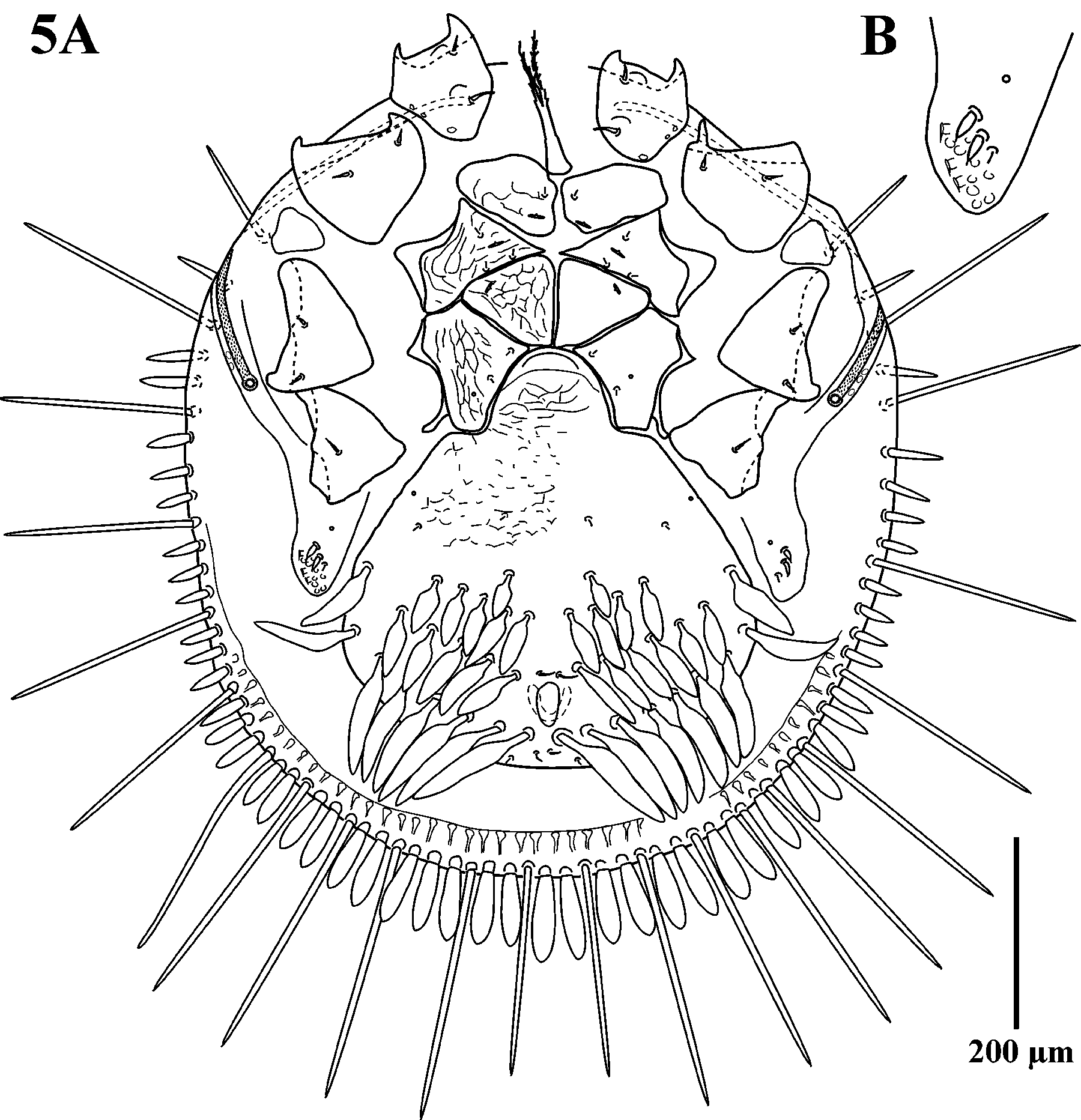
Female (Fig. 5). Idiosomal length 868, width 718 (N = 1). Dorsum as in male. Marginal setae slightly more numerous and slightly longer than in male, but pattern very similar (Table 1). Bladelike setae in posterior median pair 98 long. Anterior pair of rodlike long setae (j 1) 122, anterior lateral pair 113, longest 265, and pair flanking posterior median pair of bladelike setae 197. Peritremes as in male. Metapodal areas sclerotized, shields broadly fused to peritrematal shields (anterior); each with two subulate and one setiform seta (Fig. 5 B). Ventrianal shield with 17 – 20 pairs of large leaflike setae, arranged in 4 rows (Table 2). Preanal and postanal setae as in male. Unpaired postanal seta absent. Sternal region anteriorly with two pairs of shields: anterior pair carrying one seta (st 1) and one lyrifissure (stp 1) each; second pair carrying three pairs of setae (st 2 – st 4) and one lyrifissure (stp 2) each. Sternogynial shield also paired, with one small lyrifissure (stp 3) on each shield. Genital area with separate and well developed latigynial shields, each carrying two small setae and one small gland pore. Mesogynial shield fused posteriorly with ventrianal shield, without setae, lyrifissures or pores. Endopodal shield remnants fused to sternal and latigynial shields. Small exopodal shieldlets between coxae II and III. Gnathosoma and palps. Gnathotectum triangular with a smooth anterior edge. Chelicera as in male. Subcapitulum, corniculi, subcapitular and hypostomal setae as in male. Palp with tibia and tarsus completely fused; pretarsal claw twotined. Palp setation (number, position, and shape) as in male. Legs. Leg shape and chaetotaxy as in male.
Klompen, Hans, Austin, Christopher C. (2007): A new species of Ophiomegistus Banks (Acari: Paramegistidae) from Papua New Guinea. Zootaxa 1387: 47-57, DOI: 10.5281/zenodo.175143
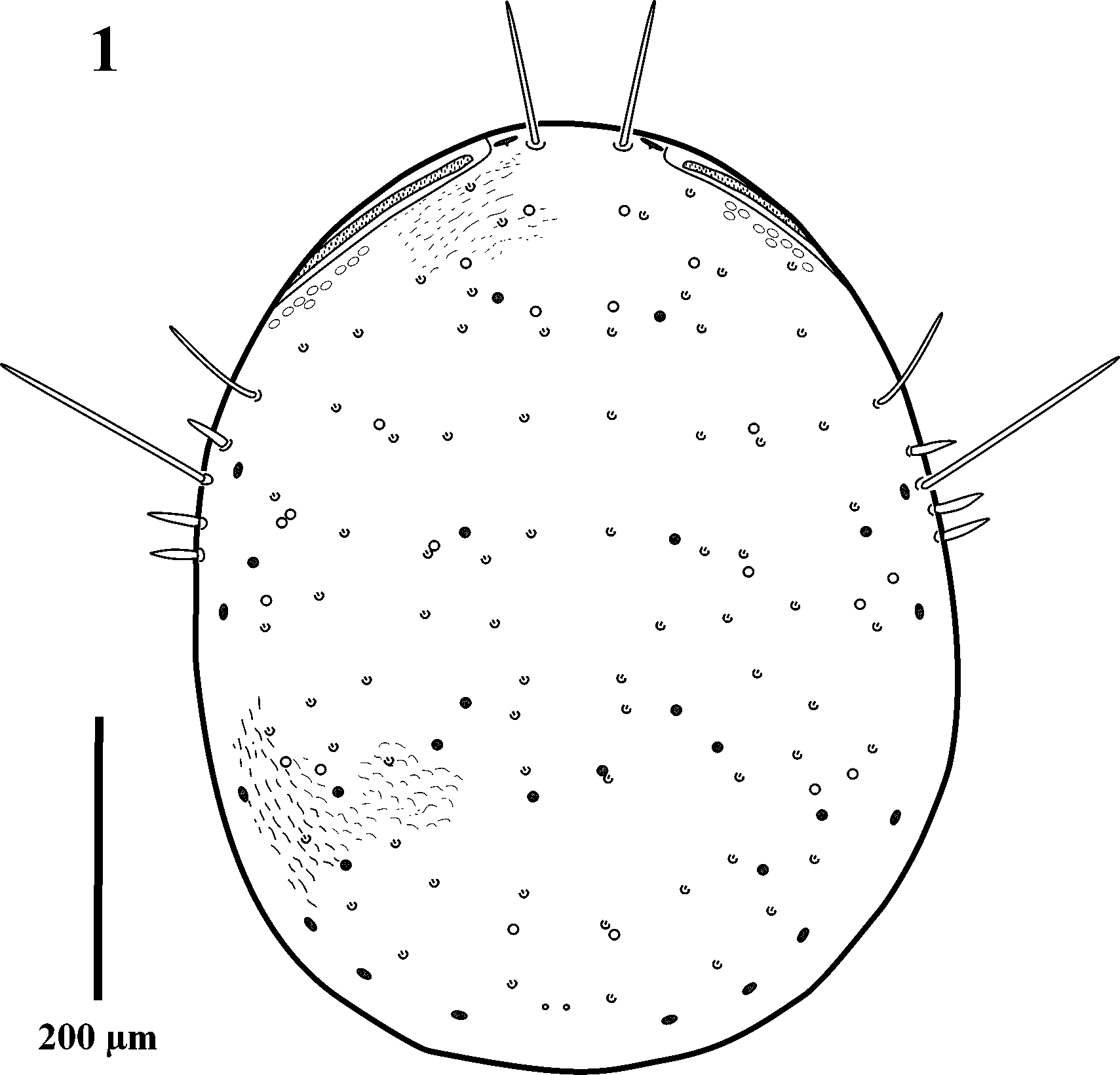
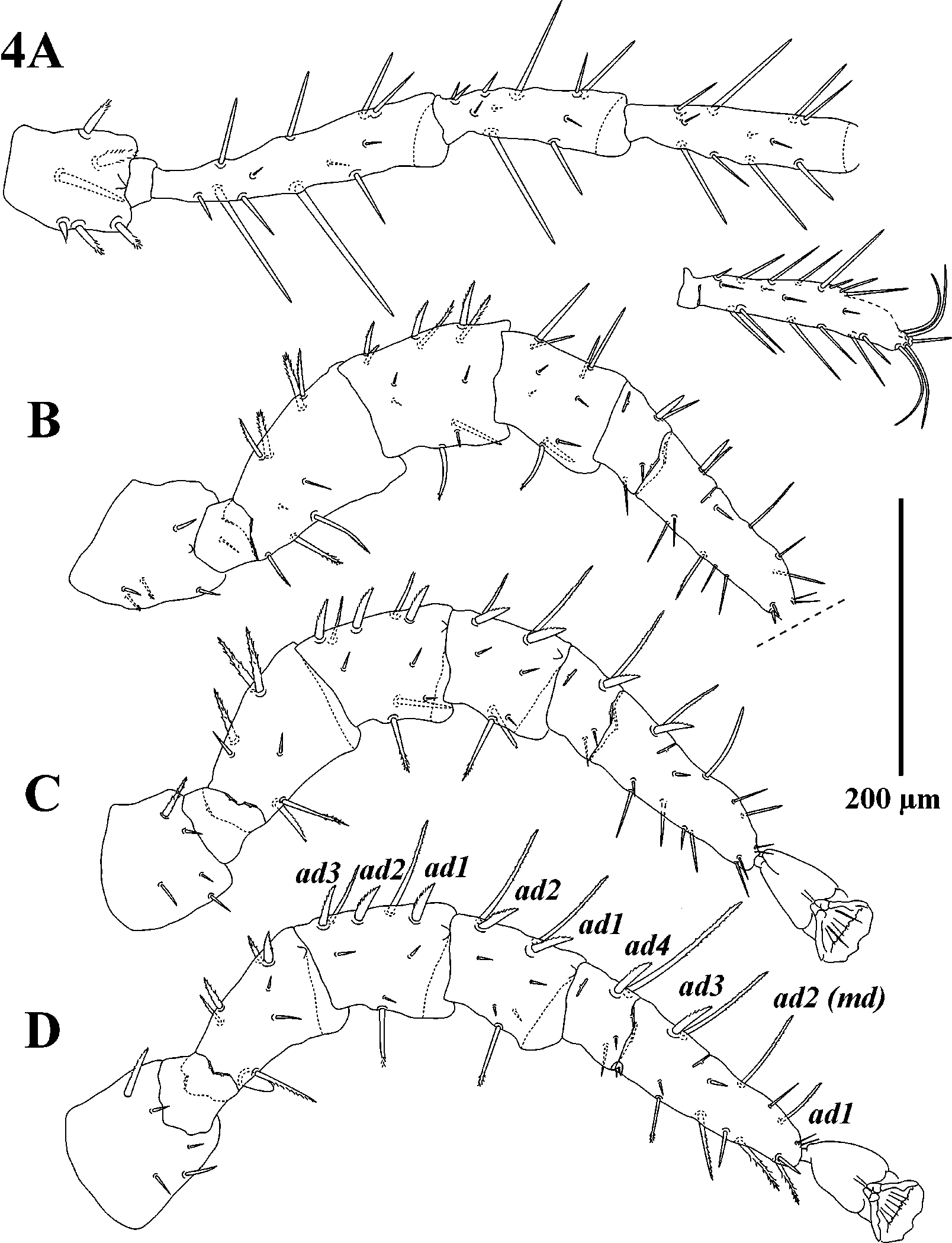
Male (Figs. 1 – 4). Idiosomal length 741 (681 – 767), width 604 (568 – 640), N = 5. Dorsum covered by a single shield with slightly crenulate patterning (Fig. 1); pattern more of less striate near the margin, uniform in the center of the shield. One pair of anterior marginal setae (j 1?) long (108 [90 – 118]) and rodlike with small barbs near the tip; other dorsal setae minute. Setal patterns are not completely regular and symmetrical, but hypertrichy appears limited; nearly all setae observed can be accommodated within the standard model for Mesostigmata (Lindquist and Evans 1965). With respect to other cuticular structures (glands, lyrifissures) assignment is tentative, due to the difficulty of distinguishing consistently between glandlike structures and lyrifissures (only anterior lyrifissure id 1 is quite distinct). Even so, the patterns appear generally symmetrical and surprisingly regular. Specialized marginal setae (R and Rv setae?) surround the entire opisthosoma. They include two types of setae, long, rodlike ones and much shorter, bladelike setae with rounded tips. The rodlike setae are generally smooth, with a few very small barbs near the tip, the bladelike setae have rounded tips and are somewhat flattened. The total number and interspersion pattern of these setae is variable between individuals and even between the left and right side of single individuals (Table 1). Lateral bladelike setae smaller than the posterior ones, with the median posterior pair longest [84 (73 – 90)]. Most rodlike setae of similar size, 231 (211 – 250) for posterior lateral ones, but the most anterior lateral pair of rodlike setae much shorter [94 (81 – 102)], and the pair flanking the median posterior pair of bladelike setae somewhat shorter [167 (150 – 184)]. Venter (Fig. 2) with a distinct anterior sclerite carrying sternal setae st 1 and one pair of lyrifissures (stp 1). Genital opening midsternal, covered by two small shields, and including a pair of small (eu) genital setae. Sternitoventrianal shield with pronounced patterning anteriorly, less distinct posteriorly. In the sternal region this shield carries four pairs of small setae, two pairs of lyrifissures (stp 2, stp 3) and one pair of small pores; two additional pairs of small setae and one pair of pores posterior to coxae IV. Posterior portion of shield with 15 – 19 pairs of large, translucent, and leaflike setae, arranged in four rows. As with the marginal setae, patterns are variable (Table 2). One pair of small preanal, and two pairs of small postanal setae surround the anus. Unpaired postanal seta absent. Metapodal areas each with well developed shields, fused broadly to peritrematal (anterior), and weakly to sternitoventrianal shields (anterolateral). Each metapodal shield usually with two subulate setae (Fig. 2 B); occasionally with one additional, setiform seta (1 of 8 sides examined), or with one subulate and 1 setiform seta (3 of 8 sides examined). Metapodal shield surface with distinct crenulated patterning near the posterior tip. Peritremes surrounded by relatively small shields, extending anteriorly to the level of coxae I. Tritosternum without subapical spines (Goff 1979) on the tritosternal laciniae.
Klompen, Hans, Austin, Christopher C. (2007): A new species of Ophiomegistus Banks (Acari: Paramegistidae) from Papua New Guinea. Zootaxa 1387: 47-57, DOI: 10.5281/zenodo.175143
Diagnosis. Female with two small setae on each latigynial shield. Ventral opisthosoma of both adults with a few very small setiform setae anterior on the ventrianal shield and 15 – 22 large, translucent, leaflike setae covering most of the posterior parts of that shield. Metapodal shields broadly fused with peritrematal shields. Marginal setae well developed, including long rodlike setae interspersed among larger numbers of distinctly shorter, rounded, and bladelike setae.
Klompen, Hans, Austin, Christopher C. (2007): A new species of Ophiomegistus Banks (Acari: Paramegistidae) from Papua New Guinea. Zootaxa 1387: 47-57, DOI: 10.5281/zenodo.175143
Remarks. We also studied two additional females from skinks collected in Milne Bay province (PAPUA NEW GUINEA: Milne Bay, Saga AHO River, Bush Camp, Cloudy Mountains, Elev 65 m, 10 ° 32 ' 39 " S 150 ° 06 ' 55 " E, coll. Austin, C. C., 18 X 2001, ex Sphenomorphus pratti, host coll. no. LSUMZ 89483, spec. no. OSAL 004134 (1 F); same collection data, ex Sphenomorphus jobiensis, host coll. no. LSUMZ 89482, spec. no. OSAL 004133 (1 F )). While superficially similar to O. spectabilis in the relative size and arrangement of the marginal and opisthogastral setae, these two females are slightly larger, and differ by having (1) only 3 (not 4) rows of opisthogastral setae, (2) bifid tips on the long rodlike marginal setae (rounded in O. spectabilis), (3) metapodal shields that are distinctly pointed posteriorly, (4) the coxal IV seta shaped as a thick, blunt spine, and (5) having setae hyp 2, hyp 3, and the subcapitular setae of similar shape (distinctly different sizes in O. spectabilis). Given the small number of available specimens from that locality, and the lack of males, it is not possible to establish whether these differences are local variations or whether the specimens represent another new species. A single male recovered at the same locality but from a different host species (PAPUA NEW GUINEA: Milne Bay, Saga AHO River, Bush Camp, Cloudy Mountains, Elev 65 m, 10 ° 32 ' 39 " S 150 ° 06 ' 55 " E, coll. Austin, C. C., 18 X 2001, ex Sphenomorphus mulleri, host coll. no. LSUMZ 89484, spec. no. OSAL 004132), does not match O. spectabilis or the females from Milne Bay. Instead it closely resembles O. kaii Goff, 1979.
Klompen, Hans, Austin, Christopher C. (2007): A new species of Ophiomegistus Banks (Acari: Paramegistidae) from Papua New Guinea. Zootaxa 1387: 47-57, DOI: 10.5281/zenodo.175143
Etymology. The specific name, spectabilis or showy, refers to the striking pattern of marginal setae in this species. Systematic affinities. Generic assignment of this species to Ophiomegistus is based on the combination of presence of a longitudinally split sternal shield and stout subulate setae on the posterior end of the metapodal shields. It is also consistent with host association, as all known Ophiomegistus are associated with squamates (snakes or skinks). The one record of O. luzonensis from a host other than a squamate, in this case a rat in New Guinea (Gunther 1942), is almost certainly an artifact. In this assignment we noticed a flaw in the latest key to the genera of Paramegistidae (Kim and Klompen 2002). The couplet in that key separating Ophiomegistus from Neomegistus uses the number of setae on each latigynial shield as the primary distinction, with Neomegistus females carrying only two setae per shield, while Ophiomegistus females carry three or more. However, females of O. brachymeleus Voss, 1966, O. mabuyae Voss, 1966, and O. keithi Domrow, 1978, as well as the female of O. spectabilis carry only two setae on each latigynial shield. That being said, Ophiomegistus can be distinguished from Neomegistus by the presence of foliate setae on the venter (absent in Neomegistus), the lack of fusion of the latigynial and ventrianal shields (partially fused in Neomegistus) and the presence of subulate setae on the metapodal shields (absent in Neomegistus) (Cheol Min Kim, pers. comm.). The above emphasizes that Ophiomegistus and Neomegistus are quite similar, despite being associated with phylogenetically unrelated host groups. This close relationship of squamate (Ophiomegistus) and millipede (Neomegistus) associated taxa mirrors the situation in the family Heterozerconidae, which also includes squamate (Amheterozercon) and millipede (all other genera) associates. The new species differs from O. brachymeleus, O. mabuyae, and O. keithi by having the foliate setae restricted to the posterior half of the ventrianal shield (rather than covering nearly all of the ventrianal shield). In addition, the striking dimorphism in shape of the marginal setae far exceeds that found in any other described Ophiomegistus species.
Klompen, Hans, Austin, Christopher C. (2007): A new species of Ophiomegistus Banks (Acari: Paramegistidae) from Papua New Guinea. Zootaxa 1387: 47-57, DOI: 10.5281/zenodo.175143
Material examined. PAPUA NEW GUINEA: Manus, Rambutyo Island, NE of Penchal Village, Elev 100 – 150 m, 02 ° 20 ' 26 " S 147 ° 47 ' 40 " E, coll. Austin, C. C., 3 IX 2001, ex Sphenomorphus pratti (Scincidae), host coll. no. LSUMZ 89480, specimens numbers OSAL 004135 338 (3 M, 1 F); same collection data, ex Sphenomorphus pratti, host coll. no. LSUMZ 89481, spec. no. OSAL 013822 (1 M); PAPUA NEW GUINEA: Manus, Penchal Village, 02 ° 19 ' 42 " S 147 ° 46 ' 00 " E, coll. Austin, C. C., 1 IX 2001, ex Sphenomorphus pratti (Scincidae), host coll. no. LSUMZ 89479, spec. no. OSAL 004586 (2 M on one slide). Deposition of types. Holotype male in Ohio State Acarology Collection (OSAL) (OSAL 4135), paratypes in Australian National Insect Collection (ANIC), Canberra (2 M, OSAL 004137 38), and OSAL (1 F, OSAL 004136, 3 M, OSAL 004586, 013822).
Klompen, Hans, Austin, Christopher C. (2007): A new species of Ophiomegistus Banks (Acari: Paramegistidae) from Papua New Guinea. Zootaxa 1387: 47-57, DOI: 10.5281/zenodo.175143
Export occurrence data
Darwin Core Archive (ZIP)
CLASSIFICATION
Taxonomic Classification Tree

NOMENCLATURE
Synonyms(1)
MULTIMEDIA
Media Files(5)
FIGURE 1. Ophiomegistus spectabilis sp. nov. (male). Dorsum. Open circles: presumed glands; filled circles: presumed lyrifissures.
Imageimage/png© Klompen, Hans;Austin, Christopher C.Klompen, Hans;Austin, Christopher C.
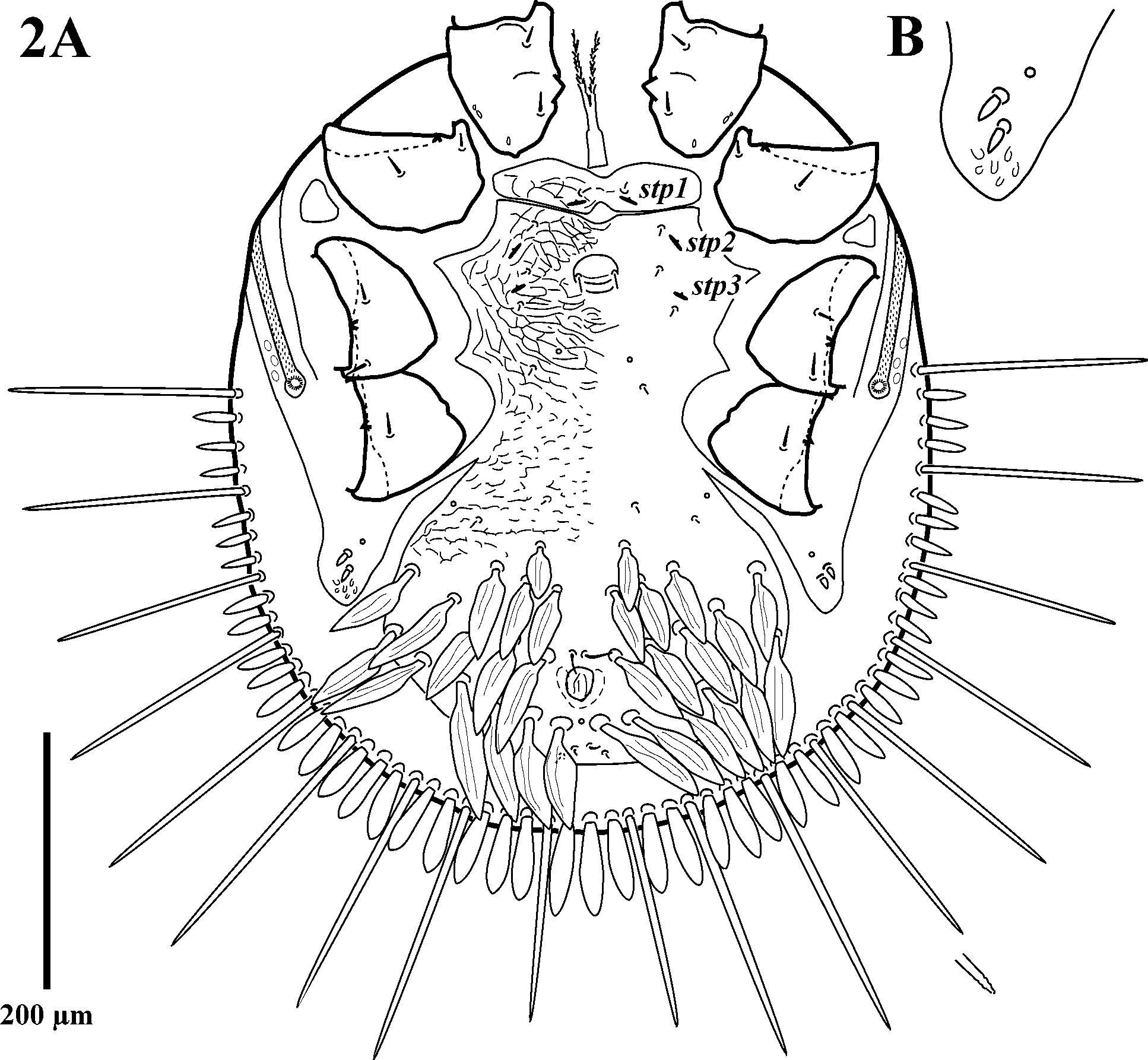
FIGURE 2. Ophiomegistus spectabilis sp. nov. (male). A, venter; B, detail metapodal area.
Imageimage/png© Klompen, Hans;Austin, Christopher C.Klompen, Hans;Austin, Christopher C.
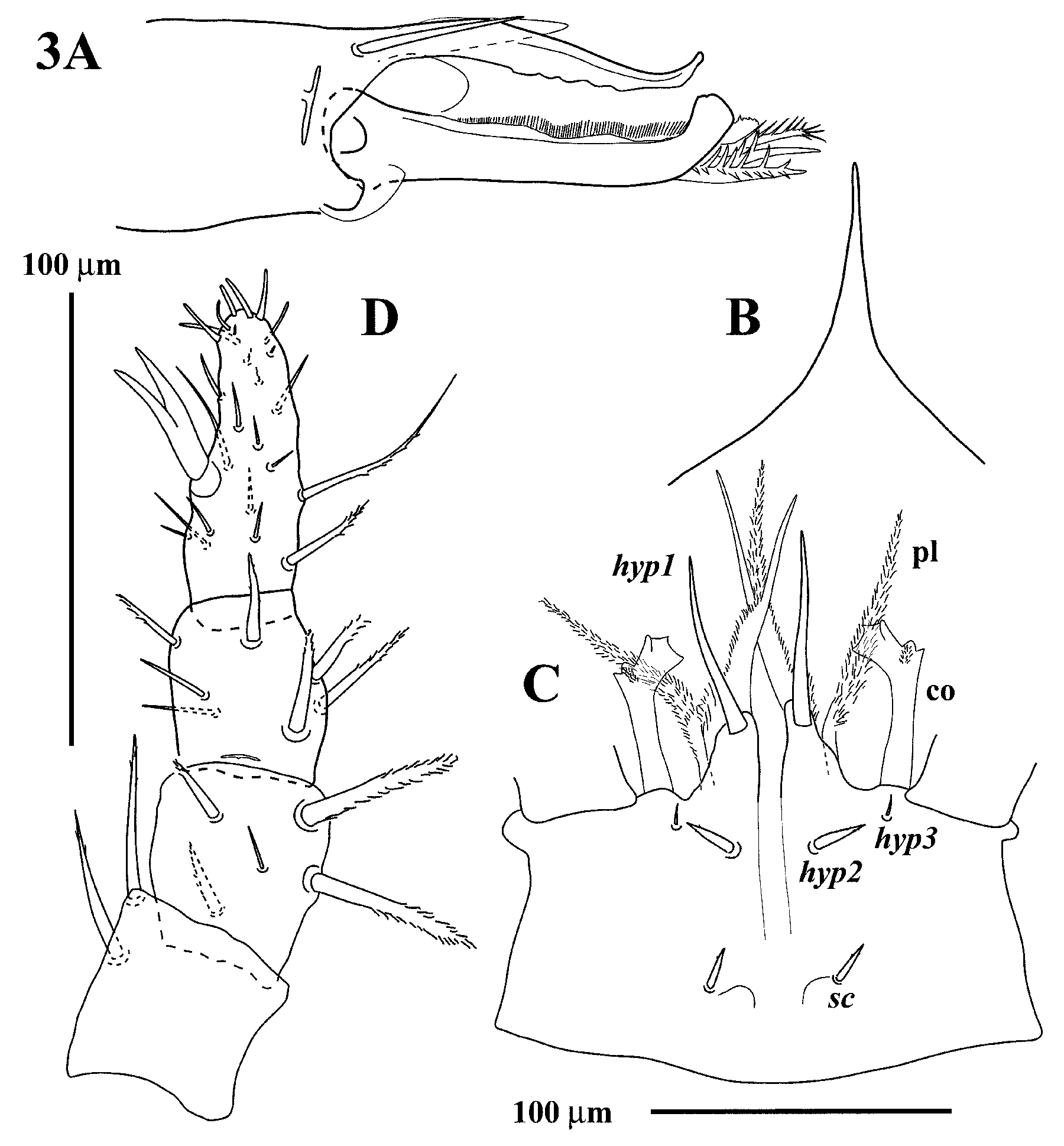
FIGURE 3. Ophiomegistus spectabilis sp. nov. (male). A, chelicera; B, gnathotectum; C, subcapitulum; D, palp, dorsal view. Scale for A, B and D identical. Abbreviations: co, corniculus; pl, paralacinia.
Imageimage/png© Klompen, Hans;Austin, Christopher C.Klompen, Hans;Austin, Christopher C.
IMAGES