AnimaliaNot EvaluatedacceptedspeciesAccepted
Bostrichobranchus crosnieri

Bostrichobranchus crosnieri

GBIF:119358749

0

Synonyms

ABOUT

Descriptions(3)

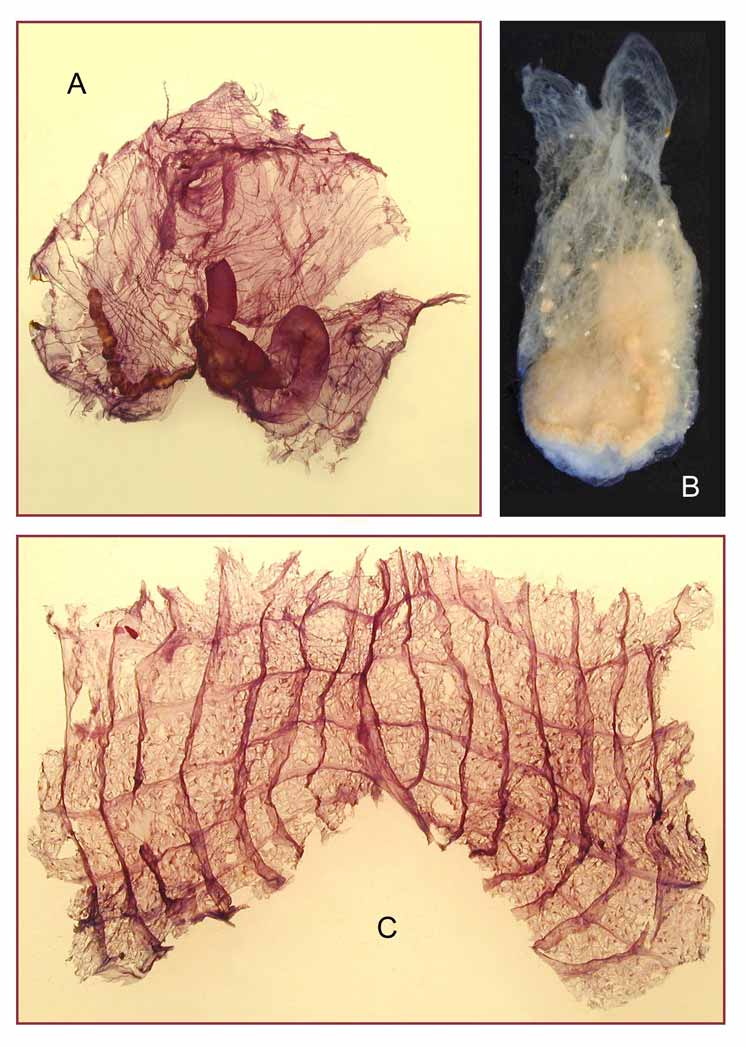
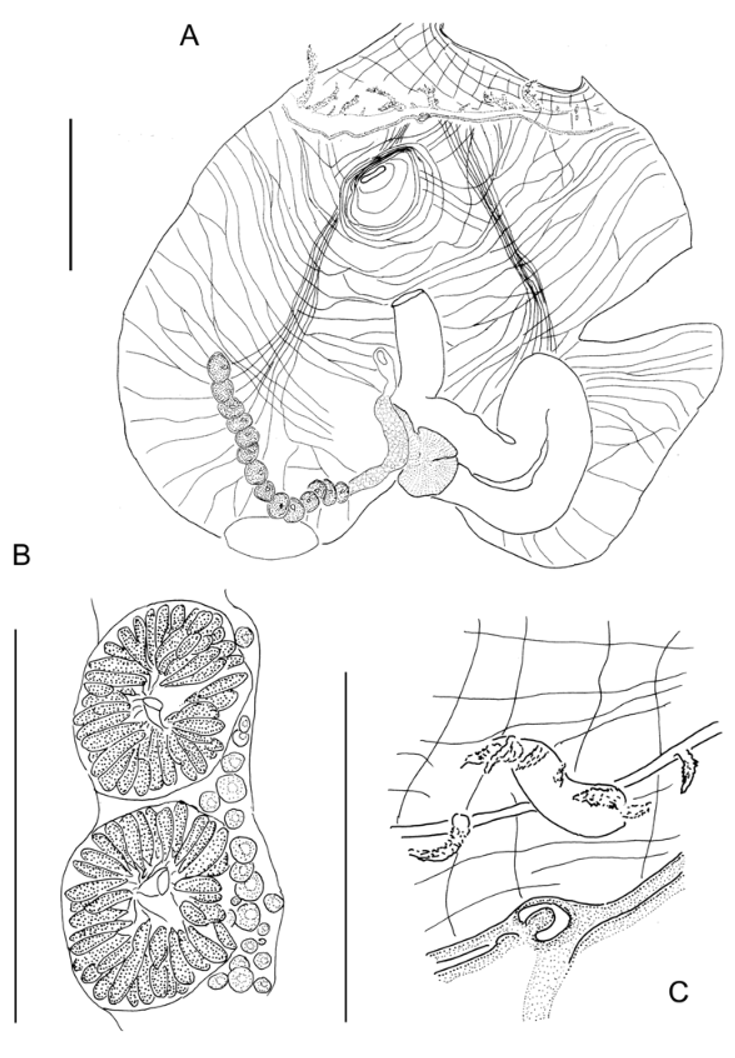
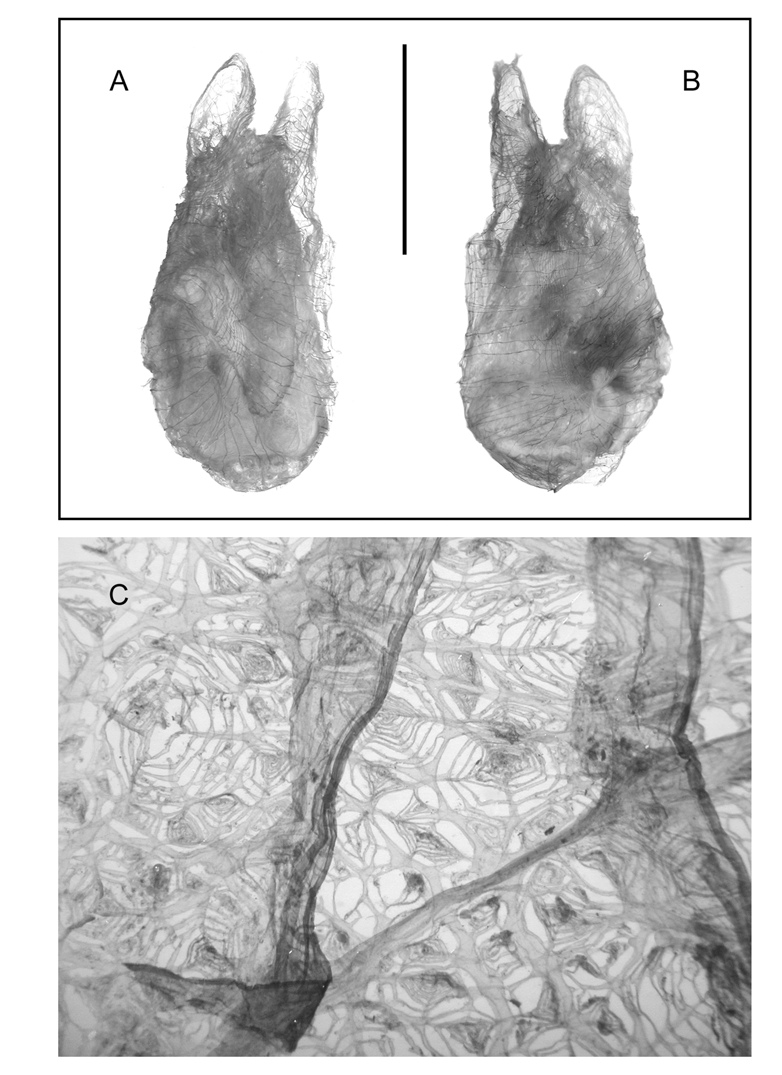
Description. All specimens are of about the same size 4 to 5 cm in length, colorless in formalin, particularly soft and consequently shapeless, embedded in a gelatinous thin tunic. They are not incrusted with sand but some particles adhere to the sticky tunic and fill the digestive tract. Amphipods inhabit some specimens. The body is easily seen through the transparent tunic. The siphons are in apical position, widely open (Fig. 1 A, B). The oral one is directed towards the ventral side, its rim partially damaged in all specimens. Four lobes are seen at the edge of the cloacal siphon in one animal. Both siphons have a long funnel of invaginated tunic. Even when the tunic is partially torn, the body remains in good condition. Its general shape is elongate, wider in the posterior part (Fig. 1 A, B). It does not seem contracted. The body wall is particularly thin and transparent with a musculature made of spaced long fibres (Figs 1 A, B, 2 B, 3 A). On the siphons, circular muscles are not branched and do not form a true sphincter; they are crossed by a few longitudinal short fibres. Around the body, circular muscles are irregularly spaced and sparsely branched (Fig. 1 A, B). On each side there is a narrow longitudinal musculature composed of a single ribbon of 8 to 10 fibres, starting from the peripharyngeal band (Figs 2 A, 3 A), they extend posteriorly remaining parallel along most of their length, fanning out at the posterior end of the body. This ribbon lies in the middle of each body side. About 12 widely separated oral tentacles (Figs 2 A, 3 A), stout with short branches, are located above a low membrane. They are unequal in length but there is not a definite pattern in the arrangement of the sizes (in the specimens where they can be observed). The peripharyngeal band has 2 crests and is not dorsally curved. The dorsal tubercle is flat, C-shaped, opened towards the right (Fig. 3 C). The dorsal lamina, smooth edged, increases in height posteriorly (Fig. 2 C). The branchial tissue is thin with an imperforated band along each side of the endostyle. There are 7 longitudinal vessels in high blades on each side (Fig. 2 C), prolonged a short distance anterior to the stigmata. Five wide transverse vessels delimit square meshes (Fig. 2 C). The stigmata are more or less numerous in a mesh, irregular in size and disposition (Fig. 1 C). They are made of a double spiral protruding in a cone for the largest. Parastigmatic vessels form an irregular web in a mesh (Fig. 1 C). The digestive loop (Fig. 2 A, 3 A) occupies half of the left side. In all specimens it is full of material. The oesophagus is short, not distinct from the stomach. There are small hepatic papillae on the external side of the stomach. No folds have been detected on the stomach wall. The intestine is wide, it extends in a long primary closed loop, and forms a secondary wide loop. The gaping anus opens with a smooth rim. The base of the rectum is attached to the stomach. There is a single tubular gonad in a ventral position on the right side (Figs 2 A, B; 3 A). The long ovary forms a half-circle along the posterior ventral line and joins the base of the rectum to which it is attached. The testis comprises a long series of lobules arranged in successive rosettes along the internal side of the ovary (Fig. 3 A, B). A short sperm duct opens internally from the centre of each rosette of testes (Fig. 3 B). The kidney is an oval vesicle at the very posterior end of the body, against the ovary (Fig. 3 A).
Monniot, Françoise, Monniot, Claude (2008): A new species of Bostrichobranchus (Ascidiacea, Molgulidae) from the eastern tropical Atlantic. Zootaxa 1742: 42-46, DOI: 10.5281/zenodo.181566

Remarks. The genus Bostrichobranchus Traustedt, 1883 is characterised, among the Molgulidae by a branchial sac without folds and bispiral stigmata many of which are independent of the longitudinal vessels. The few species described until now have a gonad located inside the gut loop, on the left side, or a gonad on each side. B. crosnieri n. sp. differs with a single gonad on the right side and also by the shape of this gonad and the design of the body musculature. Bostrichobranchus pilularis (Verrill, 1871) is widely distributed in the north western Atlantic from Canada to Florida. Many specimens of this species have been described under several names and a synonymy was established by Van Name (1945) with a redescription of the species. The gonad is located inside the gut loop.
Monniot, Françoise, Monniot, Claude (2008): A new species of Bostrichobranchus (Ascidiacea, Molgulidae) from the eastern tropical Atlantic. Zootaxa 1742: 42-46, DOI: 10.5281/zenodo.181566
Material examined. Mauritania, west of cape Barbas, 21 ° 47 ’ N – 17 ° 27 ’ W, 3 / VII / 1883, 9 specimens. (The depth is doubful as in many cases for the stations of the “ Talisman ” cruise, the internal labels: 240 m differ from the board list: 140 m). Syntypes: MNHN S 3 BOS 6. The species is dedicated to Alain Crosnier who has carried out and initiated so many works in marine invertebrate diversity.
Monniot, Françoise, Monniot, Claude (2008): A new species of Bostrichobranchus (Ascidiacea, Molgulidae) from the eastern tropical Atlantic. Zootaxa 1742: 42-46, DOI: 10.5281/zenodo.181566

Export occurrence data

Darwin Core Archive (ZIP)

CLASSIFICATION

Taxonomic Classification Tree

MULTIMEDIA

Media Files(3)

FIGURE 1. Bostrichobranchus crosnieri n. sp. A, B, right and left sides of a body without tunic, scale bar = 2 cm; C, meshes of the branchial tissue.

Imageimage/png© Monniot, Françoise;Monniot, ClaudeMonniot, Françoise;Monniot, Claude

FIGURE 2. Bostrichobranchus crosnieri n. sp. A, body dissected along the ventral line, branchial sac removed, stained with hemalum; B, right side of a specimen devoid of tunic to show the gonad in transparency; C, whole branchial tissue removed from the body and stained with hemalum.

Imageimage/png© Monniot, Françoise;Monniot, ClaudeMonniot, Françoise;Monniot, Claude

FIGURE 3. Bostrichobranchus crosnieri n. sp. A dissected body, branchial sac removed; B, detail of a part of the gonad with testis rosettes; C, neural area with a tentacle. Scale bars: A = 10 mm; B = O. 4 mm; C = 0.5 mm.

Imageimage/png© Monniot, Françoise;Monniot, ClaudeMonniot, Françoise;Monniot, Claude

IMAGES

Gallery(3)

See Gallery

Occurrences with images

Source Information

A new species of Bostrichobranchus (Ascidiacea, Molgulidae) from the eastern tropical Atlantic

checklist

This dataset contains the digitized treatments in Plazi based on the original journal article Monniot, Françoise, Monniot, Claude (2008): A new species of Bostrichobranchus (Ascidiacea, Molgulidae) from the eastern tropical Atlantic. Zootaxa 1742: 42-46, DOI: 10.5281/zenodo.181566

Abstract

During the ancient oceanographic expedition of the « Talisman » in 1883, several specimens of a new ascidian species of an uncommon genus of Molgulidae were dredged on a sedimentary bottom off Mauritania. This material was stored in the collections of the Muséum national d’Histoire naturelle where it was overlooked until recently. The good condition of some of them reveals original characters of the musculature and gonads compared to those of the three other species known in the genus Bostrichobranchus.

Key words: Ascidian, Molgulidae, new species, eastern Atlantic, Bostrichobranchus

Monniot F, Monniot C, plazi (2008). A new species of Bostrichobranchus (Ascidiacea, Molgulidae) from the eastern tropical Atlantic. Plazi.org taxonomic treatments database. Checklist dataset https://doi.org/10.5281/zenodo.181566 accessed via GBIF.org on 2026-06-14.

CC0Published 12/31/2008View dataset
GBIF Usage Key
119358749
Dataset Key
259d4d71-dd01-4f95-99cc-6814f286dda7
Origin
source
Backbone Key
7556242
Taxon ID
03E387C0A33AAB4BF49CF9ADFF0146F0.taxon
Last Crawled
6/4/2026
Last Interpreted
6/4/2026