AnimaliaNot EvaluatedacceptedspeciesAccepted
Halecium arcticum

Halecium arcticum

GBIF:119370801

0

Synonyms

ABOUT

Descriptions(6)

Biology Found between 5 m (this study) and 40 m (Broch, 1910) depth. Colonies growing on different types of substratum, most frequently colonizing rhizoids of laminarians (Laminaria digitata, L. saccharina, Alaria esculenta) and bryozoans (Table 2). Rarely, they were found on Eudendrium annulatum Norman, 1864, ascidiacea, Balanus sp., and rock.
Ronowicz, Marta, Schuchert, Peter (2007): Halecium arcticum (Cnidaria: Hydrozoa), a new species of hydroid from Spitsbergen. Zootaxa 1549: 55-62, DOI: 10.5281/zenodo.178055

? Halecium reversum. — Naumov, 1969: 487, fig. 341. in part Halecium undulatum. — Calder, 1970: 1510, pl. 2 figs 5 – 9.
Ronowicz, Marta, Schuchert, Peter (2007): Halecium arcticum (Cnidaria: Hydrozoa), a new species of hydroid from Spitsbergen. Zootaxa 1549: 55-62, DOI: 10.5281/zenodo.178055
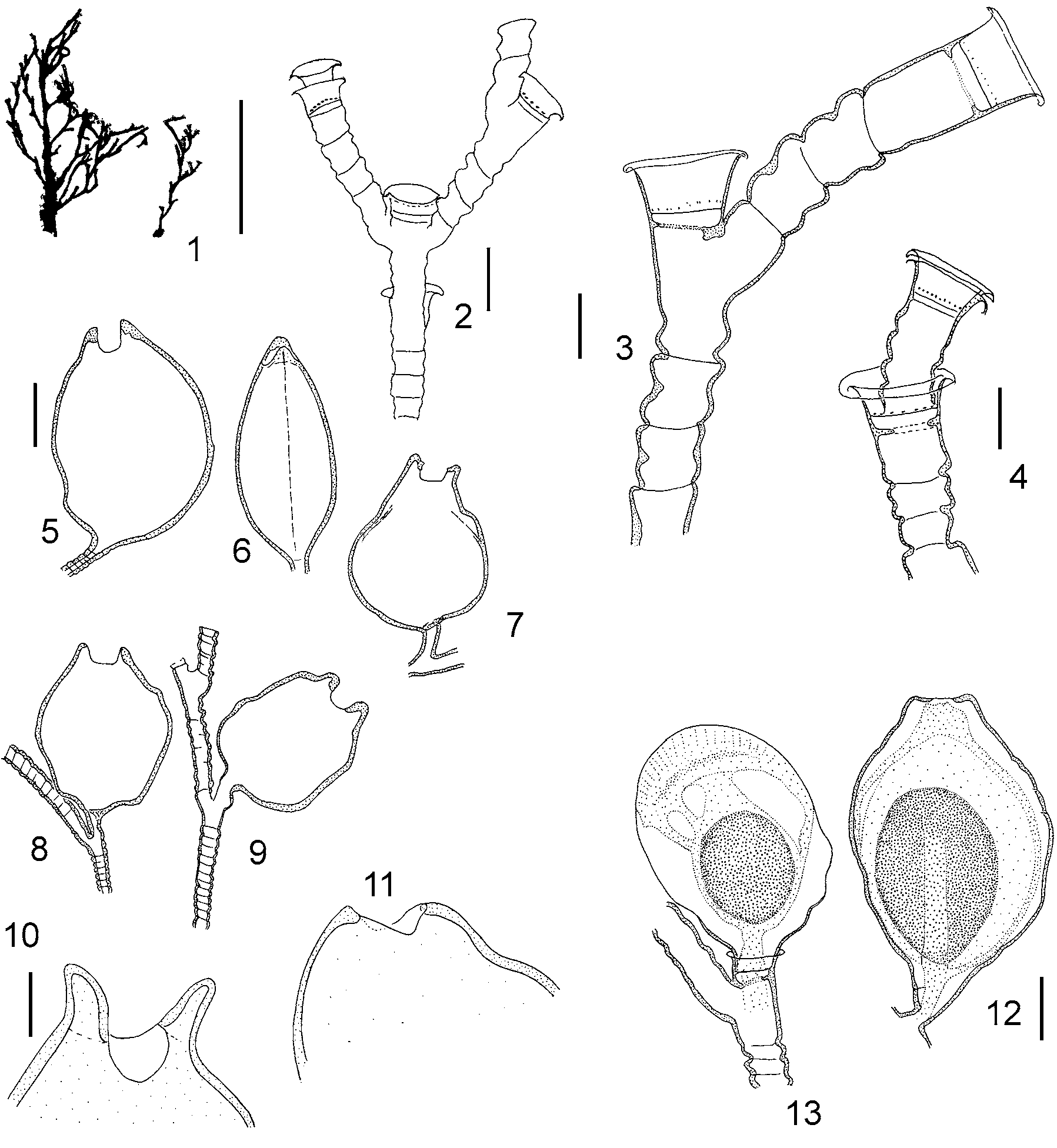
Description Erect, branching stems arising from creeping, ramified stolons. Stems usually short, monosiphonic, occasionally weakly polysiphonic in basal part (up to 5 tubes). Colonies without distinct primary axis, bushy, branching irregularly, with up to 40 hydranths per shoot; paired or unpaired side branches arising mostly at acute angles immediately below hydrothecae (Figs 2 – 3). Perisarc rather thick, strongly corrugated nearly throughout, with smooth stretches below hydrothecae and at origin of some branches (Fig. 2); nodes frequent, irregularly distributed, often delimiting short segments with two annular bulges but without hydrothecae (Fig. 3). No zooxanthellae observed. Primary hydrothecae either at end of side-branches or mostly on distal part of short segments, hydrophore relatively short, hydrothecae thus appearing almost sessile. Hydrotheca relatively deep, walls everted, rim rolled, diaphragm thin, ring of desmocytes present; below diaphragm regularly an annular thickening of the perisarc (pseudodiaphragm, Figs 3 – 4). Secondary hydrothecae with distinct hydrophore; hydrophore as high as its diameter or longer (Fig. 4). Hydranth with about 16 tentacles. Two types of nematocysts: (1) abundant elongate, almond shaped capsules, (6 – 7) x (2) μm, not seen discharged; (2) rare oval microbasic heteronemes, (8 – 9.5) x (3 – 3.5) μm, not seen discharged. Colonies monoecious with dimorphic gonothecae. Gonothecae lacking hydranths and arising from branches or stolons, sometimes developing from within primary hydrothecae; stalk either annulated or smooth; usually on stems, sometimes on stolons. Female gonothecae (Figs 5 – 10) circular to slightly ovoid, lentil-shaped, with two prominent, distal horns flanking a U-shaped aperture (Figs 9 – 10); horns rarely absent (Fig. 11). Perisarc rather thick, without crests, ridges or radiating creases; no internal secondary capsule; soft tissue not forming reticulate pattern; irregular pedicel of variable length. Gonotheca with usually 6 – 7 developing planulae. Male gonothecae smaller (Figs 12 – 13), ovoid lenticular, flattened for about a factor 1.6 (ratio width-thickness), surface smooth; usually without distinct horns, rarely a small one present; small, distal aperture on slight neck formation. For dimensions, see Table 1. TABLE 1. Dimensions of some characters of Halecium arcticum sp. nov.
Ronowicz, Marta, Schuchert, Peter (2007): Halecium arcticum (Cnidaria: Hydrozoa), a new species of hydroid from Spitsbergen. Zootaxa 1549: 55-62, DOI: 10.5281/zenodo.178055
Eudendrium. annulatum 2 (Hydrozoa) Ascidiacea 2 Balanus sp. 2 Rock 2
Ronowicz, Marta, Schuchert, Peter (2007): Halecium arcticum (Cnidaria: Hydrozoa), a new species of hydroid from Spitsbergen. Zootaxa 1549: 55-62, DOI: 10.5281/zenodo.178055
Diagnosis Branched stems, up to 16 mm, mono- or rarely polysiphonic, strongly annulated or corrugated, many short segments without hydrothecae; hydrothecae deep, everted; female gonotheca lentil-shaped, surface smooth, with two distinct apical processes.
Ronowicz, Marta, Schuchert, Peter (2007): Halecium arcticum (Cnidaria: Hydrozoa), a new species of hydroid from Spitsbergen. Zootaxa 1549: 55-62, DOI: 10.5281/zenodo.178055
Distribution Svalbard Archipelago, NE Canada. Substratum F % Algae 55 Bryozoans 10 Bivalves 3
Ronowicz, Marta, Schuchert, Peter (2007): Halecium arcticum (Cnidaria: Hydrozoa), a new species of hydroid from Spitsbergen. Zootaxa 1549: 55-62, DOI: 10.5281/zenodo.178055

Export occurrence data

Darwin Core Archive (ZIP)

CLASSIFICATION

Taxonomic Classification Tree

NOMENCLATURE

Synonyms(1)

MULTIMEDIA

Media Files(1)

FIGURES 1 – 12. Halecium arcticum sp. nov, all after preserved material from Spitsbergen. (1) Colony silhouettes, the left one is polysiphonic, the right one monosiphonic, scale bar 5 mm. (2) Typical branching pattern, scale bar 0.2 mm. (3) Terminal region of a branch with two hydrothecae, note presence of a pseudodiaphragm below diaphragm and the short, quadrangular segments, scale bar 0.1 mm. (4) Primary and secondary hydrothecae, scale bar 0.1 mm. (5) Female gonotheca in frontal view, scale bar 0.5 mm. (6) Same as (5), in side view. (7 – 9) Female gonothecae, note variation, same scale as (5). (10) Distal end of female gonotheca with characteristic horns flanking the opening, scale bar 0.2 mm. (11) Rare, mature, female gonotheca lacking distal horns; same scale as 10. (12) Mature male gonotheca seen from broad side, with sperm mass, scale bar 0.2 mm. (13) Immature male gonotheca, same scale as (12).

Imageimage/png© Ronowicz, Marta;Schuchert, PeterRonowicz, Marta;Schuchert, Peter

IMAGES

Gallery(1)

See Gallery

Occurrences with images

Source Information

Halecium arcticum (Cnidaria: Hydrozoa), a new species of hydroid from Spitsbergen

checklist

This dataset contains the digitized treatments in Plazi based on the original journal article Ronowicz, Marta, Schuchert, Peter (2007): Halecium arcticum (Cnidaria: Hydrozoa), a new species of hydroid from Spitsbergen. Zootaxa 1549: 55-62, DOI: 10.5281/zenodo.178055

Abstract

A new species of the genus Halecium is described and figured. The new species was found among the kelp forest-associated fauna collected during the Polish diving expedition to Hornsund (Spitsbergen, Svalbard Archipelago) in 2003. The relationships with several closely-related Halecium species are discussed.

Key words: Benthic hydroid, new species, Halecium, Svalbard, Arctic

Ronowicz M, Schuchert P, plazi (2007). Halecium arcticum (Cnidaria: Hydrozoa), a new species of hydroid from Spitsbergen. Plazi.org taxonomic treatments database. Checklist dataset https://doi.org/10.5281/zenodo.178055 accessed via GBIF.org on 2026-06-17.

CC0Published 12/31/2007View dataset
GBIF Usage Key
119370801
Dataset Key
0811e40c-b4fb-4d01-9698-051c767212e6
Origin
source
Backbone Key
2268484
Taxon ID
CA248786BB1E0169B2FB7FD431CDFDBF.taxon
Last Crawled
6/11/2026
Last Interpreted
6/11/2026