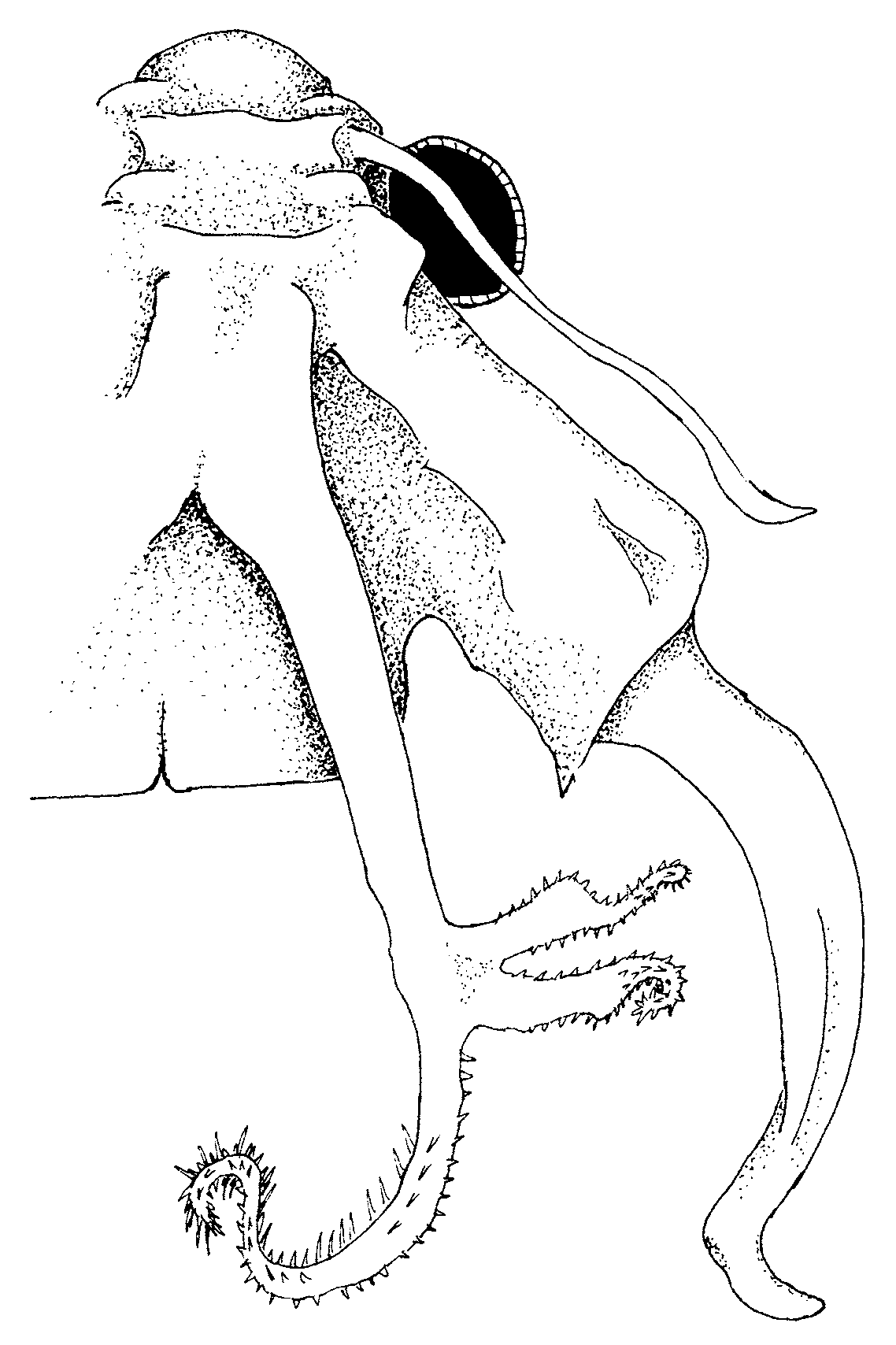
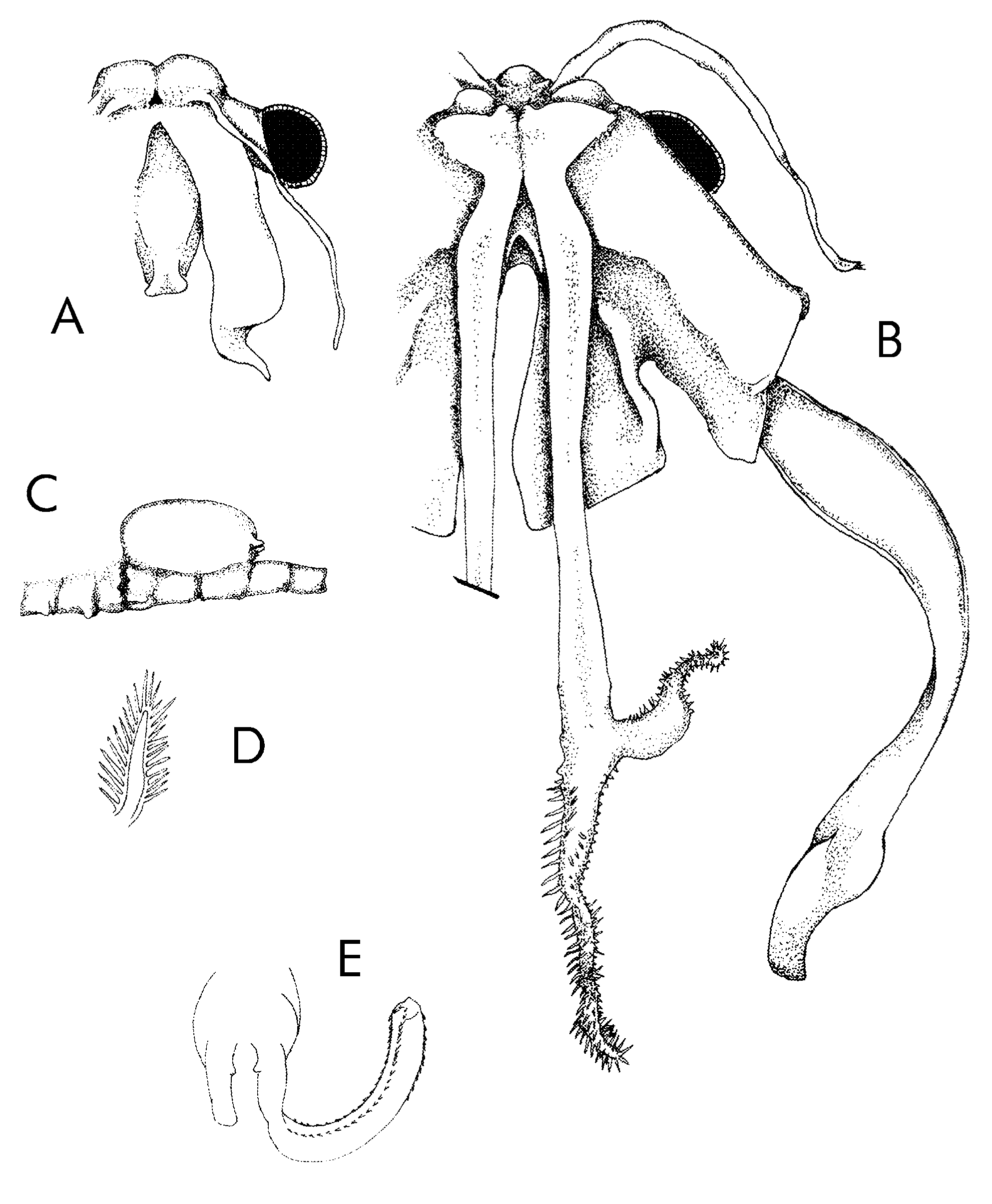
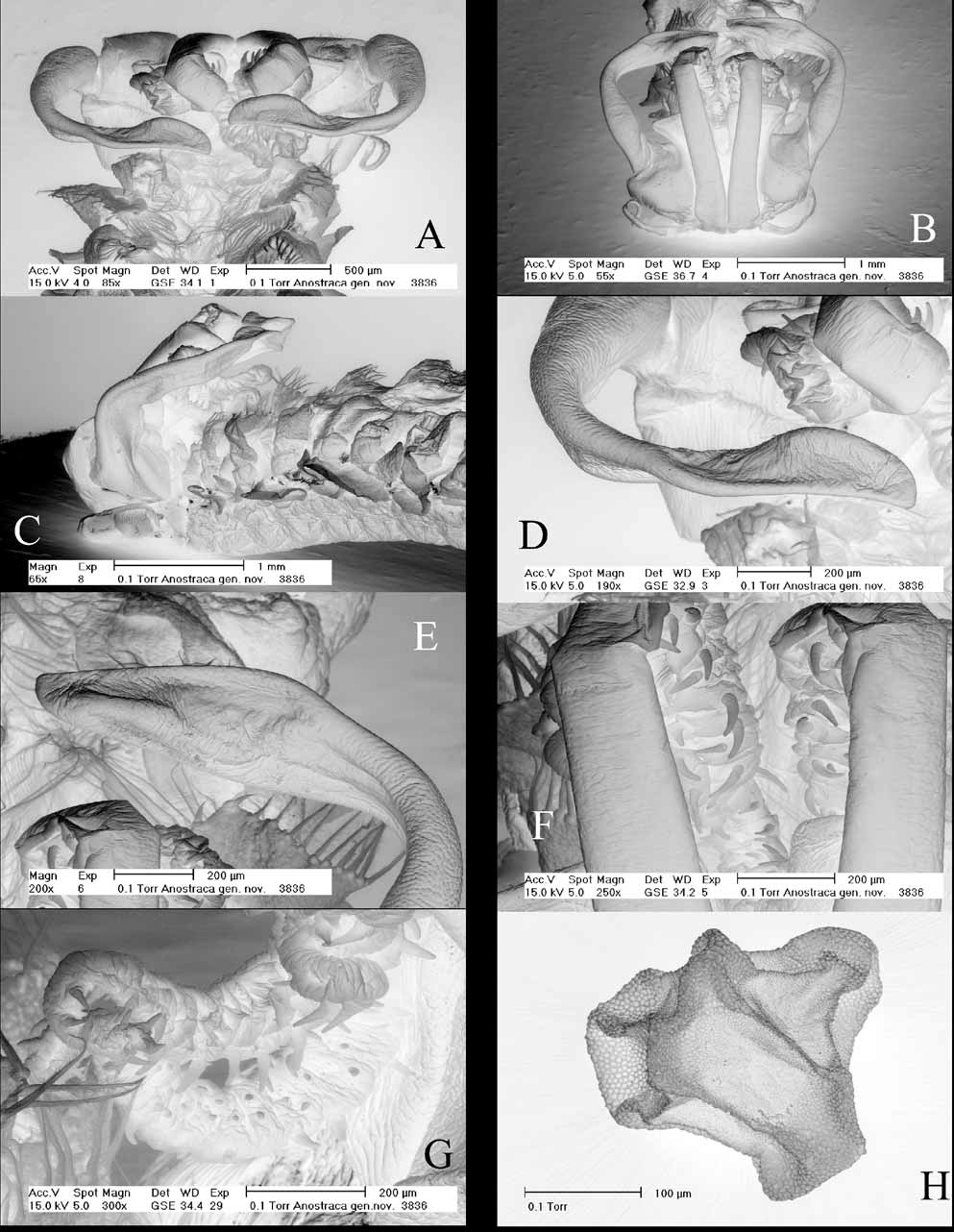
Diagnosis. Rigid portion of gonopods inflated, slightly expanded over genital segments. Everted gonopods extending to third or fourth abdominal segment. Rigid basal portion of each gonopod subcylindrical, smooth, bearing a single medial rounded projection. Distal eversible portion of each gonopod subcylindrical with an anteriolateral longitudinal row and a posteriolateral longitudinal row of flattened, posteriorly directed spines, which unite at the apex of the gonopod at the gonopore. Gonopod with an anteriomedial and a posteriomedial longitudinal row of flattened, posteriorly directed spines on the distal quarter. Frontal appendages present. Female with brood pouch sub-cylindrical not extending beyond second abdominal segment. Amplexial groove present, more pronounced laterally. Female with rudimentary dorsal ornamentation. Cercopods margined with spines. Two species from eastern Australia. Differential diagnosis. The family Branchipodidae contains six genera: Australobranchipus gen. nov., Branchipus Schaeffer, 1766, Branchipodopsis Sars, 1989, Rhinobranchipus Brendonck, 1995, Metabranchipus Masi, 1925, and Pumilibranchipus Hamer & Brendonck, 1995. Australobranchipus lacks the ornamentation of the rigid proximal portions of the gonopods that characterize Metabranchipus and Rhinobranchipus. The basal portions of the gonopods in Metabranchipus bear lateral protrusions that are covered with fine spines and the ventromedial processes have a serrated medial margin (Brendonck 1995 a, Brendonck & Belk 1997). Conversely, in Rhinobranchipus, in addition to the ventromedial process, a lobiform ventral projection tipped with a small spine is also present. Otherwise the gonopod rigid basal portions of Australobranchipus are similar to Branchipus, Branchipodopsis, and Pumilibranchipus. In Branchipus the medial process tends to be elongated, curved, and apically acute, whereas in Branchipodopsis the medial process may be a small rounded protuberance, or an acute projection (Brendonck 1995 a, Brendonck and Belk 1997). Pumilibranchipus has an acute medial projection, and just posterior to the first projection is a small spiniform projection (Hamer 1994, 1999, Brendonck 1995 b, Brendonck & Belk 1997). In Australobranchipus the medial projection is short and hemispherical, similar to some Branchipodopsis. The distal eversible portion of the gonopods in Australobranchipus bears four distinct, separated longitudinal rows of small denticuliform spines, whereas Rhinobranchipus, Branchipus, Branchipodopsis, and Metabranchipus have different arrangements of large papilliform spines. The form of Australobranchipus gonopods is most similar to Pumilibranchipus. The eversible portion of the gonopod in Pumilibranchipus is subequal in length to the rigid basal portion, and bears a single, longitudinal row of 4 to 5 posteriorly directed subconical spines, each with a serrate apex (Hamer 1994, 1999, Brendonck 1995 b, Brendonck & Belk 1997). In contrast, Australobranchipus has the distal eversible portion twice as long as the basal portion, and four longitudinal rows of ten or more small, flattened, smooth spines. Australobranchipus parooensis sp. nov. (Figures 1, 2)
Rogers, Christopher, Timms, Brian V, Jocquè, Merlijn, Brendonck, Luc (2007): A new genus and species of branchipodid fairy shrimp (Crustacea: Branchiopoda: Anostraca) from Australia. Zootaxa 1551: 49-59, DOI: 10.5281/zenodo.178120