AnimaliaNot EvaluatedacceptedspeciesAccepted
Oligoxystre bolivianum

Oligoxystre bolivianum

Vol, 2001

GBIF:119371490

0year

0

Synonyms

ABOUT

Descriptions(4)

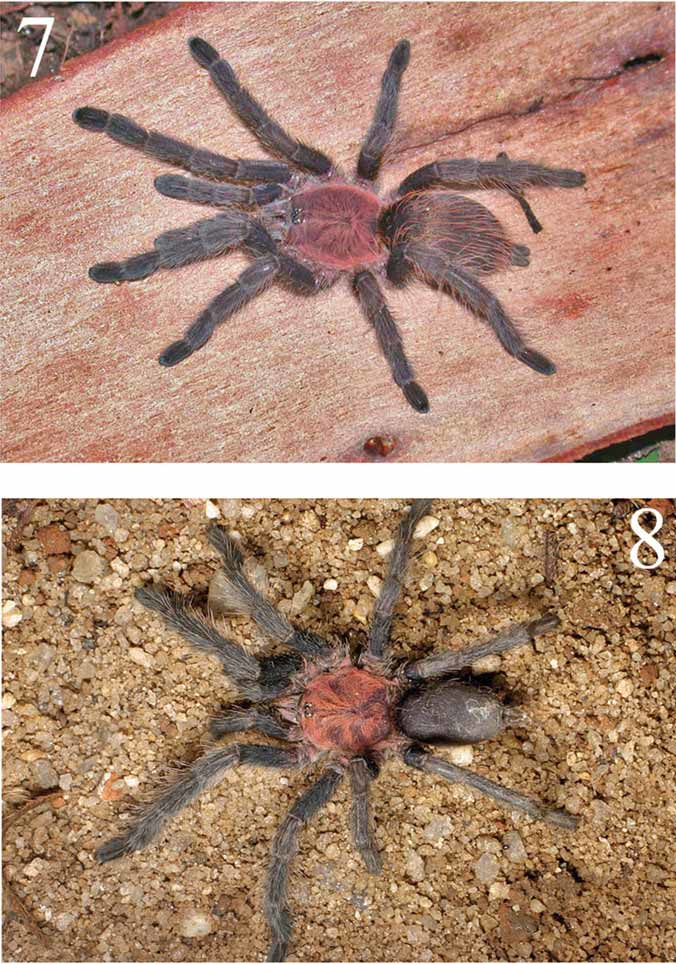
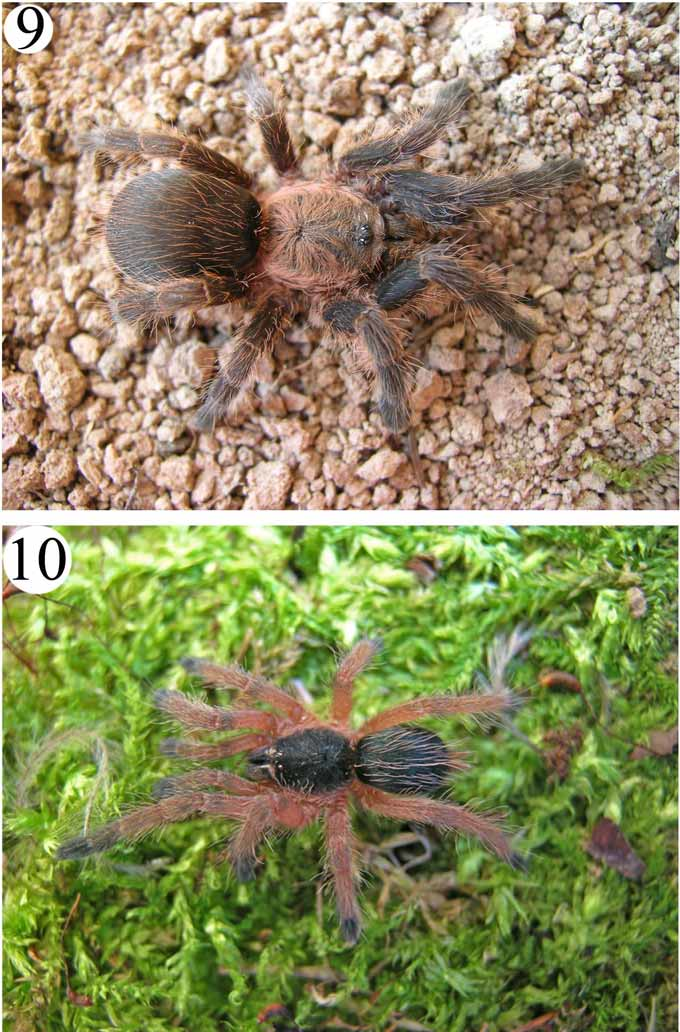
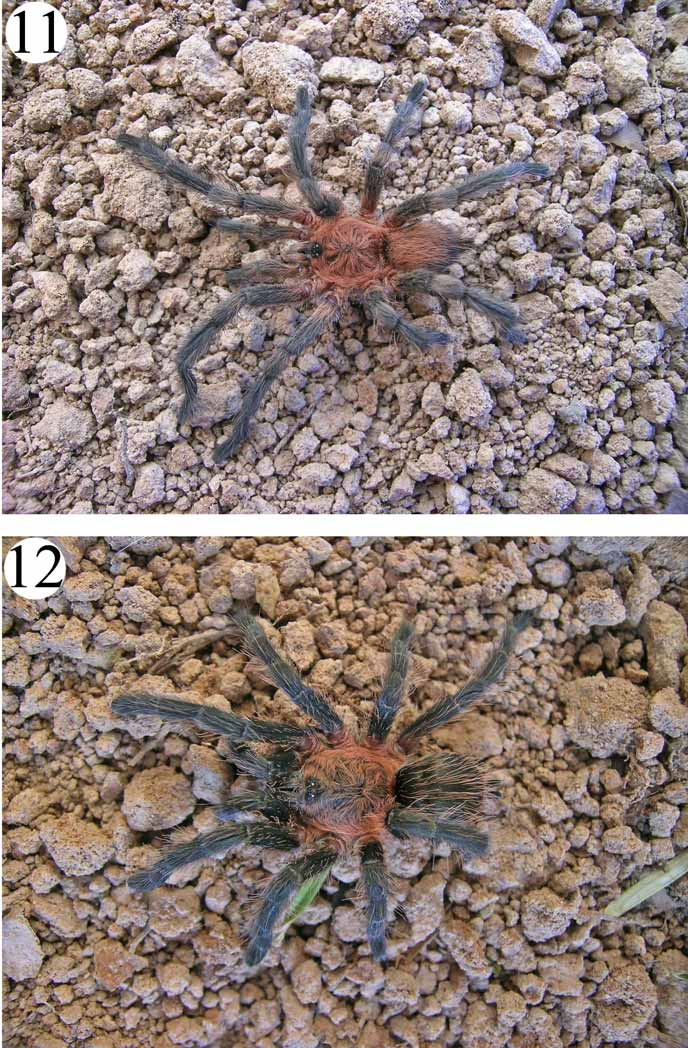
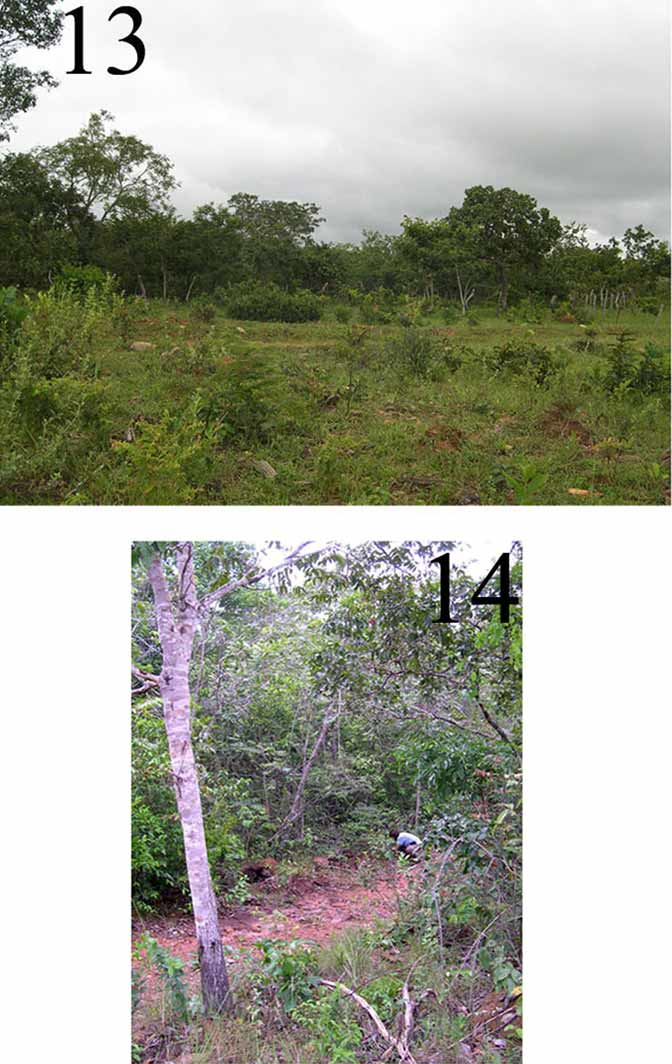
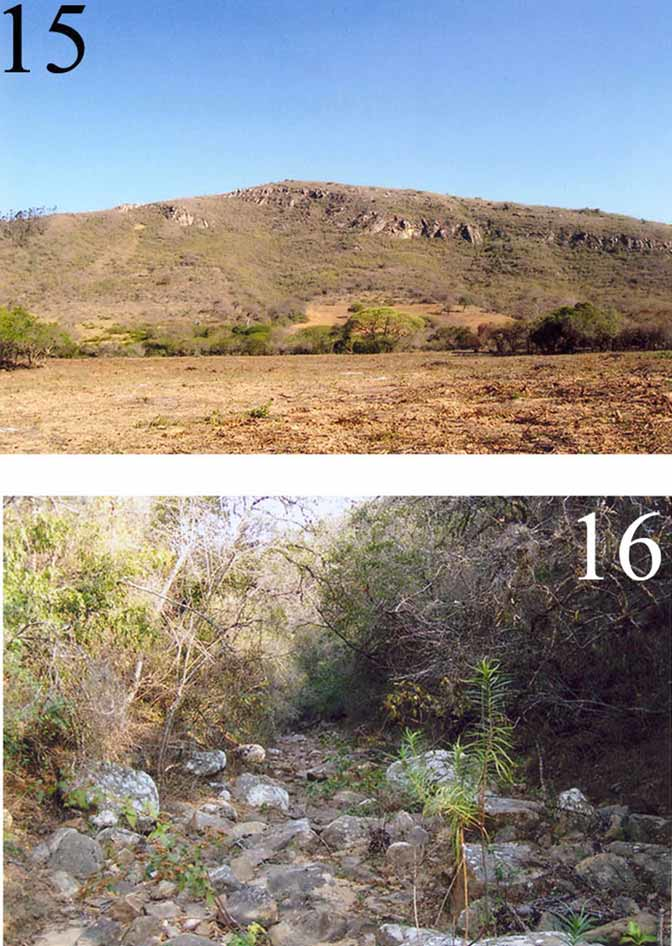
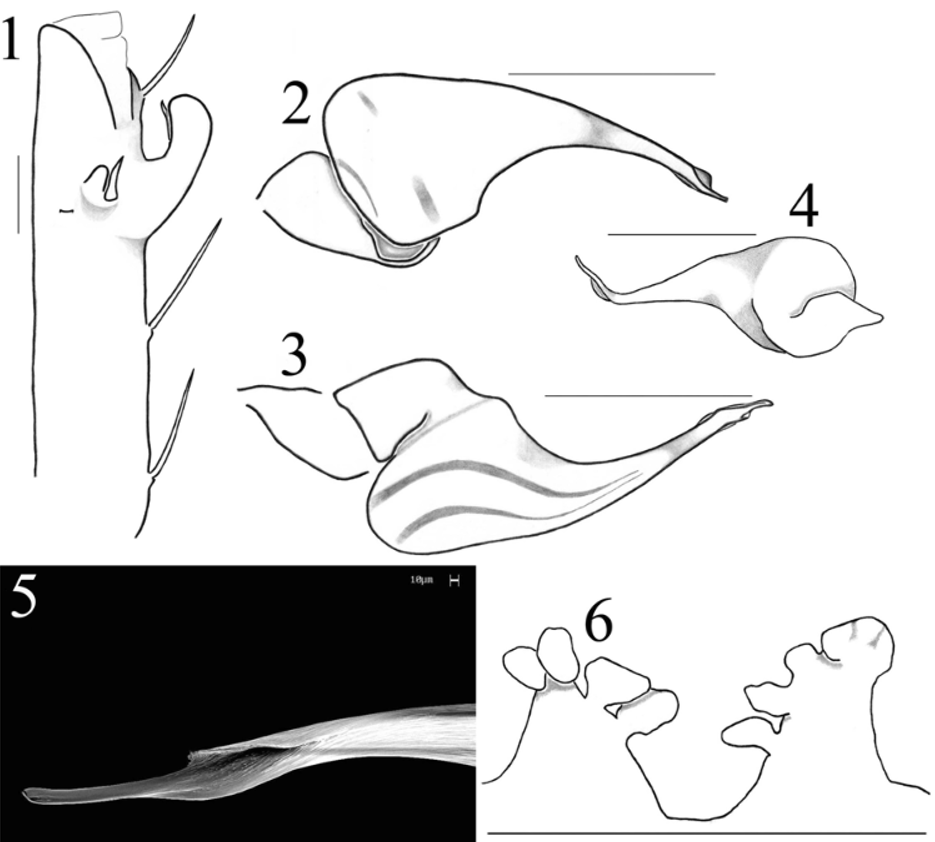
Description. Male (MZSP 26076). Total length: 21.4. Carapace: length 8.52; width 6.98. Eye tubercle: length 1.18; width 1.52. Labium: length 0.5; width 1.37. Sternum: length 4.37; width 3.65. Basal segment of chelicera with 8 teeth. Labium with 3 cuspules. Maxilla with 20 – 23 cuspules. Thoracic fovea slightly recurved. Palp: femur 4.53 / patella 2.9 / tibia 3.43 / cymbium 1.78 / total 12.64. Legs I: femur 7.8 / patella 4.46 / tibia 5.76 / metatarsus 5.44 / tarsus 3.33 / total 26.79. II: 6.98 / 3.91 / 5.09 / 4.89 / 3.13 / 24. III: 6.06 / 3.05 / 4.32 / 4.99 / 3.1 / 21.52. IV: 7.95 / 3.73 / 6.41 / 6.89 / 3.57 / 28.55. Spines: Palp: femur (d) 0 - 0 - p 1, patella 0, tibia (v) 0 - 0 - 1, (p) 1 - 1 - 1; Legs: I: femur (d) 0 - 0 - p 1, patella 0, tibia (v) 2 - 2 - ap 1, (p) 0 - 1 - 0, metatarsus (v) r 1 - 0 - 0; II: femur (d) 0 - 0 - 2, patella 0, tibia (v) 2 - 2 - ap 2, (p) 0 - 1 - 1, metatarsus (v) 1 - 0 - 0; III: femur (d) 1 - 5 - 3, patella 0, tibia (r) 1 - 1 - 0, (v) 4 - 3 - ap 2, (p) 1 - 1 - 0, metatarsus (r) 1 - 1 - 0, (v) 0 - 2 - ap 3, (p) 1 - 1 - 1; IV: femur (d) 1 - 5 - 3, patella 0, tibia (r) 1 - 1 - 1, (v) 3 - 3 - ap 3, (p) 0 - 1 - 1, metatarsus (r) 1 - 1 - 1, (v) 2 - 0 - ap 3, (p) 1 - 1 - 1. Retrolateral lobe of cymbium slightly larger than prolateral lobe. Palpal bulb with short embolus, bent distally (Fig. 4), with small subapical keel (Figs. 2 – 5). Retrolateral branch of tibial spur with spine inserted on its midlength, internal branch with spine inserted on its base (Fig. 1). Metatarsus I bends retrolaterally to tibial spur. Carapace reddish. Abdomen dark with some clear setae (Fig. 8). Female (MZSP 23224). Total length: 21.1. Carapace: length 9.17; width 7.46. Eye tubercle: length 1.32; width 1.65. Labium: length 0.64; width 1.64. Sternum: length 4.12; width 3.92. Basal segment of chelicera with 8 – 10 teeth. Labium with 3 cuspules. Maxilla with 19 – 20 cuspules. Palp: femur 4.58 / patella 3.33 / tibia 2.75 / tarsus 2.85 / total 13.51. Legs I: femur 6.59 / patella 4.57 / tibia 4.5 / metatarsus 3.98 / tarsus 2.61 / total 22.25. II: 5.75 / 3.92 / 3.71 / 3.56 / 2.5 / 19.44. III: 5.24 / 3.2 / 3.31 / 3.82 / 2.6 / 18.17. IV: 6.85 / 4.04 / 5.35 / 5.54 / 2.94 / 24.72. Spines. Palp: femur (d) 0 - 0 - p 1, patella 0, tibia (v) 0 - 2 - ap 2, (p) 0 - 1 - 0. Legs I: femur (d) 0 - 0 - p 1, patella 0, tibia (v) 0 - 1 - ap 1, (p) 0 - 1 - 0, metatarsus (v) r 1 - 0 - 0. II: femur (d) 0 - 0 - p 1, patella 0, tibia (v) 0 - 1 - ap 1, (p) 0 - 1 - 0, metatarsus (v) r 1 - 0 - 0. III: femur (d) 0 - 0 - 1, patella 0, tibia (r) 1 - 1 - 0, (v) 0 - 2 - ap 2, (p) 1 - 1 - 0, metatarsus (r) 0 - 1 - 1, (p) 1 - 1 - 1, (v) 0 - 2 - ap 2. IV: femur 0, patella 0, tibia (r) 0 - 1 - 1, (v) 0 - 1 - ap 2, metatarsus (r) 0 - 1 - 1, (v) p 1 - 4 - ap 3, (p) 0 - 1 - 0. Spermathecae paired, receptacula short, as wide as long, with apical termini (Fig. 6). Coloration similar to male (Fig. 7). Note. This species has a very wide distribution, from central Brazil to eastern Bolivia. Although spiders in different populations show variation in color (Figs. 7 – 12), they all have the same genitalia morphology, and therefore are assigned to the same species. Natural history. In their revision, Gerschman & Schiapelli (1973) stated that spiders of some Ischnocolinae can be found under stones and fallen trunks. Similarly, Vol (2001) stated that the specimens that he described, were collected inside houses as well as under rocks with silk. The specimens studied herein, from Samaipata, Bolivia (Figs. 15 – 16) were collected under rocks (Dirk Weinmann, pers. com.), as was the material from the type-locality, Catalão, Goiás, Brazil (Figs. 13 – 14). Both of these areas are dry environments, but the forest in Brazil, called " cerradão ", has a denser canopy than the habitat in Bolivia, where only some scattered trees are present. At the other locality in Bolivia, Rurrenabaque, Beni, the specimens were collected between the leaf stalk and the tree trunk (Figs. 17 – 18; Dirk Weinmann, pers. com.). Both specimens from Catalão were raised in captivity until they molted into adults. Each one was placed in a terrarium with 7 cm layer of soil and a large stone. The spiders built a tunnel web between the stone and the glass of the terrarium; the tunnel could be seen from outside (Figs. 19 – 20). Several times, the spiders were seen carrying small portions of soil grains and sticking them to the web, until the tunnel was completely covered with soil. This behavior may be interpreted as an attempt to hide the web from predators, since it would not be easily seen. The spiders were seen and fed at both entrances of the tunnel. Apparently, they showed no preferences for either entrance. Beneath the stone, the tunnels branched into several secondary, smaller tunnels through which the spider would walk rapidly.
Guadanucci, José Paulo Leite (2007): A revision of the Neotropical spider genus Oligoxystre Vellard 1924 (Theraphosidae, Ischnocolinae). Zootaxa 1555: 1-20, DOI: 10.5281/zenodo.178227

Note. Vol (2001) established Pseudoligoxystre by comparing his material to a species then placed in Oligoxystre (O. argentineniense) and observed the following differences: embolus shorter, tarsi longer and each spermathecal receptacle bearing two apical lobes. According to Vol, Oligoxystre has a long and thin embolus and the spermethecae formed by two long tubes bearing a rounded termini. The name Pseudoligoxystre comes from the resemblance that it has with Oligoxystre, because they both have a labium wider than long with few cuspules (fewer than 10). However, when Vol described Pseudoligoxystre, the only material available to him for comparison was O. argentinense, which has since been transferred to Catumuri. It is clear that Vol used O. argentinense to differ his new genus when he mentions that the genus Oligoxystre presents the palpal bulb and spermathecae as described above. Guadanucci (2004) described Catumiri for Oligoxystre argentinense and three new species. According to his description Catumiri differs from Oligoxystre by the divided anterior tarsal scopula, spermathecae receptacles each with one apical terminus; presence of a row of teeth on the prolateral margin of the tarsal claws of males. According to Vellard (1924), Oligoxystre is characterized by the labium wider than long with 4 or 5 cuspules; maxilae with 15 – 20 cuspules; tarsal scopula I and II undivided; metatarsus I occupied by scopula until the 1 / 3 basal region and II more than apical half occupied by scopula, matching perfectly with Vol`s description of Pseudoligoxystre. It was not possible to have access to the type-material. Males from the typelocality (MZSP 26082, 26083) that match Vol's descritpion were examined. Concluding, Vol erroneously used Catumiri argentinense (instead of the description of the type species) to compare and establish Pseudoligoxystre, ignoring Vellard`s description of Oligoxystre. Catumiri comprises a different group from Oligoxystre, as described as a new genus by Guadanucci (2004). Therefore, Pseudoligoxystre is considered here junior synonym of Oligoxystre.
Guadanucci, José Paulo Leite (2007): A revision of the Neotropical spider genus Oligoxystre Vellard 1924 (Theraphosidae, Ischnocolinae). Zootaxa 1555: 1-20, DOI: 10.5281/zenodo.178227
Diagnosis. Males may be distinguished from all other species by the palpal bulb with a short embolus with a small subapical keel (Figs. 2 – 5). Females may be distinguished by the spermathecal receptacula being as wide as long, with apical termini apical (Fig. 6).
Guadanucci, José Paulo Leite (2007): A revision of the Neotropical spider genus Oligoxystre Vellard 1924 (Theraphosidae, Ischnocolinae). Zootaxa 1555: 1-20, DOI: 10.5281/zenodo.178227
Material examined. BOLIVIA. Santa Cruz: Samaipata, 2 ɗ (MZSP 26082, 26083); Beni: San Buenaventura, 2 ɗ (MZSP 26084, 26086), 1 Ψ (MZSP 26085). BRAZIL. Distrito Federal: Brasília, 4 Ψ (MNRJ), 3 Ψ and 1 ɗ (MNRJ), 1 ɗ (UnB 870), 1 ɗ (UnB 131), 1 Ψ (UnB 343), 1 Ψ (UnB 765), 1 ɗ (UnB 1129), 1 Ψ (UnB 1645); Sobradinho, 1 Ψ (UnB 1795), 1 ɗ (UnB 1824), 1 ɗ (UnB 1910), 1 Ψ (UnB 1993), 1 Ψ (UnB 2099), 1 ɗ (UnB 2604), 1 ɗ (UnB 2752). Goiás: Aragarças, 1 ɗ (MNRJ 3850); Catalão: Fazenda Alvorada 1 ɗ (MZSP 26076), 1 Ψ (MZSP 23224), Mineiros, 1 ɗ (IBSP 9493). Mato Grosso: Chapada dos Guimarães, 1 ɗ (IBSP 9494), (IBSP 9495), 1 Ψ (IBSP 9043), (IBSP 9504), 1 Ψ (IBSP 9503), 1 Ψ (IBSP 9505), 1 Ψ (IBSP 9143), 1 Ψ (IBSP 9040), 1 Ψ (MZSP 18978); Cuiabá, 1 ɗ (IBSP 9496); Diamantina, 1 ɗ (IBSP 5686); Manso, 1 ɗ (UnB 202), 1 j (UnB 188). Rondônia: U. H. Samuel, Porto Velho, 1 Ψ (IBSP 9506).
Guadanucci, José Paulo Leite (2007): A revision of the Neotropical spider genus Oligoxystre Vellard 1924 (Theraphosidae, Ischnocolinae). Zootaxa 1555: 1-20, DOI: 10.5281/zenodo.178227

Export occurrence data

Darwin Core Archive (ZIP)

CLASSIFICATION

Taxonomic Classification Tree

MULTIMEDIA

Media Files(8)

FIGURES 1 – 6. Oligoxystre bolivianum. 1 – 4. Male MZSP 26076. 1. Tibial apophysis, ventral-prolateral view. 2. Bulb, retrolateral view. 3. Bulb, prolateral view. 4. Bulb, dorsal view. 5. Male, embolus tip. 6. Female, MZSP 23224, spermathecae, dorsal view. Scale = 1 mm.

Imageimage/png© Guadanucci, José Paulo LeiteGuadanucci, José Paulo Leite

FIGURES 7 – 8. Oligoxystre bolivianum. 7. Female MZSP 23224, from Catalão, Goiás, Brazil (photo: J. Guadanucci). 8. Male MZSP 26076, from Catalão, Goiás, Brazil (photo: H. Mariano).

Imageimage/png© Guadanucci, José Paulo LeiteGuadanucci, José Paulo Leite

FIGURES 9 – 10. Oligoxystre bolivianum. 9. Female, from Samaipata, Santa Cruz, Bolívia. 10. Spiderling, from Rurrenabaque, Beni, Bolívia (photos: J. Guadanucci).

Imageimage/png© Guadanucci, José Paulo LeiteGuadanucci, José Paulo Leite

FIGURES 11 – 12. Oligoxystre bolivianum. 11. Male, from Rurrenabaque, Beni, Bolívia. 12. Female, from Rurrenabaque, Beni, Bolívia (photos: J. Guadanucci).

Imageimage/png© Guadanucci, José Paulo LeiteGuadanucci, José Paulo Leite

FIGURES 13 – 14. Collecting site of Oligoxystre bolivianum. 13. Landscape of Catalão, Goiás, Brazil. 14. Forest in Catalão, Goiás, Brazil (photos: A. Monteiro).

Imageimage/png© Guadanucci, José Paulo LeiteGuadanucci, José Paulo Leite

FIGURES 15 – 16. Collecting site of Oligoxystre bolivianum. 15. Landscape of Samaipata, Santa Cruz, Bolívia. 16. Collecting site in Samaipata, Santa Cruz, Bolívia (photos: D. Weinmann).

Imageimage/png© Guadanucci, José Paulo LeiteGuadanucci, José Paulo Leite

IMAGES

Gallery(8)

See Gallery

Occurrences with images

Source Information

A revision of the Neotropical spider genus Oligoxystre Vellard 1924 (Theraphosidae, Ischnocolinae)

checklist

This dataset contains the digitized treatments in Plazi based on the original journal article Guadanucci, José Paulo Leite (2007): A revision of the Neotropical spider genus Oligoxystre Vellard 1924 (Theraphosidae, Ischnocolinae). Zootaxa 1555: 1-20, DOI: 10.5281/zenodo.178227

Abstract

The genus Oligoxystre Vellard 1924 is revised. Pseudoligoxystre Vol 2001 is synonymized with Oligoxystre and its typespecies, P. bolivianum Vol 2001, is considered valid. The type-specimen of Oligoxystre auratum Vellard 1924, type-species by original designation, is considered lost. No additional material matching the original description was found and therefore the species is diagnosed from the original description. Four new species, all from Brazil, are also described: O. caatinga, O. dominguense, O. tucuruiense, and O. rufoniger. Data on natural history of O. bolivianum from field and captivity observations are presented. The genus Cenobiopelma Mello-Leitão & Arlé 1934) is based upon Cenobiopelma mimeticum Mello-Leitão & Arlé 1934 for which no type was ever designated and hence both are considered nomina nuda.

Key words: Araneae, Mygalomorphae, Ischnocolinae, Pseudoligoxystre, Cenobiopelma

Guadanucci J P L, plazi (2007). A revision of the Neotropical spider genus Oligoxystre Vellard 1924 (Theraphosidae, Ischnocolinae). Plazi.org taxonomic treatments database. Checklist dataset https://doi.org/10.5281/zenodo.178227 accessed via GBIF.org on 2026-06-15.

CC0Published 12/31/2007View dataset
GBIF Usage Key
119371490
Dataset Key
0088f909-2c33-4a47-a180-1d5835cf127a
Origin
source
Backbone Key
2154319
Taxon ID
03E28784FFE3FF97EE9BFEA8FD49FDE4.taxon
Last Crawled
6/11/2026
Last Interpreted
6/11/2026