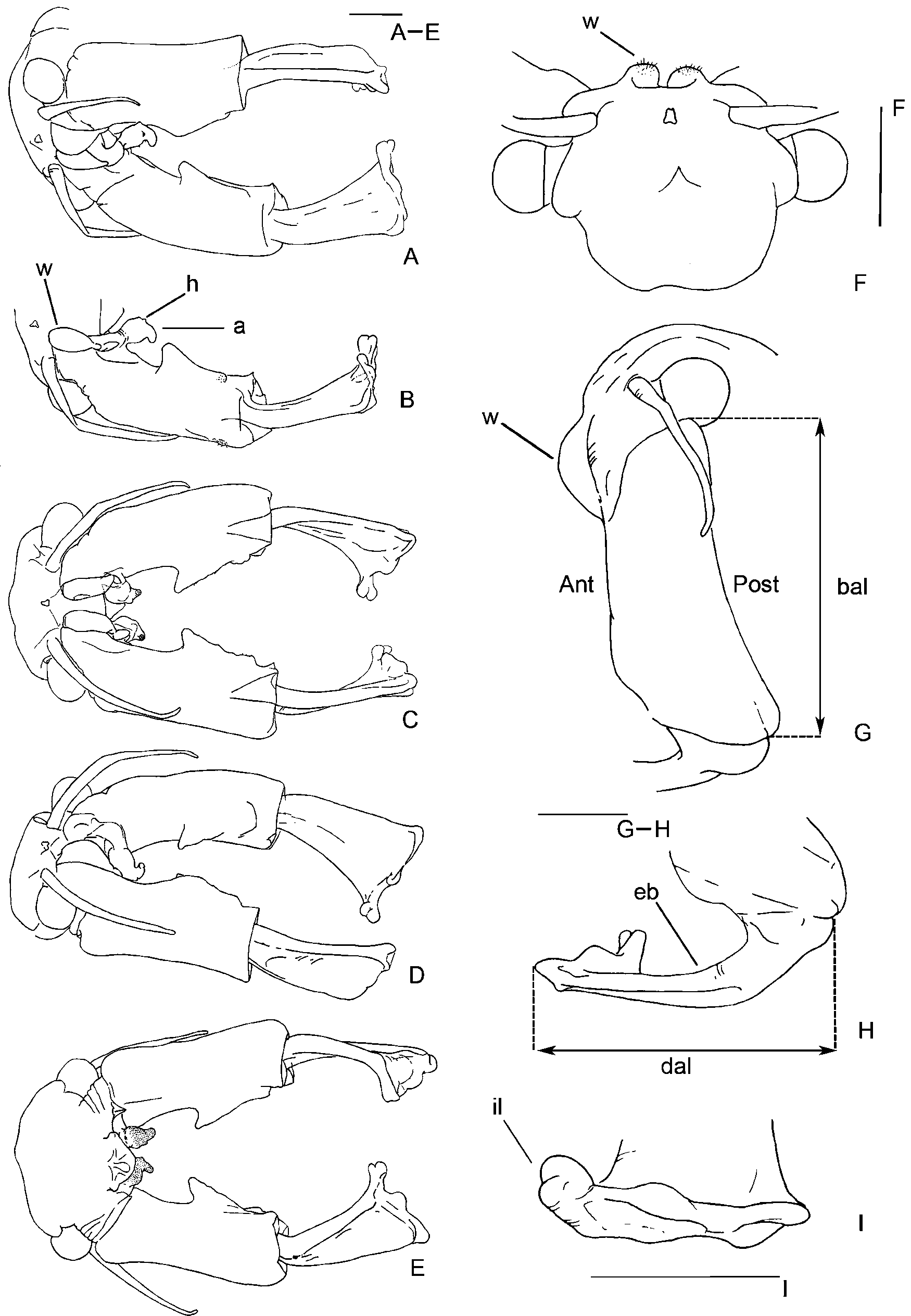
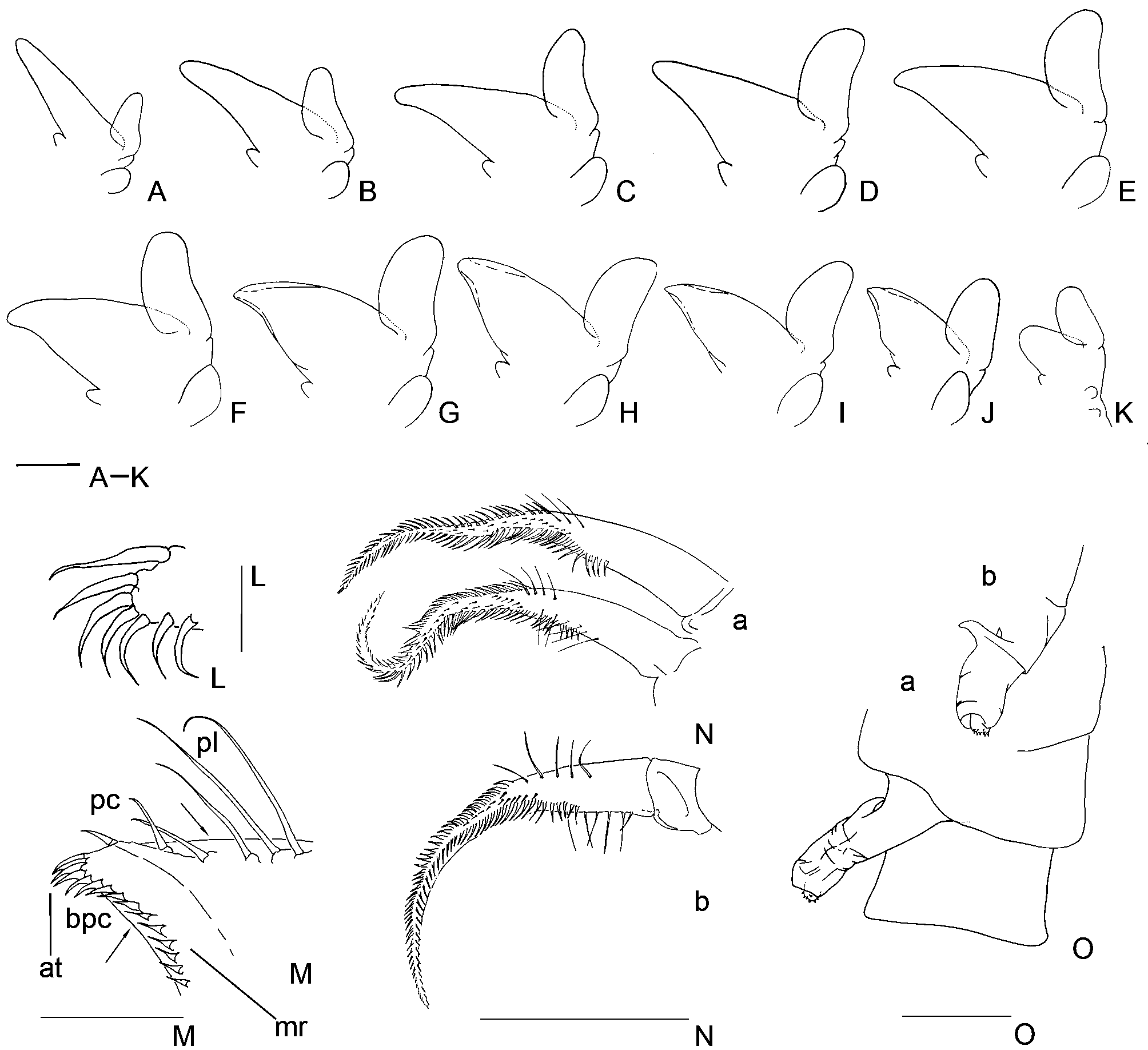
Description. Male: Mean total length from front to end of the abdomen with uropods (cercopods) without setae: 16.9 mm (16.1 – 18.1 mm). Mean uropods (cercopods) without setae length: 1.3 mm (1.1 – 1.4 mm). Average ratio of “ head + thorax ” to “ abdomen + uropods without setae ”: 1.02. Pedunculate eye diameter: 0.6 – 0.7 mm. Antenna 1 as usual, filiform and slender, 2.3 – 2.8 mm, long. Antenna 1 length is 4 times the diameter of compound eye. Antenna 2 basal article (Figs 1 A – E), 2.7 – 3.1 mm long (Fig. 1 G), bearing a proximal anteriomedial rough welt provided with sensory setae, projecting beyond basal article anterior surface and visible in dorsal view (Fig. 1 F). Welt extending posteriorly and terminating as a conspicuous apophysis (Figs 1 A – E). Apophysis hanging medially from the posteriomedial side of article, proximally swollen until it reaches a heel shaped area (Fig. 1 B), arcing anteriorly, apex rounded. Apophysis and apex posterior surface with cuticular ornamentation and with some scattered sensory setae (Fig. 1 E). Basal article proximomedial half concave and smooth (Figs 1 C, 1 E). Basal article distal half with a longitudinal crest produced proximally in a strong blunt medioposteriorly directed point with some scattered small sensory setae. Crest lengthened following the major axis of the article but not reaching its distal end (Figs 1 A – E). Crest margin uneven (Figs 1 C, 1 E), with sparse hyaline sensory structures. Antenna 2 distal article (Figs 1 A – E, 1 H), 2.2 – 3.1 mm long, is strongly rotated anteriorly and articulates almost perpendicularly to basal article. Therefore, in head anterior view, both the basal article anterior surface and the distal article lateral and anteriorly rotated margin can be seen at the same time (Fig. 1 C). This margin curves very slightly to the article apex. Anteriomedially rotated article surface is flattened, slightly convex, adopting a strikingly triangular shape (Figs 1 A – E), widening strongly from its proximal articulation (“ vertex ” of the triangle) to the apex (“ base ” of the triangle). Distal portion of article bends anteriorly forming an explanate complicated three-lobed apex (Figs 1 A-E, 1 I). The inner (medial) lobe is prominent, and subdivided distally into two rounded lobes (Fig. 1 I). Mouth parts typical of the genus. Maxillae 1 with 21 - 22 long setae plus a short strong spine on limb ventral tip, base as wide as twice long seta width. Maxillae 2 with 5 plumose distal setae plus 1 – 2 anteriorly directed densely plumose setae, with setules all around. Thoracic appendages typical of the genus. First through 10 th endopodites triangular elongate (Figs 2 A – J), very narrow in first two (endopodite length / endopodite width ratio 3.7 and 3.2 respectively) gradually widening more than length until 7 th limb (endopodite length / endopodite width ratio varies between 3.2 and 1.9); 8 th to 10 th thoracopod endopodite reduces in size yet maintaining the length and width proportions. First through 10 th endopodites with medial cuticular reinforcement, as in other Branchinecta (Cohen 1995). 11 th endopodite suboval (Fig. 2 K), without medial reinforcement. Endopodite and exopodite length ratio (without setae) is approximately 2.5 in the first thoracopod, varies from 2.0 to 1.7 in the 2 nd to the 7 th thoracopod, and diminishes from 1.6 to 1.4 in the 9 th and 10 th thoracopod. In the 11 th thoracopod the exopodite is slightly longer than the endopodite. Thoracopod 1 endopodite lower margin proximal half with plumose setae and middle of the distal half with only one half-plumose, half-pectinate seta; more distally, close to the apex of endopodite are two shorter robust pectinate setae. Thoracopods 2 through 10 endopodite lower margin with proximally plumose setae advancing more distally as the appendage series progresses; distally in the margin, with 2 – 3 widely spaced pectinate setae, decreasing in size and increasing in robustness to apex, and restricted to a progressively shorter margin portion in successive pairs. Thoracopods 1 and 2 endopodite apex with two or three bipectinate uniformly curved or sinuous setae bearing short setules (Figs 2 L, 2 N a, b); these setae are similar shaped though slightly longer than the setae of the endopodite medial margin, which are more spaced than the apical ones. Thoracopods 3 through 10 endopodites with an apical tuft of close set robust bipectinate curved setae similar to those present in thoracopods 1 and 2 apex. Also, the setae along the endopodite medial margin are similar in shape and spacing to the setae in the thoracopods 1 and 2 but smaller and more gracile, almost half the length of the setae of the apical tuft, seeming denticles with short lateral setules (Fig. 2 M); as consequence, the tuft of scratching setae of the apex seems more conspicuous. In thoracopods 1 through 10, all over the medial margin, from its distal to its proximal part, the curved setae gradually become straight and at the same time sinuous in their tip, whereas in the proximal part of the margin the setae are curved in the opposite direction of the distal setae; the setae are almost uniform in length along the margin. From thoracopod 7 trough 10, a group of setae in the lower and the medial margins are sub-marginally inserted (Figs 2 G – J; arrows in Fig. 2 M); maybe, this arrangement is related with the folding of the endopodites and could allow the setae to change their attack angle. In the 11 th pair of thoracic appendages, the lower margin of endopodite is only provided with plumose setae. Apex of the lobe widely rounded; the setae bordering it are thin, bipectinate, and slightly curved. Towards the medial margin, in distal to proximal direction, the setae decrease in size; they are bipectinate and gradually become straight and then curved in inverted-direction. The 1 st and 2 nd endites in all the thoracic appendages, with the typical anostracan number and arrangement of anterior setae (Linder 1941). In the 1 st pair of thoracic appendages the number of anterior setae on the remaining endites differs from the values stated by Linder (1941) for the genus: 4 to 5 anterior setae were found in the 3 rd endite, 5 to 7 in the 4 th endite and 5 to 7 in the 5 th endite. On the other hand, in the 2 nd to 11 th pairs of thoracic appendages, the number of anterior setae agrees with the values stated by Linder (1941): 2 for the 3 rd endite, 2 for the 4 th and 4 to 6 for the 5 th. In addition, thoracopods 1 st to 10 th show elliptical branchial sacs with smooth margins, and branchial laminae with serrated margins without a conspicuous marginal deep notch (although in some appendages small discontinuities were observed). In the 11 th pair, both branchial sac and lamina are markedly reduced, rounded and triangular shaped respectively (Fig. 2 K). Genital segments not much prominent in lateral view. Gonopods (according to Rogers et al. 2007), typical of the genus (Fig. 2 O a, b). Non-eversible part with a sclerotized, curved and sharp spur-like process. Eversible part, with the two dentate warts typical of the genus; in one male, in the middle of this part, one gonopod of the pair also showed a couple of small triangular and flattened evaginations ending in a hyaline sinuous tip; these structures have been interpreted like anomalies. Testes extending 2 or 3 segments behind the genital segments. Joint between the two last abdominal segments, not well defined. Uropods not convergent, uniformly provided with plumose setae all over the margin. Female: Mean total length from front to end of the abdomen with uropods (cercopods) without setae: 15.8 mm (14.3 – 17.3 mm). Mean uropods (cercopods) without setae length: 0.9 mm (0.8 – 1 mm). Although females are smaller than males, the proportions among tagmata are maintained. Average ratio of “ head + thorax ” to “ abdomen + uropods without setae ”: 1.04. Pedunculate eye 0.4 mm diameter, smaller than in the male. Antenna 1 as usual, filiform and slender, shorter than in the male, 0.9 – 1.1 mm long. Therefore, unlike the male, antenna 1 length is only 2.4 times the diameter of compound eye. Antenna 2 (Fig. 3 A) sub-conical, with the usual verrucose sensory areas with hyaline hairs, ending in a spine which fits 5 to 7 times in the whole appendage length (antenna 2 total length: 1.4 – 1.7 mm; spine length: 0.2 – 0.3 mm. Mouth parts as in the male. Maxillae 1 with 21 long setae plus a short strong spine on limb ventral tip, base as wide as twice long seta width. Maxillae 2 with 6 plumose distal setae plus 1 – 2 anteriorly directed densely plumose setae, with setules all around. Thoracic appendages uniform in type and arrangement of setae bordering the lobes. Endopodite not lengthened as in the male, sub-rectangular in thoracopods 1 st through 5 th, sub-oval in pairs 6 th to 11 th; without cuticular reinforcement along the medial margin. First through 10 th thoracopods endopodite lower margin with plumose setae, and distally 2 to 4 long pectinate ones. Distal medial endopodite margin with curved pectinate setae smaller than those of distal lower margin, decreasing slowly in size and becoming straight bipectinate towards proximal medial margin. Thoracopod 11 th lower margin, with plumose setae all along. Rounded apex and medial margin with straight and bipectinate setae, gradually decreasing in size proximally. The first and 2 nd endites in all the thoracic appendages with the typical anostracan number and arrangement of anterior setae (Linder 1941). In the 1 st pair of thoracic appendages the number of anterior setae on the remaining endites differs from the values stated by Linder (1941) for the genus: 4 to 6 anterior setae were found in the 3 rd endite, 5 to 7 in the 4 th endite and 5 to 6 in the 5 th endite. On the other hand, in the 2 nd to 11 th pairs of thoracic appendages, the number of anterior setae agrees with the values stated by Linder (1941): 2 for the 3 rd endite, 2 for the 4 th and 4 to 8 for the 5 th. Branchial sacs elliptical in pairs 1 st to 10 th and somewhat pointed from pairs 5 to 10, with smooth margins; branchial laminae as in the male. In the 11 th pair, both branchial sac and lamina are markedly reduced, rounded somewhat pointed and triangular shaped respectively. First thoracic segment bearing a pair of lateral roughed auriculate evaginations just posterior to maxillary gland, and a pair of small dorsal and conical spiny mounds with the apex posteriorly directed (Fig. 3 A), which initiates a row of dorsal similarly shaped mounds, that extends up to 11 th thoracic segment. The 2 nd pair of mounds is the most prominent of the series; the remaining pairs slightly decreasing in size posteriorly. Both mounds of each pair are very close in the dorsal middline. Brood pouch fusiform (Fig. 3 B), dorsally more convex than ventrally, forming an angle of 30 ° with the longitudinal axis of the body and extending to the 3 rd – 5 th post-genital segments. The lips at the apex are the dorsal almost twice the length of the ventral one. Oviducts wide, fitting up to 3 oocytes in its width. Ovaries extending at most to the 8 th thoracic segment forwards and to the 4 th post-genital segment backwards. Cyst diameter 299 – 403 µm. Joint between the last two abdominal segments not well defined. Uropods as in the male.
Cohen, Rosa Graciela (2008): A new species of Branchinecta (Crustacea: Branchiopoda: Anostraca) from the Argentinian Tierra del Fuego. Zootaxa 1884: 60-68, DOI: 10.5281/zenodo.184274