
AnimaliaacceptedfamilyAccepted
Isanthidae
Carlgren, 1938
GBIF:119378796
0year
ABOUT
Descriptions(2)
Carlgren (1938, p. 59) defined the family Isanthidae as “ Nynantheae with basilar muscles. Sphincter mesogloeal. Mesenteries divisible into macro- and microcnemes. No acontia. ” In his catalogue, Carlgren (1949, p. 76) changed the family definition to “ Thenaria (Mesomyaria) with well developed mesogloeal sphincter. Mesenteries divisible into macro- and microcnemes. No acontia. Retractors of mesenteries very strong, strongly restricted (reniform) to almost circumscribed. ” Due to the weak sphincter of Eltaninactis infundibulum, Dunn (1983, p. 58) proposed to alter the first sentence of the generic description to “ Thenaria (Mesomyaria) with mesogloeal sphincter ... ” instead of “ …. with well developed mesogleal sphincter … ”. Uncertainty remains over the affiliation of the genus Eltaninactis to the family Isanthidae, as noted in Sanamyan’s (2001) description of E. psammophorum.
Häussermann, Verena, Försterra, Günter (2008): A new species of sea anemone from the Chilean fjord region, Paraisanthus fabiani (Actiniaria: Isanthidae), with a discussion of the family Isanthidae Carlgren, 1938. Zootaxa 1897: 27-42, DOI: 10.5281/zenodo.184465
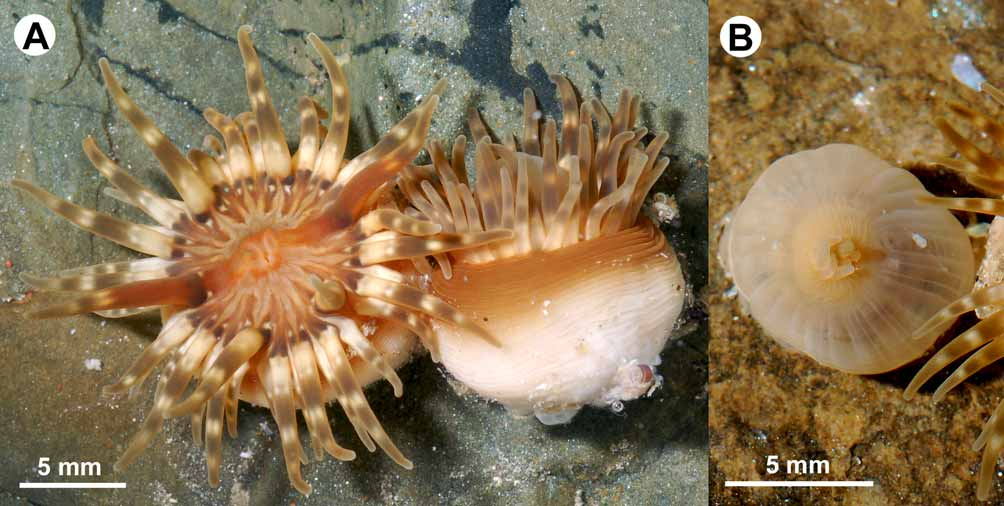
Type species: Isanthus capensis Carlgren, 1938 (Fig. 6) Definition of the genus Paraisanthus Sanamyan and Sanamyan, 1998: Isanthidae with well-developed pedal disc. Column smooth. Margin distinct. Sphincter mesogloeal, well developed. Radial muscles of oral disc and longitudinal muscles of tentacles ectodermal. Two siphonoglyphs, two pairs of directives. Six pairs of macrocnemes. More mesenteries distally than proximally, at least in adults. Cnidom: spirocysts, p-mastigophores, basitrichs, heterotrichs, holotrichs. Type species: Paraisanthus tamarae Sanamyan and Sanamyan, 1998
Häussermann, Verena, Försterra, Günter (2008): A new species of sea anemone from the Chilean fjord region, Paraisanthus fabiani (Actiniaria: Isanthidae), with a discussion of the family Isanthidae Carlgren, 1938. Zootaxa 1897: 27-42, DOI: 10.5281/zenodo.184465
Export occurrence data
Darwin Core Archive (ZIP)
CLASSIFICATION
Taxonomic Classification Tree

MULTIMEDIA
Media Files(1)
FIGURE 6. Live specimens of Isanthus capensis: A, view of oral disc and column; note inner six tentacles slightly closer to the mouth with directive axes distinctly coloured; B, contracted specimen; specimens collected by Charles Griffiths from intertidal area, in sand between rocks, Table Bay, South Africa. Photos courtesy of Charles Griffiths.
Imageimage/png© Häussermann, Verena;Försterra, GünterHäussermann, Verena;Försterra, Günter
IMAGES