AnimaliaNot EvaluatedacceptedspeciesAccepted
Paraisanthus fabiani

Paraisanthus fabiani

GBIF:119378799

ABOUT

Descriptions(3)

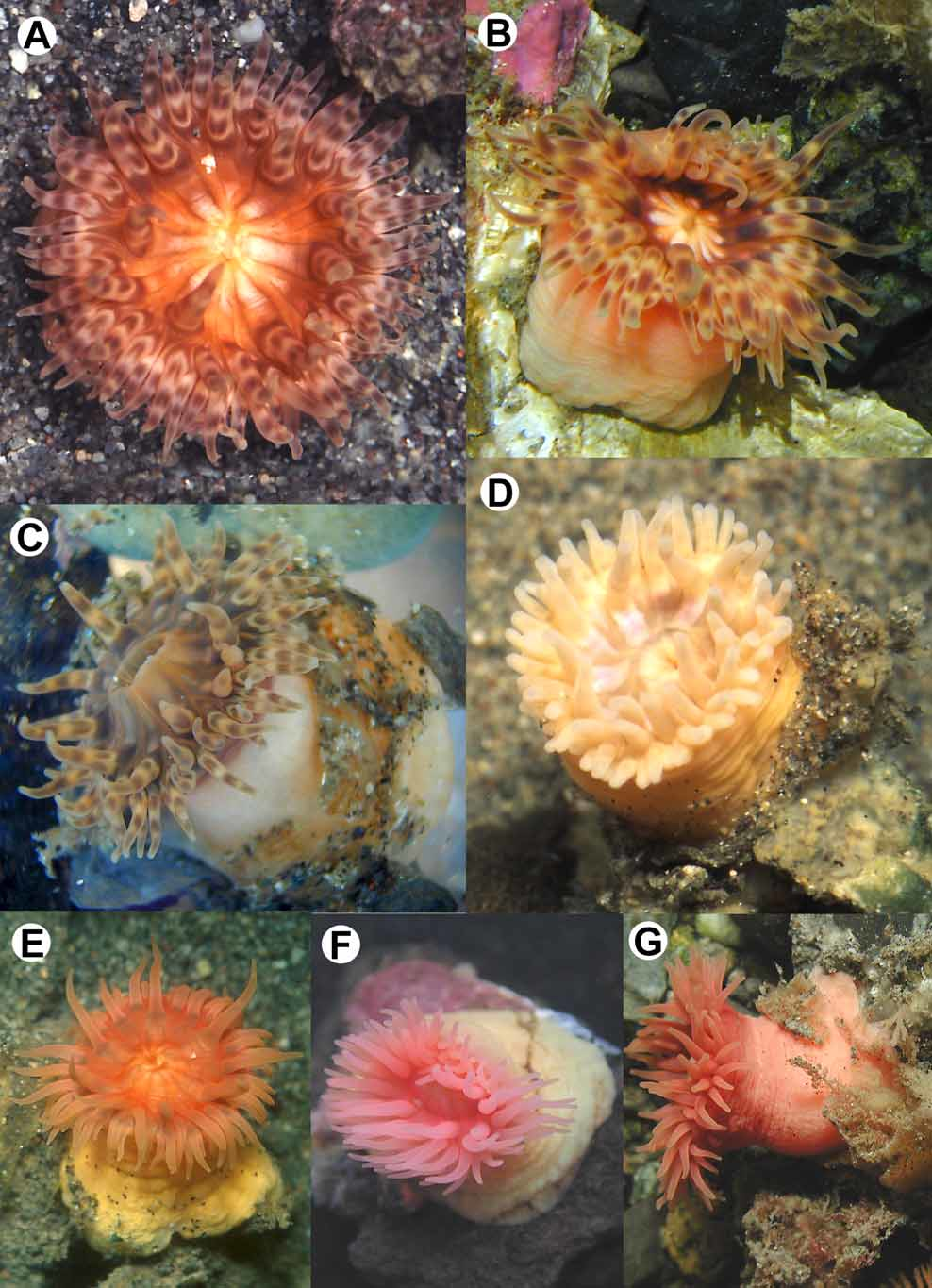
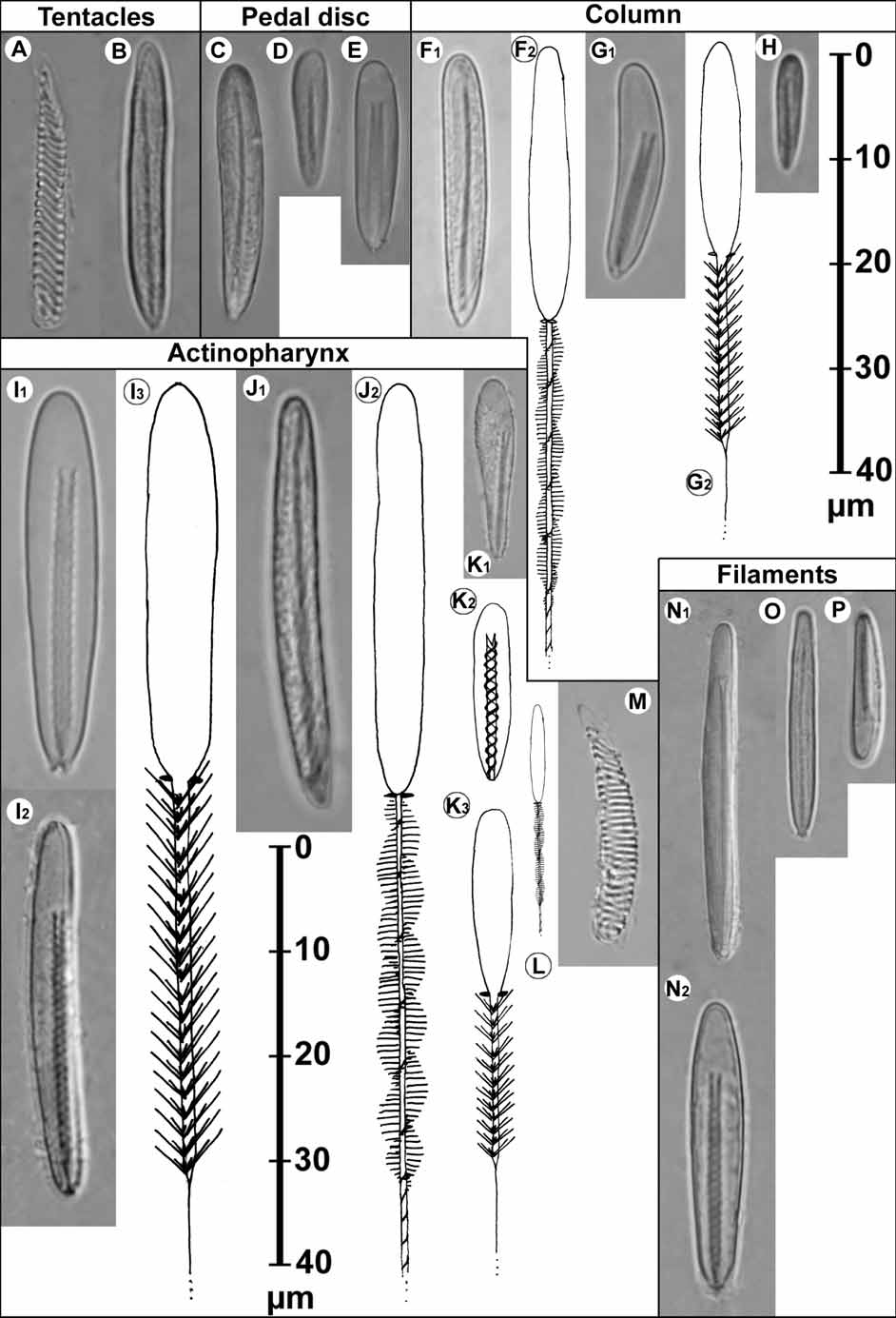
Colour (Figs. 3 A – G). Oral disc red, orange, yellowish, pale rose, pink, light brown or ochre; uniformly coloured or with (often 12) reddish-brown radial lines visible on endocoels, or with 12 - lobed, petal-like white and yellow pattern (Fig. 2 B). Mesenterial insertions visible through oral disc. Actinopharynx yellow to light brown. Tentacles slightly transparent, rose to red or pink, yellowish, light brown or ochre; uniformly coloured (Figs. 2 D – G) or with 3 – 6 brown transverse bands at inner and outer or only inner side (Figs. 2 A – C). Column rose-coloured, reddish, yellowish, orange to ochre, or light brown; uniformly coloured or distalmost 1 / 4 – 1 / 5 more intensely coloured (often brown; Fig. 2 D) with a short transition to paler proximal portion of column; colour generally continuously fading towards pedal disc. Pedal disc coloured as column, not transparent. Preserved specimens whitish to brown. Oral disc and tentacles. Between 66 and 110 conical tentacles, hexamerously arranged in 5 – 6 cycles, last cycle generally not complete, length about half diameter of oral disc, inner longer than outer, situated on outer third to half of oral disc, innermost 12 (two cycles) in many animals slightly more central (Fig. 2 A), more intensely coloured and directed upward. Oral disc circular, mesenterial insertions in many specimens visible as darker lines (Figs. 2 A, C, D, E). Mouth opening central, slightly oval, slightly elevated in many specimens. Column. In situ higher than broad, after sampling broader than high, proximally broader than distally; smooth, often with loose ring of mucus and dirt in proximal part (Figs. 2 C, D, G). Small fosse. Column can completely cover tentacles when retracted. Pedal disc. More or less circular, generally wider than column and oral disc, limbus slightly lobed. Internal anatomy. In most parts of column, 24 mesenteries hexamerously arranged in four cycles, first cycle (six pairs) including directives fertile macrocnemes with strong circumscript retractors, second and third cycle (six plus 12 pairs) sterile microcnemes without retractors, fourth cycle incomplete, pairs of extremely small microcnemes only just below margin, unequal proximal extension of mesenteries of a pair. Mesenteries of second cycle wider than those of third cycle. More tentacles than mesenteries in mid-column and at base. Actinopharynx deeply furrowed, with two distinct siphonoglyphs, about half length of column; two pairs of FIGURE 3. Histological sections of Paraisanthus fabiani: A, macrocneme with retractor and parietobasilar muscle; B, transverse section of the upper column; C, transverse section of the lower column; D, longitudinal section of the upper column with sphincter; E, cross section through tentacle; F, longitudinal section of the pedal disc with basilar muscles. 1 st to 3 rd cycle of mesenteries I, II, III, basilar muscles bm, directives d, ectoderm ec, endoderm en, ectodermal longitudinal muscles of tentacle et, mesogloea m, macrocnemes ma, filaments mf, microcnemes mi, parietobasilar muscles pb, actinopharynx ph, retractor muscles r, sperms s, siphonoglyph si, sphincter sp. TABLE 2. Size and distribution of cnidae of Paraisanthus fabiani n. sp. (ZSM 20070247 / 1, letters refer to Fig. 4), in each tissue in order of abundance: s: sporadic, f: few, c: common and v: very common. “ m l “ and “ m w ” are the means, “ d l ” and “ d w ” are the standard deviations (all in µm), “ t ” is the apparent total number of turns of spine-rows on the shaft, “ # ” is the number of capsules measured, “ p ” is the proportion of specimens having this cnida type. Exceptional sizes in parentheses. Spirocysts (A, M), basitrichs (B, C, D, F, H, J, L, O), microbasic p-mastigophores (E, N, P), microbasic pmastigophores B 1 (G, I, K). directives. Oral and marginal stomata; marginal stomata circular, in the centre of stronger mesenteries (stomata not always visible in smaller specimens). Sexes separate, no signs of asexual reproduction. Five of the sectioned specimens with reproductive tissue, collected in February and March, four male (ZSM 20070246, ZSM 20070247 / 1, ZSM 20070249, USNM 1101612), one female (ZSM 20051690). No zooxanthellae. Sphincter mesogloeal, strong, nearly entire width of mesogloea (Fig. 3 D), restricted to uppermost part (~ 1 / 8 – 1 / 10) of column. Macrocneme retractors strong, strongly restricted to circumscribed (Figs. 3 A – C). Parietobasilar muscles distinct on perfect mesenteries (Figs. 3 A – C); basilar muscles distinct (Fig. 3 F). Longitudinal muscles of tentacles (Fig. 3 E) and radial muscles of oral disc ectodermal. Endodermal circular muscles of column well marked, weaker at sphincter level (Fig. 3 D). Cnidom. Spirocysts, basitrichs, microbasic p-mastigophores B (Fig. 4). Cnidae of eight specimens were examined.
Häussermann, Verena, Försterra, Günter (2008): A new species of sea anemone from the Chilean fjord region, Paraisanthus fabiani (Actiniaria: Isanthidae), with a discussion of the family Isanthidae Carlgren, 1938. Zootaxa 1897: 27-42, DOI: 10.5281/zenodo.184465

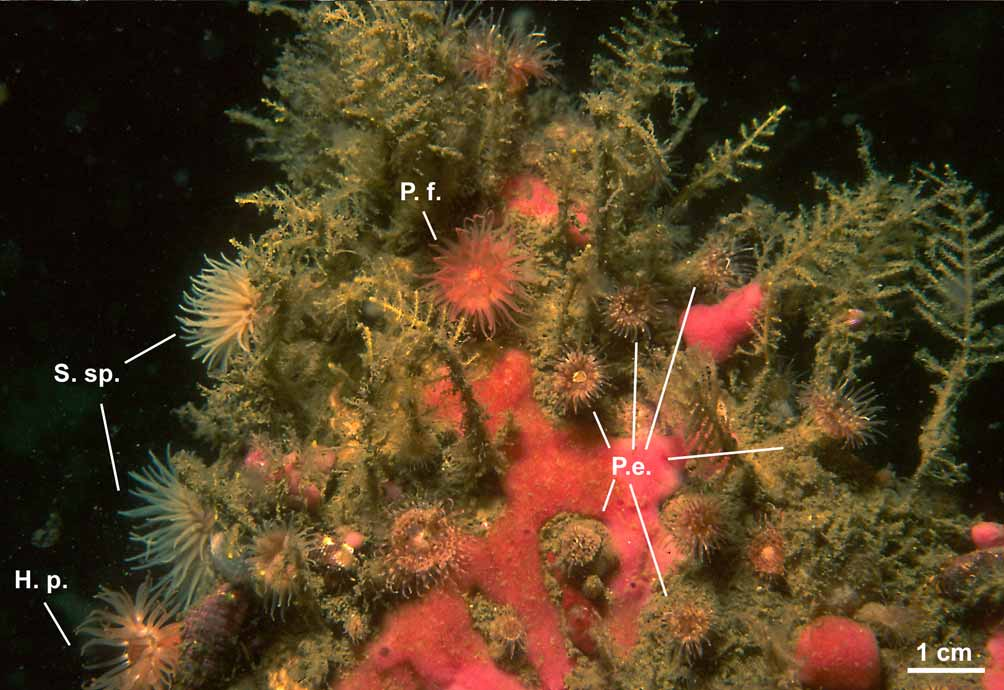
Natural history and field notes. Not abundant at any site, but if present, generally several clustered specimens found (Fig. 5). Pedal disc and column generally hidden in holes or crevices of rocky substrate, between stones or between polychaete tubes into which entire animal retracts when disturbed (Fig. 5). Tentacles of neighbouring specimens regularly in contact with each other. Specimens observed in same habitat with the sea anemones Halcurias pilatus McMurrich, 1893, Phellia exlex McMurrich, 1904, Sagartiidae sp. (Fig. 5 C), and a corallimorpharian (Corynactis sp.); in Central Patagonian Zone also with the sea anemone Metridium senile lobatum Carlgren, 1899 (Riemann-Zürneck 1975). Difficult to collect without injury due to cryptic microhabitats; ideally collected with hammer and chisel together with substrate. Specimens relatively sensitive; reattach only slowly to hard substrate in aquarium even if not injured. In the aquarium, specimens soon hide column between or under stones or in holes in substrate (such as dead barnacles). Addition of MgCl 2 to aquarium water (for relaxation) provoked spawning in one specimen collected in February 1998 at Quellón.
Häussermann, Verena, Försterra, Günter (2008): A new species of sea anemone from the Chilean fjord region, Paraisanthus fabiani (Actiniaria: Isanthidae), with a discussion of the family Isanthidae Carlgren, 1938. Zootaxa 1897: 27-42, DOI: 10.5281/zenodo.184465
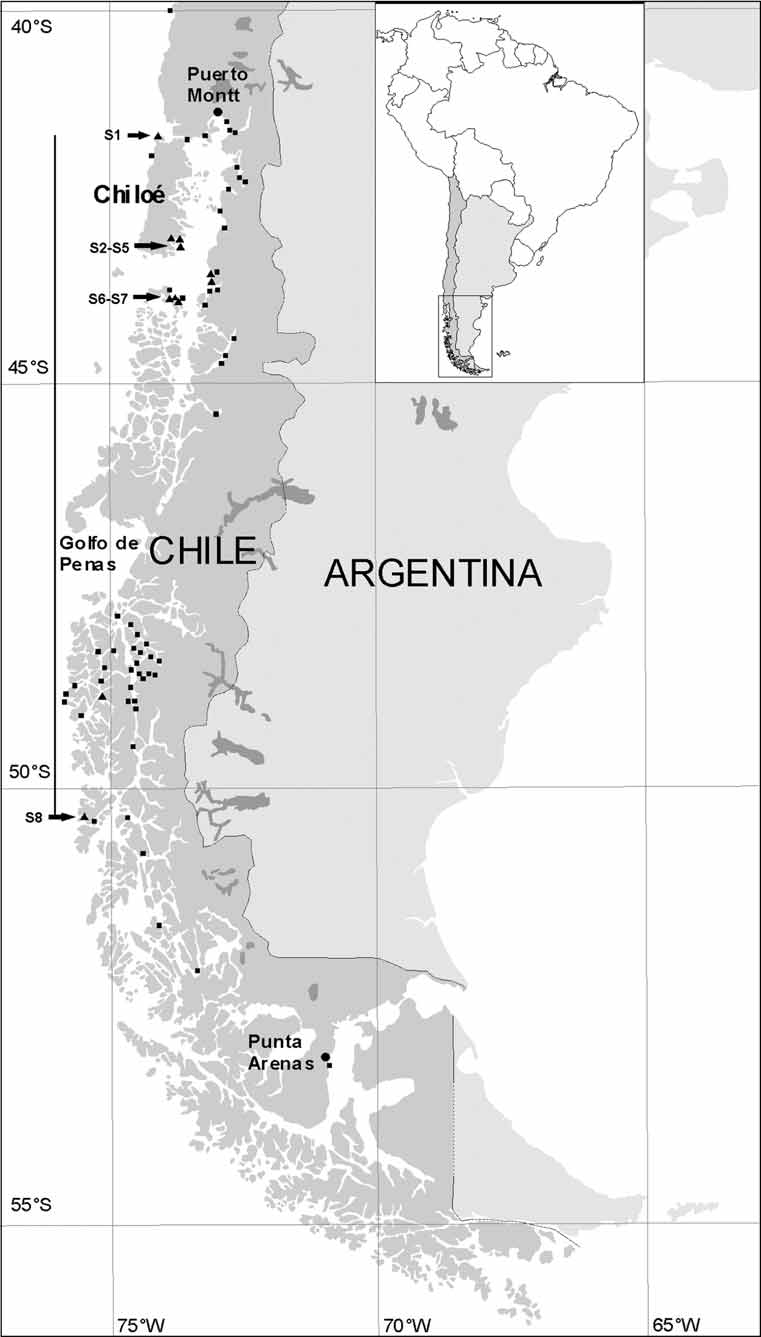
Etymology. The species is dedicated to our son Fabian who was born on May 16 th 2007 some days after the submission of this paper. Habitat, distribution, and zoogeography. Shallow subtidal to at least 30 m in less protected channels and at exposed islands of Chilean fjord region between Faro Corona, Chiloé Island (41 ° 47 ’ 02.0 ’’ S; 73 ° 52 ’ 58.8 ’’ W) and Archipelago Madre de Dios (50 ° 20 ’ 23.1 " S; 75 ° 22 ’ 39.2 " W) (Fig. 1). Not present along exposed coast north of fjord region between Faro Corona, North Chiloé Island, and Arica, North Chile (41 ° 47 ’ S to about 15 ° S), or in southern third of fjord region between Archipelago Madre de Dios and Straits of Magellan (50 ° 20 ’ S to about 53 ° S) (Fig. 1); neither present in protected fjords and channels with superficial fresh water layer. Thus, it is present in both the Northern and the Central Patagonian Zone (see Pickard 1971; Häussermann 2006), which are separated by Peninsula Taitao and Golfo de Penas (Fig. 1), hypothesized by Lancellotti and Vasquez (2000) and Häussermann and Försterra (2005) to be zoogeographic barriers, but not in the Southern Patagonian Zone south of the Straits of Magellan.
Häussermann, Verena, Försterra, Günter (2008): A new species of sea anemone from the Chilean fjord region, Paraisanthus fabiani (Actiniaria: Isanthidae), with a discussion of the family Isanthidae Carlgren, 1938. Zootaxa 1897: 27-42, DOI: 10.5281/zenodo.184465

Export occurrence data

Darwin Core Archive (ZIP)

CLASSIFICATION

Taxonomic Classification Tree

MULTIMEDIA

Media Files(4)

FIGURE 1. Type locality and distribution of Paraisanthus fabiani in shallow water of the Chilean fjord region. Black line: latitudinal extent of geographic distribution. Triangles: study sites S 1 - S 8 where P. fabiani was observed. Squares: study sites where P. fabiani was not observed.

Imageimage/png© Häussermann, Verena;Försterra, GünterHäussermann, Verena;Försterra, Günter

FIGURE 2. Colour varieties of Paraisanthus fabiani; all photos taken in aquaria. Oral disc diameter 7 – 12 mm, pedal disc diameter 7 – 16 mm, specimens 13 – 20 mm long. Note the ring of mucus and dirt around the column (Fig. 2 C, D, G).

Imageimage/png© Häussermann, Verena;Försterra, GünterHäussermann, Verena;Försterra, Günter

FIGURE 4. Cnidae of Paraisanthus fabiani. Letters A-P correspond to cnidae listed in Table 2.

Imageimage/png© Häussermann, Verena;Försterra, GünterHäussermann, Verena;Försterra, Günter

FIGURE 5. Specimens of Paraisanthus fabiani and some other sea anemone species with which this species is regularly associated in situ. H. p.: Halcurias pilatus, P. e.: Phellia exlex, P. f.: Paraisanthus fabiani, S. sp.: Sagartiidae sp., here with an unidentified pink chondrillid sponge, Isla Cailín, 18 m.

Imageimage/png© Häussermann, Verena;Försterra, GünterHäussermann, Verena;Försterra, Günter

IMAGES

Gallery(4)

See Gallery

Occurrences with images

Source Information

A new species of sea anemone from the Chilean fjord region, Paraisanthus fabiani (Actiniaria: Isanthidae), with a discussion of the family Isanthidae Carlgren, 1938

checklist

This dataset contains the digitized treatments in Plazi based on the original journal article Häussermann, Verena, Försterra, Günter (2008): A new species of sea anemone from the Chilean fjord region, Paraisanthus fabiani (Actiniaria: Isanthidae), with a discussion of the family Isanthidae Carlgren, 1938. Zootaxa 1897: 27-42, DOI: 10.5281/zenodo.184465

Abstract

A new species of Paraisanthus, P. fabiani, is described from Chile, the eighth species of this small family of mesomyarian anemones. Specimens of this species are characterized by six pairs of macrocnemes and 18 pairs of microcnemes in the middle and lower column and a fourth incomplete cycle of extremely small mesenteries in the uppermost column, between 66 and 110 tentacles, and a smooth column without holotrichs or heterotrichs. Specimens occur from the shallow subtidal to at least 30 m around exposed islands and in less protected channels of the fjord region between Chiloé Island (41°7’04.8’’S; 73°53’02.4’’W) and the Madre de Dios Archipelago (50°20’23.1’’S; 75°22’39.2’’W). They often protrude from small rocky crevices or between polychaete tubes, so that in situ only the oral disc is visible. The description is based on examination of 27 specimens collected between 1997 and 2007 and on documentation of live specimens in both their natural environment and aquaria. Paraisanthus fabiani was found at only 15 of over 150 study sites along the Chilean coast. If it was present at a site, generally more than 10 specimens were found. For the first time, in situ photographs are provided for a member of the family Isanthidae. In addition, live photographs are provided for the type species of the family Isanthidae, Isanthus capensis from South Africa. Family Isanthidae constitutes five genera, which are distinguished mainly by number of macrocnemes, texture and division of the column, and direction of growth of mesenteries.

Key words: Coelenterata, Cnidaria, Anthozoa, benthos, shallow water

Häussermann V, Försterra G, plazi (2008). A new species of sea anemone from the Chilean fjord region, Paraisanthus fabiani (Actiniaria: Isanthidae), with a discussion of the family Isanthidae Carlgren, 1938. Plazi.org taxonomic treatments database. Checklist dataset https://doi.org/10.5281/zenodo.184465 accessed via GBIF.org on 2026-06-17.

CC0Published 12/31/2008View dataset
GBIF Usage Key
119378799
Dataset Key
0cdaaabe-dc8d-47de-9e6b-f869d336045f
Origin
source
Backbone Key
5841845
Taxon ID
03829541FFB8FFF029A2FCE77550FB4D.taxon
Last Crawled
6/11/2026
Last Interpreted
6/11/2026