AnimaliaNot EvaluatedacceptedspeciesAccepted
Haemopis lateromaculata

Haemopis lateromaculata

Mathers, 1963

GBIF:119380932

0year

ABOUT

Descriptions(2)

General distribution: Nearctic (Figures 2 D, 3 C, Table 2).
Madill, Jacqueline, Hovingh, Peter (2007): Freshwater leech (Annelida: Hirudinida) distribution in the Canadian Province of Newfoundland and Labrador and adjacent regions: check-list, new records, new pigmentation forms, and Pleistocene refugia. Zootaxa 1657: 1-21, DOI: 10.5281/zenodo.179881
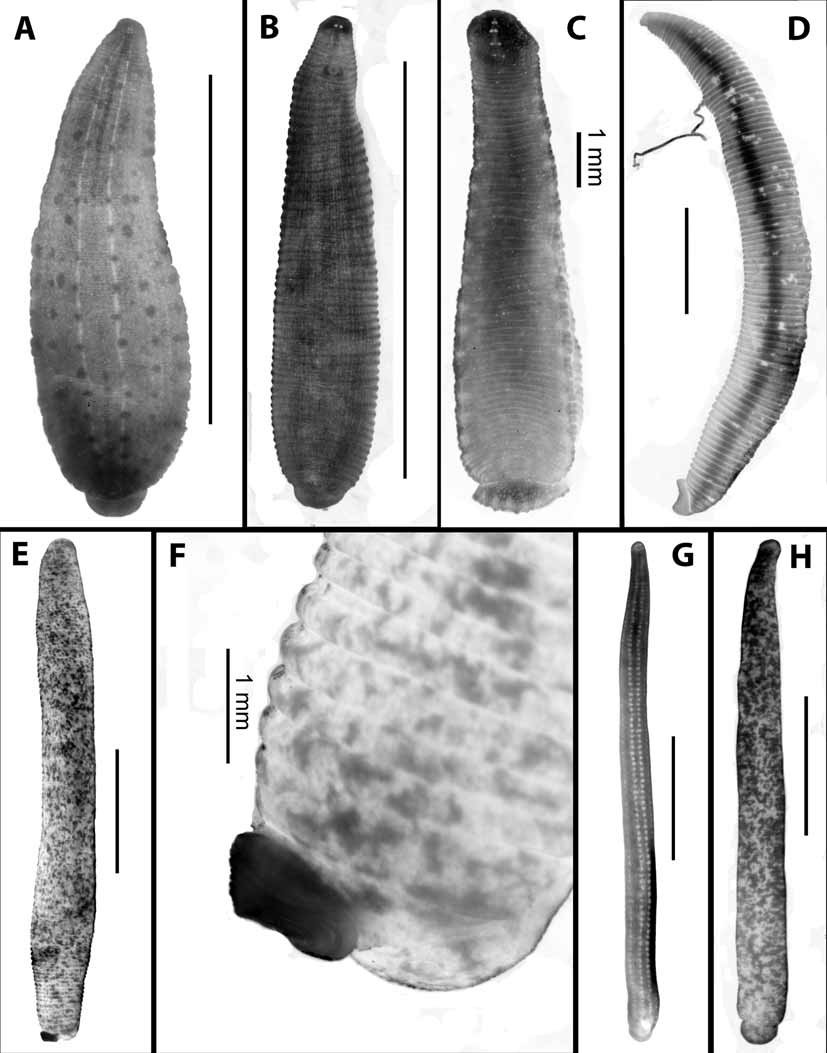
Newfoundland: Museum specimens (identified by JM): CMNA 1982 – 0654: Patrick Cove (Placentia Bay); CMNA 1985 – 0378: Point Lance at St. Mary’s Bay. Both records are on the Avalon Peninsula. Previously unreported for Canada, these records are the first outside of Iowa and Minnesota (Mathers 1963). Notes on the species. The unusual conditions under which Haemopis lateromaculata was found follows: On November 15, 1981, Cecelia McGrath in Patrick Cove noticed large, black worms heading across her lawn. R. Morris, Agriculture Canada, described the animals as “ 5 – 7 cm long, olive dorsally with small, black irregular flecks, … ventrally black, sucker large, and light, yellow, longitudinal stripes. ” On November 8, 1985, D. G. Walsch found another H. lateromaculata in a freshwater well in Point Lance. All species of Haemopidae are amphibious, i. e., they can swim and crawl in aquatic environments, and when conditions are right, they can travel overland. The skin of leeches is moist and absorbent, and needs wet conditions such as dew-drenched surroundings, or rainfall to avoid desiccation. In both records, H. lateromaculata was collected in the late fall. These Haemopis most likely were looking for suitable winter quarters just as Moore (1923) described for another bloodsucker species, Macrobdella decora. Ms. McGrath claimed that these animals had never been near her property previously and must have traveled a fair distance overland because their original freshwater habitat was nowhere in sight. Dorsally, Haemopis lateromaculata resembles the most common species of horse-leech (Haemopis marmorata (Say )) since its dorsum is dark and mottled. However, the two lateral yellow stripes, and the uniformly plain ventrum are diagnostic of living H. lateromaculata. Preserved specimens can also be identified by dissection and microscope examination. The male and female gonopores are 5 annuli apart, and in the furrows between the annuli. According to Mathers (1963) and Hovingh (pers. observation 2006), H. lateromaculata can be distinguished from H. marmorata by comparing the relative size, shape, and orientation of internal organs. For example, H. lateromaculata has a U-shaped male penis sheath (Mathers 1963) and H. marmorata has a longer J-shaped penis sheath (Klemm 1985).
Madill, Jacqueline, Hovingh, Peter (2007): Freshwater leech (Annelida: Hirudinida) distribution in the Canadian Province of Newfoundland and Labrador and adjacent regions: check-list, new records, new pigmentation forms, and Pleistocene refugia. Zootaxa 1657: 1-21, DOI: 10.5281/zenodo.179881

Export occurrence data

Darwin Core Archive (ZIP)

CLASSIFICATION

Taxonomic Classification Tree

MULTIMEDIA

Media Files(1)

FIGURE 2. Photographs of selected Newfoundland and Labrador leeches. D was collected by Cecelia McGrath in 1982. A, Dorsal view of Glossiphonia elegans (Verrill), site 17; B, Dorsal view of Helobdella modesta (Verrill), site 12; C, Dorsal view of Theromyzon sp., site 6; D, Lateral view of Haemopis lateromaculata Mathers, showing the plain ventrum separated from the speckled dorsum by a lighter pattern on the side, CMNA 1982 – 0654; E, Dorsal view of Haemopis marmorata (Say), site 12; F, Closeup of anal protrusion of Haemopis marmorata, Site 12; G, Erpobdella punctata (Leidy) (normal pigmentation), site 7; H, Erpobdella obscura (Verrill) [normal pigmentation], site 21. Scale bars are in cm unless otherwise indicated.

Imageimage/png© Madill, Jacqueline;Hovingh, PeterMadill, Jacqueline;Hovingh, Peter

IMAGES

Gallery(1)

See Gallery

Occurrences with images

Source Information

Freshwater leech (Annelida: Hirudinida) distribution in the Canadian Province of Newfoundland and Labrador and adjacent regions: check-list, new records, new pigmentation forms, and Pleistocene refugia

checklist

This dataset contains the digitized treatments in Plazi based on the original journal article Madill, Jacqueline, Hovingh, Peter (2007): Freshwater leech (Annelida: Hirudinida) distribution in the Canadian Province of Newfoundland and Labrador and adjacent regions: check-list, new records, new pigmentation forms, and Pleistocene refugia. Zootaxa 1657: 1-21, DOI: 10.5281/zenodo.179881

Abstract

The freshwater leeches (Hirudinida) in the Province of Newfoundland and Labrador were investigated by examining the literature, the Canadian Museum of Nature and the United States National Museum of Natural History records, and a leech survey. New pigmentation forms are described for Erpobdella punctata (Leidy) and Erpobdella obscura (Verrill). This is the first published record for Haemopis lateromaculata Mathers in Canada. Four species (Glossiphonia elegans (Verrill), Helobdella modesta (Verrill), Erpobdella punctata, and Erpobdella obscura) were found in both Labrador and Newfoundland with Erpobdella obscura common in Labrador and the other three species common in Newfoundland. Seven other species of leeches were less abundant in Newfoundland with 6 of these species very restricted in distribution. The abundance of leech species in Newfoundland and the paucity of leech species in Labrador suggested that the island species were present in a Pleistocene refugium associated with Newfoundland or the Grand Banks. Post-Pleistocene barriers to leech mobility are examined, and possible timing of colonization events is proposed in this model.

Key words: Annelida, Leeches, Hirudinida, Glossiphoniidae, Haemopidae, Hirudinidae, Erpobdellidae, Newfoundland, Labrador, pigmentation patterns, Pleistocene refugia, new record

Madill J, Hovingh P, plazi (2007). Freshwater leech (Annelida: Hirudinida) distribution in the Canadian Province of Newfoundland and Labrador and adjacent regions: check-list, new records, new pigmentation forms, and Pleistocene refugia. Plazi.org taxonomic treatments database. Checklist dataset https://doi.org/10.5281/zenodo.179881 accessed via GBIF.org on 2026-06-17.

CC0Published 12/31/2007View dataset
GBIF Usage Key
119380932
Dataset Key
4450f512-2b32-4d43-8291-95a78b92b0b4
Origin
source
Backbone Key
2308811
Taxon ID
03C78785FF95CA4D3598FC5BFD5B86A7.taxon
Last Crawled
6/11/2026
Last Interpreted
6/11/2026
