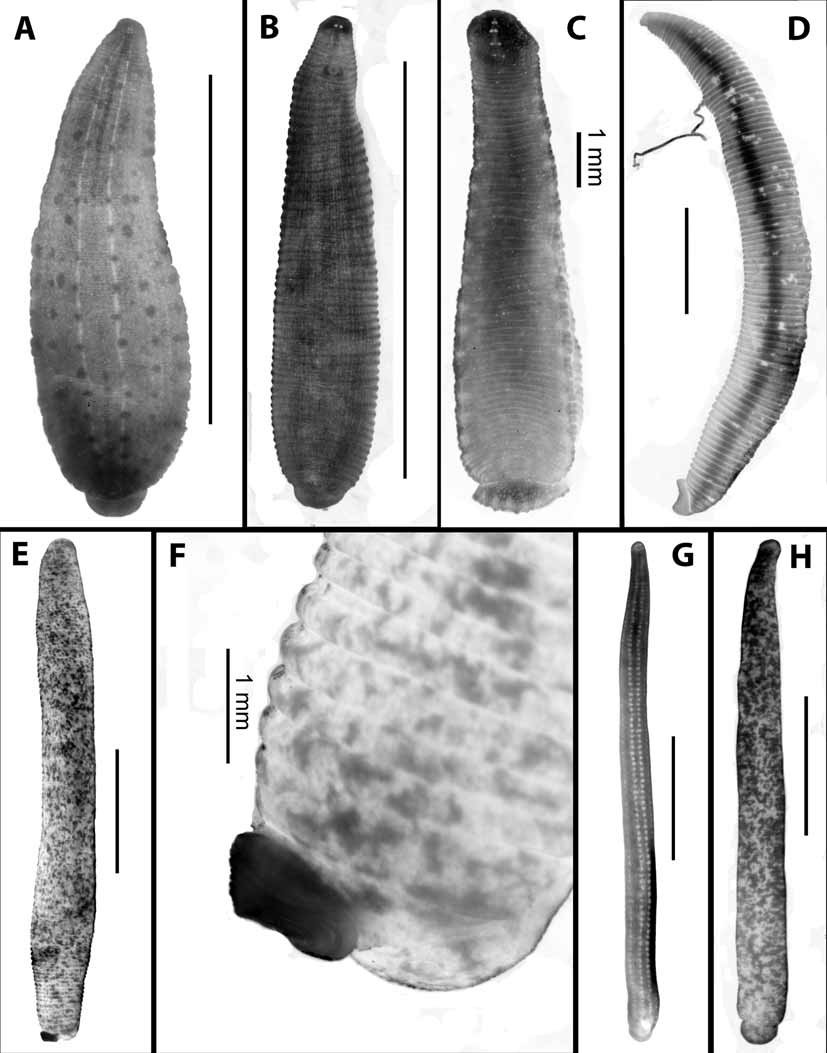
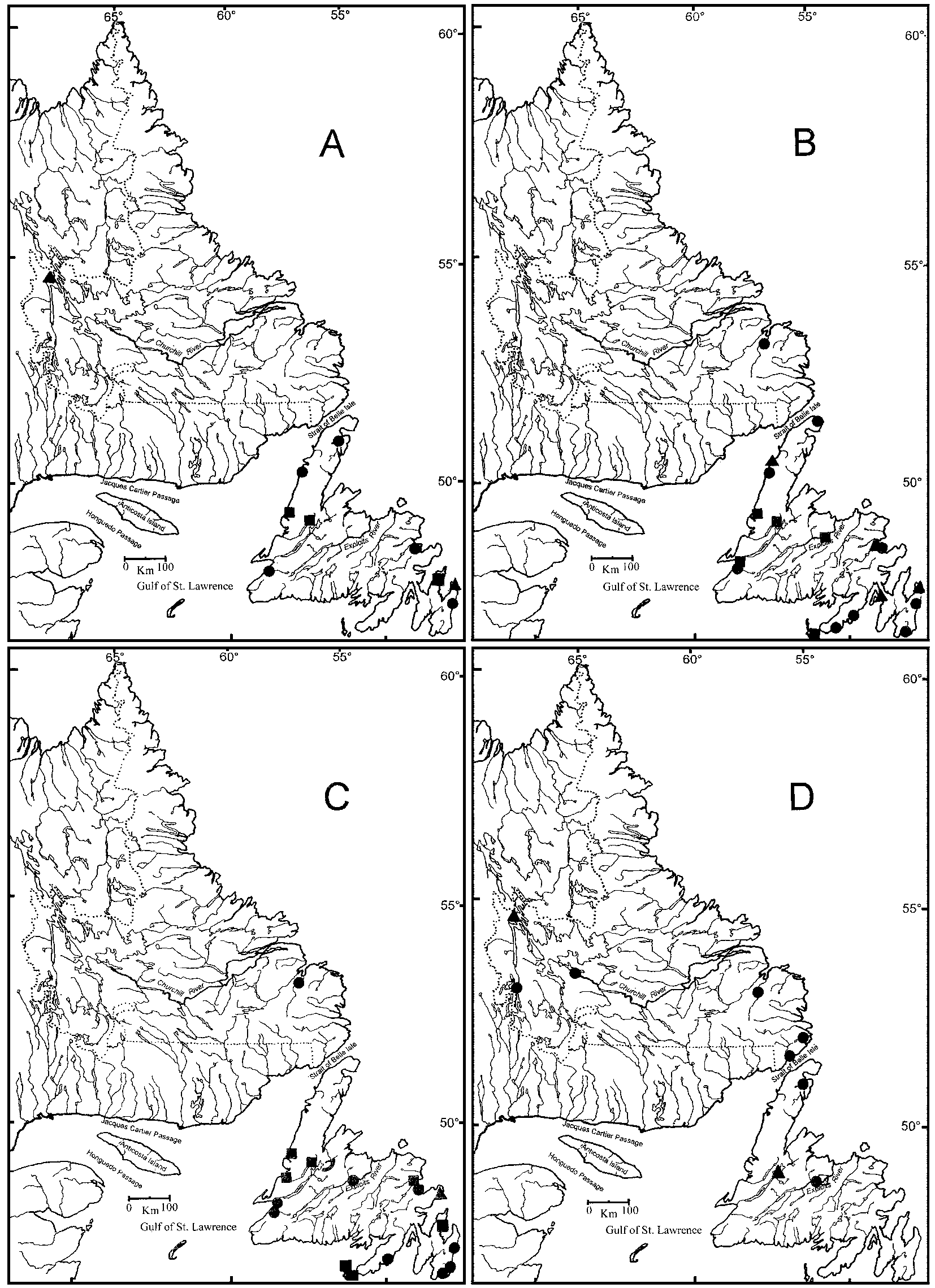
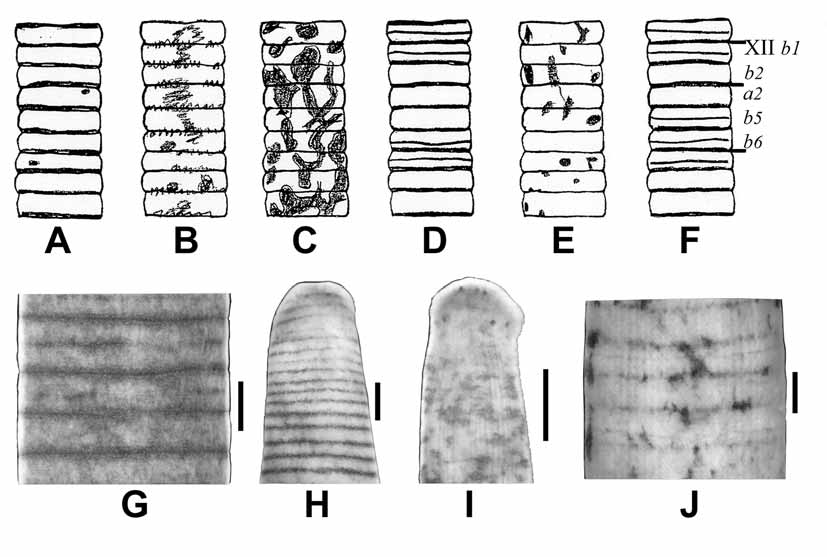
Common name: Bait leech General distribution: Nearctic (Figures 2 H, 4 D, 6, 7, Tables 1, 2). Newfoundland: Survey: Site 7 (CMNA 2006 – 0023), Site 18 (CMNA 2006 – 0022); Museum specimen: CMNA 1900 – 5994; Literature: Pawlowski (1948) at Grand Falls. Labrador: Survey: Site 20 (CMNA 2006 – 0021), Site 21 (CMNA 2006 – 0020), Site 22 (CMNA 2006 – 0019), Site 23 (CMNA 2006 – 0018), Site 28 (CMNA 2006 – 0017), and Site 29 (CMNA 2006 – 0016); Museum specimen: CMNA 1988 – 0127 (Figure 4 D). Notes on the species. Verrill’s (1872) description of Erpobdella obscura strongly resembles some of the Newfoundland and Labrador specimens but there is also a previously unpublished color variation. Klemm (1985) describes the normal appearance of Erpobdella obscura (Figures 6 F, 7 B, E, I, J) as “ color variable, dorsum greenish-brown, covered with sparse scattered black or light colored blotches, interlacing or irregular spots, or plain (uniform), no striping … ” In Newfoundland and Labrador, we found Erpobdella obscura, with a pattern which we call ‘ ringed’ because of horizontal dark pigment in the furrows between the annuli (Figure 7 A, D, F – H). These are remarkably similar to other ‘ ringed’ specimens collected by J. Metcalfe-Smith in the Grand River, Ontario (north of Kitchener) at Winterbourne, Glen Morris, Upper Bellwood, and Elora Gorge (Figure 6, Table 3). Location Latitude Longitude Catalogue Number Catalogue Number Normal ‘ Ringed’ The anatomy of ‘ ringed’ forms was the same as normal specimens (Figure 6). Verrill (1874) had described the large mouth (Figure 6 A), the presence of 4 pairs of eyes (2 labial and 2 buccal) (Figure 6 B), the separation of the gonopores by 2 annuli (Figure 6 D), the partial subdivision of some annuli (Figures 6 B, D, E, 7 G, J), the large, raised anal orifice (Figure 6 E), and the spiraling of the ejaculatory ducts of Erpobdella obscura exiting the atrial cornua (Figure 6 C, G). The anatomy of both varieties was very similar in these respects. According to Sawyer (1972) the most distinguishable feature of the species is subdivision of the annuli. In Ontario, The normal variety co-existed in the same locations as ‘ ringed’ specimens (Table 3). Intermediate forms were also noted. High magnification reveals that normal specimens have anastomosing patches of dark color dispersed all over the dermis, and the furrows of the annuli are colored (Figure 7 I, J). The patterns were different in ‘ ringed’ specimens, with pigment restricted to the furrows of the annuli, as well as between subdivisions of the annuli (Figure 7 G, H). Colors of live ‘ ringed’ specimens in Ontario were recorded using the Naturalist’s Colour Guide (Smithe 1975). Background color varies between clay (color 26); smoke gray (color 45); buff (color 124); and tawny olive (color 223 D). The rings were either black, plumbeous (color 78) or glaucous (color 79) respectively. The stomach contents of the ‘ ringed’ specimens were analyzed by J. Metcalfe-Smith in May, and July, 1983, and included mostly insect larvae: chironomids, simulids, diptereans, ephemeropterans, plus 1 ostracod. In addition to the 4 specimens in Newfoundland and 14 specimens in Labrador, another 150 specimens in Ontario were examined (Figures 6, 7). Mean length of preserved ‘ ringed’ specimens were consistently longer, as follows: Ontario ‘ ringed’ 3.61 cm, normal 2.81 cm; Newfoundland ‘ ringed’ 7.41 cm, normal 3.89 cm; Labrador ‘ ringed’ 6.68 cm, normal 3.75 cm, and intermediate forms 5.01 cm. In Newfoundland and Labrador, some Erpobdella obscura specimens had normal pigmentation patterns as figured by Klemm (1985: Figure 7.103) such as those found in sites 18 and 21 (Figure 7 C). Specimens from sites 7 and 29 were unique ‘ ringed’ forms (dark interannuli) (Figure 7 D, F). Secondary intra-annular segmentation occurred in two to four adjacent annuli per segment which were also very dark, and extended partly into the ventrum. Both ‘ ringed’ and normal specimens cohabited at site 28. Intermediate forms occurred at sites 22, 23, and 28 with both spots and rings (Figure 7 A, B). The ‘ ringed’ form has not been found in the Great Basin (Hovingh 2004) or noted by Klemm (1985). Survey Results. Pawlowski (1948) noted that of the 58 stations surveyed in Newfoundland, leeches were found in only 14 sites (24 %). In the 2004 survey which was only concerned with leech distribution, 19 sites in Newfoundland and 10 sites in Labrador were surveyed. Leeches were found at 13 sites (68 %) in Newfoundland Island and in 7 sites (70 %) in Labrador. The success of the 2004 survey is attributed to selecting sites with abundant rocks and logs and vegetative growth which looked “ good ” for leech collecting. Five species were common to both surveys, with Alboglossiphonia and Theromyzon found in one of the surveys. No Piscicolidae (fish leeches) were caught in any of the surveys, but there is a chance that piscicolid leeches may exist in the study area since the preferred method of collection for this group is to look for these leeches on their host fishes. A casual mention of Macrobdella decora in Labrador (Moore 1923) is not substantiated in any literature records, nor was this species found in any surveys. Also, the single report of Hirudo (Blanchard 1896) from Newfoundland Island suggests that this species does not reproduce in Newfoundland. Newfoundland and Labrador leeches include the widely distributed and common leeches Glossiphonia elegans, Helobdella modesta, Erpobdella punctata, and Erpobdella obscura. These were the only leeches found in Labrador. Two widespread taxa in North America were found at one location each: Theromyzon, a waterfowl leech, and Erpobdella parva, suggesting a confinement of movement on Newfoundland. Haemopis marmorata was found at 3 sites by surveys and H. grandis and H. lateromaculata were noted only in museum collections. Future Haemopis surveys with baited traps would assist in determining the ranges of these 3 species. Alboglossiphonia heteroclita and Erpobdella fervida were only noted in literature from 1 site each. FIGURE 8. Postglacial events that explain the presence of leeches in Newfoundland and Labrador, adapted from Dyke (2004) and Occhietti et al. (2004). Panel A. Barrier events: the Laurentian Channel and the northward Esquiman Channel (unlabeled) with its 200 meter depth contour; # 1, the Strait of Belle Isle with glacial and marine blockage and possible land bridge; # 2, the Jacques Cartier Passage with glacial and marine blockage and possible land bridge; # 3, North Shore of the Gulf of St. Lawrence ice sheet blockage; # 4, St. Lawrence River glacial blockage. Late Glacial Maximum refugia include A, St Pierre Bank (38 – 60 m below sea level); B, Green Bank (60 – 80 m below sea level); and C, Grand Bank (70 – 75 m below sea level) off the southern coast of Newfoundland. The shaded areas are land when the minimum sea level was at - 120 m during the Last Glacial Maximum and the heavy solid line is the 200 m contour of the present sea level. The ice sheets are denoted by a heavy dotted line at 18,000 years BP (not labeled) associated in part with the - 200 m contour; the thick dashed line on the Grand Banks is the limit of a 14,000 years BP glacial lobe (unlabeled); the dashed line at 11,000 years BP, and the thin dashed line at years 9000 years BP (both labeled). Light dots denote provincial boundaries. Panel B. Scheme showing hypothetical movement of leeches through time in Newfoundland and Labrador regions: (1) Colonization of Newfoundland from Labrador before 70,000 years BP; (2) colonization of the Grand Banks from Newfoundland after 50,000 years BP; (3) colonization of Newfoundland from the Grand Banks 13,000 to 11,000 years BP; (4) the return colonization of Labrador and the North Shore 11,000 to 10,000 years BP; (5) and the colonization of Île d’Anticosti from the North shore and the colonization of Île de la Madeleine from Prince Edward Island (PE) after 10,000 years BP; and (6) the colonization of Sable Island from Nova Scotia.
Madill, Jacqueline, Hovingh, Peter (2007): Freshwater leech (Annelida: Hirudinida) distribution in the Canadian Province of Newfoundland and Labrador and adjacent regions: check-list, new records, new pigmentation forms, and Pleistocene refugia. Zootaxa 1657: 1-21, DOI: 10.5281/zenodo.179881