AnimaliaNot EvaluatedacceptedspeciesAccepted
Malo kingi

Malo kingi

GBIF:119381472

ABOUT

Descriptions(11)

Additional paratypes, lacking halo bands: MTQ G 60028 (= J 1446), Mackay-Bucasia, coll. E. H. Brown, 15 December 1964; gravid female, 25.89 mm BH, 23.10 mm DBW, 12.02 mm IRW. MTQ G 60029 (= J 1544, 1 of 8), Clump Point Jetty, Mission Beach, QLD, caught by JHB 2100 hours by night light, 19 January 1966; 25.32 mm BH, 19.59 mm DBW, 9.02 mm IRW; gonads immature. MTQ G 60030 (= J 1544, 1 of 8), same data as MTQ G 60029; immature, 18.97 mm BH, 17.13 mm DBW, 6.64 mm IRW. SAM H 1049, Shute Harbour, Whitsundays, QLD, at surface, 15 December 1999; gravid female, 27.02 mm BH, 23.34 mm DBW, 11.93 mm IRW. SAM H 1050, Port Douglas, Dickson Inlet, near marina, coll. by R. Hore, March 1997; male, 26.75 mm BH, 24.34 mm DBW, 12.19 mm IRW. SAM H 1062, Port Douglas, QLD, coll. by J. Seymour, 27 November 1997, 27.66 mm BH, 23.92 mm DBW, 10.64 mm IRW, 1.90 mm TBW.
Gershwin, Lisa-Ann (2007): Malo kingi: A new species of Irukandji jellyfish (Cnidaria: Cubozoa: Carybdeida), possibly lethal to humans, from Queensland, Australia. Zootaxa 1659: 55-68, DOI: 10.5281/zenodo.274030

CASE 1: Barnes (Kinsey 1988) gave a thorough account of his own testing with the smallest specimen he had of this species from Mission Beach; however, he developed only transient neuralgias, but not the “ fullblown Irukandji Syndrome ” that one might anticipate. However, other specimens from the same collection (and presumably more mature than the “ smallest specimen ”) are nonetheless immature, leaving open the possibility that they were not in their “ toxic stage ”, if such a division of toxic and non-toxic stages does exist. CASE 2: An earlier experimental sting that was attributed to Pseudo-Irukandji in Weipa produced only minor skin effects (Kinsey 1988). The largest specimen was used for the sting experiment, but no further indication of its size or maturity was given, and the specimen cannot be located. Thus, it is possible that the specimen was immature. Furthermore, it is also possible that the species used in this experiment was not actually M. kingi, as the nematocysts figured by Barnes (Kinsey 1988) are different. CASE 3: The death of Robert W. King (discussed above), from whom nematocysts matching those of this species were recovered (Huynh et al. 2003; Gershwin 2006 a), raises the likelihood that this species is harmful to humans. CASE 4: I was personally stung quite extensively across the palms of both hands by this species in June 2003 at Port Douglas, without systemic effects. However, both hands blistered badly and several layers of skin completely peeled about one week after the sting event. The specimen proved to be immature when examined, and was subsequently used for DNA analysis (Gershwin 2005 a). CASE 5: A 13 - year-old female was stung by a 5 mm piece of tentacle on the touchpad of the right index finger while collecting this species at The Strand in Townsville in Oct 2004. She later described feeling nauseous, severe pain and general malaise, but medical care was not sought. The specimen proved to be a spawning female, and now resides in my teaching collection. Furthermore, around the time the specimens from Mackay were captured, numerous symptoms atypical for Cairns cases of Irukandji Syndrome were noted, including rapid syndrome onset, lower leg pains, priapism, allergic reaction, lassitude, and cardiopulmonary decompensation (Fenner and Carney 1999). Because of its morphological and genetic relationship to other members of the Irukandji species group (Gershwin 2005 a), this species should be considered potentially very dangerous. It is imperative that the venom of this species be investigated. The toxins of this species may have been studied inadvertently through mis-identification. Wiltshire et al. (2000) attempted to study the toxins of Carukia barnesi; however, images of the specimen and nematocysts are clearly not of C. barnesi. Their specimen in Fig. 2 is too large and too rounded, and the gonads are too heavy, to be C. barnesi, and the tentacles lack the characteristic “ tails ” by which C. barnesi is diagnosed. However, these features are characteristic of M. kingi. Furthermore, the tentacular nematocysts in their Fig. 3 are not known from the cnidome of C. barnesi, but are characteristic of the nematocysts on M. kingi tentacles. Ecology. Very little is known about the ecology of the halo-form, except that it is typically found washed up on the beach in late summer. The non-halo form is also sometimes found washed up, but far more specimens have been captured by trawling or by light-attraction. Barnes (in Kinsey 1988, p. 54) reported that of eight specimens caught on a given night, two had “ congolai prawns ” in the gut, whereas a third had a fish “ of sufficient size to distort the shape of the jellyfish. ” The jellyfish swam with the tentacles quite contracted, and were clearly phototropic.
Gershwin, Lisa-Ann (2007): Malo kingi: A new species of Irukandji jellyfish (Cnidaria: Cubozoa: Carybdeida), possibly lethal to humans, from Queensland, Australia. Zootaxa 1659: 55-68, DOI: 10.5281/zenodo.274030
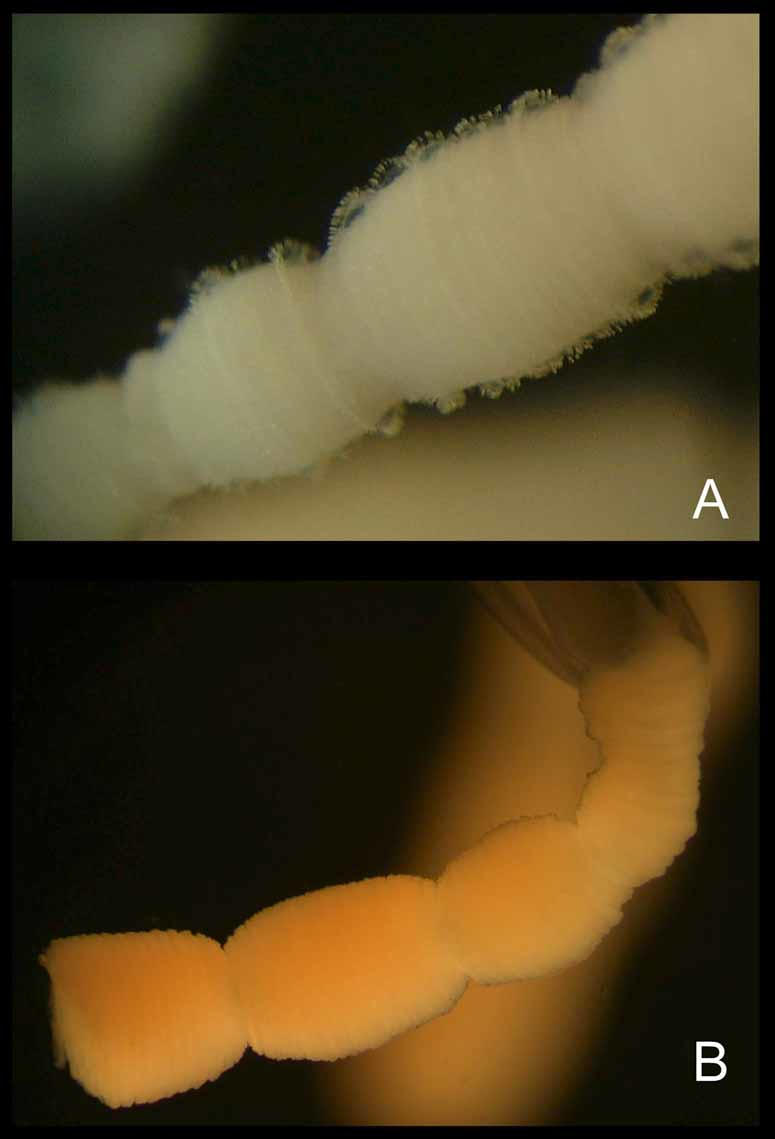
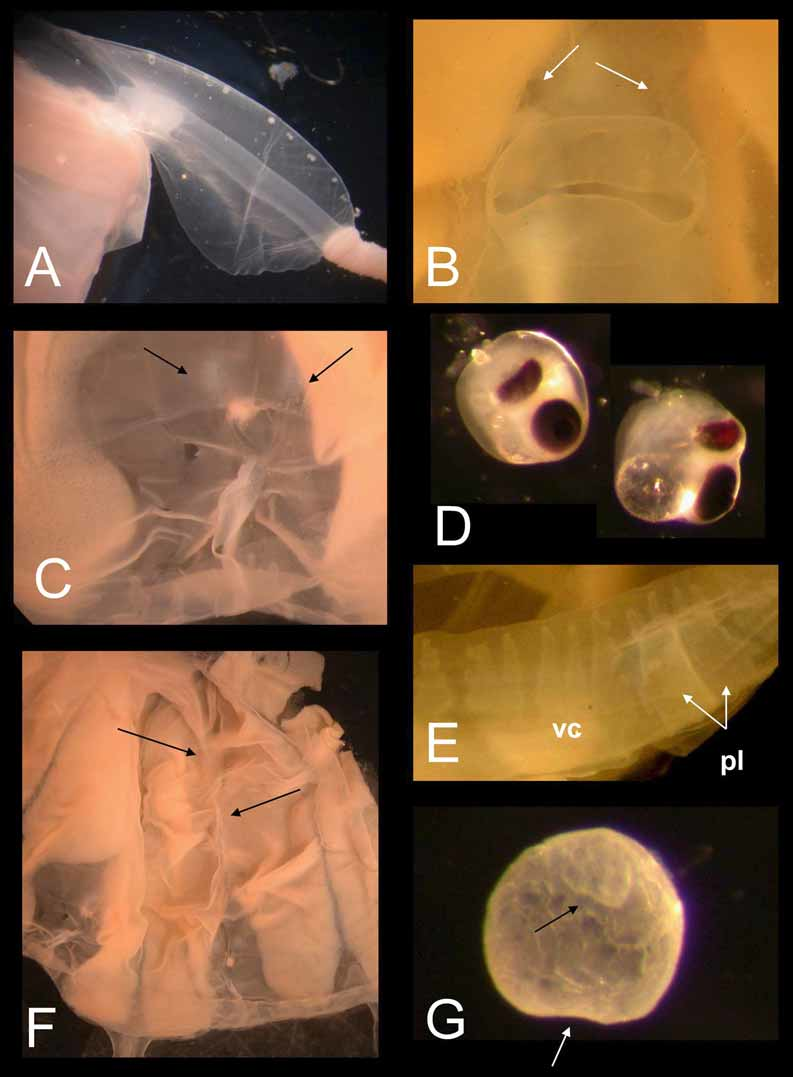
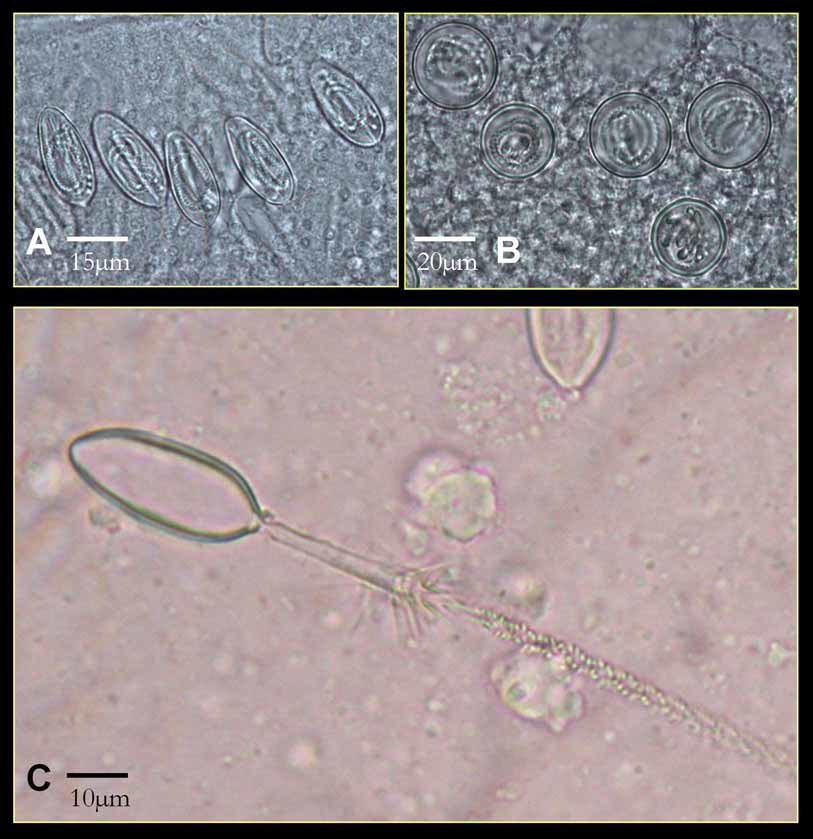
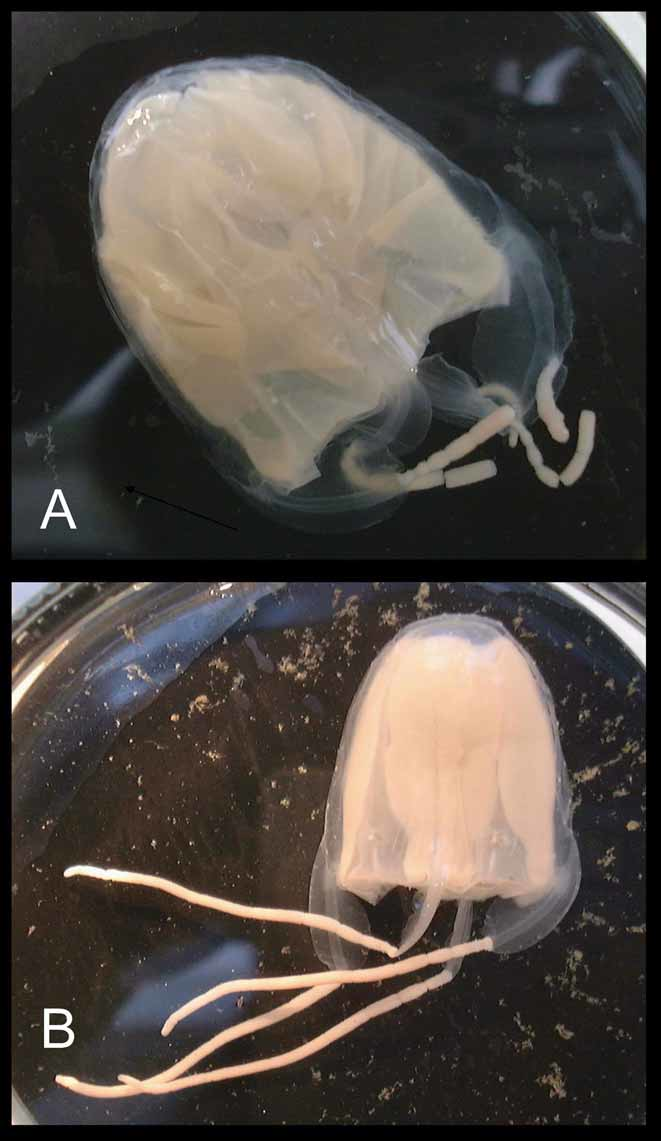
Description of holotype. Bell to about 3 cm tall, half as wide, narrower at apex than base, evenly rounded aborally (Figure 1). Mesoglea fairly thick, with the medusa typically holding its shape in water. Exumbrellar mammillations on apex; with low, round, gelatinous warts along body walls. Interradial furrows shallow, with raised ridges along either side, running the full height of bell. Adradial furrows poorly defined in upper half, shallowly defining rhopaliar region in lower half, but not defining interradial pillars. Tentacles 4, one per pedalium, appearing “ segmented ” at similar intervals, by which tentacle diameter grows distally; with halo-like thin sheet-rings perpendicular to tentacle axis, regularly spaced throughout length, approximately 60 per cm retracted (preserved); with nematocysts on halos only, inserted end on around outer edges of halos (Figure 2). Pedalia 4, interradial, long, scalpel-shaped, with moderately flared inner keel (Figure 3 A); without nematocyst freckles on outer keel. Pedalial canal about 1.40 mm wide; outer keel as wide as pedalial canal, inner keel about 3 times as wide as pedalial canal. Pedalial canals narrow and straight, with small hump near base, lacking smoothly rounded knee-like bend or upward-pointing thorn; strongly quadrate in cross section through most of length, with ridges shallower distally, unflared at tentacle insertion. Rhopalial niche ostium frown-shaped, with one upper and one lower covering scale (Figure 3 B); upper scale broadly convex with a shallow W-shape, i. e., two shallow points at about the quarter and three-quarter position. Rhopalial horns relatively short, broad, curved inward like Viking horns (Figure 3 B, C). Rhopalial windows flat, with horizontal concavity at rhopalial stalk (Figure 3 C). Rhopalial warts not observed. Eye morphology and statolith shape not discernable in preserved holotype specimen; lateral eye spots lacking in other specimens (Figure 3 D). Velarial canals palmate, with about 4 – 5 main somewhat-branched fingers per octant (Figure 3 E), all arising from a single common root extending from gastric pouch, past velarial turnover, onto velarium; lacking nematocyst patches or warts. Perradial lappets narrow triangular (Figure 3 F), with multiple finger-like extensions reaching velarial margin; with round nematocyst patches in two rows of 3 – 4. Frenulum a single sheet, lacking gelatinous buttresses; nearly reaching velarial margin. Stomach small, flat, with short manubrium; lips broadly pointed. Phacellae lacking. Mesenteries well developed, flap-like throughout stomach region to about halfway toward rhopalium; sessile cord-like another quarter way toward rhopalium, with a transparent strip of tissue reaching rhopaliar niche region. Interradial septa simple, lacking perforations. Gonads large and leaf-like along full length of interradial septa, reaching up to stomach and down past pedalia into velarial canals, overlapping perradially but with a keyhole-shaped outline around rhopaliar niches. Variation. The specimens listed separately in the paratype section above, which lack the halo-like bands, include those colloquially called “ Pseudo-Irukandji ” by Barnes (Kinsey 1988) and Gershwin (2005 a). I believe that these specimens lacking halos are an immature form of M. kingi, rather than an entirely different species (see remarks below). In paratypes with tentacles relaxed, the halo bands are about 35 per cm (preserved, e. g., paratypes SAM H 968, AM G 16005, MTQ G 55276). Curiously, the holotype and some of the paratypes have low gelatinous warts on the body, while the other paratypes lack any trace of such warts. Two pedalia on the holotype are branched, in a fashion similar to the uppermost, unpaired tentacles of the chirodropids; I believe this is just an aberration (it is lacking in other specimens of this species, but I have seen it on rare occasions in other taxa). Also in the holotype, the halo-like rings do not extend the full length of the tentacles, but are most clearly exhibited proximally. Despite these apparent aberrations, I believe this is the best specimen to represent the species because of its spectacular preservation of the peculiar endwise insertion of nematocysts, which have been somewhat worn away in the paratypes. Many of the specimens bear tentacles that are curiously “ segmented ” in appearance, much like a string of sausages; whether this is an artifact is still unclear. Some specimens have small, round nematocyst “ freckles ” on the outer keel of the pedalia, whereas the holotype does not. Most of the halo-form paratypes and some of the non-halo-form paratypes have complexly branched velarial canals, i. e., with lateral diverticula, whereas in others the canal branches are more digitiform. The taxonomic significance of these differences, if any, is not at this time well understood. Statoliths. Several statoliths have been examined from paratypes and non-type specimens of Malo kingi, and are different from those of other cubozoans in general morphology. In M. kingi, the statolith is globular in shape, with a “ basal ” indentation and an “ apical ” tooth (Figure 3 G). In the genus Carukia, for which Malo has previously been mistaken, the statoliths are sub-spherical, lacking both the tooth and “ basal ” indentation. A comparison of statolith shapes in cubozoans was given by Gershwin (2005 a). Colouration. In life, the bell is transparent and colourless; tentacles faintly pink; exumbrellar nematocyst warts pale purple. Nematocysts. As previously discussed (Gershwin and Alderslade 2005; Gershwin 2005 a; Gershwin 2005 b; Gershwin 2006 a), the principal tentacular nematocysts of Malo kingi are elongate club-shaped Type 4 microbasic p - mastigophores with a cylindrical shaft and terminal distally-aimed spines (Figure 4 A, C). This type of nematocyst is characteristic of the “ Pseudo-Irukandji ” clade of jellyfishes (Gershwin 2005 a). I found no difference in nematocyst shape between the halo-form and non-halo-form specimens, but nematocyst size differed slightly, possibly due to maturity (Halo: 32.98 – 37.56 µm long by 11.65 – 16.36 µm wide, n = 30, Non-halo: 30.27 – 36.68 µm long by 13.02 – 16.04 µm wide, n = 44). The exumbrellar nematocysts are entirely spherical isorhizas, 20.10 – 24.87 µm diameter, n = 45 (Figure 4 B). Spherical isorhizas are similar throughout the carybdeid species with exumbrellar nematocysts.
Gershwin, Lisa-Ann (2007): Malo kingi: A new species of Irukandji jellyfish (Cnidaria: Cubozoa: Carybdeida), possibly lethal to humans, from Queensland, Australia. Zootaxa 1659: 55-68, DOI: 10.5281/zenodo.274030
It is possible that as Pseudo-Irukandji matures, it concurrently changes its physical and chemical properties, becoming lethal with halo-form tentacle bands. A similar phenomenon was shown for Chironex fleckeri, which changes its nematocyst ratio and lethality as it grows (Carrette et al. 2002). The same phenomenon was hypothesised to occur in Alatina mordens, a species linked with severe and non-severe cases of Irukandji Syndrome (Gershwin 2005 c; Little et al. 2006; Gershwin 2006 b). It is also possible that the halo-form M. kingi and the non-halo-form Pseudo-Irukandji are different species rather than adult and juvenile, respectively, of the same species. Other than the differences in tentacle banding structure and orientation of the nematocysts (Figure 2), the two forms are more or less identical. Without data to the contrary, it seems more conservative to provisionally regard the non-haloed form as an immature variant of the haloed form; however, I have treated them somewhat separately herein, in order to facilitate further study. Whether the non-haloed form proves to be an immature M. kingi, or a different species altogether, M. kingi is nonetheless unique and recognizable among the currently described species of cubozoans. As of this writing, we know little about M. kingi in terms of its habits and habitats, sting capabilities, occurrence patterns in time and space, and life cycle. A high priority should be placed on answering these questions.
Gershwin, Lisa-Ann (2007): Malo kingi: A new species of Irukandji jellyfish (Cnidaria: Cubozoa: Carybdeida), possibly lethal to humans, from Queensland, Australia. Zootaxa 1659: 55-68, DOI: 10.5281/zenodo.274030
“ Pseudo-Irukandji ” — Kinsey 1988: 48 – 55. Gershwin 2005 a: throughout, plate 4.7 d; taxonomy and phylogeny. Gershwin 2005 b: 3, 20, 22; comparison with M. maxima. Gershwin & Alderslade 2005: 27, 34; comparison with Gerongia rifkinae. Gershwin 2006 a: 10, pl. 21; cnidome. Carukia barnesi. — Wiltshire et al. 2000: 241 – 250, figs. 2, 3, 6; characterization of proteins [not Carukia barnesi Southcott, 1967]. Unidentified. —? Huynh et al. 2003: fig. 2 D; nematocyst from fatal envenomation. “ Halo-Irukandji ” — Gershwin 2005 a: throughout, plate 4.7 c; taxonomy and phylogeny. Gershwin 2005 b: 20, 22; comparison with M. maxima. Gershwin 2006 a: 10, pl. 20; cnidome.
Gershwin, Lisa-Ann (2007): Malo kingi: A new species of Irukandji jellyfish (Cnidaria: Cubozoa: Carybdeida), possibly lethal to humans, from Queensland, Australia. Zootaxa 1659: 55-68, DOI: 10.5281/zenodo.274030
Diagnosis. Malo with halo-like rings encircling tentacles; nematocysts inserted end-on into edges of rings, radiating outward; velarial canals with one root per octant, palmate, with 4 digitiform extensions; bell with pale purple nematocyst warts.
Gershwin, Lisa-Ann (2007): Malo kingi: A new species of Irukandji jellyfish (Cnidaria: Cubozoa: Carybdeida), possibly lethal to humans, from Queensland, Australia. Zootaxa 1659: 55-68, DOI: 10.5281/zenodo.274030
Remarks. Malo kingi differs conspicuously from all other carybdeids in having a unique halo-form tentacle structure and a unique combination of other characters (Table 1). Malo kingi has characteristic “ halo ” bands with club-shaped Type 4 microbasic p - mastigophore nematocysts inserted end-on around the outer edges of the rings. There is another interesting form from Dampier, Western Australia, which has halo bands; however, it awaits additional material and a formal description. From Carukia barnesi, with which M. kingi has been confused in the past (Wiltshire et al. 2000), it further differs in having a larger body size, smoother bell, purple exumbrellar nematocyst warts, only two median eyes on each rhopalium, complexly branched and more numerous velarial canals, and short, thick rhopaliar horns. C. barnesi, in contrast, is characterized by having conspicuous “ tailed ” nematocyst bands, and a small, pyramidal body with red nematocyst warts; furthermore, C. barnesi has six eyes on each rhopalium, two unbranched velarial canals per octant, and the rhopaliar horns are long and narrow. The species Malo kingi is most likely to be confused with is M. maxima. The two share many characters, including the tall, narrow body shape; purple exumbrellar nematocyst warts; frown-shaped rhopaliar niche ostia; lack of gastric phacellae; short, broad rhopaliar horns; and palmate velarial canals. However, the body of M. maxima is relatively taller with squarer corners, pedalia have small nematocyst freckles on the outer keel, and nematocysts have spines along the whole shaft, whereas in M. kingi, the apex of the body is quite rounded, sometimes pedalia lack freckles, and nematocyst spines are only at the distal end of the shaft. The two species also inhabit different oceans. Other species that M. kingi might be confused with include Gerongia rifkinae, “ Morbakka ”, and Carybdea spp. Like M. kingi, G. rifkinae also has frown-shaped rhopaliar niche ostia, purple nematocyst warts, a row of nematocyst warts on the perradial lappets, and short, thick rhopaliar horns. However, G. rifkinae has a conspicuous upward-pointing “ spike ” at the bend of the pedalial canals, flared tentacle bases and pedalial canals where they join, and a heavier, more robust body. The “ Morbakka ” spp. have larger, more robust, wartier bodies, pedalial and tentacular characters similar to G. rifkinae, and velarial canals with numerous lateral diverticula, having a “ feathered ” appearance. While Malo kingi is approximately the same height as immature Carybdea rastonii and C. xaymacana, they are entirely different, with M. kingi having a slimmer body, frownshaped rhopaliar niche ostia, and no gastric phacellae. Carybdea spp., in contrast, have conspicuous gastric phacellae, heart-shaped rhopaliar niche ostia, and angular, more box-shaped bodies. One might argue that, because of its bizarre halo-form tentacles, M. kingi should be placed in its own genus, separate from M. maxima and others. I prefer a conservative approach based on overall similarity (e. g., comparative morphology of the major structures, including the rhopalial niches, pedalia, and velarial structures, lack of phacellae, and subumbrellar features). It is clear from 18 S rDNA and morphological comparisons (Gershwin 2005 a) that M. kingi is in the clade containing M. maxima, separate from but closely related to Gerongia, “ Morbakka ”, and Carukia spp.
Gershwin, Lisa-Ann (2007): Malo kingi: A new species of Irukandji jellyfish (Cnidaria: Cubozoa: Carybdeida), possibly lethal to humans, from Queensland, Australia. Zootaxa 1659: 55-68, DOI: 10.5281/zenodo.274030
Distribution. To date, only five halo-banded specimens of this species have been found, four at Mackay and one at Port Douglas. However, many more specimens of the non-halo form have been found from Port Douglas to Townsville, and well out onto the reefs and islands (Hartwick collection, unpublished). Specimens of M. kingi have been found throughout the year in very low numbers, but they are most commonly found in late summer and early winter.
Gershwin, Lisa-Ann (2007): Malo kingi: A new species of Irukandji jellyfish (Cnidaria: Cubozoa: Carybdeida), possibly lethal to humans, from Queensland, Australia. Zootaxa 1659: 55-68, DOI: 10.5281/zenodo.274030
Etymology. This species is named to honour Robert W. King, the second person in history to have been confirmed to have died from Irukandji Syndrome; Bob had no pre-existing conditions, and is believed to have died from toxin-induced hypertension, leading to multiple inter-cranial haemorrhages. Nematocysts recovered from his body and clothing (Huynh et al. 2003) match those characteristic of this species. Furthermore, I believe the coming decades will prove that his unfortunate death, and his partner’s efforts to ensure that his death would not be in vain, mark a significant turning point in Irukandji knowledge and management efforts. It is primarily for this second reason that it is a pleasure to honour Bob King in the naming of this species. Stinging ability and toxins. Whether Malo kingi is dangerous to humans is currently ambiguous. Known and suspected sting cases relating to this species present a conflicting picture about its virulence. It is possible that M. kingi becomes more toxic as it grows (see ‘ Remarks’ below).
Gershwin, Lisa-Ann (2007): Malo kingi: A new species of Irukandji jellyfish (Cnidaria: Cubozoa: Carybdeida), possibly lethal to humans, from Queensland, Australia. Zootaxa 1659: 55-68, DOI: 10.5281/zenodo.274030
Holotype: QM G 317361, Port Douglas Marina, Dickson Inlet, N. QLD, near boardwalk, coll. March 1997 by R. Hore; male, 31.12 mm BH, 30.13 mm DBW, 15.86 mm IRW, 1.09 mm TBW. Paratypes: SAM H 968, Harbour Beach, Mackay, QLD, stranded on sand at high tide, coll. by P. Barker, March 1998; male, BH 27.17 mm, DBW 28.24 mm, IRW 14.46 mm, TBW 1.29 mm. AM G 16005, same locality as SAM H 968, March 1998; male, BH 29.21 mm, DBW 30.59 mm, IRW 14.46 mm. MTQ G 55276, same locality as SAM H 968, December 1998; spawning female, BH 24.28 mm, DBW> 25.19 mm, IRW 12.56 mm, TBW 1.20 mm.
Gershwin, Lisa-Ann (2007): Malo kingi: A new species of Irukandji jellyfish (Cnidaria: Cubozoa: Carybdeida), possibly lethal to humans, from Queensland, Australia. Zootaxa 1659: 55-68, DOI: 10.5281/zenodo.274030
Other material: Numerous specimens from the Hartwick offshore sampling programme are still being processed and will be reported on shortly. J 1544 (1 of 8 – present location of remaining specimens of this lot is unknown) held at JCU Cairns Zoology Department, same data as holotype; 20.82 mm BH, 18.38 mm DBW, 8.34 mm IRW. The whereabouts of Barnes lots J 1011 and J 1358 are unknown, and thus conspecificity cannot be confirmed; the nematocysts of J 1011 (in Kinsey 1988) cast some doubt on whether this form is indeed conspecific. Unregistered, Harbour Beach, Mackay, QLD, stranded on sand at high tide, coll. by P. Barker, Dec 1998, male, BH 19.83 mm, DBW 21.72 mm, IRW 10.65 mm [previously confirmed, but cannot be currently located]. Unregistered, Harbour Beach, Mackay, coll. by P. Barker, 19 January 2000; spawning female, 18.50 mm BH, 18.47 mm DBW, 8.82 mm IRW [previously confirmed, but cannot be currently located]. Unregistered (Gershwin teaching collection), The Strand, Townsville, coll. by Surf Life Savers 10 October 2004, stranded on beach at high tide; spawning female; specimen stung a 13 year old female who got sick but did not seek medical treatment. Type locality. Dickson Inlet, Port Douglas, Far North Queensland, Australia.
Gershwin, Lisa-Ann (2007): Malo kingi: A new species of Irukandji jellyfish (Cnidaria: Cubozoa: Carybdeida), possibly lethal to humans, from Queensland, Australia. Zootaxa 1659: 55-68, DOI: 10.5281/zenodo.274030

Export occurrence data

Darwin Core Archive (ZIP)

CLASSIFICATION

Taxonomic Classification Tree

MULTIMEDIA

Media Files(4)

FIGURE 1. Malo kingi n. sp. A. Holotype, preserved (“ halo ” form). B. Paratype SAM H 1049, preserved (“ pseudo ” form). Specimens are opaque due to preservation.

Imageimage/png© Gershwin, Lisa-AnnGershwin, Lisa-Ann

FIGURE 2. Malo kingi n. sp. A. Tentacle of holotype; note “ halo-like ” perpendicular tissue flaps, with nematocysts inserted end-on around periphery. B. Tentacle of “ Pseudo-Irukandji ” form; note smoothly rounded bands with embedded nematocysts.

Imageimage/png© Gershwin, Lisa-AnnGershwin, Lisa-Ann

FIGURE 3. Malo kingi n. sp. A. Pedalium. B. Rhopalial niche ostium; note short, broad, curved rhopalial horns (arrows). C. Rhopalial horns (arrows), subumbrellar view; note also single-sheet-like frenulum below. D. Rhopalium (removed from animal), front view (left), side view (right); note lack of lateral eye spots. E. Velarial canals (vc) and perradial lappets (pl); note nipple-like extensions on lappets. F. Mesenteries; note flap-like nature in stomach region (arrows), with only cord-like extension to rhopalium. G. Statolith, from “ pseudo ” form; note “ apical ” tooth (black arrow), concave “ base ” (white arrow).

Imageimage/png© Gershwin, Lisa-AnnGershwin, Lisa-Ann

FIGURE 4. Malo kingi n. sp. A. Tentacular nematocyst, undischarged. B. Exumbrellar nematocysts from bell wart, spherical holotrichous isorhiza. C. Tentacular nematocyst, discharged, Type 4 microbasic p - mastigophores; note spines orientated away from capsule, confined to distal end of shaft.

Imageimage/png© Gershwin, Lisa-AnnGershwin, Lisa-Ann

IMAGES

Gallery(4)

See Gallery

Occurrences with images

Source Information

Malo kingi: A new species of Irukandji jellyfish (Cnidaria: Cubozoa: Carybdeida), possibly lethal to humans, from Queensland, Australia

checklist

This dataset contains the digitized treatments in Plazi based on the original journal article Gershwin, Lisa-Ann (2007): Malo kingi: A new species of Irukandji jellyfish (Cnidaria: Cubozoa: Carybdeida), possibly lethal to humans, from Queensland, Australia. Zootaxa 1659: 55-68, DOI: 10.5281/zenodo.274030

Abstract

Irukandji stings may be lethal to humans, and yet, until late 2005, only one of the many suspected Irukandji stingers had been formally named and classified. This paper describes Malo kingi, n. sp., which is apparently responsible for a recent fatality. This species differs from all other cubozoans in having halo-like rings of tissue encircling the tentacles, with club-shaped Type 4 microbasic mastigophores inserted end-on around the periphery of the rings. It further differs from its only current congener, Malo maxima, in having: a much smaller, more rounded body; different tubule winding patterns in the undischarged nematocysts; spines confined to the distal-most portion of the shaft in the discharged nematocysts; relatively broader pedalia; somewhat less well defined rhopalial horns; and perradial lappets with a greater number of nematocyst warts and nipple-like terminal extensions. Much additional work is needed to better understand the general biology of this and other dangerous species so as to prevent further fatalities, debilitating illnesses, and threats to the tourism industry resulting from the marine stinger problem. Treatment of envenomations, management issues regarding sting prevention, and the related implications for tourism, all rely on being able to consistently and accurately identify public health hazards. The need still exists for an aggressive awareness campaign aimed at residents and visitors regarding education and prevention of Irukandji stings.

Key words: Cnidaria, Cubozoa, Carybdeida, Tamoyidae, Irukandji Syndrome, Great Barrier Reef, Queensland, Australia, taxonomy, fatal stinging

Gershwin L, plazi (2007). Malo kingi: A new species of Irukandji jellyfish (Cnidaria: Cubozoa: Carybdeida), possibly lethal to humans, from Queensland, Australia. Plazi.org taxonomic treatments database. Checklist dataset https://doi.org/10.5281/zenodo.274030 accessed via GBIF.org on 2026-06-16.

CC0Published 12/31/2007View dataset
GBIF Usage Key
119381472
Dataset Key
311c1a58-9109-43a4-bd1f-657a3fda5aed
Origin
source
Backbone Key
5842340
Taxon ID
990C87DEFF335858FF18FB4DFEF67806.taxon
Last Crawled
6/11/2026
Last Interpreted
6/11/2026