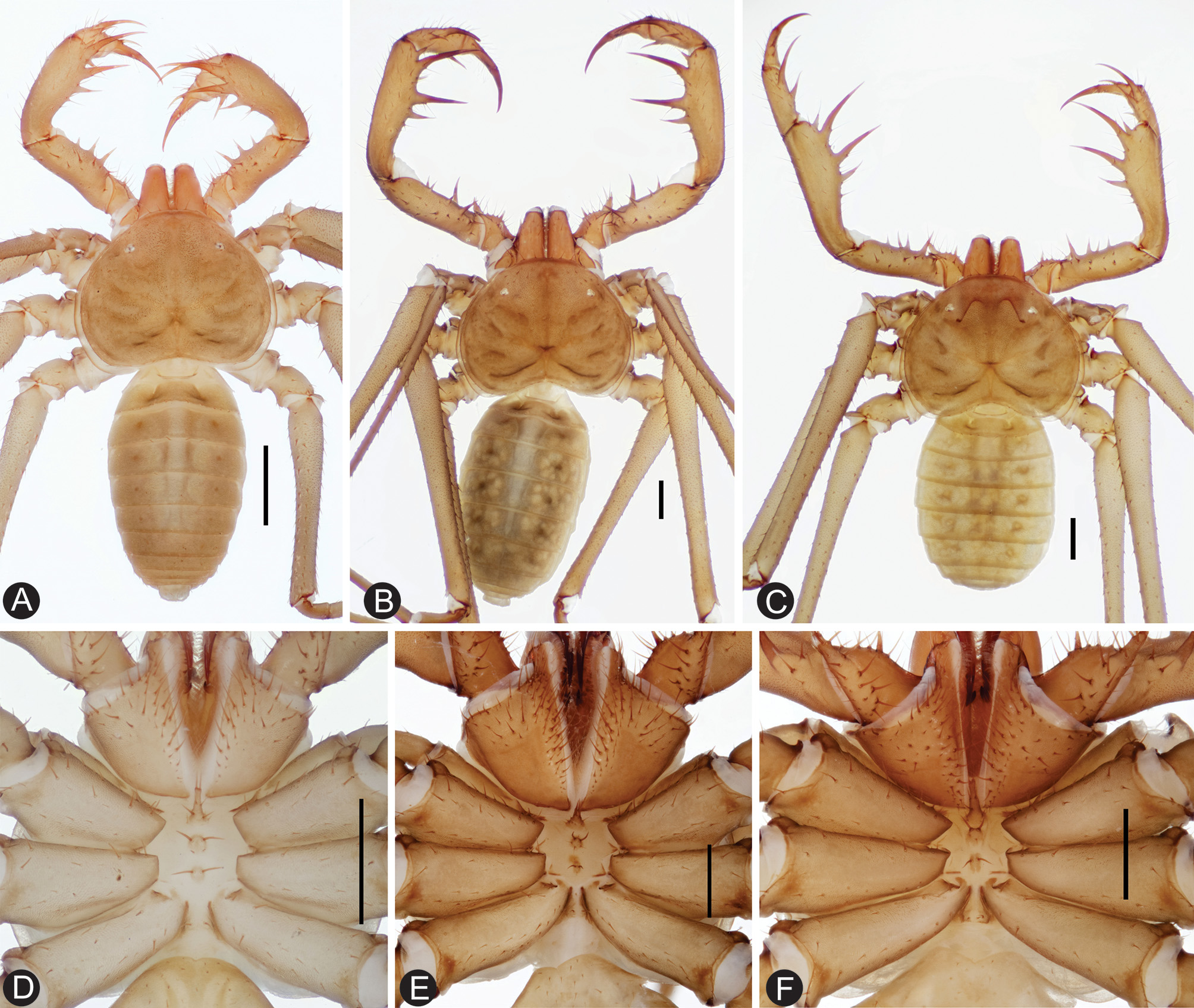
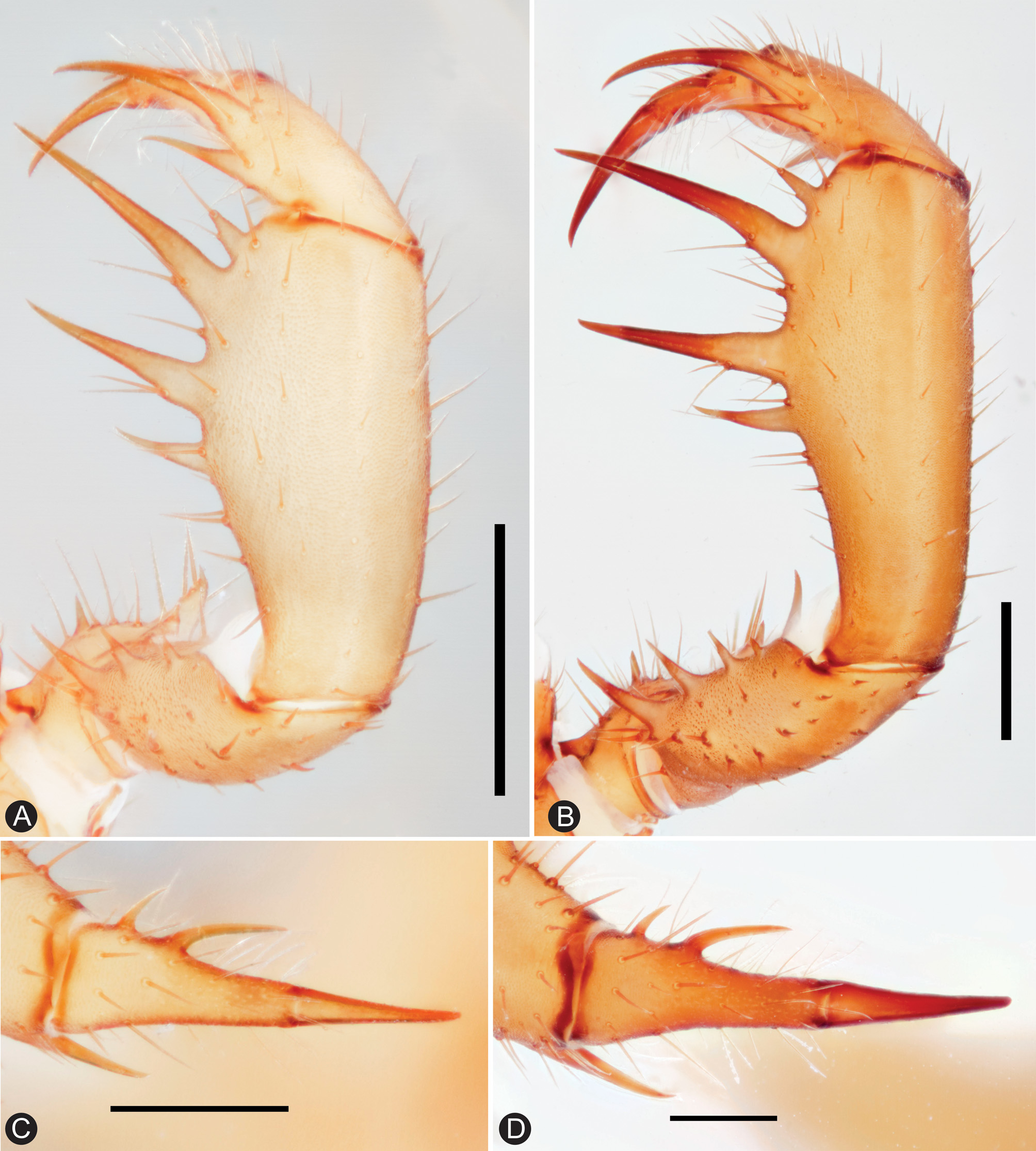
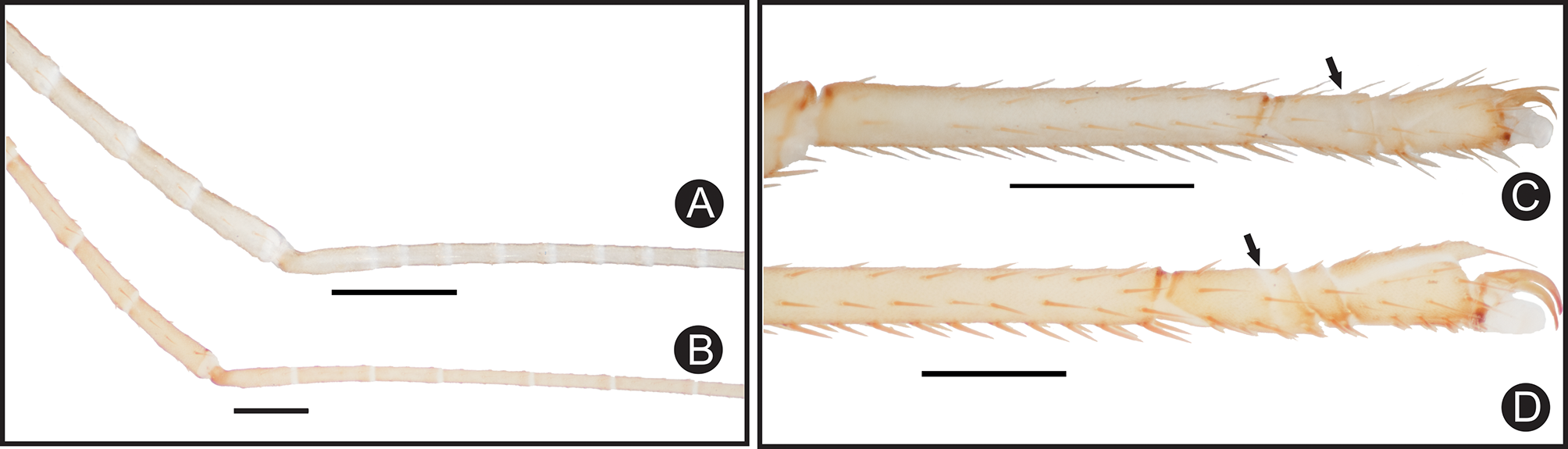
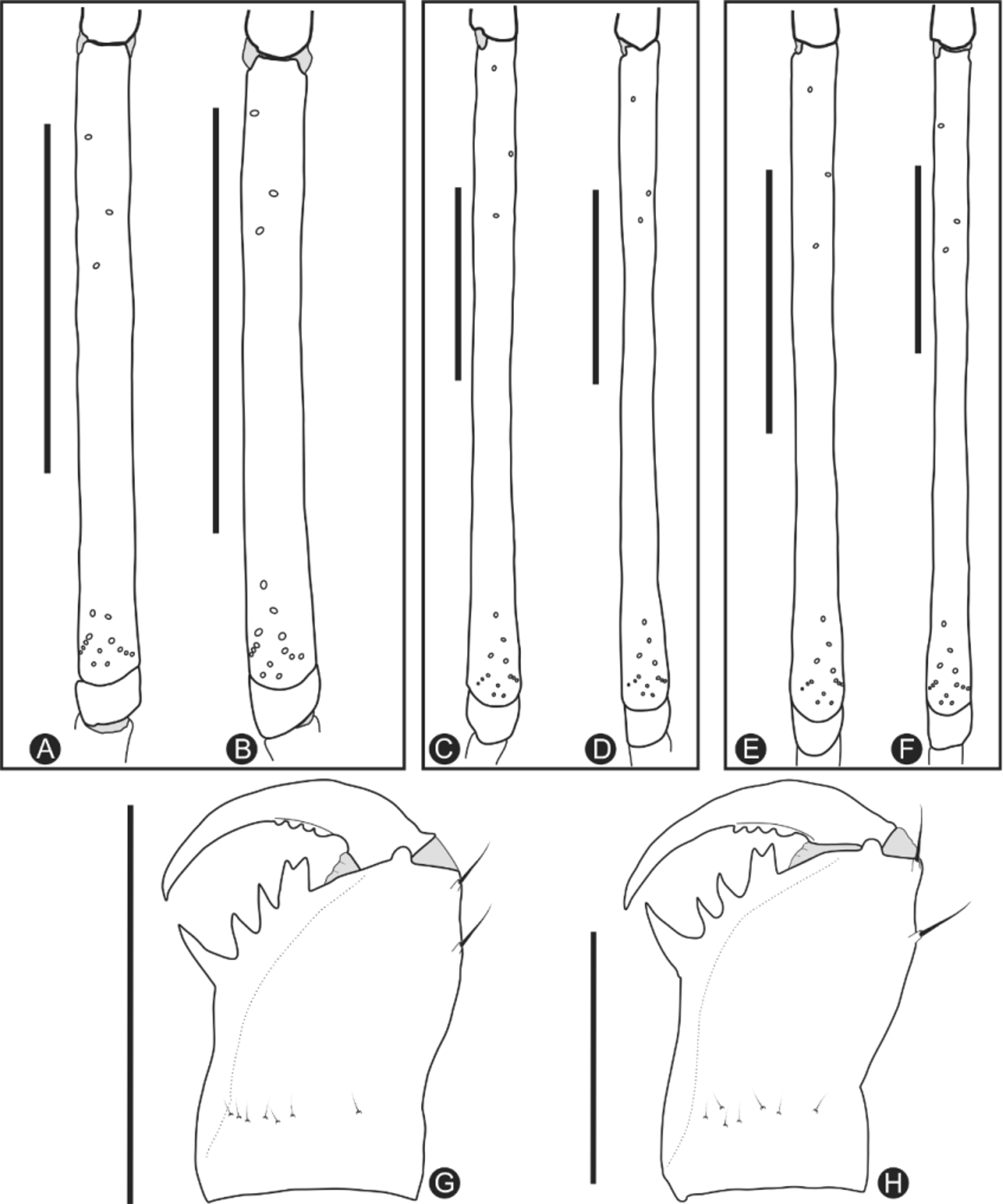
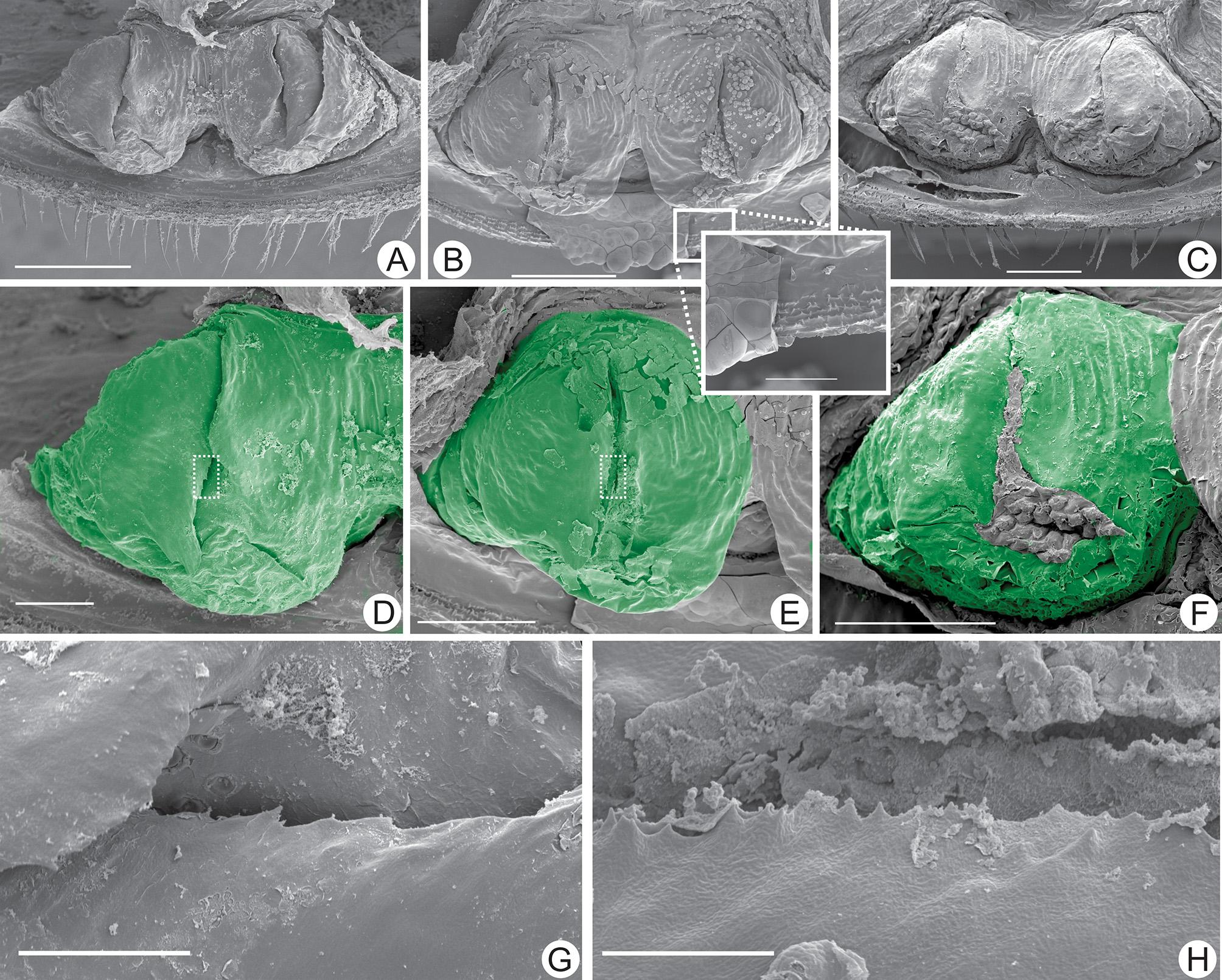
Description of the female holotype (variations found in the paratypes are indicated in brackets; description of the chelicerae and gonopods based on paratypes): Carapace (Fig. 1 B, C). Carapace flattened, wider than long (1.4 times), slightly bent downwards below lateral eyes; a thin median furrow reaches the fovea starting from the depression that replace the median eye and tubercle. Anterior margin straight, with six frontal setae. Frontal process large, triangular, not visible from above, with a rounded tip. Three pairs of shallow furrows in the lateral of the carapace, and a triangular and deep fovea. First pair of furrows placed just behind the lateral boss behind the lateral eyes; any of the furrows reaches the middle line. Median eyes and tubercle completely absent, a deep depression instead; no setae present in the depression. Lateral eyes well developed, pale, one large setae behind each triad; lenses directed upwards and slightly anteriorly. Sternum (Fig. 1 E, F): tetra-segmented, all pieces well sclerotized. Tritosternum with a round basis and projected anteriorly in a small blunt tubercle, reaching the base of the pedipalp coxae, with two apical, two median and several smaller ones on the base (the paratypes have a longer tritosternum and longer basal pair of setae). Middle piece (tetrasternum) in one convex piece, with a pair of large setae in its apex, and four small setae in its base. Third piece (pentasternum) formed by one convex piece, smaller than the middle piece, with two long setae at its top and with one small setae on its base. Sternites separated from each other by length of the third piece. Metasternum not paired (i. e., one single piece), with one pair of setae on an elevation at the posterior region of the plaque. Abdomen (Fig. 1 B, C): oblong, with almost indistinguishable punctuations. Ventral sacs not developed. Chelicera (Fig. 5 H): Cheliceral furrow with four internal teeth; first tooth (upper) bifid, proximal cusp of the same size as distal cusp. Third tooth slightly thinner and shorter than second tooth. Fourth tooth one third larger than the third. No tooth in the external row of the basal segment. Mesal face with a longitudinal row of seven (five in paratypes) setae. Claw with four denticles. Pedipalp: Trochanter (Fig. 2 C – F): large ventral apophysis, located in the posterior border of the trochanter, spiniform, bearing 13 – 14 large setae, and with a blunt tip pointed forward; two subequal spines, one in about the center of the anterior row of setiferous tubercles (three setae on each side), the other at the external border, below the apophysis, a bit curved inwards. Femur (Fig. 2 C – H, 3 B): three dorsal spines in the left pedipalp and four in the right pedipalp (the last spine very small) [in one male (HUJINVAM 116) the left pedipalp have four spines and the right three; two female paratypes (HUJINVAM 116) have four spines in both pedipalps, the last one very tiny (Fig. 2 G, H)] with two prominent setiferous tubercle before the first spine (I> II> III> IV); three ventral spines (I> II> III) with one small setiferous tubercle before the first spine. Tibia (Fig. 2 C – F; 3 B): three dorsal spines (I> II> III); one spine distal to I (about one fourth the size of I); one small setiferous tubercle proximal to spine III; spine II two thirds spine I and spine III one third spine I; spine I and II with two setiferous tubercle on its basal third; spine III with one setiferous tubercle in its half. Two ventral spines [the female paratype (HUJINVAM 116) have three, the last (proximal) very tiny]; second spine half size of the first. Basitarsus (Fig. 2 C – F): two dorsal spines, the basal 2 / 3 the size of the distal. One ventral spine at the distal half, 2 / 3 the basal spine dorsal. Distitarsus (Fig. 3 D): two large curved spines, the distal half the size of the article and pointed forward; the proximal one third the size of the distal and pointed upward. Cleaning organ about half of the article length. Claw (Fig. 3 D): long, with an acute, curved tip. Legs: All setose. Ventral corner of the prolateral face of femora II – IV projecting in a distinct spiniform process. Femur length: I> III> II> IV. Tibia I with 23 articles; distal segments with two small trichobothria, one on the dorsal and one in the lateral (ectal) side of the segment; on the left leg, one trichobothria in the second, third and fourth (from distal to proximal) segments, close to the distal border, the trichobothria on the third segment more lateral, the others more dorsal [in the paratypes they are ventral]; the right leg has two trichobothria in the third segment, one dorsal and one mesal; no trichobothria on the other segments. Tarsus (basitarsus + distitarsus) I with 41 articles; proximal segment 1.7 times longer than the next (Fig. 4 B). Leg IV: Basitibia: divided into three pseudo-articles, with one trichobothrium on the first third of the last pseudo-segments (trichobothrium bt). Distitibia (Fig. 5 C – F): three proximal and 13 distal trichobothria (total of 16); trichobothrium bc midway to bf and sbf [in the paratypes, bc is closer to sbf than to bf]; sf and sc with five trichobotrhia. Basitibia-distitibia length DT> BT 1> BT 4> BT 3> BT 2. Tarsus: with very strong mark of the white ring in the distal part of the second segment of distitarsus IV (Fig. 4 D). Measurements (in mm): Female (n = 3): Carapace: Length: 2.84 (2.48 – 3.05), Width: 4.02 (3.40 – 4.40). Pedipalp: Femur 2.74 (2.13 – 3.09), Tibia 2.72 (1.88 – 3.28), Basitarsus 1.54 (1.13 – 1.88), Distitarsus 0.99 (0.80 – 1.10), Tarsal claw 0.94 (0.73 – 1.08). Leg I: Femur 9.35 (6.90 – 11.41), Tibia 15.60 (15.40 – 15.80), Tarsus 15.25 (14.00 – 16.50). Leg II: Femur 6.27 (5.12 – 6.96), Basitibia 4.44 (3.60 – 5.00), Distitibia 3.14 (2.64 – 3.50), Basitarsus 1.67 (1.28 – 1.92), Other tarsal articles 0.95 (0.78 – 1.12). Leg III: Femur 7.12 (6.00 – 7.76), Basitibia 5.63 (4.80 – 6.08), Distitibia 3.51 (3.12 – 3.80), Basitarsus 1.97 (1.44 – 2.40), Other tarsal articles 0.93 (0.80 – 1.00). Leg IV: Femur 6.36 (5.25 – 7.04), Basitibia I 3.32 (2.81 – 3.75), Basitibia II 1.04 (0.81 – 1.20), Basitibia III 1.63 (1.25 – 1.85), Distitibia 3.43 (2.69 – 4.00), Basitarsus 2.66 (1.58 – 4.30), Other tarsal articles 1.28 (0.85 – 2.00). Measurements: Male (n = 1): Carapace: Length: 2.64, Width: 3.80. Pedipalp: Femur 2.75, Tibia 2.59, Basitarsus 1.44, Distitarsus 0.93, Tarsal claw 0.90. Leg I: Femur 9.30, Tibia 17.18, Tarsus 15.40. Leg II: Femur 6.16, Basitibia 4.24, Distitibia 3.04, Basitarsus 1.53, Other tarsal articles 0.80. Leg III: Femur 6.80, Basitibia 5.36, Distitibia 3.44, Basitarsus 1.84, Other tarsal articles 0.84. Leg IV: Femur 6.00, Basitibia I 4.00, Basitibia II 1.35, Distitibia 3.45, Basitarsus 1.75, Other tarsal articles 0.85. Color Pattern (in alcohol): Chelicerae, pedipalps, carapace and abdomen yellowish-brown. Legs tibia and tarsus lighter colored. Color in live animals is similar, except for the chelicerae that are burgundy. Genitalia: Female gonopod (Figs. 6 B, C, E, F, H): posterior margin of genital operculum straight, with few setae along its margin and on its surface. Gonopods oval, cushion-like, placed close to the border of the genital operculum, with a soft projection in the shape of a claw-like flap that covers the genital operculum. Internal border of the external flap is serrated, with abundant cusps close to each other. The gonopod of the female from FC (Fig. 6 F) is retracted to hold the sperm sac. A layer of sediment was present in the border of genital operculum of one specimen (detail of Fig. 6 B); part of this sediment was removed to the observation of the gonopods; the presence of this cover may have a biological purpose (e. g. maintenance of moist to the book lungs or the gonopods), but cannot be inferred by now. Male gonopod with distal border of fistula sclerotized; PI curved; Lol 1 long and fimbriated. Natural history. C. reddelli sp. nov. was found in two karst caves located in the valley of the Caves Branch river in central Belize: Footprint Cave, and Waterfall cave (Actun Lubul Ha). Both caves are decorated with stalagmites, stalactites and columns of dense flowstone. Footprint cave has a stream flowing straight through it, confined to the lower passage of the cave. It emerges out of the cave’s entrance and joins the Caves Branch river about 2 km away. Only one entrance to the cave is known. Although we found several small-sized arthropods in this cave (isopods, diplurans), the most frequently encountered prey items were nymphs of Mayagryllus apterus Desutter-Grandcolas and Hubbell, 1993 (Orthoptera: Gryllidae) and Belicenochrus peckorum Armas and Víquez, 2010 (Schizomida: Hubbardiidae). The Waterfall cave has a stream flowing between two entrances separated by ca. 2 km of passage and divided by a series of cascades. This cave contains many dry cavities, and has more abundance of insects (M. apterus, cockroaches) and other arthropods (isopods, spiders, soft ticks). The population of C. reddelli sp. nov. in the Waterfall caves appears larger (more specimens were recorded) in comparison to the Footprint cave. Individuals were never found close to each other. The egg sac contains 4 – 10 eggs measuring 1.5 – 1.64 mm in diameter. At 25 ° C, egg development takes ca. 150 days. The hatching praenymphae are white and measure 2.2 – 2.5 mm. They climb and stay on the mother’s back for 14 days, after which they molt into protonymphae measuring 2.8 mm in length.
Miranda, Gustavo Silva De, Giupponi, Alessandro Ponce De Leão, Wizen, Gil (2016): Two new species of whip spider (Amblypygi): an epigean and a cave dwelling Charinus Simon, 1892 from Belize. Zootaxa 4098 (3): 545-559, DOI: 10.11646/zootaxa.4098.3.7