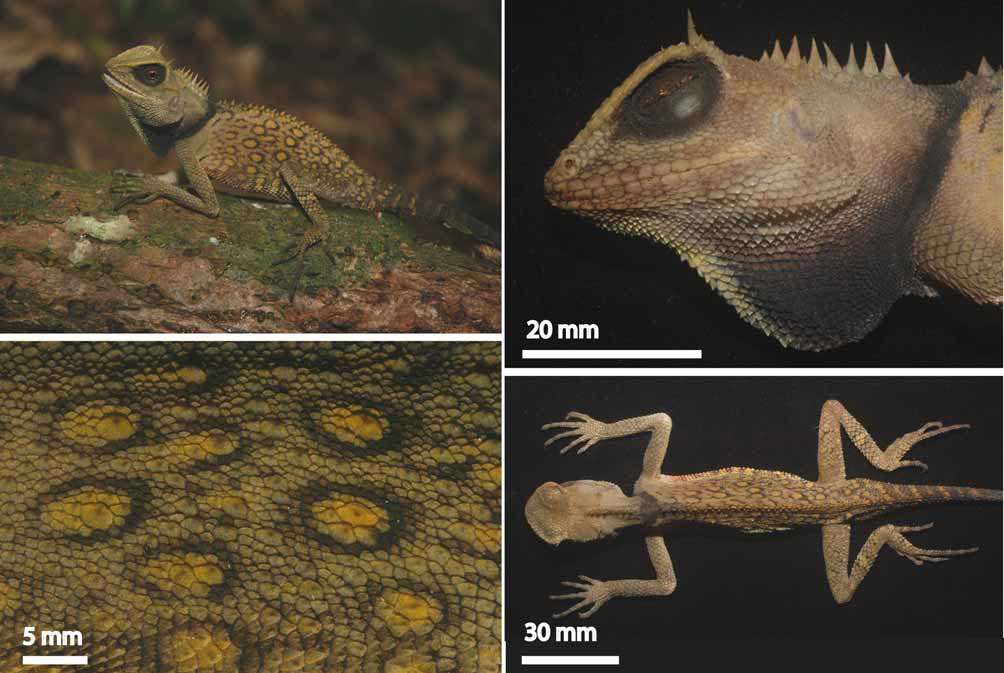
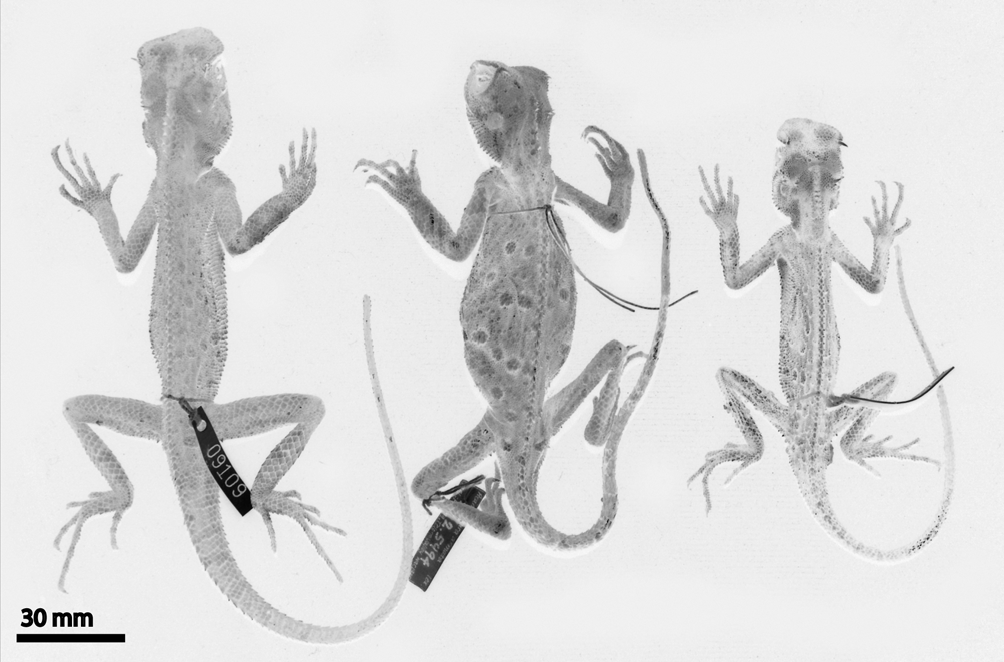
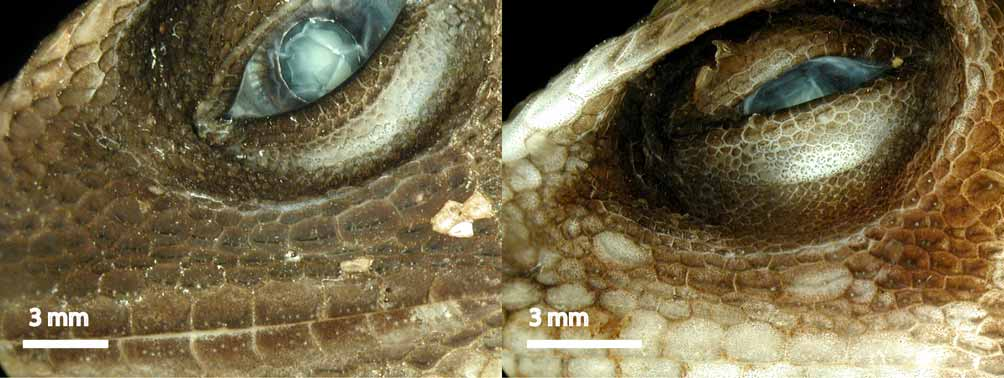
INFRAL 12 11 11 VENT 57 54 47 FI 21 21 20 TO 25 27 23 TL / SVL 1.5 1.5 1.4 OS 2.3 1.8 2.2 NSSOS 4 or 5 5 5 CS 15 15 14 RW 4.5 3.6 5.2 RH 1.8 1.4 2 RS 9 9 9 NS 8 8 8 NCS 11 12 11 NSCSL 7 9 11 NR 2 1 1 NSSLC 11 12 14 MW 1.8 1.4 2 MH 1.8 1.4 2.4 to be continued. Comparisons to other species. Acanthosaura bintangensis can be differentiated from all other species of Acanthosaura by having elliptical keeled scales below the orbit of the eye and by having more subdigital lamellae on the fourth finger (23 vs. 16 – 18 for A. armata, 16 – 17 for A. capra, 19 – 22 for A. coronata, 14 – 18 for A. crucigera, 16 – 21 for A. nataliae, and 17 – 19 for A. lepidogaster). Acanthosaura bintangensis differs from A. capra and A. nataliae by having a spine on the occiput between tympanum and nuchal crest (vs. lacking), from A. coronata, A. crucigera, and A. lepidogaster by having more subdigital lamellae on the fourth toe (26 – 28 vs. 22 – 24 for A. capra, 15 – 22 for A. coronata, 19 – 24 for A. crucigera, and 23 for A. lepidogaster). Acanthosaura bintangensis can be differentiated from all other species of Acanthosaura except for A. titiwangsaensis sp. nov. by having more canthus rostralis-supracilliary scales (14 – 15 vs. 11 – 13 for A. armata, 13 for A. coronata, 12 – 13 for A. crucigera, 13 for A. nataliae, and 10 – 12 for A. lepidogaster). Acanthosaura bintangensis differs from A. armata, A. coronata, A. crucigera, and A. lepidogaster by lacking a light patch on the knee. It can be differentiated from A. coronata and A. nataliae by having a black nuchal collar. Acanthosaura bintangensis differs from A. armata, and A. nataliae, by having a higher number of scales between the diastema (11 – 15 vs. 1 – 8 for A. armata and 10 for A. nataliae). Acanthosaura bintangensis can be separated from A. armata, and A. nataliae by having fewer ventral scales (47 – 57 vs. 59 – 68 for A. armata, and 64 – 71 for A. nataliae). Acanthosaura bintangensis differs from A. nataliae by having a lower number of scales between the seventh supralabial and the sixth canthal (9 – 14 vs. 16 for A. nataliae). Acanthosaura bintangensis differs from A. lepidogaster by having a smaller diastema length divided by snout vent length (4.3 – 6.7 % vs. 7.8 – 8.2 % for A. lepidogaster; Table 1). Acanthosaura titiwangsaensis can be differentiated from all other species of Acanthosaura except for A. bintangensis by having a higher number of canthus rostralis-supracilliary scales (14 – 15 vs. 11 – 13 for A. armata, 13 for A. coronata, 12 – 13 for A. crucigera, 13 A. nataliae, and 10 – 12 for A. lepidogaster). Acanthosaura titiwangsaensis differs from A. nataliae and A. capra by having an occipital spine. It can be differentiated from A. armata, A. coronata, A. crucigera, and A. lepidogaster by lacking a light patch on the knee. Acanthosaura titiwangsaensis differs from A. armata, A. capra, A. crucigera and A. lepidogaster by having a higher number of subdigital lamellae on the fourth finger (20 – 21 vs. 16 – 18 for A. armata, 16 – 17 for A. capra, 14 – 18 A. crucigera, and 17 – 19 for A. lepidogaster). Acanthosaura titiwangsaensis differs from A. armata, A. coronata, A. crucigera, A. nataliae, and A. lepidogaster in having a higher number of scales bordering the rostral (9 vs. 5 – 7 for A. armata, 8 for A. coronata, 6 – 7 for A. crucigera) and by having a lower number of scales bordering the nostrils, (9 vs. 13 for A. nataliae, and 10 – 12 for A. lepidogaster). It can be differentiated from A. armata and A. nataliae on having a lower number of ventral scales (47 – 57 vs. 59 – 68 for A. armata, and 64 – 71 for A. nataliae). It can be differentiated from A. coronata by having a higher number of subdigital lamellae on the fourth toe (23 – 27 vs. 15 – 22 for A. coronata It can be differentiated from A. coronata, A, nataliae, and A. lepidogaster in having a higher number of scales from the fifth canthal to the fifth supra labial (9 – 11 vs. 6 – 7 for A. coronata, 8 for A. nataliae, and 8 for A. lepidogaster). Acanthosaura titiwangsaensis differs from A. coronata, A. crucigera, and A. nataliae by having a higher number of scales bordering the mental (5 vs. 4 for A. coronata, 4 for A. crucigera, and 4 for A. nataliae). Acanthosaura titiwangsaensis differs from A. lepidogaster by having a smaller diastema length divided by snout vent length (4.9 – 6.7 % vs. 7.8 – 8.2 % for A. lepidogaster). This species differs from A. coronata and A. nataliae by having a nuchal diamond present on the nape. Acanthosaura titiwangsaensis differs from A. armata by having a higher number of scales between the diastema (10 – 13 vs. 1 – 8 for A. armata). It differs from A. lepidogaster by having a larger gular pouch (Table 1). Acanthosaura bintangensis and A. titiwangsaensis most closely resemble each other but can be differentiated by their number of subdigital lamellae under the fourth finger (23 in A. bintangensis vs. 20 – 21 for A. titiwangsaensis); number of scales surrounding the occipital spine (A. bintangensis 6 – 7 vs. 4 – 5 for A. titiwangsaensis); number of scales between the fifth canthal to the fifth supralabial (A. bintangensis 7 – 8 vs. 9 – 11 for A. titiwangsaensis); by the presence of two elliptical keeled scales below the orbit in A. bintangensis and their absence in A. titiwangsaensis (Fig. 7); by the yellow medial gular stripe in A. bintangensis and its absence in A. titiwangsaensis; and A. bintangensis having more spots on the dorsum than the latter (Table 1; Fig. 2, 5).
Wood, Perry L., Grismer, Jesse L., Grismer, Lee, Ahmad, Norhayati, Onn, Chan Kin, Bauer, Aaron M. (2009): Two new montane species of Acanthosaura Gray, 1831 (Squamata: Agamidae) from Peninsular Malaysia. Zootaxa 2012: 28-46, DOI: 10.5281/zenodo.185821