
AnimaliaNot EvaluatedacceptedspeciesAccepted
Lophopodella carteri
(Hyatt, 1866) Hyatt, 1866
GBIF:119384680
0year
0
Synonyms
ABOUT
Descriptions(4)
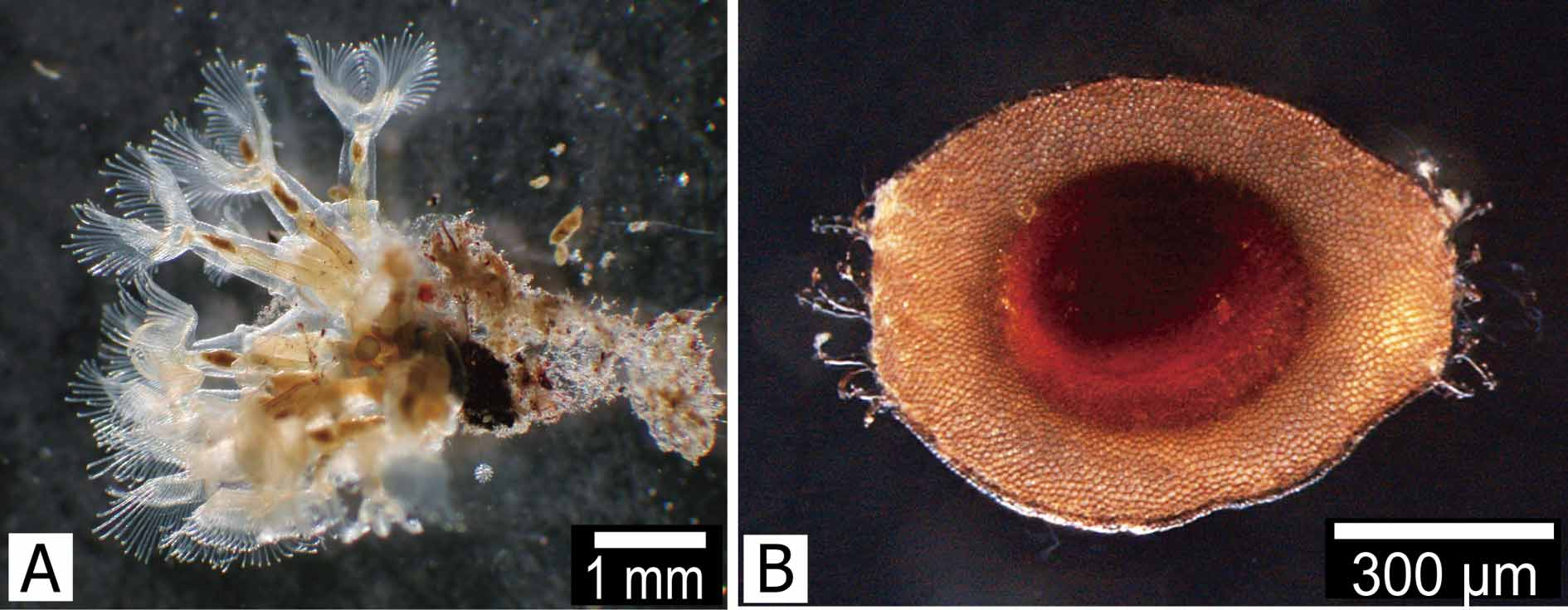
Description. Okinawan colonies transparent, soft, gelatinous, sac-like or lobate in form; our specimens up to about 5 mm in diameter, attached to sunken wood. Ectocyst of colony hyaline, thick, soft, not encrusted (Fig. 9 A); ectocyst of polypides in the short, tubular colony soft. Tentacle number 68 – 82. Floatoblast (spinoblast) a flat, elliptical, disk, 797 – 821 (813 ± 10) μm long by 614 – 631 (621 ± 7) μm wide (n = 5) (Fig. 9 B). Annulus of floatoblast 153 – 192 (175 ± 15) μm wide at sides, 212 – 274 (240 ± 24) μm wide at ends (n = 5); floatoblast with 6 – 10 spines at each end; spines 40 – 60 μm long, with small, hook-shaped lateral projections. Both fenestra and annulus with weak surface reticulation.
Hirose, Masato, Mawatari, Shunsuke F. (2011): Freshwater Bryozoa of Okinawa, Japan, with descriptions of Rumarcanella gen. nov. (Phylactolaemata: Plumatellidae) and two new species. Zootaxa 2732: 1-19, DOI: 10.5281/zenodo.276554
Remarks. Hyatt (1866) first reported Lophopodella carteri from southern Asia, and the species was subsequently reported globally. Variation in the statoblasts of Lophopodella carteri has been well studied (Rogick, 1936; Oda, 1955).
Hirose, Masato, Mawatari, Shunsuke F. (2011): Freshwater Bryozoa of Okinawa, Japan, with descriptions of Rumarcanella gen. nov. (Phylactolaemata: Plumatellidae) and two new species. Zootaxa 2732: 1-19, DOI: 10.5281/zenodo.276554
Distribution. Reported from Asia (India, Java, China, Korea, and Japan), North America, Europe, Africa, Australia, and New Zealand (Lacourt 1968; Wood & Okamura 2005); in Japan, widely distributed from Okinawa to Hokkaido, reported mainly from large lakes on Honshu (Lake Biwa, Kasumiga-ura, Hachiro-gata) and Hokkaido (Utonai Lake).
Hirose, Masato, Mawatari, Shunsuke F. (2011): Freshwater Bryozoa of Okinawa, Japan, with descriptions of Rumarcanella gen. nov. (Phylactolaemata: Plumatellidae) and two new species. Zootaxa 2732: 1-19, DOI: 10.5281/zenodo.276554
Material examined. Several mature colonies and floatoblasts from Fukuji Dam, village of Higashi.
Hirose, Masato, Mawatari, Shunsuke F. (2011): Freshwater Bryozoa of Okinawa, Japan, with descriptions of Rumarcanella gen. nov. (Phylactolaemata: Plumatellidae) and two new species. Zootaxa 2732: 1-19, DOI: 10.5281/zenodo.276554
Export occurrence data
Darwin Core Archive (ZIP)
CLASSIFICATION
Taxonomic Classification Tree

IMAGES