
AnimaliaNot EvaluatedacceptedspeciesAccepted

Rumarcanella yanbaruensis
GBIF:119384689
ABOUT
Descriptions(6)
Description. Colony tubular, branching, transparent; brownish transparent only in basal part (Figs 6 A, B). Floatoblast (Fig. 6 D) oblong-elliptical; large, 350 – 416 (387 ± 21) μm long (n = 16) by 205 – 262 (231 ± 21) μm wide; length / width ratio about 1.8; sides almost parallel (Figs 6 C, D); ventral fenestra oval, 203 – 249 (242 ± 11) μm long by 168 – 196 (192 ± 7) μm wide; dorsal fenestra 171 – 202 (192 ± 9) μm long by 137 – 161 (153 ± 6) μm wide. Surface of floatoblast fenestrae entirely covered by low, rounded tubercles topped with hypertubercles (Figs 7 A – D). Floatoblast valves nearly symmetrical in lateral and transverse views; both valves nearly flat; fenestra of ventral valve convex; floatoblast suture line finely denticulate (Figs 7 B, D). Annulus wider at both ends; annulus of ventral valve 15 – 20 μm wide on sides, 70 – 80 μm wide at ends; annulus of dorsal valve about 20 – 25 μm wide on sides and 90 – 120 μm wide at ends; annulus sculpturing comprising a coarse pavement of circular elements. Sessoblast (Fig. 7 E) rounded-elliptical, 258 – 310 (288 ± 21) μm long by 205 – 237 (219 ± 13) μm wide (n = 5), length / width ratio about 1.3; fenestra covered with small cylindrical tubercles; annulus weakly reticulate; margin of annulus coarsely serrate (Fig. 7 F).
Hirose, Masato, Mawatari, Shunsuke F. (2011): Freshwater Bryozoa of Okinawa, Japan, with descriptions of Rumarcanella gen. nov. (Phylactolaemata: Plumatellidae) and two new species. Zootaxa 2732: 1-19, DOI: 10.5281/zenodo.276554
Plumatella sp. 1. Hirose et al. 2008: 65.
Hirose, Masato, Mawatari, Shunsuke F. (2011): Freshwater Bryozoa of Okinawa, Japan, with descriptions of Rumarcanella gen. nov. (Phylactolaemata: Plumatellidae) and two new species. Zootaxa 2732: 1-19, DOI: 10.5281/zenodo.276554
Remarks. Although colonies of Rumarcanella yanbaruensis resemble Hyalinella colonies, the tuberculate sessoblast and thin colony wall are very similar to those in R. vorstmani. The floatoblast of R. yanbaruensis resembles that of Hyalinella lendenfeldi in the wide annulus and flat form, but is smaller with larger fenestrae than in H. lendenfeldi. The fenestrae of R. yanbaruensis are similar in size to fenestrae in old illustrations of Plumatella princeps (e. g. Kraepelin 1887), but R. yanbaruensis clearly differs from P. princeps, P. emarginata, and related species in having a large dorsal fenestra, wide flat annulus and denticulate suture line. A molecular phylogeny (Hirose et al. 2008) showed R. yanbaruensis to be basal in a clade containing the four species of Rumarcanella.
Hirose, Masato, Mawatari, Shunsuke F. (2011): Freshwater Bryozoa of Okinawa, Japan, with descriptions of Rumarcanella gen. nov. (Phylactolaemata: Plumatellidae) and two new species. Zootaxa 2732: 1-19, DOI: 10.5281/zenodo.276554
Distribution. Known only from the Yambaru area, northern Okinawa.
Hirose, Masato, Mawatari, Shunsuke F. (2011): Freshwater Bryozoa of Okinawa, Japan, with descriptions of Rumarcanella gen. nov. (Phylactolaemata: Plumatellidae) and two new species. Zootaxa 2732: 1-19, DOI: 10.5281/zenodo.276554
Etymology. The species name is from the Ryukyuan language yanbaru, in reference to the Yanbaru area, where the type locality is located.
Hirose, Masato, Mawatari, Shunsuke F. (2011): Freshwater Bryozoa of Okinawa, Japan, with descriptions of Rumarcanella gen. nov. (Phylactolaemata: Plumatellidae) and two new species. Zootaxa 2732: 1-19, DOI: 10.5281/zenodo.276554
Material examined. Holotype. Colony with floatoblasts, collected 2 November 2007 from Benoki Dam, village of Kunigami; specimen deposited in National Science Museum, Tokyo (NSMT-Te 680). Paratype. Colony with floatoblasts, same collection data as for holotype; specimen deposited in National Science Museum, Tokyo (NSMT-Te 681). Other material examined. Floatoblasts, Fukuji Dam, village of Kunigami.
Hirose, Masato, Mawatari, Shunsuke F. (2011): Freshwater Bryozoa of Okinawa, Japan, with descriptions of Rumarcanella gen. nov. (Phylactolaemata: Plumatellidae) and two new species. Zootaxa 2732: 1-19, DOI: 10.5281/zenodo.276554
Export occurrence data
Darwin Core Archive (ZIP)
CLASSIFICATION
Taxonomic Classification Tree

MULTIMEDIA
Media Files(2)
FIGURE 6. Rumarcanella yanbaruensis n. sp. A, colony. B, floatoblast, ventral (left) and dorsal (right) valves.
Imageimage/png© Hirose, Masato;Mawatari, Shunsuke F.Hirose, Masato;Mawatari, Shunsuke F.
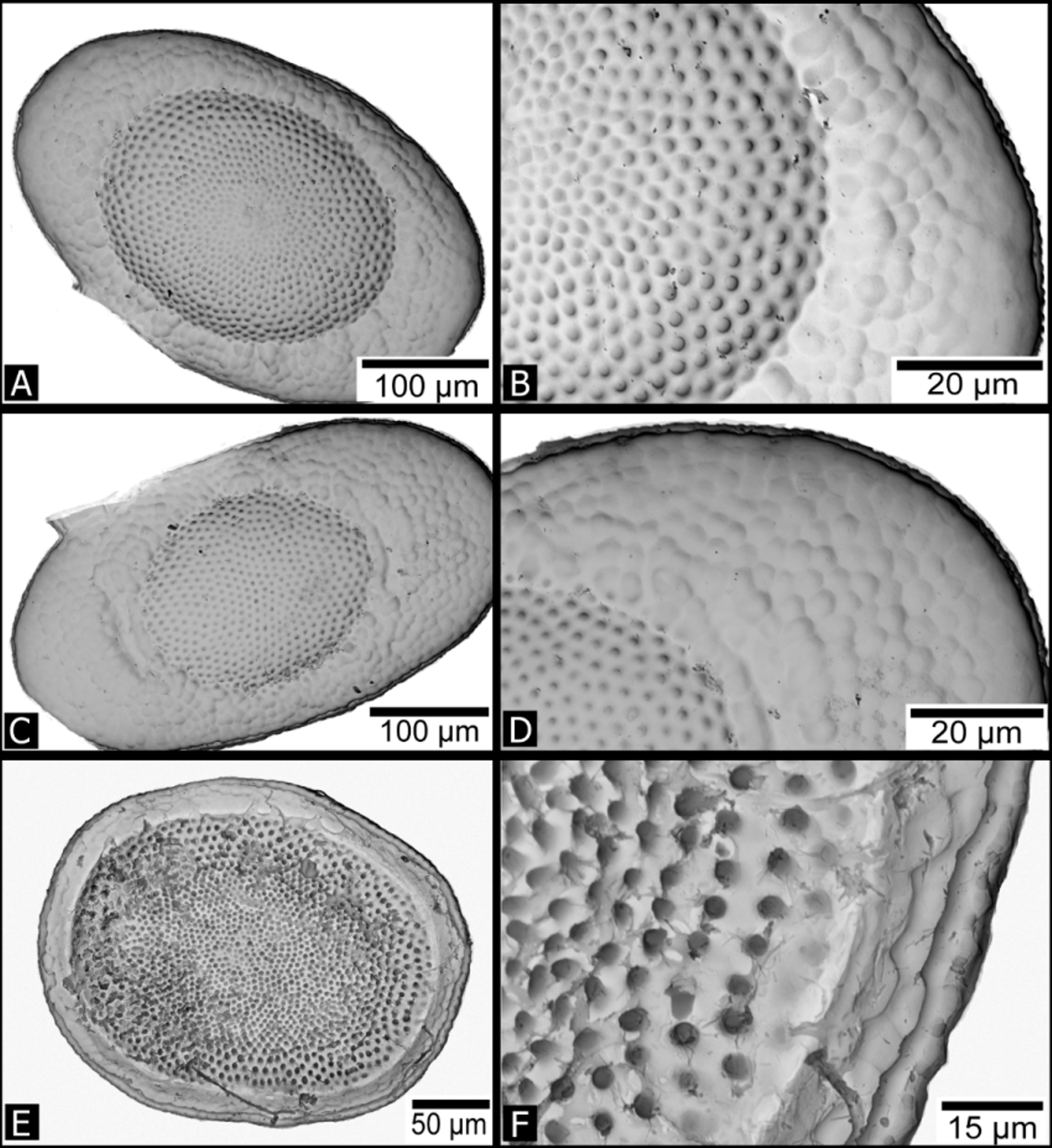
FIGURE 7. Rumarcanella yanbaruensis n. sp. SEM micrographs of statoblasts. A, floatoblast ventral valve. B, enlargement of A, showing hypertubercles on the fenestra. C, floatoblast dorsal valve. D, enlargement of C, showing hypertubercles on the fenestra. E, sessoblast. F, enlargement of E, showing cylindrical tubercles on the fenestra.
Imageimage/png© Hirose, Masato;Mawatari, Shunsuke F.Hirose, Masato;Mawatari, Shunsuke F.
IMAGES