AnimaliaNot EvaluatedacceptedspeciesAccepted
Ophryotrocha shieldsi

Ophryotrocha shieldsi

GBIF:119388599

ABOUT

Descriptions(5)

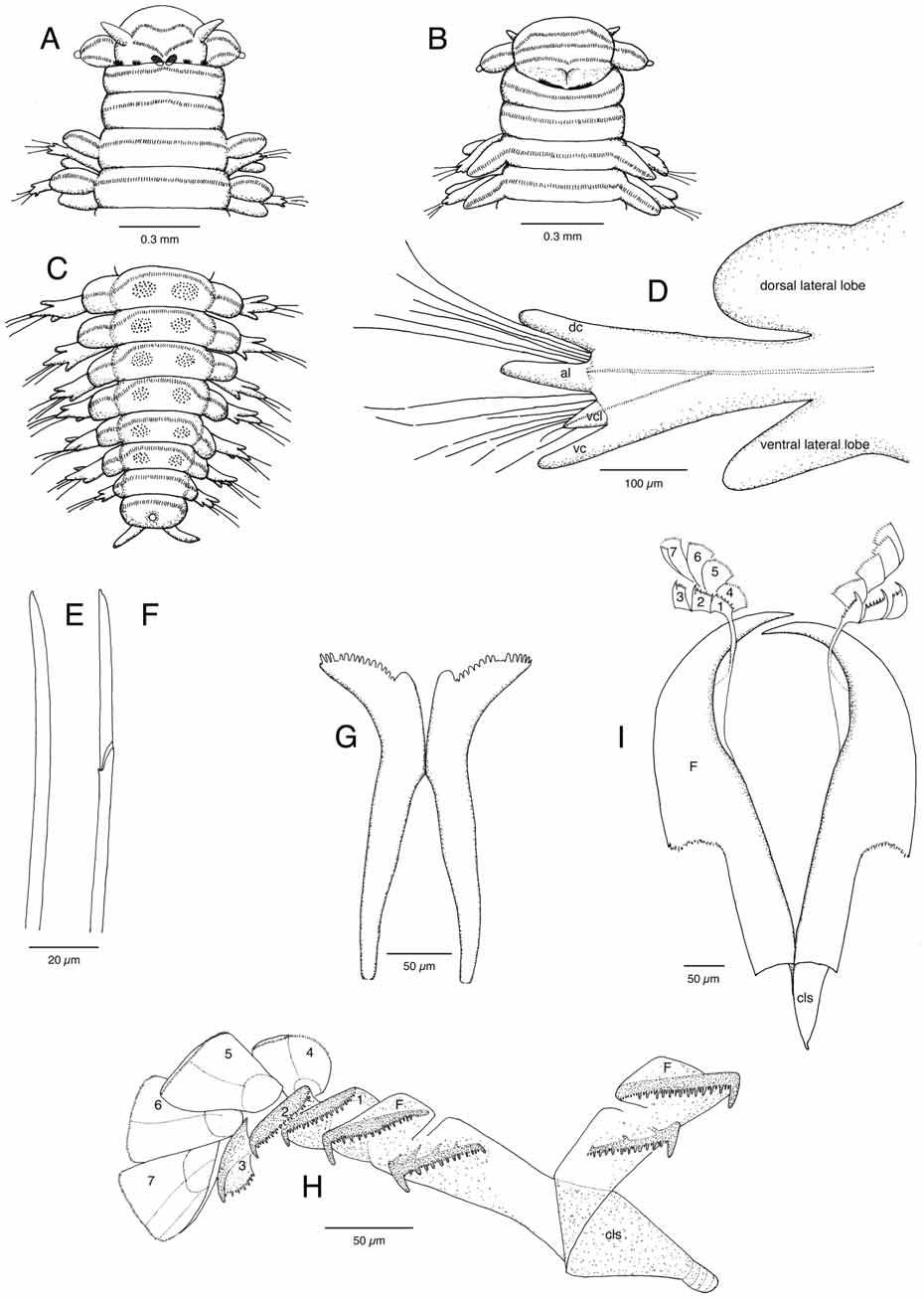
Description. Live specimens up to 16 mm long for 46 chaetigers. Length of holotype 7.3 mm for 43 chaetigers (paratypes 2.5 – 6.0 mm for 29 – 36 chaetigers), width of holotype 0.9 mm including dorsal lateral lobes at chaetiger 10 (paratypes 0.3 – 0.7 mm). Live specimens with striking colour pattern of salmon pink pigmentation on peristomial rings and lateral segmental lobes, body otherwise whitish. Preserved specimens opaque white. Body long, slender, slightly tapering towards posterior end, dorsal side convex, ventral side slightly concave (Fig. 2 A, C). Prostomium (Figs. 2 B, 3 A) with ciliary ring in front of antennae, continuous across palpophores, additional incomplete band dorsally behind antennae and ventrally in front and behind ciliary ring (Figs. 2 C, 3 B); peristomial rings and chaetigerous segments encircled by ciliary rings, continuous across lateral dorsal and ventral lobes. Prostomium about twice as wide as long, bearing pair of dorsolateral cirriform antennae and pair of ventrolateral biarticulate palps. Palps consisting of large palpophore and small globular palpostyle. Pair of oval slanted eyes (Fig. 3 A) at centre of posterior edge of prostomium, posteriorly almost touching, anteriorly further apart. Eyes internal, light-reflecting structures, appearing silvery white in live animals under incident light but invisible in preserved specimens. Nuchal organs at level of eyes, two at either side of eyes. Peristomium represented by 2 apodous achaetous rings, similar in length to following chaetigers. Chaetigers with well developed parapodia and prominent dorsal and ventral lateral lobes. Dorsal lobes (Figs. 2 A, 3 A, C) ovate, cushion-like, ventral lobes (Figs. 2 C, 3 B) digitate to triangular; lobes present on all chaetigers but best developed in middle body region. Parapodia (Fig. 2 D, 3 D) uniramous, long and slender, distally dilating, bearing dorsal and ventral cirrus and acicular lobe; each structure digitate, about as long as median width of parapodium. Parapodia supported by acicula, terminating in acicular lobe and subacicular short simple chaeta or accessory acicula, emerging from ventral chaetal lobe; chaetal lobe in most cases completely retracted (Fig. 2 D, E) or expanded to triangular lobe (Fig. 3 D). Chaetae long and very thin (Fig. 2 E); supra-acicular fascicle with 5 - 8 simple spatulate chaetae (Fig. 3 E), subacicular fascicle with 5 - 7 heterogomph falcigers (Fig. 3 F); upper part of simple chaetae and appendage of falcigers minutely serrated, with blunt tip; shaft of falciger minutely serrated. Pygidium wider than long, with pair of digitate pygidial cirri; anus dorsal (Fig. 3 C). Mature males with rosette glands, paired dorsal segmental glandular structures on posterior half of body (Figs. 2 F, 3 C). Structures consisting of circular clusters of large cells with perforated integument (Fig. 2 G) (for discussion of rosette glands see Paxton & Åkesson 2007). Mandibles strongly sclerotised, black; consisting of two elongate shafts widening to distal cutting plates with slightly curved anterior edge with medial roundish protrusion and 13 – 16 conical teeth (Fig. 3 G). Maxillary apparatus of P- and K-type; maxillae consisting of forceps fused with carrier-like structure and 7 pairs of anterior denticles (D). P-type maxillae occurring in females and immature males, weakly sclerotised with serrated ridges slightly darker (Figs. 2 H, 3 H). P-forceps with two transverse ridges, each with about 30 alternating larger and smaller teeth and a large fang. Denticles 1 – 3 similar to ridges of forceps with alternating large and small teeth and fang, D 4 – 7 more delicate, with very finely serrated edge. K-type maxillae only in mature males, darkly sclerotised, almost black (Fig. 3 I). K-forceps smooth, distally falcate. Denticles attached by ligament strut to forceps; serration of denticles similar to P-type but with fewer teeth.
Paxton, Hannelore, Davey, Adam (2010): A new species of Ophryotrocha (Annelida: Dorvilleidae) associated with fish farming at Macquarie Harbour, Tasmania, Australia. Zootaxa 2509: 53-61, DOI: 10.5281/zenodo.196027

Remarks. The new species is the fourth species of the O. lobifera group. Like O. lobifera it has cushionlike lateral lobes. However, in O. lobifera the dorsal lobes are triangular, while in O. shieldsi they are ovate. Other differences are: O. shieldsi has palps with small globular rather than longer digitate palpostyles, Pmaxillae with forceps and denticles serrated by alternating large and small teeth rather than uniform teeth, and mandibles with curved rather than straight anterior edge. Ophryotrocha lipovskyae and O. craigsmithi differ from both species by possessing lamella-like lateral dorsal lobes. Analysis of DNA sequences of the mitochondrial CO 1 and ribosomal 16 S genes has demonstrated that O. shieldsi is sufficiently genetically isolated from the other three species to warrant specific status (Helena Wiklund, personal communication 2009). Accession numbers for DNA sequences from O. shieldsi, published on GenBank: HM 181931 (CO 1), HM 181932 (16 S).
Paxton, Hannelore, Davey, Adam (2010): A new species of Ophryotrocha (Annelida: Dorvilleidae) associated with fish farming at Macquarie Harbour, Tasmania, Australia. Zootaxa 2509: 53-61, DOI: 10.5281/zenodo.196027
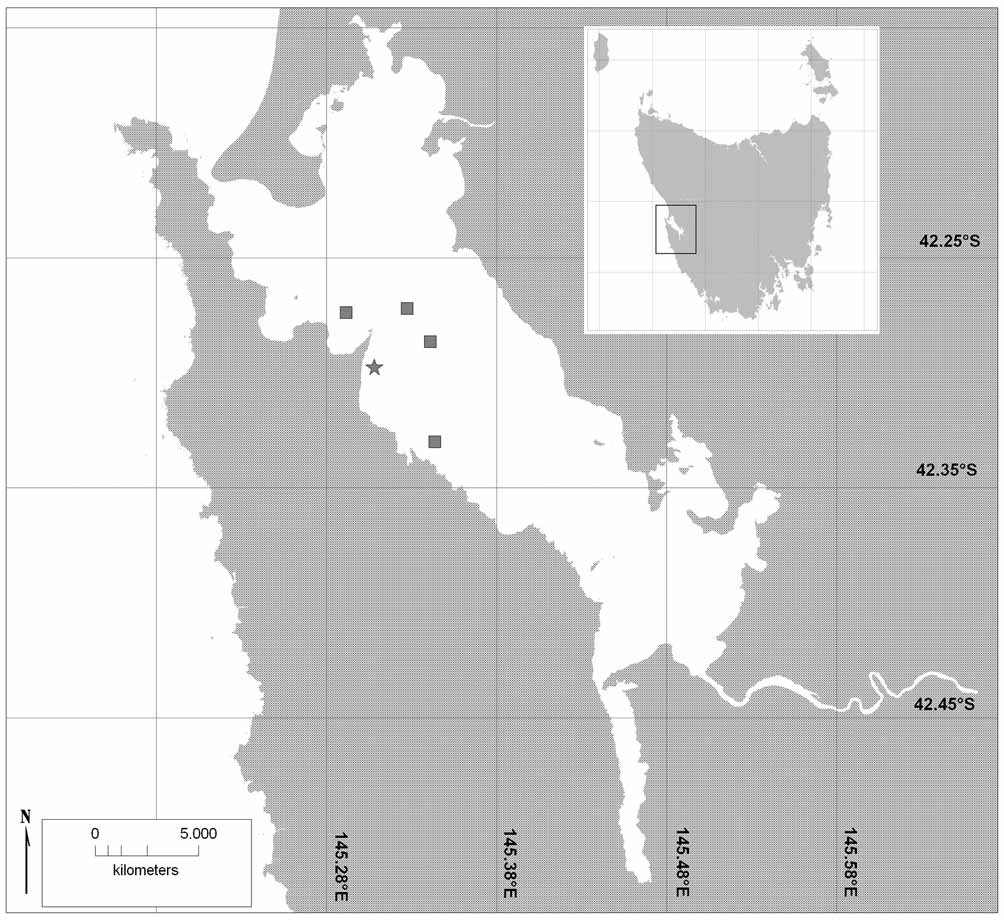
Distribution. At present only within Macquarie Harbour, Tasmania, directly underneath salmon cages.
Paxton, Hannelore, Davey, Adam (2010): A new species of Ophryotrocha (Annelida: Dorvilleidae) associated with fish farming at Macquarie Harbour, Tasmania, Australia. Zootaxa 2509: 53-61, DOI: 10.5281/zenodo.196027
Etymology. The new species is named in honour of Derek Shields, who originally observed the aggregations of the new species, and encouraged the second author to study these animals.
Paxton, Hannelore, Davey, Adam (2010): A new species of Ophryotrocha (Annelida: Dorvilleidae) associated with fish farming at Macquarie Harbour, Tasmania, Australia. Zootaxa 2509: 53-61, DOI: 10.5281/zenodo.196027
Material examined. Type material: Liberty Point, Macquarie Harbour, Tasmania, 42 º 18 ’ 17.21063 ” S; 145 º 19 ’ 14.60318 ” E, beneath sea cages, 20 m, SCUBA diving, February 2002, collectors A. Davey, J. Lane, D. Shields, holotype (AM W. 36644), 10 paratypes (AM W. 36645); same locality and collectors, 20 m, modified ROV, 4 February 2009, 20 paratypes (AM W. 36646). DNA voucher specimen: Same locality and collectors, 4 February 2009 (GNM Polychaeta 13224).
Paxton, Hannelore, Davey, Adam (2010): A new species of Ophryotrocha (Annelida: Dorvilleidae) associated with fish farming at Macquarie Harbour, Tasmania, Australia. Zootaxa 2509: 53-61, DOI: 10.5281/zenodo.196027

Export occurrence data

Darwin Core Archive (ZIP)

CLASSIFICATION

Taxonomic Classification Tree

MULTIMEDIA

Media Files(3)

FIGURE 1. Maps of Tasmania (inset) and Macquarie Harbour. Squares and star denote locations of sea cages, with star marking type locality of Ophryotrocha shieldsi, sp. nov.

Imageimage/png© Paxton, Hannelore;Davey, AdamPaxton, Hannelore;Davey, Adam

FIGURE 2. Ophryotrocha shieldsi, sp. nov. SEM images. A, complete specimen, dorsal view; B, anterior end, dorsal view; C, same, ventral view; D, median parapodia, anteroventral view; E, distal part of parapodium showing chaetae, anterior view; F, posterior body region, showing paired rosette glands, dorsal view; G, enlarged rosette gland; H, Pmaxillae, ventral view.

Imageimage/png© Paxton, Hannelore;Davey, AdamPaxton, Hannelore;Davey, Adam

FIGURE 3. Ophryotrocha shieldsi, sp. nov. A, anterior end, dorsal view. B, same, ventral view; C, posterior end, dorsal view; D, median parapodium, anterior view; E, simple chaeta; F, heterogomph falciger; G, mandibles, dorsal view; H, Pmaxillae, dorsal view; I, K-maxillae, dorsal view; Abbreviations: al, acicular lobe; cls, carrier-like structure; dc, dorsal cirrus; F, forceps; vc, ventral cirrus; vcl, ventral chaetal lobe; numerals refer to anterior denticles.

Imageimage/png© Paxton, Hannelore;Davey, AdamPaxton, Hannelore;Davey, Adam

IMAGES

Gallery(3)

See Gallery

Occurrences with images

Source Information

A new species of Ophryotrocha (Annelida: Dorvilleidae) associated with fish farming at Macquarie Harbour, Tasmania, Australia

checklist

This dataset contains the digitized treatments in Plazi based on the original journal article Paxton, Hannelore, Davey, Adam (2010): A new species of Ophryotrocha (Annelida: Dorvilleidae) associated with fish farming at Macquarie Harbour, Tasmania, Australia. Zootaxa 2509: 53-61, DOI: 10.5281/zenodo.196027

Abstract

Ophryotrocha shieldsi, sp. nov. is described from Macquarie Harbour, Tasmania, Australia, where it occurs in high densities beneath the sea cages of fish farms. SCUBA and ROV underwater observations revealed closely spaced mounds of aggregations of the new species. It is closely related to O. lobifera Oug, a species reported from fish farms and whale-falls in the North Sea, from which it can be distinguished by its ovate rather than triangular dorsal lateral lobes, palps with small globular rather than longer digitate palpostyles, and additional jaw differences.

Key words: Polychaeta, fish farms, organic enrichment, taxonomy

Paxton H, Davey A, plazi (2010). A new species of Ophryotrocha (Annelida: Dorvilleidae) associated with fish farming at Macquarie Harbour, Tasmania, Australia. Plazi.org taxonomic treatments database. Checklist dataset https://doi.org/10.5281/zenodo.196027 accessed via GBIF.org on 2026-06-15.

CC0Published 12/31/2010View dataset
GBIF Usage Key
119388599
Dataset Key
040c51cb-fd0f-461e-91fa-8032717a2a80
Origin
source
Backbone Key
6785265
Taxon ID
337AED51FFC8FFB942C64771CB3EF850.taxon
Last Crawled
6/11/2026
Last Interpreted
6/11/2026