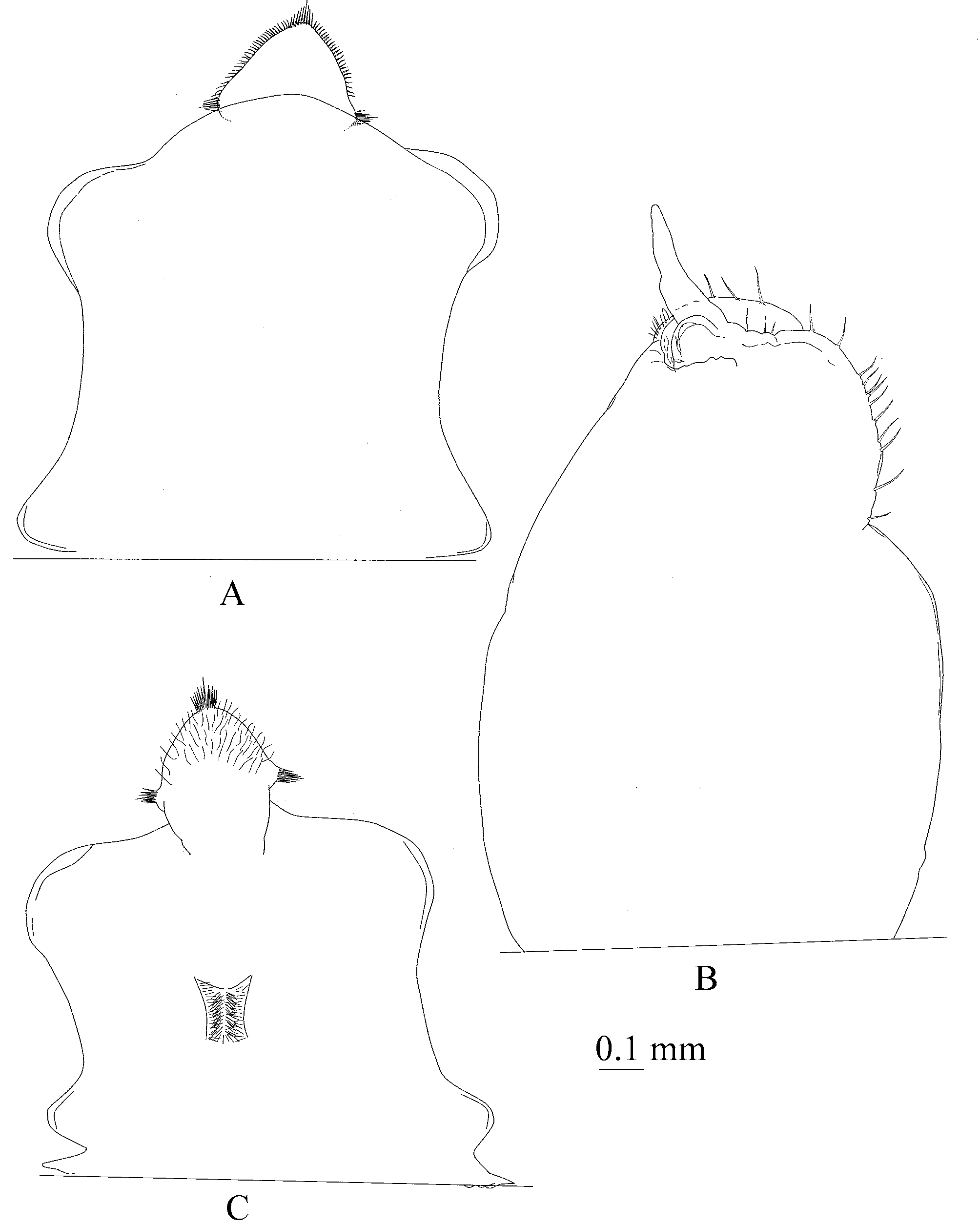
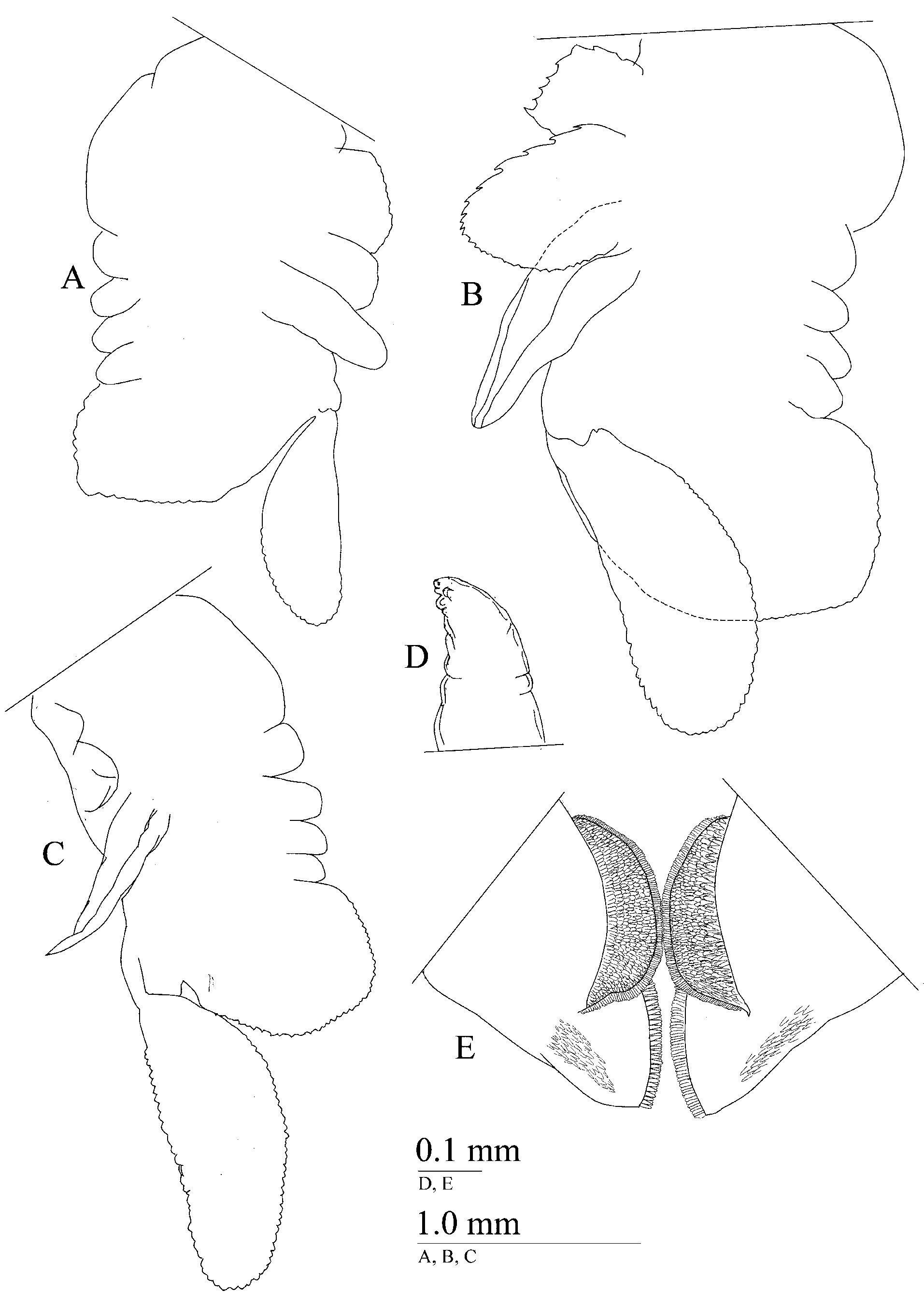
Description. Male. Length of preserved material 12.6 mm. Thoracic and abdominal somites unadorned. First antennae (Fig. 8 C) approximately as long as the first antennomere of the second antennae, with claviform tip, provided with three long sub-apical setae and 10 apical aesthetascs. Second antennae (Fig. 8 B; Fig. 14 a – c) short and strong. The first antennomere (Fig. 15 G), longer than the second, is cylindrical and bent medially; proximally, it bears a well developed cylindro-conical apophysis, half as long as the antennomere. The apophysis ends in an apex densely covered by denticles. The second antennomere is strong, falciform, bent medially and exhibiting on its medial margin a hook-like expansion at one-third of its length. On the inner margin, a conical, pointed apophysis bearing a few tubercles on its surface arises near the origin of this antennomere and is one-sixth the length of the antennomere. Lower lamella (Fig. 8 A) small and triangular, without a carina, with lobes and tubercles along the margins and on the surface; latero-proximally, there are four finger-like expansions more markedly developed than the remaining ones, giving the lamella an asymmetrical appearance. Upper lamella (Figs. 8 E – D) long, narrow and pointed, bearing on each side a series of numerous, almost similar digitiform expansions decreasing in size toward the pointed apex. On its lateral margin, there is a group of three-four robust, much more developed digitiform expansions. Labrum (Figs. 9 A – C) characterized by the shape of the ventral distal process and by the presence and position of three groups of longer setae. Mandibles asymmetrical (Figs. 14 d – f). Right mandible: molar surface bearing, at its posterior tip, three pointed projections of the same length. Left molar surface provided with 8 stout teeth differing in size on the lateral outer margin. First pair of maxillae could not be observed. in the sole male available for study. Thoracopods: notopods of the first, sixth and eleventh pair are illustrated (Figs. 10 A – C). The feature of the endopodites of the first and eleventh pair, the first in particular, is characteristic; the margins of those of the sixth and seventh pair do not exhibit the projections observed in the two previously described species. Gonopods. The apophyses of the basal gonopods are wide and short (Fig. 10 E). Apical part of the retractile part of the gonopods (Fig. 10 D) curved and ending in three tiny tubercles. Cercopods longer than the last three metameres. Female: length measured as in the male: 12.3 mm. First antennae and oral appendages as in the male. Second antennae (Figs. 9 B; 15 I), seen dorsally, roughly elliptical and ending in a thin apex bent upwards, slightly longer than half the length of the first pair. Labrum and notopods as described in the male. Thoracic segments. Eighth to eleventh provided with latero-dorsal bulges, varying in shape and size depending on the metamere (Figs. 11 A, C). Their number also differs: there are five in the eighth, four in the ninth, two very small in the tenth, and two large and spherical in the eleventh. The eleventh somite also presents two large tubercles on each side (Fig. 11 D). Brood pouch oval (Fig. 11 B and 15 H), roughly reaching the distal margin of the third abdominal somite. Cercopods, as in the male, longer than the last three abdominal somites. Cyst morphology. The morphology of the cysts (Fig. 14 g) is peculiar and markedly differs from any of the previously examined Chirocephalus species (35 of the 49 known, see Mura, 2001), either in the “ diaphanus ” group or in the remaining ones. The surface of the cysts appears somewhat “ reticulated ” due to the presence of low intersecting ridges. Affinities. We hesitated for a long time before proposing Chirocephalus brteki sp. nov. since, having only two specimens, we did not have information on the constancy or variability of the considered characters. Our decision to propose the new species was based on the fact that such characters are constant in other species of the same group recently described by us. We hope that the discovery of other material will allow us to supplement the present description. Based on the discussed characters, the new species can certainly be ascribed to the “ bairdi ” species group (Brtek, 1995), presently including another seven species and one subspecies: Chirocephalus bairdi (Brauer, 1877); C. kerkyrensis (Pesta, 1936); C. brevipalpis (Orghidan, 1953); C. orghidani Brtek, 1966; C. vornatscheri Brtek, 1968; C. vornatscheri bulgaricus Flossner, 1980; C. murae Brtek & Cottarelli, 2006; C. anatolicus Cottarelli, Mura & Özkütük, 2007. (For further details on the species group, see Brtek & Cottarelli, 2006). The second antennae of the males conform to a pattern quite common to all of the species of the group; the distal article of these appendages, with a relatively small basal apophysis and some tubercles, resembles those seen in C. kerkyrensis and C. murae, and to a lesser degree the corresponding structure of C. bairdi. However, this article is bent in the above three species but not in the new species. Likewise, the ratio between the length of the distal portion from the hook-like expansion to the apex and the length of the entire article is different. The apophysis of the basal article of the antenna is claviform and twice as long as the distal one. Because of these features, the new species is closest to C. kerkyrensis and most distant from C. brevipalpis. C. brteki sp. nov. is characterized by an upper lamella longer than the lower lamella and by three digitiform latero-basal expansions: a similar morphology can be seen in C. kerkyrensis (cf. Cottarelli 1965), C. brevipalpis and C. murae. C. brteki sp. nov. clearly differs from the remaining species of the group by the peculiar pattern of the lower lamella, very unlike what is observed in the other taxa of the “ bairdi ” group. In fact, many species of the group (C. kerkyrensis, C. vornatscheri, C. orghidani, C. murae, C. anatolicus) have a lower lamella more or less markedly divided into two lobes. The structure of the rigid part of the gonopods (particularly wide and short) is another discriminant feature: in this regard, C. vornatscheri and C. brevipalpis are closest to the new species, in that C. murae, C. anatolicus and C. kerkyrensis have a much narrower and longer rigid part of the gonopods. The eversible portion differs from the corresponding one in C. murae, being narrower and longer, whereas in C. anatolicus it is bent almost at a right angle at its apex. No description is available for the other taxa of the group. As regards the particular ornamentation on somites VIII – XI in the female of C. brteki, it can be noted that many other species of this group are characterized by ornamented thoracic, genital or abdominal metameres (cf. Brtek & Cottarelli, 2006; Cottarelli et al., 2007). However, each one, including the new species, can easily be recognized by its exclusive pattern. In its shape and pattern, the brood pouch resembles that of C. kerkyrensis and seems slightly longer and more tapering than those of C. murae and C. anatolicus.
Cottarelli, Vezio, Aygen, Cem, Mura, Graziella (2010): Fairy shrimps from Asiatic Turkey: Redescription of C hirocephalus tauricus Pesta, 1921 and descriptions of C hirocephalus algidus sp. nov. and C hirocephalus brteki sp. nov. (Crustacea, Branchiopoda, Anostraca). Zootaxa 2528: 29-52, DOI: 10.5281/zenodo.196472