
AnimaliaNot EvaluatedacceptedspeciesAccepted
Aplidiopsis chilensis
GBIF:119391090
ABOUT
Descriptions(3)
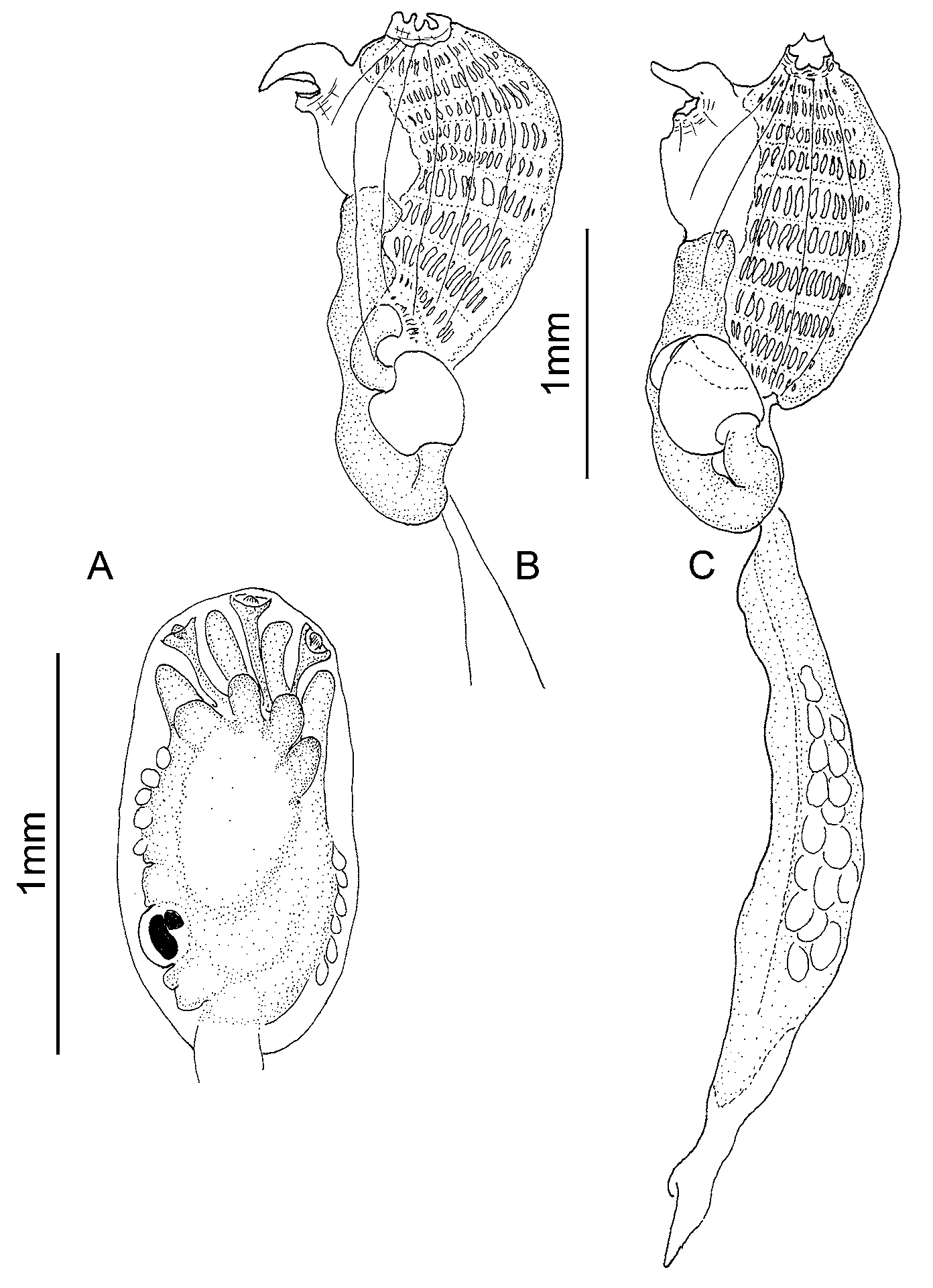
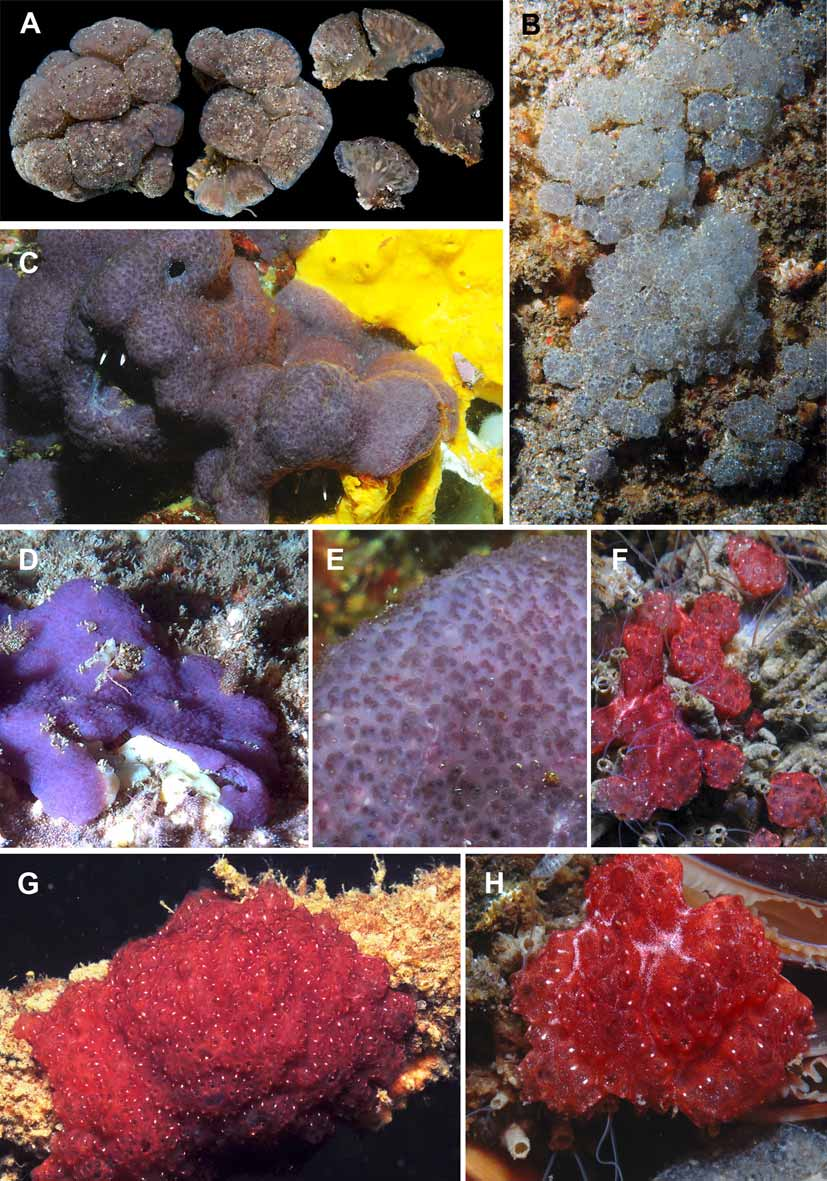
Description. Preserved material is represented by several fragments, largest of which is 2.5 cm wide and about 1.5 cm high, separated from a larger colony. Colony consists of numerous small crowded heads attached to a common base by short stalks rapidly narrowing basally. In the preserved specimen heads are almost flat topped; on underwater photograph of the living specimen they are more inflated and hemispherical (Figure 6 B). Each head has one or a few circular systems, each with one large central cloacal opening on a short siphon visible clearly only in live. Sparse sand grains are attached to surface of the test but completely absent inside, otherwise the test is clear and transparent, especially in the upper expanded part of heads. Living specimen appears to be colourless, formalin preserved material is dull gray-brownish due to colour of zooids. Zooids are up to 4.5 mm long with wide thorax and narrower abdomen together about 2 mm. They are almost parallel to each other and open on the top of the head. Almost sessile branchial aperture has usual six small pointed lobes. The atrial aperture sometimes drawn into a wide short siphon with the upper border extending into a wide, rather short, simple atrial lip. Fine muscles encircle both apertures to form weak sphincters, and about 6 thin longitudinal muscles run from the branchial aperture to the bottom of the thorax where they bunch together into a weak band continuing to the end of abdomen. In general, thoracic muscles appear to be rather weak and in many zooids (preserved without anesthesia) thoraces are not contracted. The branchial sac has usually 10, rarely 11, rows of 11 to 13 stigmata. The abdomen is two or three times shorter than the thorax. The gut loop is not twisted, but smooth walled asymmetrical stomach obliquely oriented and a short oesophagus curves at a right angle to enter to it (Figure 2 B). Post pyloric part of the gut loop is short and the intestine has no clear division into regions. The rectum opens with a slit-like anus on the level of the middle of the thorax. No gastric reservoir was detected. The postabdomen is not particularly long, being only slightly longer than the thorax and abdomen together, attached by a narrow stalk to the left side of the abdomen. Typically it is spindle-shaped, being wider in its middle part, and in most zooids is filled by parenchymatous tissue. Male follicles are in the middle of postabdomen, arranged in more than two rows. No ovary seen and no larva present in the examined material.
Sanamyan, Karen, Schories, Dirk, Sanamyan, Nadya (2010): New records of aplousobranch ascidians from Central Chile. Zootaxa 2537: 58-68, DOI: 10.5281/zenodo.196669
Remarks. The genus Aplidiopsis currently comprises 17 species no one of which has been recorded from the Pacific coasts of South America. The present species is characterized by a combination of characters including the shape of the colony, small number of rows of stigmata, position of the atrial languet on the upper rim of the atrial opening. Aplidiopsis discoveryi Millar, 1960 from New Zealand has 14 rows of stigmata and colony of irregular shape. Colony of A. amoyense Tokioka, 1967 from China is composed of similar lobes and has small number of rows of stigmata (12), but the systems are stellate rather than circular, and unlike the present species, the atrial languet is inserted far anterior to atrial aperture. Aplidiopsis tokaraensis Tokioka, 1954 also has 12 rows of stigmata but the number of stigmata in each row is much larger, 18 – 20. Other Pacific species also differ significantly from the present one: Australian A. mammillata Kott, 1992 and A. sabulosa Kott, 1992 have very long thoraxes (18 and 20 rows of stigmata) and A. confluata Kott, 1992 has different colony and zooids. Indonesian A. ocellatus Monniot & Monniot, 1996 has 17 rows of stigmata and different colony. New Caledonian A. gelidus has 11 rows of stigmata but different shape of postabdomen and has a different colony. Common North Pacific A. pannosum has very different massive colonies. Aplidiopsis chilensis n. sp. so far is known from the single colony and most probably is a rare species in the studied region, we never saw similar colonies on hundreds of underwater photographs taken on diver accessible depths along the coasts of central and southern Chile.
Sanamyan, Karen, Schories, Dirk, Sanamyan, Nadya (2010): New records of aplousobranch ascidians from Central Chile. Zootaxa 2537: 58-68, DOI: 10.5281/zenodo.196669
Material examined: Chile, 4. region: Punta de Choros, wreck Lynch, 20 m, 20 November 2009, one colony. Holotype KBPIG 1397 / 1.
Sanamyan, Karen, Schories, Dirk, Sanamyan, Nadya (2010): New records of aplousobranch ascidians from Central Chile. Zootaxa 2537: 58-68, DOI: 10.5281/zenodo.196669
Export occurrence data
Darwin Core Archive (ZIP)
CLASSIFICATION
Taxonomic Classification Tree

IMAGES