
AnimaliaNot EvaluatedacceptedspeciesAccepted
Distaplia arnbackae
GBIF:119391097
0
Synonyms
ABOUT
Descriptions(5)
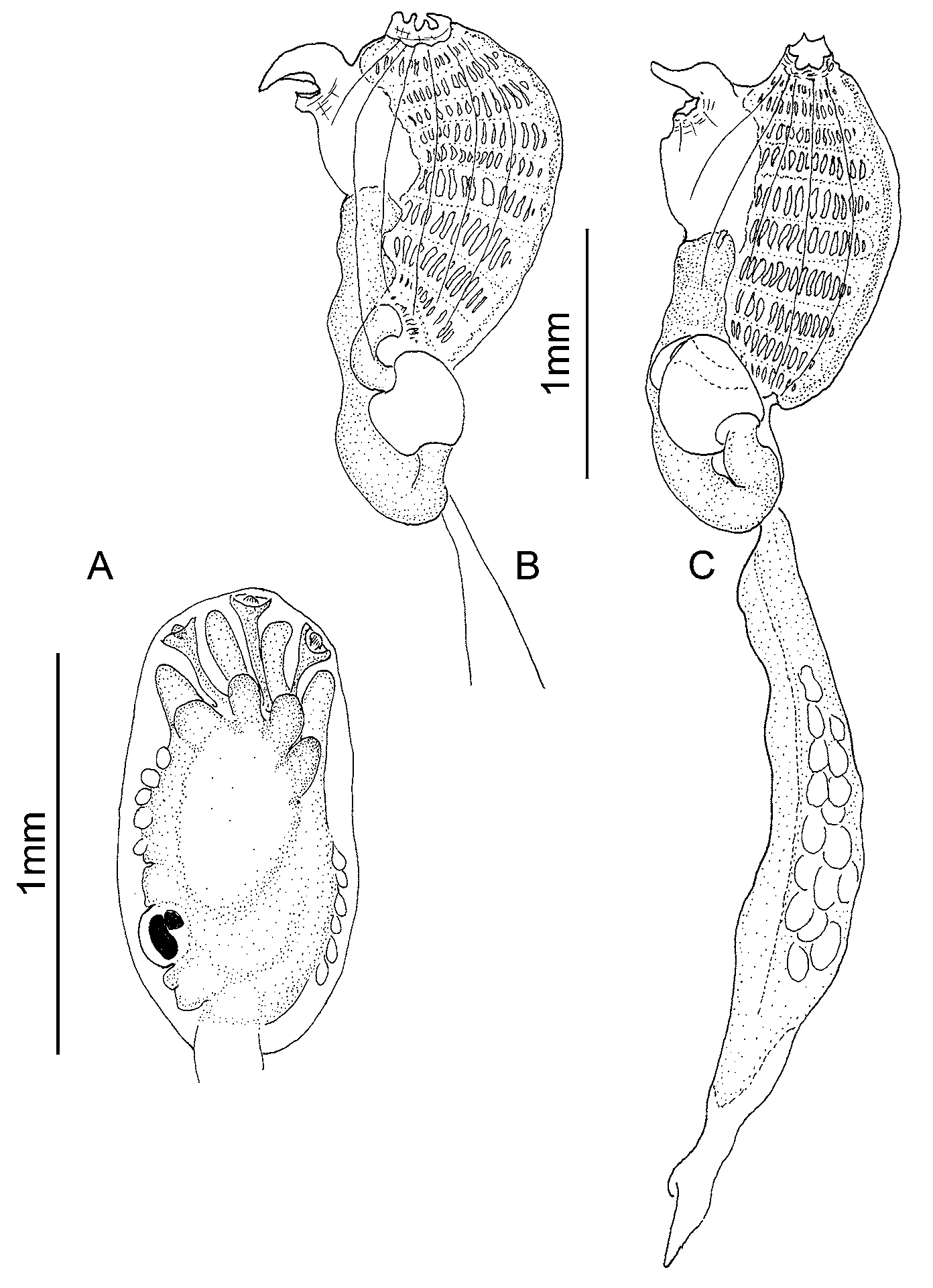
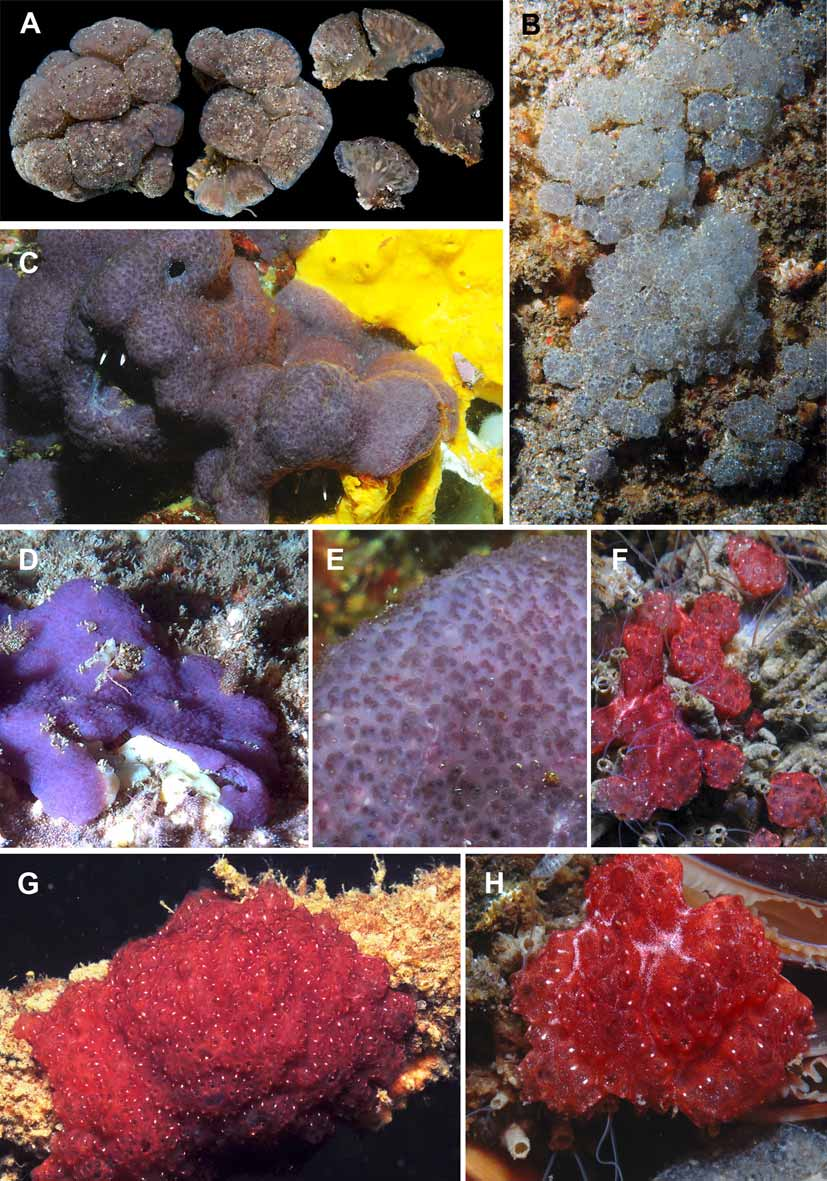
Description. Younger colonies consist of several small button shaped cormidiums some of which are well separated and some fused together (Figure 6 F); larger colonies are mostly solid encrusting sheets or cushions attached to substratum by the whole lower surface. In preservative they are rarely more than 5 mm thick and the largest collected colony is about 5 cm in extent. The test is free from encrusting or embedded sand and has soft spongy consistence characteristic for many Distaplia species. Zooids open on the upper surface only and are arranged into crowded circular or oval systems, each containing about 10 to 20 zooids with a cloacal opening in its centre. In younger colonies the systems are less crowded and are separated from each other by a shallow groove; smaller, button shaped colonies contain mostly a single system. The colour is very constant, all collected colonies as numerous seen on underwater photographs are always brilliant scarlet red, sometimes with sparse minute granules of white pigment especially between the systems, and often with white dot or a short white band on intersiphonal area of each zooid sometimes extending to the atrial languet. These markings may appear on photographs as small white splashes (Figure 6 G, H). The colour is not retained in preservative (formaline) for a long time, the preservative extracts red pigment, become purple-violet, and colonies fade to gray in about one year. Contracted zooids are no more than 3 mm long. Elongated branchial siphon has 6 small rounded lobes. Atrial aperture is a narrow transverse slit with short plain edged anterior languet; sometimes short atrial siphon is present (Figure 4 B). Crowded circular muscles form a sphincter around the branchial siphon and similar, but more spaced muscles are around trial aperture. About 15 fine spaced muscles are on the thorax. Some of them originate at the base of the branchial siphon, but most run obliquely from ventral side to the base of the thorax. Branchial sac has four rows of 15 or 16 long stigmata; each row is crossed by a parastigmatic vessel. Oesophageal neck is not especially long, being typically of the same length as the thorax. Obliquely oriented asymmetrical stomach has almost smooth wall, with faint and not always obvious internal plications. There are no apparent subdivisions of the intestine. A conspicuous elongated gastric reservoir lies in the gut loop and sometimes fills whole free space there. Gonads are on the right and below the pole of the gut loop. Male follicles form a loose rosette or a bunch with their ducts converging to the proximal end of the vas deferens in the centre of the bunch. One to three large ova are just below the gut loop. Several colonies contain numerous brood pooches with developing embryos and larvae which are mostly detached from zooids and freely lie in the tunic. Up to five larvae may present in each brood pouch. Larvae are elongated, with a trunk up to 1.1 mm long and a tail reaching a little more than halfway around it. An ocellus and an otolith are present. Adhesive organs are arranged triradially, two ventral ones have a single bulb at ventral side of the bases of their stalk, and a dorsal adhesive organ has two bulbs on the dorsal side of its stalk.
Sanamyan, Karen, Schories, Dirk, Sanamyan, Nadya (2010): New records of aplousobranch ascidians from Central Chile. Zootaxa 2537: 58-68, DOI: 10.5281/zenodo.196669
Distaplia sp. Ärnbäck, 1929: 14.
Sanamyan, Karen, Schories, Dirk, Sanamyan, Nadya (2010): New records of aplousobranch ascidians from Central Chile. Zootaxa 2537: 58-68, DOI: 10.5281/zenodo.196669
No other species of this genus are known from Chilean coasts north off Strait of Magellan. The colonies identified as D. colligans by Lagger et al. (2009) from Lilihuapi Island (42 ° S) are certainly misidentified, they have much smaller larva than usually found in Distaplia and the colour photo (Lagger et al., 2009: Figure 2 F) shows colonies very similar to colonies of Diplosoma species which is abundand in neighboring waters (e. g. Chiloe Island, our unpublished data).
Sanamyan, Karen, Schories, Dirk, Sanamyan, Nadya (2010): New records of aplousobranch ascidians from Central Chile. Zootaxa 2537: 58-68, DOI: 10.5281/zenodo.196669
Remarks. This species was described by Ärnbäck (1929) from Guaitecas Island, a location where it is rather common. A small colony examined by Ärnbäck's (1929) contained only immature zooids. Basing on the structure of zooid she pointed a close similarity of her material with Californian D. occidentalis but hesitated to identify Chilean specimens with that species referring to a large geographical distance between the records of these species. Van Name (1945) included Ärnbäck's record under the question to synonymy of D. occidentalis, and latter identified specimens from Chile with this species. He wrote: " In the present report I venture to assign the Chilean specimens to the North American species, as I am not able to mention any distinguishing characters. " (Van Name, 1954: 9). Nevertheless, although zooids of Chilean species are similar to those of N. American D. occidentalis, the North and South American species appear to be distinct. Indeed, although several Distaplia species have distinctive zooids, in many others the zooids are virtually identical and in many cases features of a colony may be more important to delimitate species. Colonies of D.
Sanamyan, Karen, Schories, Dirk, Sanamyan, Nadya (2010): New records of aplousobranch ascidians from Central Chile. Zootaxa 2537: 58-68, DOI: 10.5281/zenodo.196669
Material examined: Chile, 4. region, Punta de Choros: Bajo tiburon, 15 m, 1 colony; 17 m, several fragments; Chile, 10. region, Caleta la Arena, 0 4 April 2009, several colonies (Holotype KBPIG 1399 / 1). Additional specimens: 10. region: Caleta la Arena, several colonies ¸ Yaldad (Chiloe), 25 February 2007, mussel culture, several colonies.
Sanamyan, Karen, Schories, Dirk, Sanamyan, Nadya (2010): New records of aplousobranch ascidians from Central Chile. Zootaxa 2537: 58-68, DOI: 10.5281/zenodo.196669
Export occurrence data
Darwin Core Archive (ZIP)
CLASSIFICATION
Taxonomic Classification Tree

NOMENCLATURE
Synonyms(2)
IMAGES