
AnimaliaNot EvaluatedacceptedspeciesAccepted
Eudistoma clivosum
GBIF:119391100
ABOUT
Descriptions(3)
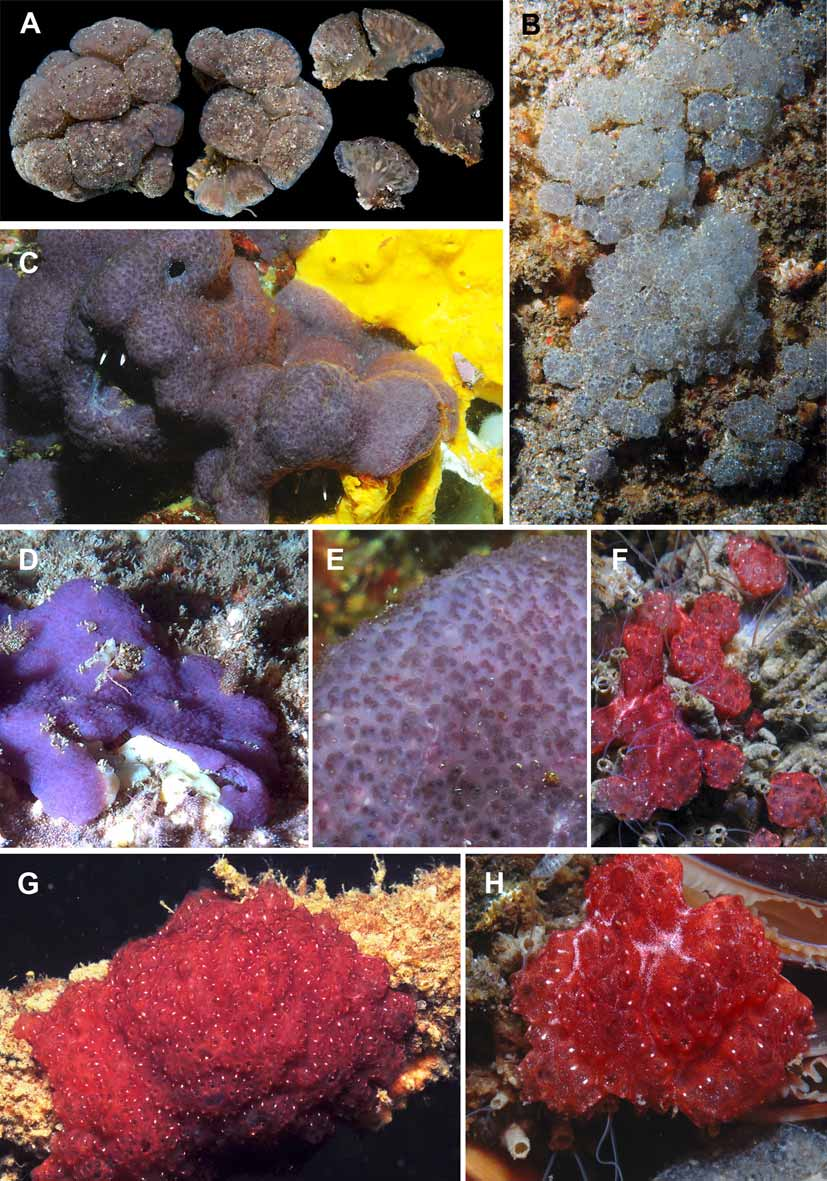
Description. Colony is a wide thick mass attached by whole lower side. The edges of the colony are rounded and the surface produced into low lobes. The largest preserved fragment is about 8 cm wide and 2 cm thick. The test is tough and opaque, of spongy consistency (in preservative), without attached or embedded sand grains or other foreign matter. In live zooids are not visible through the test; in preserved colonies the test become slightly clearer (but still opaque) and contracted zooids may appear as white blotches visible through the superficial layer of the tunic. The colour in live varies from lilac to dirty purple, in formaline all specimens are dark purplish to dark brown. Zooids are not pigmented and are opaque whitish. They are arranged into very indistinct rudimentary systems consisting of two, three or four zooids with atrial apertures opening close to each other. Even on living specimens these systems are not always apparent, and in some parts of a colony zooids may appear as randomly distributed. No traces of any sort of depressions or shallow cloacal cavities are associated with systems. Zooids are strongly contracted, no more than 4.5 mm long, and withdrawn to the base of the colony. Both siphons are six lobed, terminal, close to each other, of equal length or, often, the atrial siphon slightly displaced dorsally and longer than the branchial. The branchial sac has three rows of stigmata with 9 or 10 stigmata in the second and third rows (counted in several less contracted zooids); the first row has a few more stigmata but these cannot be counted precisely. The first row of stigmata slightly bents dorsally. Thin well spaced longitudinal muscles originate at the base of the branchial siphon, run on the sides of the thorax and continue as a wide band to the end of the abdomen. The wall of the abdomen is thick and opaque. Digestive tract is typical for the genus with long oesophagus and smooth walled stomach in the end of abdomen. Post pyloric subdivision of the intestine into regions is obscured by contraction of zooids. Neither gastric vesicle nor pyloric gland were detected. Testis follicles are large and numerous, spread beside the gut loop in posterior end of the abdomen. The ovary is at the level of posterior end of the stomach and may contain a few rather large (0.5 mm) eggs. Up to two large eggs or developing embryos are in atrial cavity of many zooids in colonies collected in November, but tailed larva are few. The trunk of the larva is 0.9 mm long. Three adhesive organs are in the antero-median line. They have typical for Eudistoma structure with thick short stalks and wide platforms of numerous closely packed columnar cells in epidermal cups. Adhesive organs alternate with three smaller median ampullae.
Sanamyan, Karen, Schories, Dirk, Sanamyan, Nadya (2010): New records of aplousobranch ascidians from Central Chile. Zootaxa 2537: 58-68, DOI: 10.5281/zenodo.196669
Remarks. The genus Eudistoma, comprising 120 valid species, is especially diverse in tropics and rather few species occur in colder waters. The main distinguishing characters of the present species are the shape and colour of the colony, hard tunic of spongy consistency without attached or embedded sand, and presence of rudimental circular systems without cloacal cavities. Zooids are similar to those of many other species of the genus, although a small number of stigmata per row is noticeable. The species could be easily distinguished from both Eudistoma species known previously from the Pacific coasts of South America: E. magalhaensis (Michaelsen, 1907) originally described from Strait of Magellan and recently redescribed from Guaitecas Islands (Sanamyan & Schories, 2007), has a very different colony consisting of separate clavate lobes. And the second species, E. pachecae Van Name, 1945, based on a single small specimen from Bay of Panama, has thin transparent gelatinous colony which differ clearly from the present species. Eudistoma clivosum n. sp. is not similar to species known from Pacific coasts of North America and not appear to be closely related to any tropical or temperate species, most of which, with few exceptions, have more stigmata per row or differ in the structure of colony or larva. The shape and colour of the colony, as appear on underwater photographs, allow distinguishing this species from other colonial ascidians occurring in the studied region. And as in the case of Aplidiopsis chilensis n. sp., we never saw similar colonies on photographs taken in more southern locations.
Sanamyan, Karen, Schories, Dirk, Sanamyan, Nadya (2010): New records of aplousobranch ascidians from Central Chile. Zootaxa 2537: 58-68, DOI: 10.5281/zenodo.196669
Material examined: Chile, 4. region, Punta de Choros: Bajo tiburon, 17 m, several large fragments of one colony (Holotype KBPIG 1398 / 1); wreck Lynch, 23 m, one colony; 25 m, one colony. All specimens collected at November 2009.
Sanamyan, Karen, Schories, Dirk, Sanamyan, Nadya (2010): New records of aplousobranch ascidians from Central Chile. Zootaxa 2537: 58-68, DOI: 10.5281/zenodo.196669
Export occurrence data
Darwin Core Archive (ZIP)
CLASSIFICATION
Taxonomic Classification Tree

IMAGES