
AnimaliaNot EvaluatedacceptedspeciesAccepted
Hypogastrura oreophila
Butschek, 1948
GBIF:119392180
0year
ABOUT
Descriptions(3)
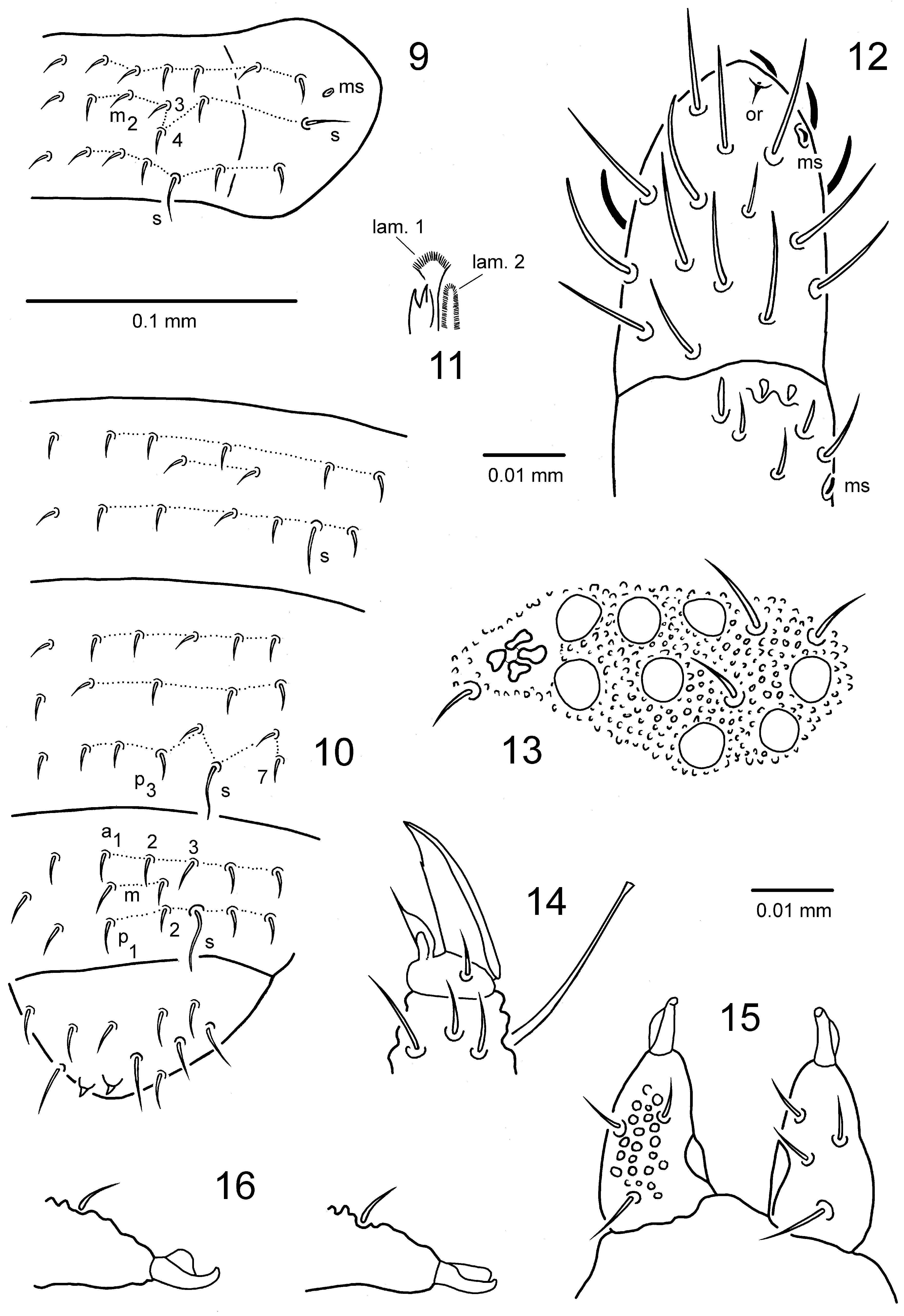
Redescription. Body length up to 0.8 mm. Colour spotted dark blue. Granulation fine and uniform, 8 – 12 granules between setae p 1 on abd. V. Chaetotaxy of head typical of the genus. Setae smooth or slightly serrated and moderately short. Body sensilla (s) 2 – 3 times longer than ordinary setae, fine and smooth. Dorsal chaetotaxy of th. II and abd. III – VI as in Figs 9 – 10. Th. I with 3 + 3 setae. Th. II with setae m 2, m 3 and m 4. Th. III with setae m 4 and sometimes m 3. Setae p 3 and p 7 on abd. IV present. Abd. V with setae a 2 set nearly in line with setae a 1 and a 3, setae p 2 present and 1 – 2 m setae usually present. Subcoxae I, II, III with 1, 2, 3 setae respectively. Microsensillum on thoracic tergum II present. Ant. IV with simple apical vesicle, subapical organite (or), microsensillum (ms), 4 (1 dorsal and 3 lateral) short, curved, cylindrical sensilla (Fig. 12). Ant. III-organ with two long (outer) and two short (internal) sensilla. Microsensillum on ant. III present (Fig. 12). Ant. I with 7 setae (seta p’ absent). Ocelli 8 + 8. Postantennal organ with 4 slightly subdivided lobes, equal to or a little larger than neighbour ocellus (Fig. 13). Accessory boss absent. Labrum with 4 apical papillae. Labral setae 5, 5, 4, prelabrals 4. Maxillary head (details hardly visible) with lamella 1 longer than maxillary teeth, broad at the tip and furnished with marginal filaments. Lamella 2 equal to maxillary teeth with marginal filaments (Fig. 11). Labium of the H. tullbergi type. Outer lobe of maxilla with 2 sublobal hairs. Tibiotarsi I, II, III with 19, 19, 18 setae respectively. Apical seta A 1 clavate. Claws with small inner tooth. Empodial appendage with broad basal lamella and apical filament reaching slightly beyond middle of inner lamella of unguis (Fig. 14). Ventral tube with 4 setae on each side (2 in upper and 2 in lower row). Retinaculum with 3 + 3 teeth. Furca slightly reduced (ratio dens + mucro / inner lamella of claws III c. 2). Dorsal side of dens with fine, uniform granulation and 2 – 4 (usually 3) setae. Mucro variable, usually hook-shaped with broad outer lamella. Ratio dens / mucro c. 3 (Figs 15 – 16). Anal spines small, situated on low basal papillae (Fig. 10).
Skarżyński, Dariusz (2011): A taxonomic study on some Alpine Hypogastrura Bourlet, 1839 (Collembola, Hypogastruridae). Zootaxa 2786: 62-68, DOI: 10.5281/zenodo.205107
Remarks. To date, H. oreophila is known only from the Alpine material (Dachstein, Niedere Tauern) described by Butschek (1948). Unfortunately, in spite of searches for types in different Austrian research institutes (Erhard Christian pers. comm.), none were found. In this situation, specimens from the area of the type locality delivered by E. Butschek to H. Gisin (MNHG) (Peter Schwendinger pers. comm.) and mentioned in the original description as other material were the only possible basis for the present redescription. Affinities. From among the species mentioned in the introduction, only two: H. exigua and H. mongolica, have –– like H. oreophila –– a low number of setae on the dens: 3 – 5 (usually 4) and 4 respectively. The former species clearly differs in the higher number of setae on the ventral tube (5 + 5), larger postantennal organ (1.5 times than neighbour ocellus), short and narrow at the tip maxillary lamella 1, mucro with indistinct low lamella and the absence of additional m-setae on abd. V. Knowledge on H. mongolica is imperfect (see above) and this species cannot be responsibly compared. Also H. magistri resembles H. oreophila in having additional m-setae on abd. V, but 5 setae on the dens, plurichaetosis of abd. IV chaetotaxy and 6 cylindrical sensilla on ant. IV (Babenko et al. 1994) make this species easy to distinguish.
Skarżyński, Dariusz (2011): A taxonomic study on some Alpine Hypogastrura Bourlet, 1839 (Collembola, Hypogastruridae). Zootaxa 2786: 62-68, DOI: 10.5281/zenodo.205107
Material examined. 28 specimens on 3 slides labeled “ Hypogastrura oreophila, det. Gisin, Ja x 635, Austria, Dachstein ” (Edelgrieshöhe, ca. 2,450 m a. s. l., tussock of plants with soil, 26. vi. 1946, leg. H. Franz) (MNHG).
Skarżyński, Dariusz (2011): A taxonomic study on some Alpine Hypogastrura Bourlet, 1839 (Collembola, Hypogastruridae). Zootaxa 2786: 62-68, DOI: 10.5281/zenodo.205107
Export occurrence data
Darwin Core Archive (ZIP)
CLASSIFICATION
Taxonomic Classification Tree

MULTIMEDIA
Media Files(1)
FIGURES 9 – 16. H. oreophila: 9, chaetotaxy of th. II; 10, chaetotaxy of abd. III – VI; 11, tip of head of maxilla; 12, chaetotaxy of ant. III – IV; 13, postantennal organ and ocelli; 14, claw III with empodial appendage; 15, furca; 16, variants of mucro. Abbreviations in text.
Imageimage/png© Skarżyński, DariuszSkarżyński, Dariusz
IMAGES