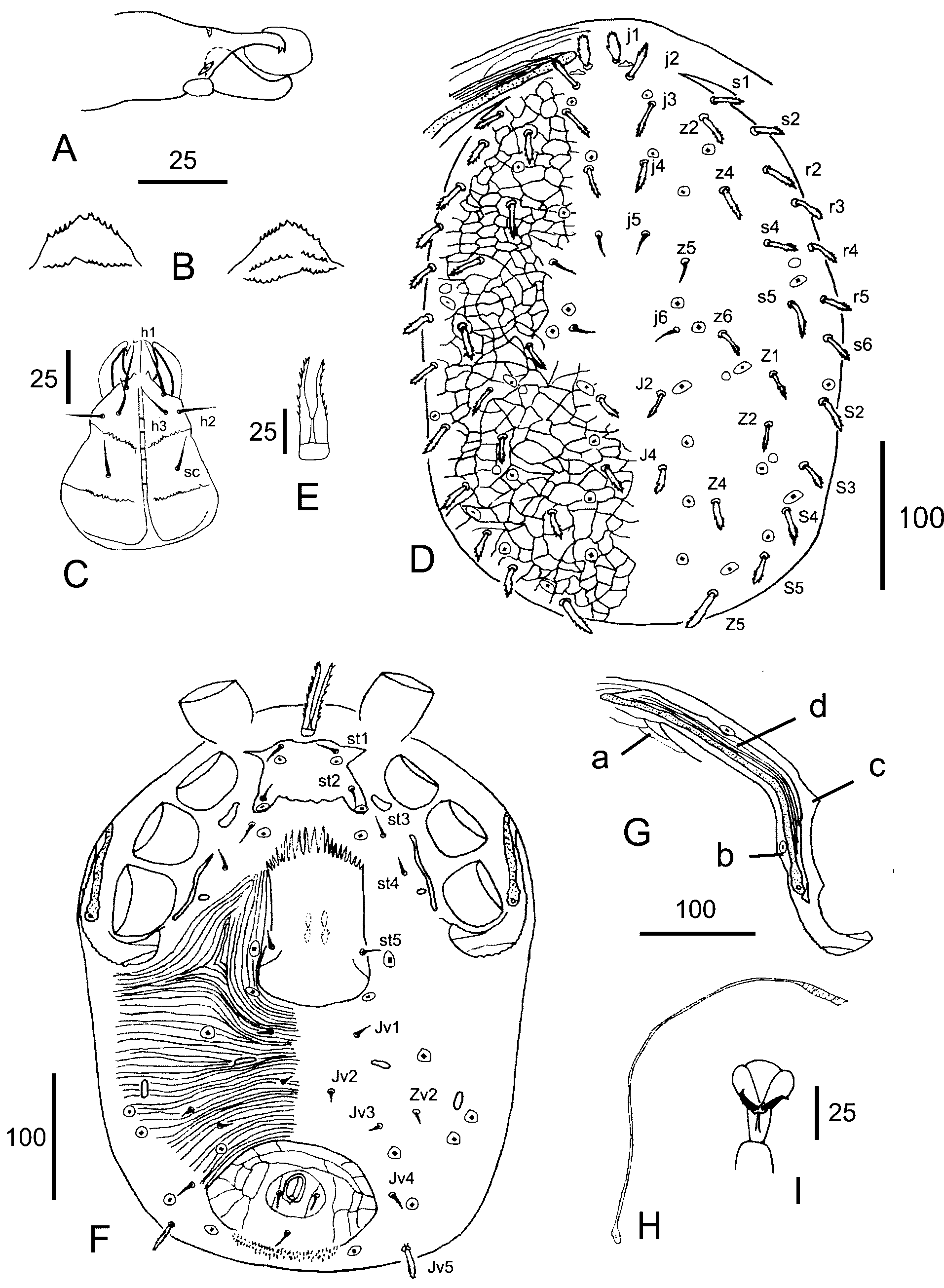
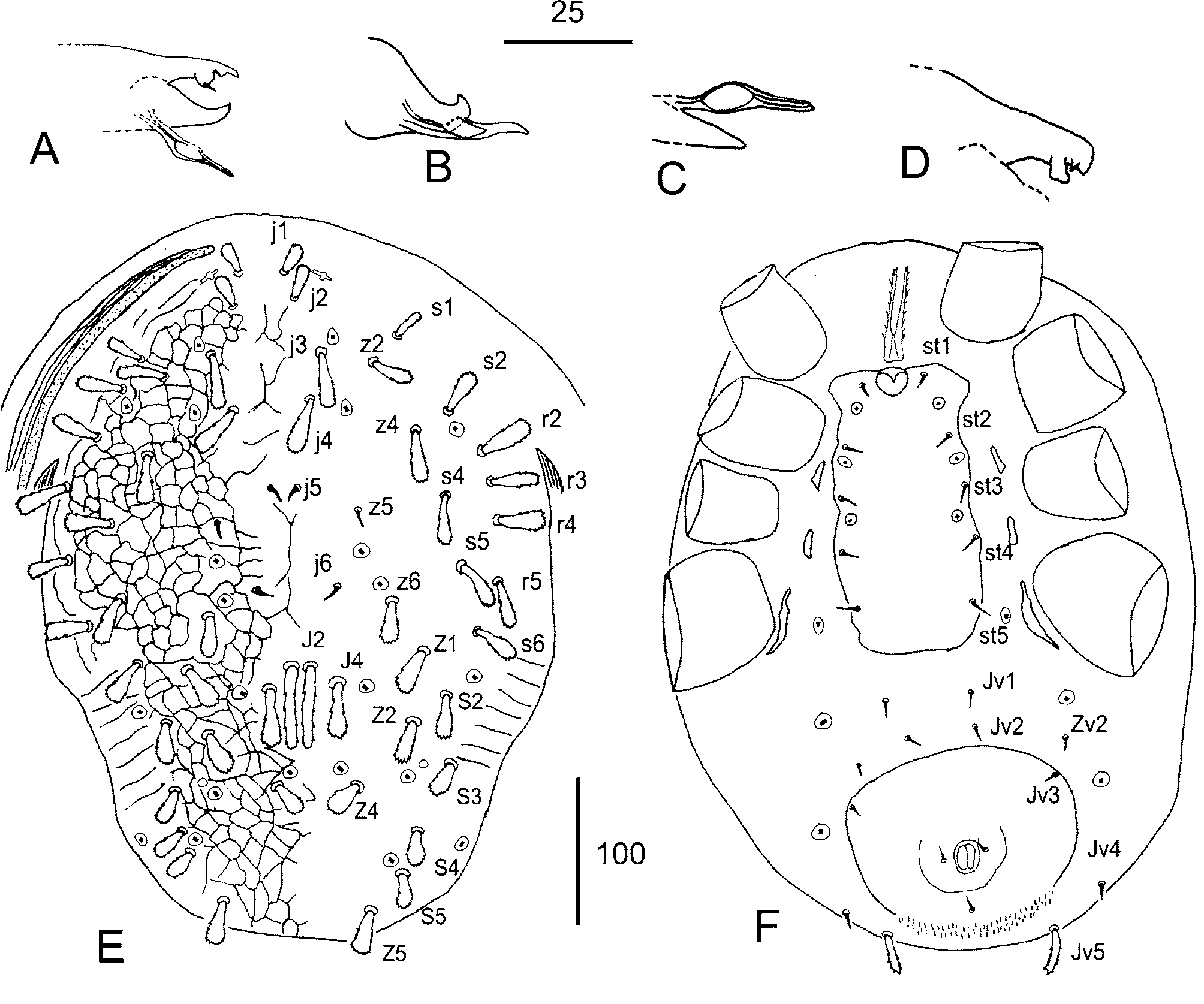
Gnathosoma (Figs 1 A – C): Fixed cheliceral digit 23 long, with a single, small tooth slightly posterior to apical tooth; with a membranous lobe externally attached to it; movable cheliceral digit 27 long, edentate. Antiaxial and dorsal lyrifissures of median cheliceral segment distinct; dorsal seta absent. Epistome with anterior projection rounded to triangular and serrated; with a row of denticles at the base of the projection; in some specimens, a second, interrupted row of denticles is present anteriorly to the row at the base of the projection. Palp apotele 2 - tined. Deutosternum narrow; transversal rows of denticles barely discernible, with five rows of few denticles each (exact numbers not possible to count). With two pairs of lines of distinct denticles laterad of deutosternal margin, one anterior and the other posterior to seta sc. Corniculi undivided, slightly sinuate, convergent, each superposed by a hyaline membrane. In most specimens, internal malae seemingly undivided, distally rounded and with smooth margin; in others, with a central longitudinal line dividing it in two distally rounded structures. Hypostomal setae lengths: h 1 20, h 2 17, h 3 16, sc 19. Dorsal idiosoma (Fig. 1 D): Dorsal shield entire, reticulated, 414 (410 - 417) long and 310 (308 - 312) wide at level of s 6; apparently with three pairs of pores (posteromediad of r 4; mediad and about in tranversal line with Z 1; posterior and slightly laterad of Z 2) and 18 pairs of lyrifissures (slightly posterior and laterad of j 1; anterior to j 3; anterolaterad to j 4; posterior to z 2; mediad and about in transverse line with z 4; posterior and slightly mediad of z 5; posteromediad of r 4; laterad and about in transverse line with j 6; mediad and about in transverse line with Z 1; posterolaterad of r 6; anterolaterad of S 2; laterad and about in transverse line with J 2; posteromesad of Z 2; mesad and about in transverse line with Z 4; posteromediad of S 3; posteromesad of S 4; posteromesad of Z 4; posteromesad of S 5). Lengths of dorsal setae: j 1 27 (25 - 30), j 2 29 (27 - 32), j 3 25, j 4 24 (23 - 25), j 5 16 (15 - 17), j 6 16 (15 - 16), J 2 25, J 4 27 (25 - 30), z 2 27, z 4 25, z 5 16 (15 - 17), z 6 24 (23 - 25), Z 1 23 (22 - 25), Z 2 23 (22 - 25), Z 4 23 (22 - 25), Z 5 31 (30 - 32), s 1 24 (23 - 25), s 2 28 (27 - 30), s 4 25 (23 - 27), s 5 28 (27 - 30), s 6 28, S 2 27 (25 - 30), S 3 27, S 4 27 (25 - 30), S 5 27 (25 - 30), r 2 26 (25 - 27), r 3 27 (25 - 30), r 4 28 (27 - 30), r 5 28 (27 - 30). Seta j 1 leaf-shaped and barbed; setae j 5, j 6 and z 5 setiform and smooth; other setae stout and barbed. Ventral idiosoma (Fig. 1 E – G): Base of tritosternum 10 long; laciniae fused along basal one-fifth of their total length (65 long). Sternal shield smooth, 55 (52 - 57) long at midline and 85 (82 - 87) wide at level of st 2, bearing 2 pairs of setae (st 1 and st 2) and two pairs of lyrifissures; setae st 3 and st 4 on unsclerotised cuticle; third pair of sternal lyrifissure posteromesad of st 3. Genital shield smooth, 84 (83 - 85) wide at the widest level, posteriorly convex, bearing st 5; flanked by two pairs of lyrifissures, the anterior, next to st 5, distinctly larger than the posterior. Anal shield reticulated and oval, 85 long at midline and 147 (145 - 150) wide at the widest level. Setae Jv 1 - Jv 5 and Zv 2 on unsclerotised cuticle. Opisthogaster with two pairs of elongate platelets (posterolaterad of Jv 1; anterolaterad of Zv 2) and six pairs of lyrifissures (posterolaterad of Jv 1; laterad and about in transverse line with Zv 2; posterolaterad of Zv 2; posterolaterad of Jv 3; posterolaterad of Jv 4, anteromediad of Jv 5). Lengths of ventral setae: st 1 20 (18 - 22), st 2 19 (18 - 20), st 3 20 (18 - 22), st 4 19 (18 - 20), st 5 20 (18 - 22), Jv 1 14 (12 - 17), Jv 2 10, Jv 3 10, Jv 4 19 (17 - 22), Jv 5 27 (25 - 30), Zv 2 10, para-anal 12, post-anal 11 (10 - 12). Unsclerotised opisthogastric cuticle striated; striae without granulation. Seta Jv 5 stout and barbed; other ventral setae setiform and smooth. Endopodal shield represented by a platelet between coxae II and III and a narrower and more elongate platelet along coxae III and IV. Exopodal shield of irregular width, with projections between legs II and III and legs III and IV; with a lyrifissure at level between coxae I and II; abutting peritreme at level of seta j 1; exopodal shields of both sides fusing to each other and to dorsal idiosomal shield at region anterior to setae j 1. Peritreme and peritrematal shield (Figs 1 D, 1 G): Peritreme extending forward to level between j 1 and j 2 (level of coxa I). Peritrematal shield narrow, fused to dorsal shield at level between s 1 and j 2, and to exopodal shield behind stigma; with a lyrifissure at level of coxa III. Spermathecal apparatus (Fig. 1 H): Induction pore apparently at postero-proximal region of coxa III; infundibulum (35 long) distinctly wider than tubulus (215 long), leading to wider ramus (15 long); rami apparently close to each other. Legs (Fig. 1 I): All legs with pulvilli and claws. Lengths of legs: I: 369 (362 - 375), II: 344 (337 - 350), III: 269 (362 - 375), IV: 416 (412 - 420). Chaetotaxy of legs I-IV: coxae: 2, 2, 2, 1; trochanters: 6, 5, 5, 5; femora: 12 (2 - 3 / 1, 2 / 2 - 2), 10 (2 - 2 / 1, 2 / 2 - 1), 6 (1 - 2 / 1, 1 / 0 - 1), 6 (1 - 2 / 1, 1 / 0 - 1); genua: 12 (2 - 3 / 2, 2 / 1 - 2), 11 (2 - 3 / 1, 2 / 1 - 2), 9 (2 - 2 / 1, 2 / 1 - 1), 9 (2 - 2 / 1, 3 / 0 - 1); tibiae: 12 (2 - 3 / 2, 2 / 1 - 2), 10 (2 - 2 / 1, 2 / 1 - 2), 8 (2 - 1 / 1, 2 / 1 - 1), 9 (2 - 2 / 1, 2 / 1 - 1); tarsi: not counted, 17, 17, 17. Many (mostly dorsal) setae of femur and genu of all legs barbed; other setae smooth. Adult male (Fig. 2 A – F) (2 specimens measured) Gnathosoma (Fig. 2 A – D): Fixed cheliceral digit 32 - 35 long, with a single tooth, next to apical tooth, and with an inflated structure of apparently variable shape, in some specimens bearing a distal spine-like extension; movable cheliceral digit 40 - 43 long, edentate. Epistome and apotele similar to female. Spermatodactyl 32 – 37 long, medially inflated and apparently concave on the ventral side; distal portion slightly sinuous and attenuate. Hypostome similar to female, corniculi distinctly less convergent in one of 4 specimens. Hypostomal setae of the following lengths: h 1 25, h 2 (not possible to measure), h 3 20, sc 24. Dorsal idiosoma (Fig. 2 E): Dorsal shield entire and mostly reticulated, with a rugose central band between setae j 1 - J 2 and with a series of marginal, diagonal ridges between setae s 6 and S 3; 427 - 430 long and 343 - 350 wide at level of r 5. Apparently with a pair of pores (mediad and about in transverse line with S 3) and 11 pairs of lyrifissures (laterad and about in transverse line with j 1; anterolaterad of j 3; laterad and about in transverse line with j 4; posterolaterad of s 2; posterior and about in longitudinal line with z 5; laterad and about in transverse line with J 2; anterolaterad of S 2; anteromediad of J 4; posteromediad of S 3; posterolaterad of S 4; anterior and in longitudinal line with S 5). Lengths of dorsal setae: j 1 22 - 27, j 2 30 - 32, j 3 45 - 47, j 4 45 - 47, j 5 13 - 15, j 6 15 - 17, J 2 60 - 63, J 4 48 - 50, z 2 38 - 40, z 4 40 - 42, z 5 13 - 15, z 6 35 - 37, Z 1 40 - 45, Z 2 27 - 32, Z 4 35 - 37, Z 5 33 - 35, s 1 20 - 25, s 2 38 - 40, s 4 40 - 45, s 5 35 - 42, s 6 38 - 40, S 2 35 - 37, S 3 30 - 32, S 4 30 - 32, S 5 30 - 32, r 2 35, r 3 38 - 40, r 4 35 - 37, r 5 40. Setae j 5, j 6 and z 5 setiform and smooth; J 2 rod-shaped and barbed; other setae leaf-shaped and barbed. Ventral idiosoma (Fig. 2 F): Base of tritosternum not differentiated; laciniae fused along basal one-third of their total length (52 long). Sternogenital shield smooth, rectangular, 202 long and 93 wide at level of st 3, bearing five pairs of setae (st 1 - st 5) and three pairs of lyrifissures. A pair of lyrifissures posterolaterad of st 5, on unsclerotised cuticle. Ventri-anal shield smooth and oval, 125 long and 162 wide at the widest level, bearing seta Jv 3. Setae Jv 1, Jv 2, Jv 4, Jv 5 and Zv 2 on unsclerotised cuticle. Opisthogaster with two pairs of lyrifissures (posterolaterad of Jv 1; posterolaterad of Jv 3). Lengths of the ventral setae: st 1 13 - 15, st 2 17, st 3 17, st 4 17, st 5 17 - 19, Jv 1 15 - 17, Jv 2 10 - 12, Jv 3 10 - 12, Jv 4 15, Jv 5 38 - 40, Zv 2 10, para - anal 15, post - anal 15. Unsclerotised opisthogastric cuticle striated; striae without granulation. Endopodal shield represented by a platelet between coxae II and III, a platelet between coxae III and IV and a platelet along coxa IV. Exopodal shield similar to female, but the lyrifissure between coxae I and II absent and exopodal shield abutting peritreme at level of seta j 2. Peritreme and peritrematal shield: Similar to female. Legs: All legs with pulvilli and claws. Lengths of legs: I – 367 - 375, II – 337 - 350, III – 360 - 362, IV – 375 - 485. Chaetotaxy of legs similar to female.
De, Gilberto J., Narita, João P. Z. (2010): Description of a new species of Neocypholaelaps (Acari: Ameroseiidae) from Brazil, with a key to the world species. Zootaxa 2554: 37-44, DOI: 10.5281/zenodo.196878