
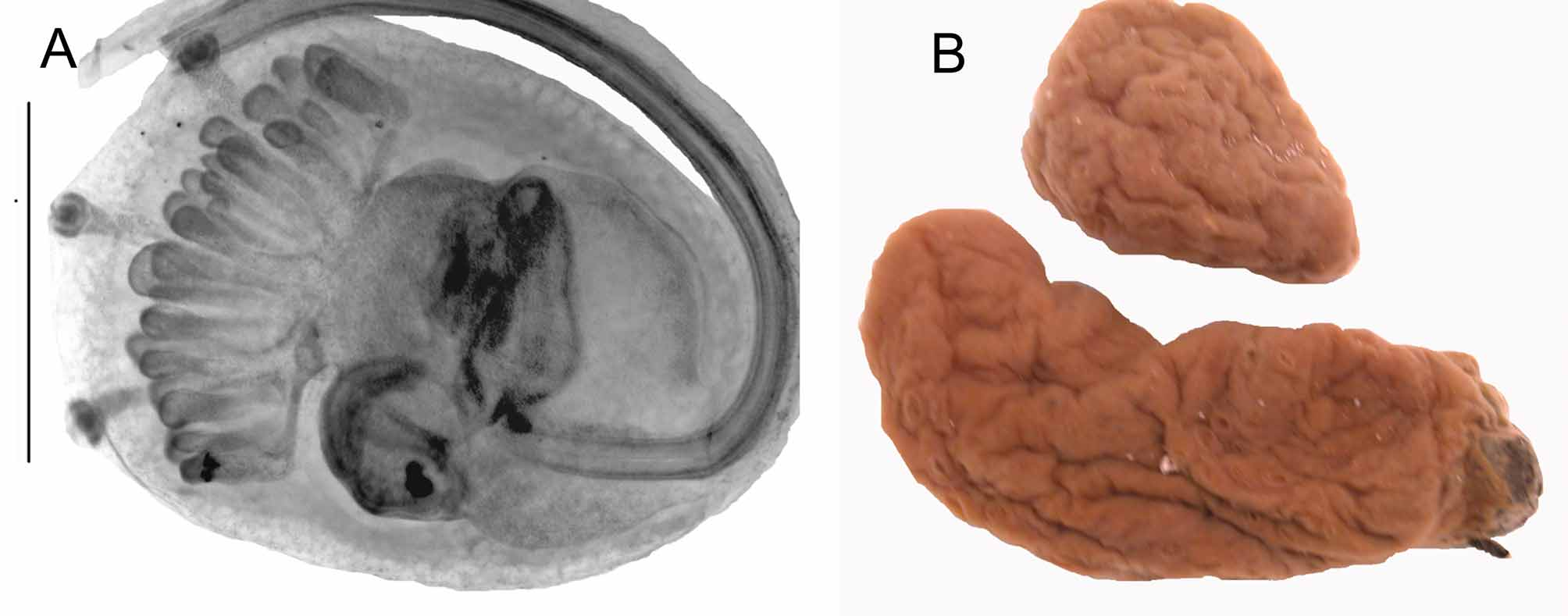
Holozoidae
GBIF:119396058
ABOUT
Descriptions(1)
Holozoidae
Distaplia colligans Sluiter, 1932
Sluiter, 1932: 7. Millar 1960: 77. Kott 1969: 32 and synonymy. Sanamyan & Schories 2003: 94 figs 3C, D, 4, and synonymy.
Stations: 5–17.
The soft spongy colonies are poorly preserved. They form flat cushions or settle in sleeves around hard polychetes tubes. Colourless in fixative liquids, the colonies may have been yellow in life as bright yellow cushions can be seen on the video recorded on board during the sampling. This is also suggested by the color photos given by Sanamyan and Schories (2003 Fig. 3 C, D) for this species. The zooids in less damaged colonies have 4 rows of stigmata crossed by parastigmatic vessels. The atrial languet is either pointed or dentate. The stomach wall has numerous thin ridges. The ovary is placed in the centre of a ring of testis vesicles. One or two not completely developed embryos hang in a brood pouch. The anatomical differences with D. cylindrica are limited to the colony shape.
One sequence for specimen A3 DIS 100 (BOLD: ASCAN015–10). Divergence from A3 DIS 98 ( D. cylindrica) is very small (0.17%). No other close hit in BOLD (best: 84%). An investigation including sequences from more specimens would be necessary to investigate the separation between these two species.
This brittle species has a peri Antarctic and eurybathic distribution.
Distaplia cylindrica (Lesson, 1830)
Holozoa cylindrica, Lesson, 1830: 439 . Kott 1969: 29 and synonymy. Sanamyan & Schories 2003: 95 and synonymy. Tatian et al. 2005: 209.
Stations (events when several trawling operations per station): 11(424)-14-54A-60.
This very spectacular species in long cylinders reaches a very large size; a colony from station 14 is 108 cm long. One sequence for specimen A3 DIS 98 (BOLD: ASCAN014-10). See D. colligans for more details. D. cylindrica is eurybathic, circumpolar, and also recorded from the Patagonian shelf.
Sycozoa sigillinoides Lesson, 1830
Lesson 1830: 436. Millar 1960: 71 fig. 19 pl. 2 figs 3–8. Monniot & Monniot 1983: 37. Kott 2006: 188. Tatian 1998: 149.
Stations: 1-3-13 A-17.
The CEAMARC colonies have short thick peduncles and very long cylindrical heads, the largest is 17 cm long on a 2 cm peduncle. The zooids open along the whole length of the colony and the common atrial aperture is terminal. There are no parastigmatic vessels crossing the stigmata. The stomach has a smooth wall. The gonads are poorly developed and no larvae have been found.
Sequences for specimen A3 SYC 38 (BOLD: ASCAN018-10) and specimen from lot A3 SYC 39 (BOLD: ASCAN019-10) are identical. No close hit in BOLD (best: 78.3%).
The species has a very wide distribution both peri antarctic and Sub-Antarctic from 50 m and deeper to the bathyal zone.
Export occurrence data
Darwin Core Archive (ZIP)
CLASSIFICATION
Taxonomic Classification Tree

IMAGES