
AnimaliaacceptedfamilyAccepted
Pyuridae

Pyuridae

GBIF:119396072

ABOUT

Descriptions(1)

Pyuridae

Bathypera hastaefera Vinogradova, 1962 (Figures 22 BD, 23B, 24B)

Vinogradova, 1962: 206, fig. 3. Kott, 1969: 140 fig.194. Monniot & Monniot 1983: 85, part of specimens included in Bathyfera splendens .

Stations (events when several trawling operations per station): 8-21-30 (66)-42-57.

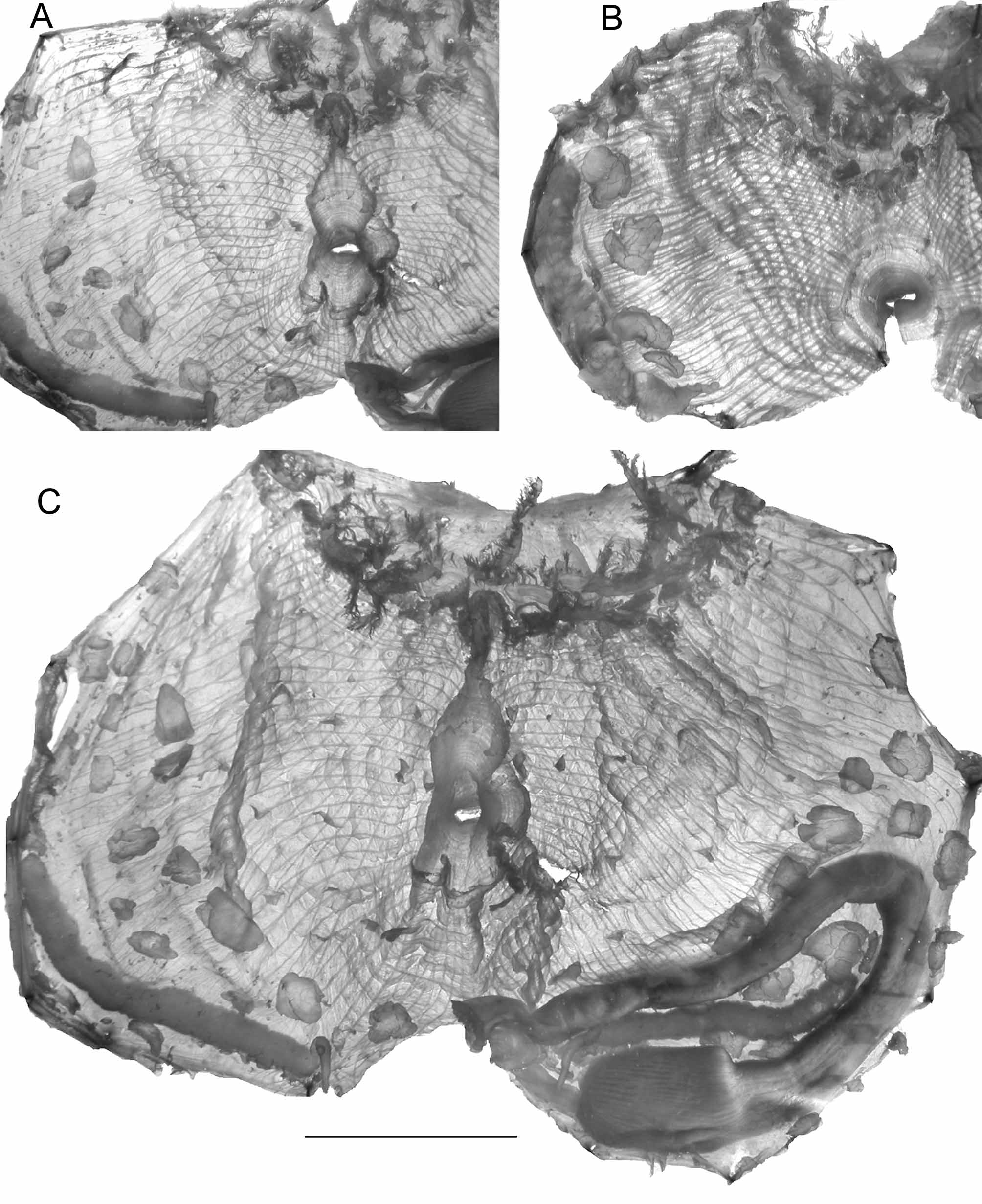
The specimens are normally spherical. When fixed the tunic has numerous parallel furrows due to the contraction of the body wall which closely adheres to the tunic (Fig. 22 D). The spicules are uniformly distributed at the colony surface, implanted on a round base and protruding in an asymmetric group of few spines of inequal length (Fig.22B). The spicules reach 600µm in length. The musculature has the same disposition as in B. splendens but the crossed longitudinal and transverse fibres are stronger and more extended on the body wall (Fig. 24B). All other characters are the same in both species taking in consideration the individual variations: branchial sac (Fig. 23 B), gut gonads and endocarps. Monniot and Monniot (1983) with few specimens estimated the differences insufficient to separate the species; the study of numerous samples collected during the CEAMARC cruise now confirms the validity of B. hastaefera .

B. hastaefera was only recorded from the eastern part of the Antarctic continent down to 2000 m. It was present in some of the CEAMARC stations in sympatry with. B. splendens .

Monniot, Françoise, Dettai, Agnès, Eleaume, Marc, Cruaud, Corinne, Ameziane, Nadia (2011): Antarctic Ascidians (Tunicata) of the French-Australian survey CEAMARC in Terre Adélie. Zootaxa 2817: 1-54, DOI: 10.5281/zenodo.277174MagnoliaPress via PlaziNo known copyright restrictions apply. See Agosti, D., Egloff, W., 2009. Taxonomic information exchange and copyright: the Plazi approach. BMC Research Notes 2009, 2:53 for further explanation.

Export occurrence data

Darwin Core Archive (ZIP)

CLASSIFICATION

Taxonomic Classification Tree

MULTIMEDIA

Media Files(3)

FIGURE 22. A, B, spicules: A, Bathypera splendens; B, Bathypera hastaefera. C, Bathypera splendens; D, Bathypera hastaefera. Scale bars: A, B = 100 µm; C, D = 3 cm.

Imageimage/png© Monniot, Françoise;Dettai, Agnès;Eleaume, Marc;Cruaud, Corinne;Ameziane, NadiaMonniot, Françoise;Dettai, Agnès;Eleaume, Marc;Cruaud, Corinne;Ameziane, Nadia

FIGURE 23. Branchial tissues: A, Bathypera splendens. B, Bathypera hastaefera.
Imageimage/png© Monniot, Françoise;Dettai, Agnès;Eleaume, Marc;Cruaud, Corinne;Ameziane, NadiaMonniot, Françoise;Dettai, Agnès;Eleaume, Marc;Cruaud, Corinne;Ameziane, Nadia

FIGURE 24. A, B, musculature of the left body side: A, Bathypera splendens; B, Bathypera hastaefera. C, Bathypera splendens, specimen ventrally opened, scale bar C = 1 cm.

Imageimage/png© Monniot, Françoise;Dettai, Agnès;Eleaume, Marc;Cruaud, Corinne;Ameziane, NadiaMonniot, Françoise;Dettai, Agnès;Eleaume, Marc;Cruaud, Corinne;Ameziane, Nadia

IMAGES

Gallery(3)

See Gallery

Occurrences with images

Source Information

Antarctic Ascidians (Tunicata) of the French-Australian survey CEAMARC in Terre Adélie

checklist

This dataset contains the digitized treatments in Plazi based on the original journal article Monniot, Françoise, Dettai, Agnès, Eleaume, Marc, Cruaud, Corinne, Ameziane, Nadia (2011): Antarctic Ascidians (Tunicata) of the French-Australian survey CEAMARC in Terre Adélie. Zootaxa 2817: 1-54, DOI: 10.5281/zenodo.277174

Abstract

A large collection of ascidians was made during the CEAMARC Aurora Australis V 3 cruise off Terre Adélie and George V Land a region rarely investigated before at these depths. Sampling was performed by beam trawls and a dredge between 138°– 146° latitude East and from 150 to 1700 m depth, on the Antarctic shelf and slope. Three of the 33 ascidian species identified are new and belong to the Stolidobranchia. Half of the species have an exclusive Antarctic distribution, others also occur in Sub-Antarctic areas, but none are common with the southern temperate fauna. The CEAMARC collection does not contain the whole range of already known species from this region. Moreover, brittle and very small specimens were not collected. COI sequences were obtained for 37 specimens, including two of the new species.

Key words: Ascidians, Antarctic, Terre Adélie, New species

Monniot F, Dettai A, Eleaume M, Cruaud C, Ameziane N, plazi (2011). Antarctic Ascidians (Tunicata) of the French-Australian survey CEAMARC in Terre Adélie. Plazi.org taxonomic treatments database. Checklist dataset https://doi.org/10.5281/zenodo.277174 accessed via GBIF.org on 2026-06-15.

CC0Published 12/31/2011View dataset
GBIF Usage Key
119396072
Dataset Key
18da0afb-302a-4912-9e86-fbbdebc414a6
Origin
source
Backbone Key
7345
Taxon ID
03B887B6FF8DFFFDFF6216B9FC4AF9CA.taxon
Last Crawled
6/11/2026
Last Interpreted
6/11/2026