AnimaliaNot EvaluatedacceptedspeciesAccepted
Pyura discoveryi

Pyura discoveryi

(Herdman, 1910) Herdman, 1910

GBIF:119396079

0year

0

Synonyms

ABOUT

Descriptions(1)

Pyura discoveryi (Herdman, 1910)

(Figures 29, 30)

Halocynthia discoveryi, Herdman, 1910:9 . Pyura discovery Herdman 1912: 19 . Primo & Vazquez 2007: 1804 and synonymy.

Stations (events when several trawling operations per station): 3-6(99)-6(103)- 8-10-11 (424)-11(429)-16A-26A- 27(33)-27(45)27(46)-30(66)-31-34-35-36(68)-41-42-45-47-49A-57-62-71-79-86E.

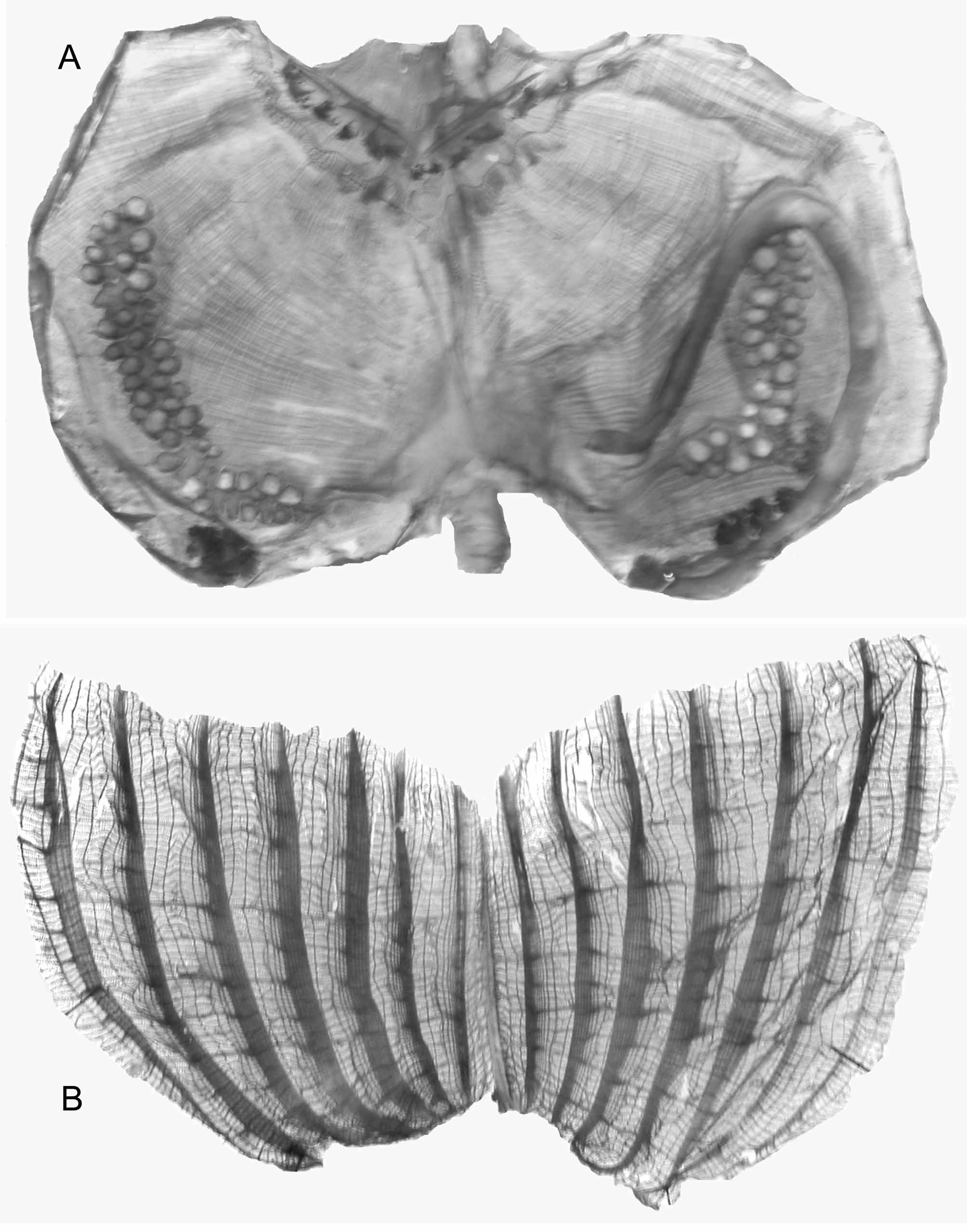
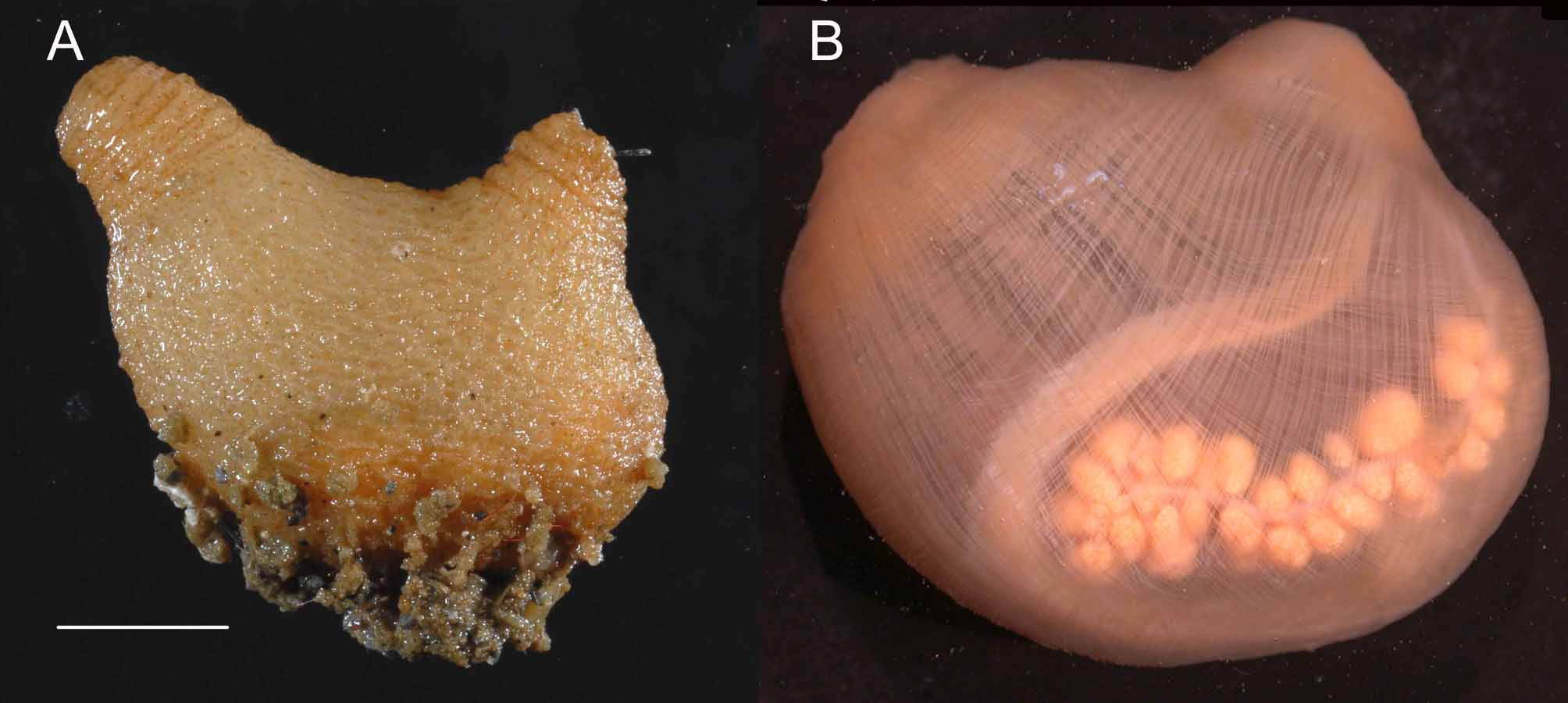
The largest specimen of the collection is 5.5 x 4 cm. The body has always the same triangular shape with well apart protruding siphons (Fig. 29 A) and a brown, hard, corrugated tunic. The basal part is often prolongated by threadlike extensions on fragmented substrate. The body wall is thin with regularly distributed muscles (Fig. 29 B). A velum is present inside both siphons. The oral tentacles are poorly ramified in 3 orders of size. The dorsal tubercle is complex located inside a wide V of the peritubercular area. The dorsal lamina is made of long languets. The most ventral of the 7 branchial folds is lower on the left side (Fig. 30 B). The branchial formula of a 35 mm specimen is:

E 1- 9 -4- 11 -5- 12 - 6- 16 -5- 20 -4- 16 -5- 12 -2-DL

DL- 3- 20 -3- 18 - 3- 20 -4- 20 - 3- 18 -3- 13 -3-8-1-E

Spiral stigmata can be seen at the top of the folds. The primary gut loop is widely open, the secondary curve is not obvious or absent (Fig. 30 A).The anus is lobed. The long gonads have numerous lobes (Fig. 30 A); the gonoducts are joined but become divergent at their extremity. No spinules could be detected on the siphon lining, even after a MEB examination.

One sequence for specimen S2 PYU 472a (BOLD: ASCAN044-10). No close hit in BOLD. This eurybathic species has a wide Antarctic distribution.

Monniot, Françoise, Dettai, Agnès, Eleaume, Marc, Cruaud, Corinne, Ameziane, Nadia (2011): Antarctic Ascidians (Tunicata) of the French-Australian survey CEAMARC in Terre Adélie. Zootaxa 2817: 1-54, DOI: 10.5281/zenodo.277174MagnoliaPress via PlaziNo known copyright restrictions apply. See Agosti, D., Egloff, W., 2009. Taxonomic information exchange and copyright: the Plazi approach. BMC Research Notes 2009, 2:53 for further explanation.

Export occurrence data

Darwin Core Archive (ZIP)

CLASSIFICATION

Taxonomic Classification Tree

MULTIMEDIA

Media Files(2)

FIGURE 29. Pyura discoveryi: A, a specimen (copyright CEAMARC), scale bar = 1 cm; B, left side of a specimen without tunic.

Imageimage/png© Monniot, Françoise;Dettai, Agnès;Eleaume, Marc;Cruaud, Corinne;Ameziane, NadiaMonniot, Françoise;Dettai, Agnès;Eleaume, Marc;Cruaud, Corinne;Ameziane, Nadia

FIGURE 30. Pyura discoveryi: A, body ventrally opened; B, branchial sac.

Imageimage/png© Monniot, Françoise;Dettai, Agnès;Eleaume, Marc;Cruaud, Corinne;Ameziane, NadiaMonniot, Françoise;Dettai, Agnès;Eleaume, Marc;Cruaud, Corinne;Ameziane, Nadia

IMAGES

Gallery(2)

See Gallery

Occurrences with images

Source Information

Antarctic Ascidians (Tunicata) of the French-Australian survey CEAMARC in Terre Adélie

checklist

This dataset contains the digitized treatments in Plazi based on the original journal article Monniot, Françoise, Dettai, Agnès, Eleaume, Marc, Cruaud, Corinne, Ameziane, Nadia (2011): Antarctic Ascidians (Tunicata) of the French-Australian survey CEAMARC in Terre Adélie. Zootaxa 2817: 1-54, DOI: 10.5281/zenodo.277174

Abstract

A large collection of ascidians was made during the CEAMARC Aurora Australis V 3 cruise off Terre Adélie and George V Land a region rarely investigated before at these depths. Sampling was performed by beam trawls and a dredge between 138°– 146° latitude East and from 150 to 1700 m depth, on the Antarctic shelf and slope. Three of the 33 ascidian species identified are new and belong to the Stolidobranchia. Half of the species have an exclusive Antarctic distribution, others also occur in Sub-Antarctic areas, but none are common with the southern temperate fauna. The CEAMARC collection does not contain the whole range of already known species from this region. Moreover, brittle and very small specimens were not collected. COI sequences were obtained for 37 specimens, including two of the new species.

Key words: Ascidians, Antarctic, Terre Adélie, New species

Monniot F, Dettai A, Eleaume M, Cruaud C, Ameziane N, plazi (2011). Antarctic Ascidians (Tunicata) of the French-Australian survey CEAMARC in Terre Adélie. Plazi.org taxonomic treatments database. Checklist dataset https://doi.org/10.5281/zenodo.277174 accessed via GBIF.org on 2026-06-15.

CC0Published 12/31/2011View dataset
GBIF Usage Key
119396079
Dataset Key
18da0afb-302a-4912-9e86-fbbdebc414a6
Origin
source
Backbone Key
2331851
Taxon ID
03B887B6FF85FFF6FF6217B6FCB5F80F.taxon
Last Crawled
6/11/2026
Last Interpreted
6/11/2026