

Sarax
GBIF:119396506
ABOUT
Descriptions(1)
Key to the species of Sarax species from Borneo
1. Anterior margin of carapace rounded; median eye tubercle well-developed or reduced in size; pedipalpal patella with 4 spines, P1 the longest, and subsequent spines decreasing in size from distal to proximal; pedipalpal tarsus with 2 or 3 spines; tibia of leg IV with 17 or 19 trichobothria ..................................................................................... 2
- Anterior margin of carapace slightly rounded, nearly straight (Fig. 1); median eye tubercle reduced in size; pedipalpal patella with 3 spines, about equal in size (Fig. 4); pedipalpal tarsus with 3 spines (Fig. 5); tibia of leg IV with 19 trichobothria (Fig. 6) ........................................................................................................... Sarax cavernicola sp. nov.
2. Pedipalpal patella with 4 major spines on antero-dorsal and 4 or 3 major spines on pedipalpal femur; pedipalpal tarsus with 2 or 3 spines; tibia leg IV with 19 trichobothria ............................................................................................. 3
- Pedipalpal patella with 4 major spines on antero-dorsal and 3 major spines on pedipalpal femur (Fig. 16); pedipalpal tarsus with 2 minute spines (Fig. 18); tibia of leg IV with 17 trichobothria (Fig. 20).................................................... ................................................................................................................................ Sarax sarawakensis (Thorell 1888)
3. Pedipalpal tarsus with 2 spines; trichobothrium bt on the middle or close to distal fourth basitibial segmenttrichobothrium bc closer to bf than to sbf or about midway between bf and sbf; with or without sexual dimorphism ............. 4
- Pedipalpal tarsus with 3 spines (Figs. 11, 13); trichobothrium bt close to distal fourth basitibial segment, trichobothrium bc about midway between bf and sbf (Fig. 12); with distinct sexual dimorphism ............ Sarax yayukae sp. nov.
4. With distinct sexual dimorphism; median eye tubercle completely divided into two parts (Fig. 26); trichobothrium bt close to proximal fourth basitibial segment, trichobothrium bc about midway between bf and sbf (Fig. 29)................ .................................................................................................................................................... Sarax mardua sp. nov.
- Without sexual dimorphism; median eye tubercle high, black and well-developed, not divided into two parts (Fig. 21); trichobothrium bt on the middle of fourth basitibial segment; trichobothrium bc closer to bf than to sbf (Fig. 25) ................................................................................................................................... Sarax sangkulirangensis sp. nov.
Export occurrence data
Darwin Core Archive (ZIP)
CLASSIFICATION
Taxonomic Classification Tree

MULTIMEDIA
Media Files(6)
FIGURES 1 – 7. Sarax cavernicola sp. nov., female holotype: 1. Carapace; 2. Left chelicera, external view; 3. Sternal area of opisthosoma, ventral view; 4. Left pedipalp, antero-dorsal view; 5. Left pedipalpal tarsus; 6. Arrangement of trichobothria on fourth basitibial segment and distibiae of left leg IV; 7. Female gonopods, dorsal view.
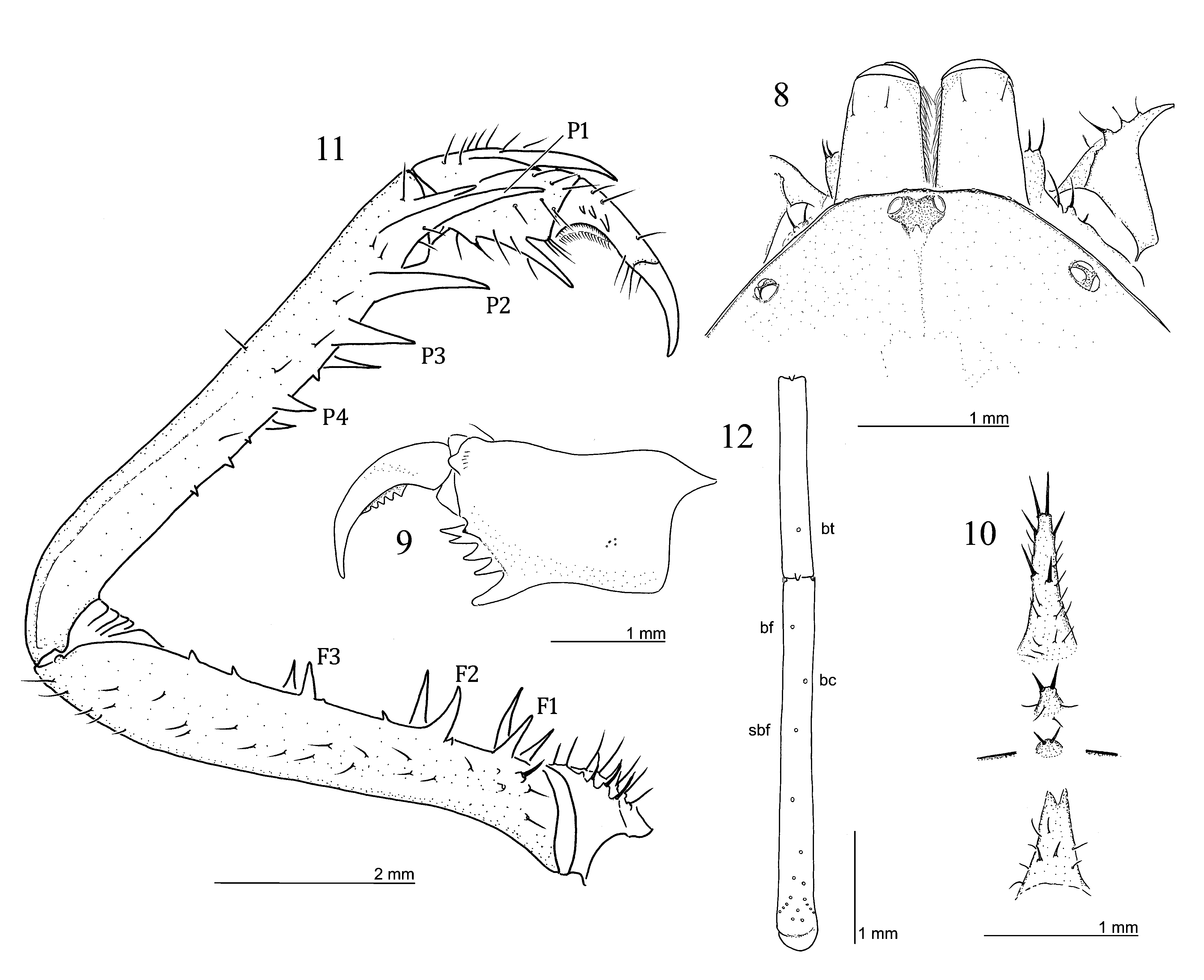
FIGURES 8 – 12. Sarax yayukae sp. nov., male holotype, unless stated otherwise: 8. Frontal area of carapace, male paratype from Liang Hajuq (MZB. Ambl. 148); 9. Left chelicerae, external view; 10. Sternal area of opisthosoma, ventral view; 11, Left pedipalp, antero-dorsal view; 12. Arrangement of trichobothria of fourth basitibial segment and distibiae of left leg IV.
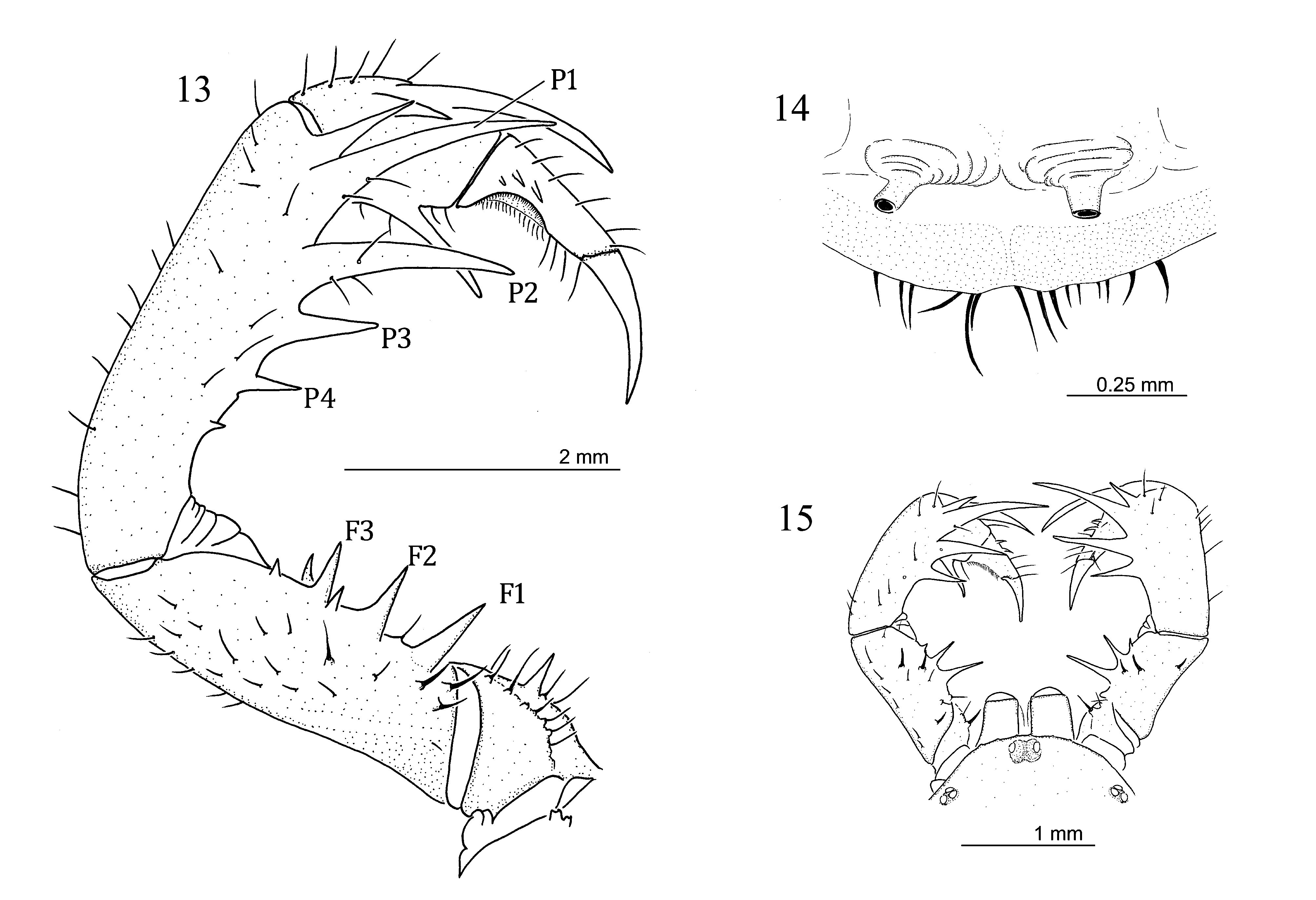
FIGURES 13 – 15. Sarax yayukae sp. nov.: 13. Left pedipalp, antero-dorsal view, female paratype (MZB. Ambl. 057); 14. Female genitalia, paratype (MZB. Ambl. 057); 15. Pedipalp and anterior margin of carapace, juvenile paratype (MZB. Ambl. 059).
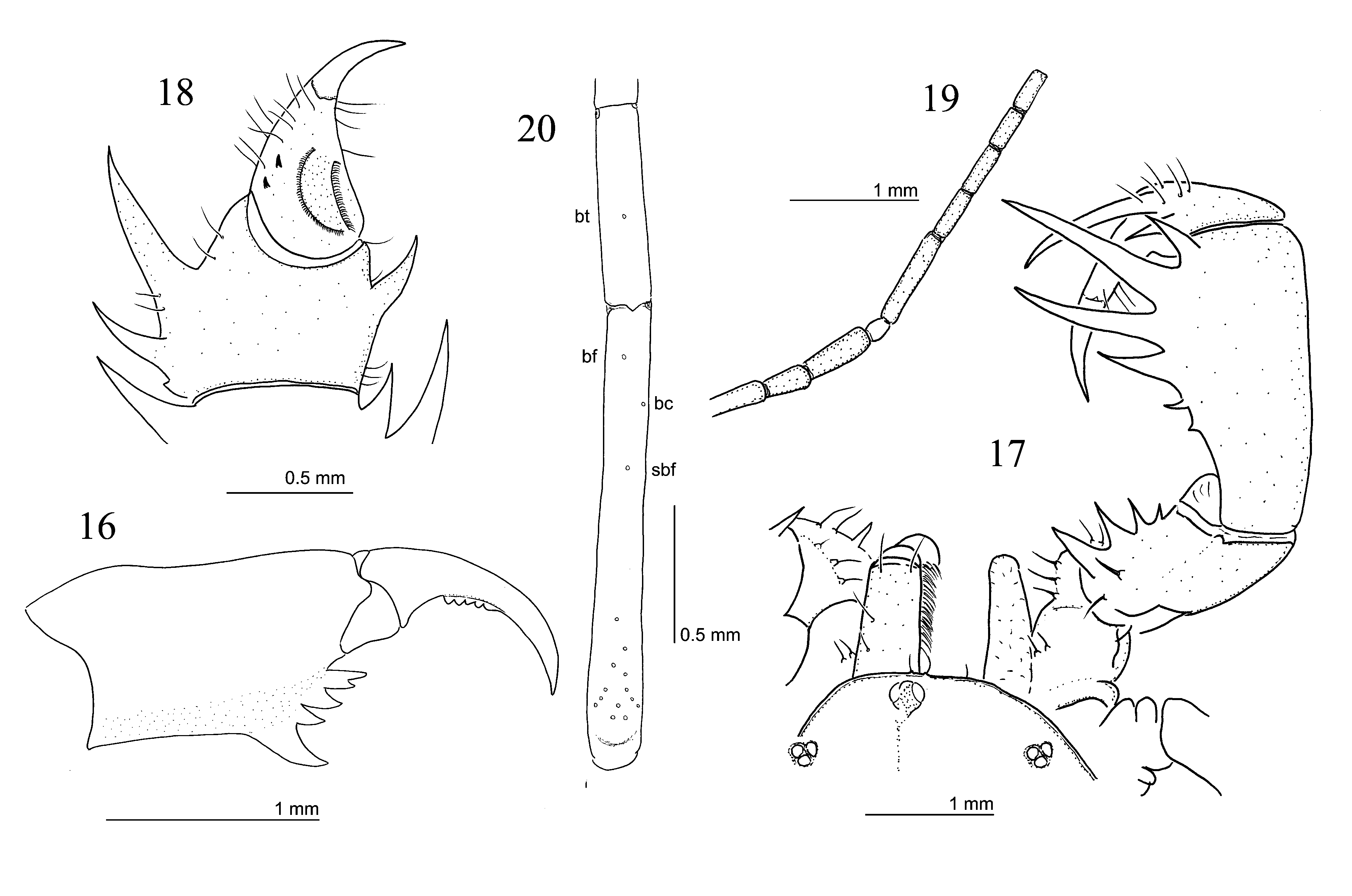
FIGURES 16 – 20. Sarax sarawakensis (Thorell 1888), female holotype from Borneo unless stated otherwise: 16. Frontal carapace and right pedipalp; 17. External view of right chelicerae; 18. Pedipalpal tarsus, internal view; 19. Tibial and tarsal segments of leg I showing three most distal tibial segments, and five most proximal tarsal segments; 20. Arrangement of trichobothria of fourth basitibial segment and distibiae of left leg IV, (MZB. Ambl. 149).
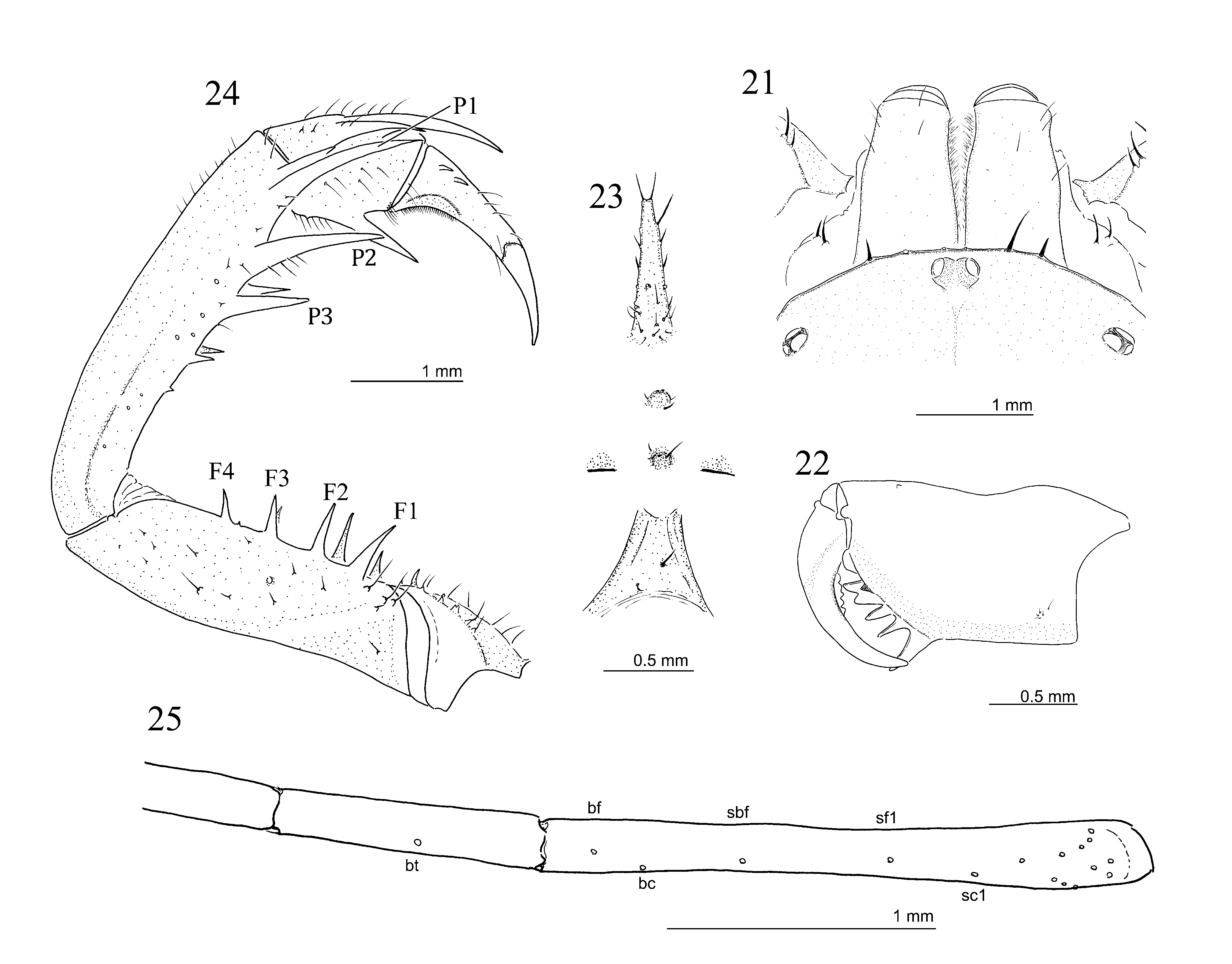
FIGURES 21 – 25. Sarax sangkulirangensis sp. nov., female holotype unless stated otherwise: 21. Frontal area of carapace of male paratype (MZB. Ambl. 150); 22. External view of left chelicerae; 23. Sternal area of opisthosoma, ventral view; 24. Antero-dorsal view of left pedipalp; 25. Fourth basitibial segment and distibiae of right leg IV, male paratype (MZB. Ambl. 150).
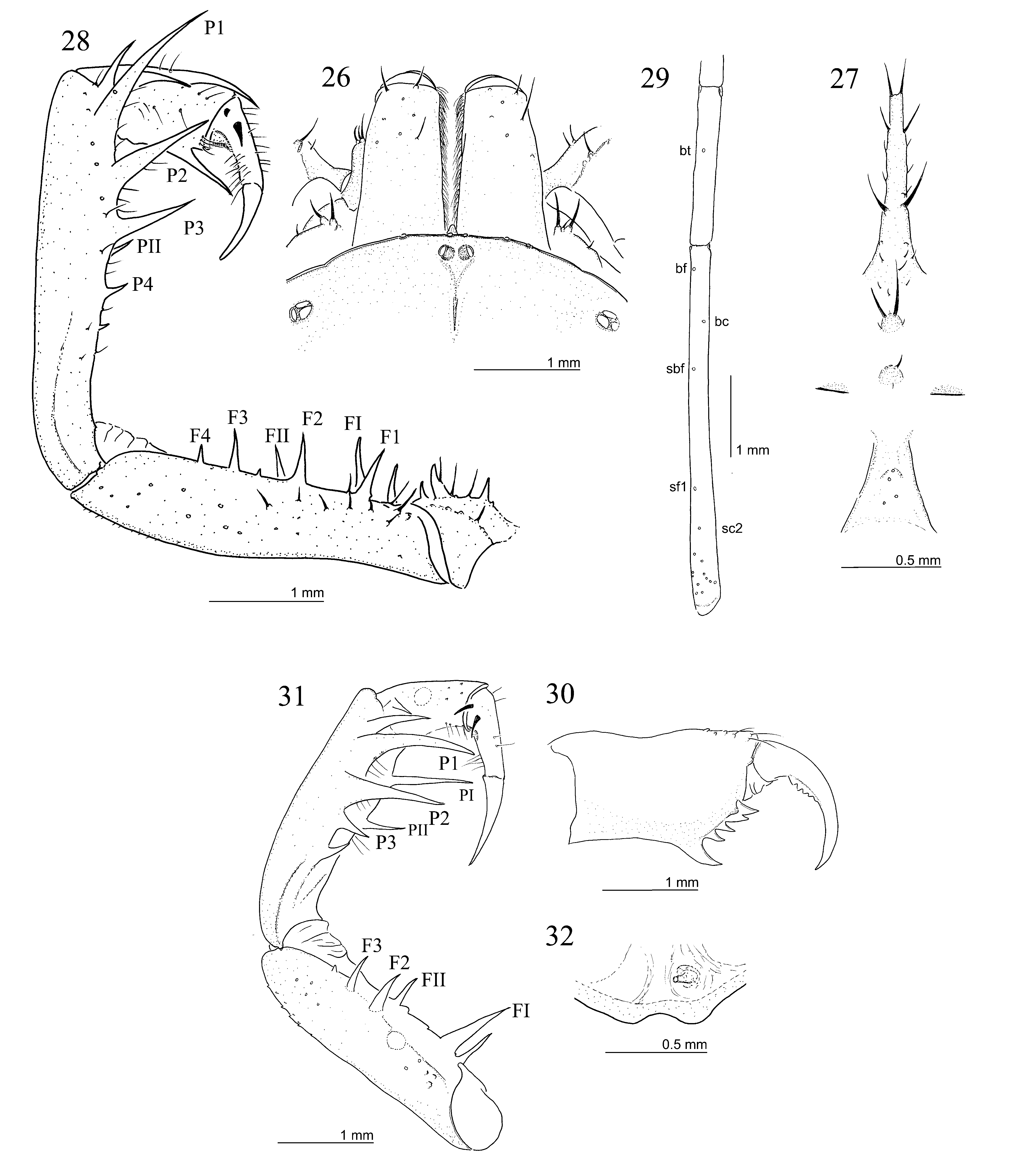
FIGURES 26 – 32. Sarax mardua sp. nov., male holotype unless stated otherwise: 26. Frontal area of carapace; 27. Sternal area of opisthosoma, ventral view; 28. Antero-dorsal view of left pedipalp; 29. Fourth basitibial segment and distibiae of right leg IV; 30. Antero-dorsal view of left pedipalp, paratype female (MNHN-Am. 12); 31. External view of left chelicerae; 32. Female gonopods, dorsal view, (MNHN-Am. 12).
IMAGES