AnimaliaNot EvaluatedacceptedspeciesAccepted
Sarax sangkulirangensis

Sarax sangkulirangensis

GBIF:119396509

ABOUT

Descriptions(6)

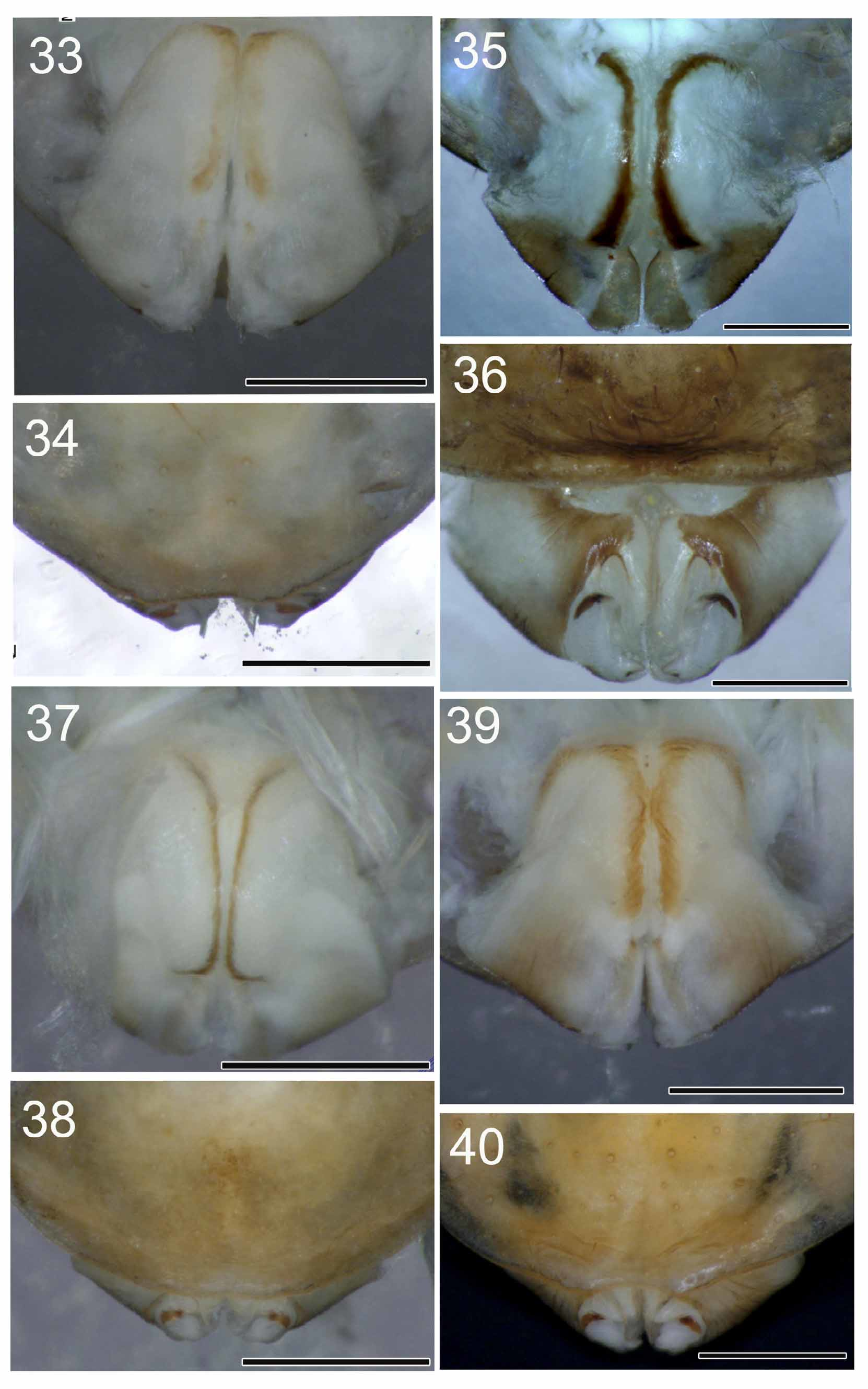
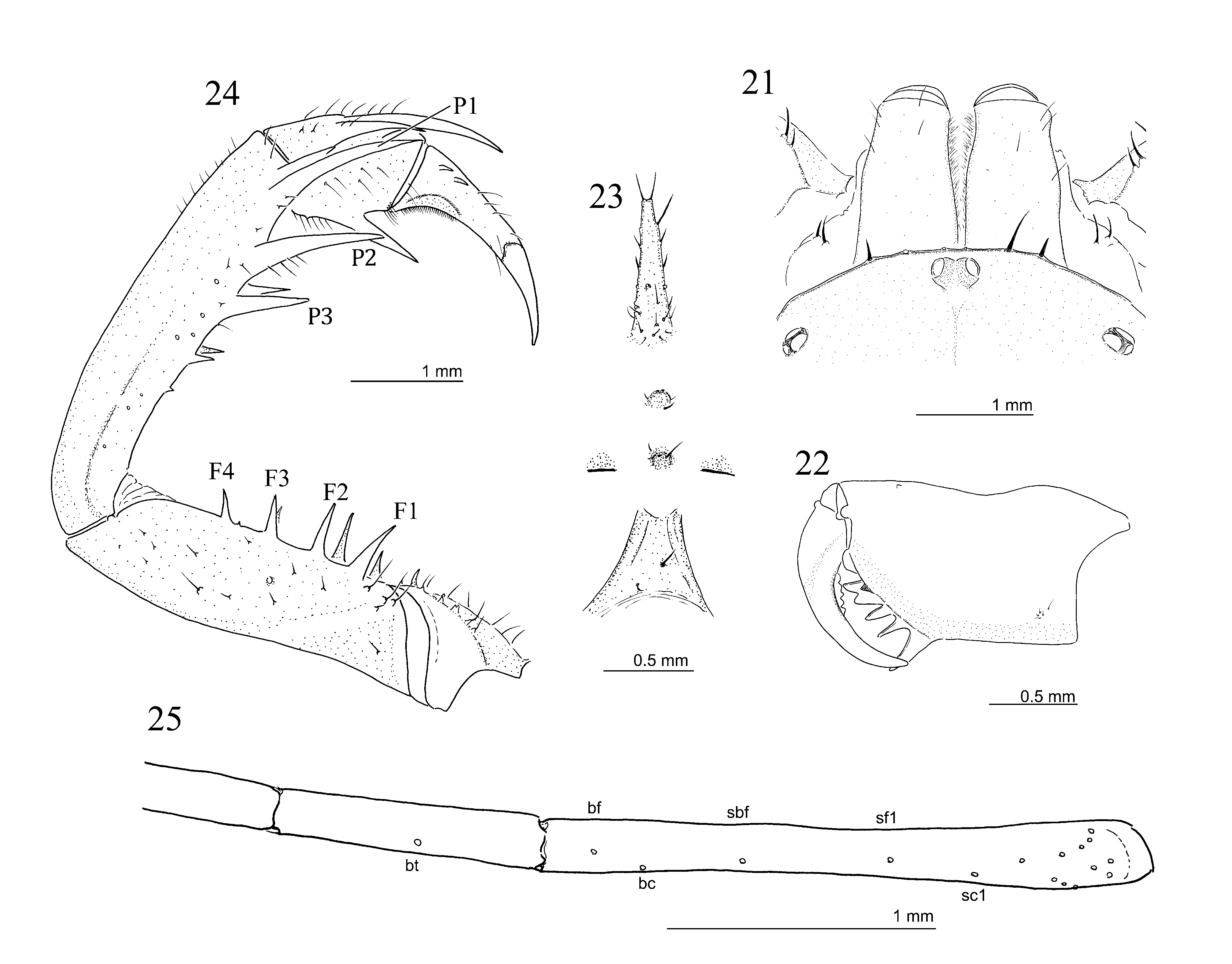
Description: Female: Color in alcohol: Carapace brown, centrally with black marks, flange yellowishbrown; pedipalp yellowish-brown except for tarsus reddish-brown and spine yellow; legs yellowish-brown, but patella dark brown; abdomen greenish-brown. Carapace (Fig. 21): Width about 1.4 – 1.7 times its length; surface granulate, without setiferous tubercles; median sulcus deep in posterior one-third of the carapace; 3 pairs lateral sulci present; flange wide and bent upward; anterior margin slightly rounded, with 6 frontal setae. Median eye tubercle black, well-developed and high, without apical setae, slightly emarginate antero-medially to form heart-shape and median eyes facing antero-laterally; lateral eyes close to lateral margin of carapace, well-developed with black tapetum. Chelicera (Fig. 22): Dorsal surface smooth, with 1 fine frontal seta and several fine setae. Basal segment with 4 teeth: lower-most tooth largest, upper-most tooth bicuspid, with upper cusp larger than lower; inner surface with several setae arranged in vertical row; outer surface with small tooth opposite bicuspid tooth, ventrally with several setae near proximal margin. Movable article with 5 teeth almost equal in size. Sternum (Fig. 23): First sternite (= tritosternum) elongate, with paired apical and several setae. Second and third sternites rounded and slightly rounded, respectively with 3 and 2 setae in addition to paired apical setae. Fourth sternite (= metasternum) with 5 setae. Pedipalp (Fig. 24): Short and stout. Trochanter on antero-dorsal margin with 4 setiferous tubercles, without median spine; antero-ventral margin with ventro-anterior apophysis equipped with several setiferous tubercles on distal margin of trochanter. Femur: antero-dorsal margin with 4 major spines (length F 1> F 2> F 3> F 4), 1 minor spine, several setiferous tubercles and small tubercles; antero-ventral margin with 4 major spines (length FI> FII> FIII> FIV), 2 minor spines and small tubercles; 1 spine present dorsally of FI and as long as three-quarters length of FI, minor spine present between FII - FIII. Patella: antero-dorsal margin with 4 major spines (length P 1> P 2> P 3> P 4), clumped distally, 1 minor spine, several setiferous tubercles and small tubercles; 1 minor spine as long as half of P 1 presents between P 1 and distal margin of patella, 1 spine presents between P 4 and proximal margin; antero-ventral margin with 4 major spines (length PII> PI> PIII> PIV), several setiferous tubercles and small tubercles present. Tibia with outer surface smooth, with spines as follows: 2 major spines on antero-dorsal margin, proximal spine about half as long as distal one; 1 major spine on antero-ventral margin close to distal margin of tibia. Tarsus completely divided (claw clearly demarcated by articulation), with 2 spines on antero-dorsal margin separated from each other by about three times basal diameter of proximal spine: proximal spine shortest, length of distal spine about twice as long as proximal one; cleaning organ ventrally with about 30 modified hairs; apotele present. Legs (Fig. 25): Femora of legs I – IV with small tubercles bearing setae. Tibia and tarsus of leg I with 23 and 41 segments, respectively; tibiae of legs II and III 2 - segmented; basitibia of leg IV 4 - segmented, fourth segment with 1 trichobothrium (value in parentheses: ratio of the distance from the trichobothrium to the proximal margin of the segment against the length of the segment), bt (0.52); distitibiae of legs II – IV each with 18 trichobothria bf 1 (0.07), sbf (0.31), bc (0.16), bt close to distal margin of basitibial fourth segment, bc close to sbf than to bf. Tarsi of legs II – IV 4 - segmented; first segment more than length of subsequent 3 segments combined; second segment with light-yellow transverse line; fourth segment without oblique slit; pulvilli present. Genitalia: Gonopods covered ventrally with genital operculum, with posterior margin concave. Gonopods paired, soft, white and tube-like. Male: Similar to female pedipalpal femur with 3 major spines (F 1> F 2> F 3) on antero-dorsal margin. Genitalia: covered ventrally by genital operculum, slightly concave on posterior margin; paired pointedprojections posteriorly, lateral lobes with brown band on basal lobe (Fig. 38). In dorsal view, soft, paired brownish band running from anterior to posterior to median section (Fig. 37). Measurements (in mm): male (n = 2) [female (n = 1)]; values for segments of the appendages are their lengths. Body length (excluding chelicera) 5.94 – 7.01 [9.85]. Carapace: median length 2.35 – 2.65 [3.63]; width 3.44 – 3.82 [5.28]; median eyes to anterior margin of carapace 0.03 – 0.07 [0.07]; distance between lateral eyes 1.65 – 1.87 [2.55]; lateral eye to anterior margin of carapace 0.32 – 0.45 [0.50]; lateral eye to lateral margin of carapace 0.14 – 0.15 [0.37]. Pedipalps: trochanter 0.97 – 1.01 [1.32]; femur 1.96 – 2.14 [3.44]; patella 2.32 – 2.45 [4.00]; tibia 1.11 – 1.50 [1.13]; tarsus 1.22 – 1.39 [2.01]. Leg I: femur 6.48 – 7.62 [12.13]; patella 0.49 – 0.55 [0.71]. Leg II: femur 3.38 – 4.53 [7.10], patella 0.62 – 0.72 [1.03]; basitibia 2.55 – 3.67 [6.17]; distitibia 1.67 – 2.30 [3.51]; metatarsus + tarsus 1.13 – 1.56 [2.74]. Leg III: femur 4.06 – 5.53 [8.35]; patella 0.65 – 0.79 [1.16]; basitibia 3.33 – 4.83 [7.65]; distitibia 1.87 – 2.48 [3.70]; metatarsus + tarsus 1.59 – 2.09 [2.89]. Leg IV: femur 3.60 – 4.81 [7.09]; patella 0.66 – 0.73 [0.58]; basitibia 3.42 – 5.38 [7.52]; distitibia 1.61 – 2.10 [3.33]; metatarsus + tarsus 1.80 – 1.92 [2.97].
Rahmadi, Cahyo, Harvey, Mark S., Kojima, Jun-Ichi (2010): Whip spiders of the genus Sarax Simon 1892 (Amblypygi: Charinidae) from Borneo Island. Zootaxa 2612: 1-21, DOI: 10.5281/zenodo.197810

Diagnosis: Sarax sangkulirangensis is relatively small sized (adult body length 5.9 – 9.8 mm), lacking sexual dimorphism, the pedipalpal tarsus has two spines with the proximal spine about half as long as distal spine, and tibia of leg IV has 19 trichobothria with bt on the middle of fourth basitibial segment, and bc closer to bf than to sbf.
Rahmadi, Cahyo, Harvey, Mark S., Kojima, Jun-Ichi (2010): Whip spiders of the genus Sarax Simon 1892 (Amblypygi: Charinidae) from Borneo Island. Zootaxa 2612: 1-21, DOI: 10.5281/zenodo.197810
Remarks: Sarax sangkulirangensis differs from S. sarawakensis by the number of trichobothria and the size of the spines on the pedipalpal tarsus. It differs from S. mardua in having smaller spines on the pedipalpal tarsus, the lack of distinct sexual dimorphism and can be easily distinguished by the high and black median eye tubercle.
Rahmadi, Cahyo, Harvey, Mark S., Kojima, Jun-Ichi (2010): Whip spiders of the genus Sarax Simon 1892 (Amblypygi: Charinidae) from Borneo Island. Zootaxa 2612: 1-21, DOI: 10.5281/zenodo.197810
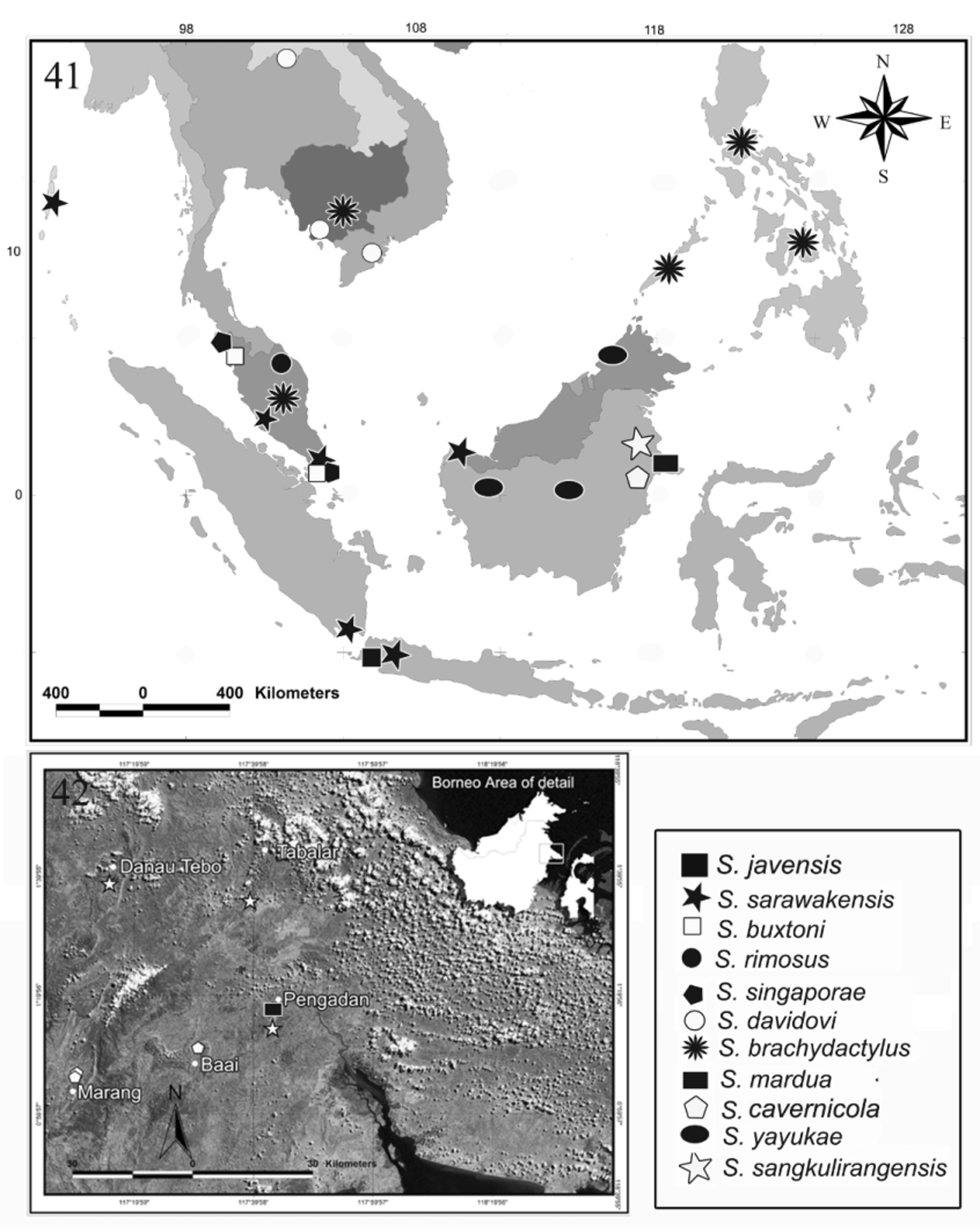
Distribution: Sarax sangkulirangensis is only known from the Sangkulirang Karst, East Kalimantan (Indonesia) (Figs. 41, 42). Natural history: This species was collected from caves situated in three different limestone hills on the northern part of the Sangkulirang Karst formation, including Tabalar Ulu which is a small limestone area with several horizontal underground rivers, the Tebo Area where an isolated karst lake is located, and Gua Ampanas. Sarax sangkulirangensis was collected from the same caves as Plusioglyphiulus similis Golovatch et al. 2009, a recently described millipede (Golovatch et al. 2009).
Rahmadi, Cahyo, Harvey, Mark S., Kojima, Jun-Ichi (2010): Whip spiders of the genus Sarax Simon 1892 (Amblypygi: Charinidae) from Borneo Island. Zootaxa 2612: 1-21, DOI: 10.5281/zenodo.197810
Etymology: The species name is derived from the name of type locality.
Rahmadi, Cahyo, Harvey, Mark S., Kojima, Jun-Ichi (2010): Whip spiders of the genus Sarax Simon 1892 (Amblypygi: Charinidae) from Borneo Island. Zootaxa 2612: 1-21, DOI: 10.5281/zenodo.197810
Material examined: Female holotype (MZB. Ambl. 070), INDONESIA: East Kalimantan: Berau Regency, District Tabalar Ulu, Gua Ke 4, GPS coordinates 1 ° 28 ' 13.23 " N, 117 ° 39 ' 28.14 " E (approximate), 9 August 2004, C. Rahmadi, ovigerous. Paratypes: 1 male (MZB. Ambl. 150), Berau Regency, Kelai District, Merapun Village, near Tebo Lake, Gua Danum Tengen, GPS coordinates 1 ° 31 ' 28.50 " N, 117 ° 22 ' 4.90 " E (approximate), 2 September 2004, Y. R. Suhardjono; 1 juvenile (MNHN-Am. 10), Berau Regency, Tabalar District, Gua Louwading, Tabalar Ulu, 11 August 2004, L. Deharveng & A. Bedos (KAL- 059); 1 male (MNHN-Am. 11), Kutai Timur Regency, Sangkulirang District, Pengadan Village, Gua Ampanas, GPS coordinates 1 ° 12 ' 01.46 " N, 117 ° 44 ' 03.58 " E (approximate), 18 August 2004, L. Deharveng & A. Bedos (KAL- 113).
Rahmadi, Cahyo, Harvey, Mark S., Kojima, Jun-Ichi (2010): Whip spiders of the genus Sarax Simon 1892 (Amblypygi: Charinidae) from Borneo Island. Zootaxa 2612: 1-21, DOI: 10.5281/zenodo.197810

Export occurrence data

Darwin Core Archive (ZIP)

CLASSIFICATION

Taxonomic Classification Tree

MULTIMEDIA

Media Files(3)

FIGURES 21 – 25. Sarax sangkulirangensis sp. nov., female holotype unless stated otherwise: 21. Frontal area of carapace of male paratype (MZB. Ambl. 150); 22. External view of left chelicerae; 23. Sternal area of opisthosoma, ventral view; 24. Antero-dorsal view of left pedipalp; 25. Fourth basitibial segment and distibiae of right leg IV, male paratype (MZB. Ambl. 150).

Imageimage/png© Rahmadi, Cahyo;Harvey, Mark S.;Kojima, Jun-IchiRahmadi, Cahyo;Harvey, Mark S.;Kojima, Jun-Ichi

FIGURES 33 – 40. Male genitalia of Sarax species from Borneo: 33. S. cavernicola, dorsal view; 34. same, ventral view; 35. S. yayukae from West and Central Kalimantan, dorsal view; 36. same, ventral view; 37. S. sangkulirangensis new species, dorsal view; 38. ventral view; 39. S. mardua from Gua Mardua, East Kalimantan, dorsal view, 40. Ventral view. Scale bars: 0.5 mm.

Imageimage/png© Rahmadi, Cahyo;Harvey, Mark S.;Kojima, Jun-IchiRahmadi, Cahyo;Harvey, Mark S.;Kojima, Jun-Ichi

FIGURES 41 – 42. Map showing the distribution of Sarax species: 41. The distribution in Southeast Asia, except for Sarax species from India and New Guinea. 42. A detailed map showing the distribution in the Sangkulirang Karst, East Kalimantan.

Imageimage/png© Rahmadi, Cahyo;Harvey, Mark S.;Kojima, Jun-IchiRahmadi, Cahyo;Harvey, Mark S.;Kojima, Jun-Ichi

IMAGES

Gallery(3)

See Gallery

Occurrences with images

Source Information

Whip spiders of the genus Sarax Simon 1892 (Amblypygi: Charinidae) from Borneo Island

checklist

This dataset contains the digitized treatments in Plazi based on the original journal article Rahmadi, Cahyo, Harvey, Mark S., Kojima, Jun-Ichi (2010): Whip spiders of the genus Sarax Simon 1892 (Amblypygi: Charinidae) from Borneo Island. Zootaxa 2612: 1-21, DOI: 10.5281/zenodo.197810

Abstract

Five species of the whip spider genus Sarax are recognized from Borneo, with the following four species newly described: Sarax yayukae sp. nov. from Sabah (Malaysia), West and Central Kalimantan (Indonesia), and three species from East Kalimantan, S. cavernicola sp. nov., S. sangkulirangensis sp. nov., and S. mardua sp. nov. . Sarax mardua and S. cavernicola have pale coloration, reduced eyes and elongate legs suggesting troglomorphic adaptations to cave environments. The characters diagnosing the family Charinidae and the genus Sarax are discussed and revised. The distribution patterns of Sarax species in Southeast Asia, especially in Borneo Island, are discussed in relation to their habitat preferences. The generic status of Stygophrynus moultoni Gravely 1915 (Charontidae) is briefly discussed.

Key words: Caves, troglomorphic species, taxonomy, new species, Stygophrynus

Rahmadi C, Harvey M S, Kojima J, plazi (2010). Whip spiders of the genus Sarax Simon 1892 (Amblypygi: Charinidae) from Borneo Island. Plazi.org taxonomic treatments database. Checklist dataset https://doi.org/10.5281/zenodo.197810 accessed via GBIF.org on 2026-06-15.

CC0Published 12/31/2010View dataset
GBIF Usage Key
119396509
Dataset Key
3fed616e-ea51-496b-b522-145b87775b5a
Origin
source
Backbone Key
7686833
Taxon ID
AD1687F3FF8DFF900CEB49FA2F74F908.taxon
Last Crawled
6/11/2026
Last Interpreted
6/11/2026