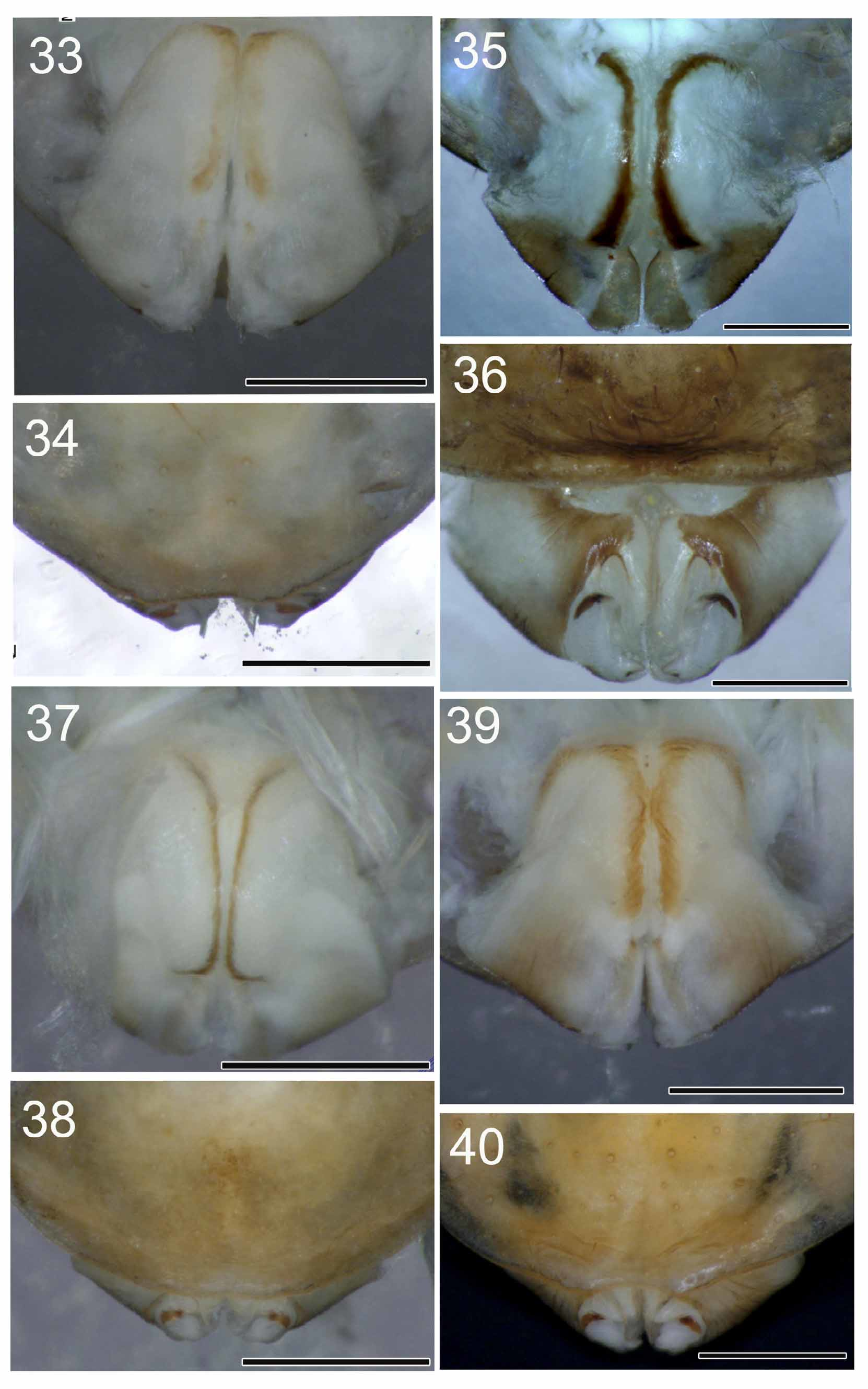
Description: Female: Color in alcohol: Carapace yellowish-brown, centrally with brown marks; pedipalp yellowish-brown except for reddish-brown spines and tarsus. Legs II – IV yellowish-brown to light yellow, except patella dark brown. Abdomen yellow with a pair of spots on each tergite. Carapace (Fig. 1): Width about 1.3 – 1.5 times its length; surface finely granulate, without setiferous tubercles, with several short setae in frontal area. Flange wide and bent upwards. Anterior margin of carapace slightly rounded, with 6 frontal setae. Median sulcus deep in posterior one-third of the carapace; a line sulcus running from posterior of median eyes to central sulcus, two paired lateral sulci present running laterally, a pair of sulci on posterior of lateral eyes. Eyes small, median eye tubercle brown, without apical setae, reduced in size, triangular in shape; median eyes facing antero-laterally; lateral eyes close to lateral margin of carapace, reduced in size, yellowish pale in color; frontal process not visible from above in holotype, and visible in paratypes. Chelicera (Fig. 2): Dorsal surface smooth, without frontal setae and with several fine setae. Basal segment with 4 teeth: lower-most tooth largest, upper-most tooth bicuspid, with upper cusp larger than lower cusp; inner surface with several setae arranged in vertical row; outer surface with one small tooth opposite of bicuspid tooth, ventrally with several setae near proximal margin. Movable article with 6 teeth; second tooth the largest and subsequent teeth decreasing in size distally. Sternum (Fig. 3): First sternite (= tritosternum) elongate, with paired apical setae and laterally many setae shorter than apical setae. Second and third sternites rounded and slightly elongate, respectively with 8 and 6 setae in addition to paired apical setae. Fourth sternite (= metasternum) with 3 setae. Pedipalp (Figs. 4 – 5): Strong and slender. Trochanter with 10 setiferous tubercles and several setae along antero-dorsal margin, 1 spine medially and 7 setiferous tubercles on antero-ventral margin; ventro-anterior apophysis equipped with several setiferous tubercles present on distal margin of trochanter. Femur: anterodorsal margin with 6 major spines (length F 1> F 3> F 5> F 2> F 4), several setiferous tubercles and small tubercles; antero-ventral margin with 7 major spines (length FII> FV> FI> FVIII> FIII> FIV> FVI> FVII), several minor spines and small tubercles. Patella: antero-dorsal margin with 3 major spines (P 1, P 2, P 3) about equal in size, several minor spines, several setiferous tubercles and small tubercles, the three major spines located on more than half of pedipalpal patella length distally, 1 minor spine present between P 1 and distal margin of patella, the length of minor spine less than half of P 1 length, 1 minor spine present between P 3 and proximal margin; antero-ventral margin with 4 major spines (length PI> PIII> PII> PIV), several setiferous tubercles and small tubercles, 2 minor spines between PIII-PIV and 3 minor spines between PIV and proximal margin. Tibia with several setiferous tubercles, outer surface roughened and several setae on inner surface; antero-dorsal margin with two major spines, proximal spine less than half as long as distal one; antero-ventral margin with 3 major spines (Fig. 5), the distal-most spine longest, following spines decreasing in size proximally, other specimens (MZB. Ambl. 0 72 – 0 73, 0 91 – 092) have only one spine without 2 additional proximal spines. Tarsus completely divided (claw clearly demarcated by articulation), antero-dorsal margin with 3 spines: proximal and medial spines short, about equal in length and close to each other (space between them about basal diameter of medial spine), distal spine longer than proximal and medial spine, medial spine by about 3 basal diameter of medial spine, without basal row of seta on proximal end of cleaning organ; cleaning organ ventrally with about 30 modified hairs; apotele present. Legs (Fig. 6): Femora of legs I – IV with small tubercles and setiferous tubercles. Tibia and tarsus of leg I with 23 and 41 segments, respectively; tibiae of legs II and III two-segmented; basitibiae of leg IV foursegmented, fourth segment with 1 trichobothrium (value in parentheses: ratio of the distance from the trichobothrium to the proximal margin of the segment against the length of the segment), bt (0.45); distitibiae of legs II-IV each with 18 trichobothria, bf (0.05), sbf (0.23), bc (0.26), sf 1 (0.60), sc 1 (0.75), bt close to proximal margin of fourth basitibial segment, bc very close to sbf (Fig. 6). Tarsi of legs II – IV four-segmented; first segment about as long as length of subsequent three segments combined; second segment with lightyellow transverse line; fourth segment without oblique slit; pulvilli present. Genitalia (Fig. 7): Covered ventrally with genital operculum slightly concave apically, paired with 2 tubes projecting medially. Male (Figs. 33 – 34): Similar to female, without distinct sexual dimorphism. Genitalia: Covered ventrally by genital operculum slightly concave on the posterior margin (Fig. 34); paired apically-pointed small projections on medial lobes; 2 brown marks present on lateral lobes. In dorsal view, paired, anteriorly rounded with 2 light brown bands running from anterior to mid-length of genitalia, 2 small brown marks present medially (Fig. 33). Measurements (in mm): male (n = 1) [female (n = 3)]; values for segments of the appendages are their lengths. Body length (excluding chelicera) 8.64 [6.17 – 16.25]. Carapace: median length 3.20 [4.57 – 6.37]; width 4.17 [6.30 – 8.29]; median eyes to anterior margin of carapace 0.08 [0.11 – 0.15]; distance between lateral eyes 1.88 [3.00 – 4.54]; lateral eye to anterior margin of carapace 0.37 [0.64 – 0.69]; lateral eye to lateral margin of carapace 0.14 [0.24 – 0.35]. Pedipalps: trochanter 1.08 [1.97 – 2.62]; femur 2.92 [5.95 – 8.98]; patella 3.26 [6.15 – 9.08]; tibia 1.59 [2.81 – 3.82]; tarsus 1.87 [3.00 – 4.51]. Leg I: femur 17.08 [24.35 – 35.79]; patella 0.86 [1.00 – 1.18]. Leg II: femur 8.25 [11.32 – 17.29], patella 1.11 [1.57 – 1.79]; basitibia 7.23 [11.22 – 12.79]; distitibia 4.52 [6.92 – 10.40]; metatarsus + tarsus 2.95 [4.08 – 5.42]. Leg III: femur 9.38 [13.16 – 18.72]; patella 1.18 [1.25 – 1.97]; basitibia 7.69 [11.67 – 19.32]; distitibia 5.18 [6.95 – 11.46]; metatarsus + tarsus 3.59 [4.28 – 5.86]. Leg IV: femur 9.08 [12.92 – 18.28]; patella 1.18 [1.21 – 1.80]; basitibia 9.90 [13.14 – 23.28]; distitibia 4.81 [6.79 – 10.29]; metatarsus + tarsus 2.40 [4.21 – 6.13].
Rahmadi, Cahyo, Harvey, Mark S., Kojima, Jun-Ichi (2010): Whip spiders of the genus Sarax Simon 1892 (Amblypygi: Charinidae) from Borneo Island. Zootaxa 2612: 1-21, DOI: 10.5281/zenodo.197810