AnimaliaNot EvaluatedacceptedspeciesAccepted
Bansella oregonica

Bansella oregonica

(Banse, 1956) Banse, 1956

GBIF:119400951

0year

0

Synonyms

ABOUT

Descriptions(2)

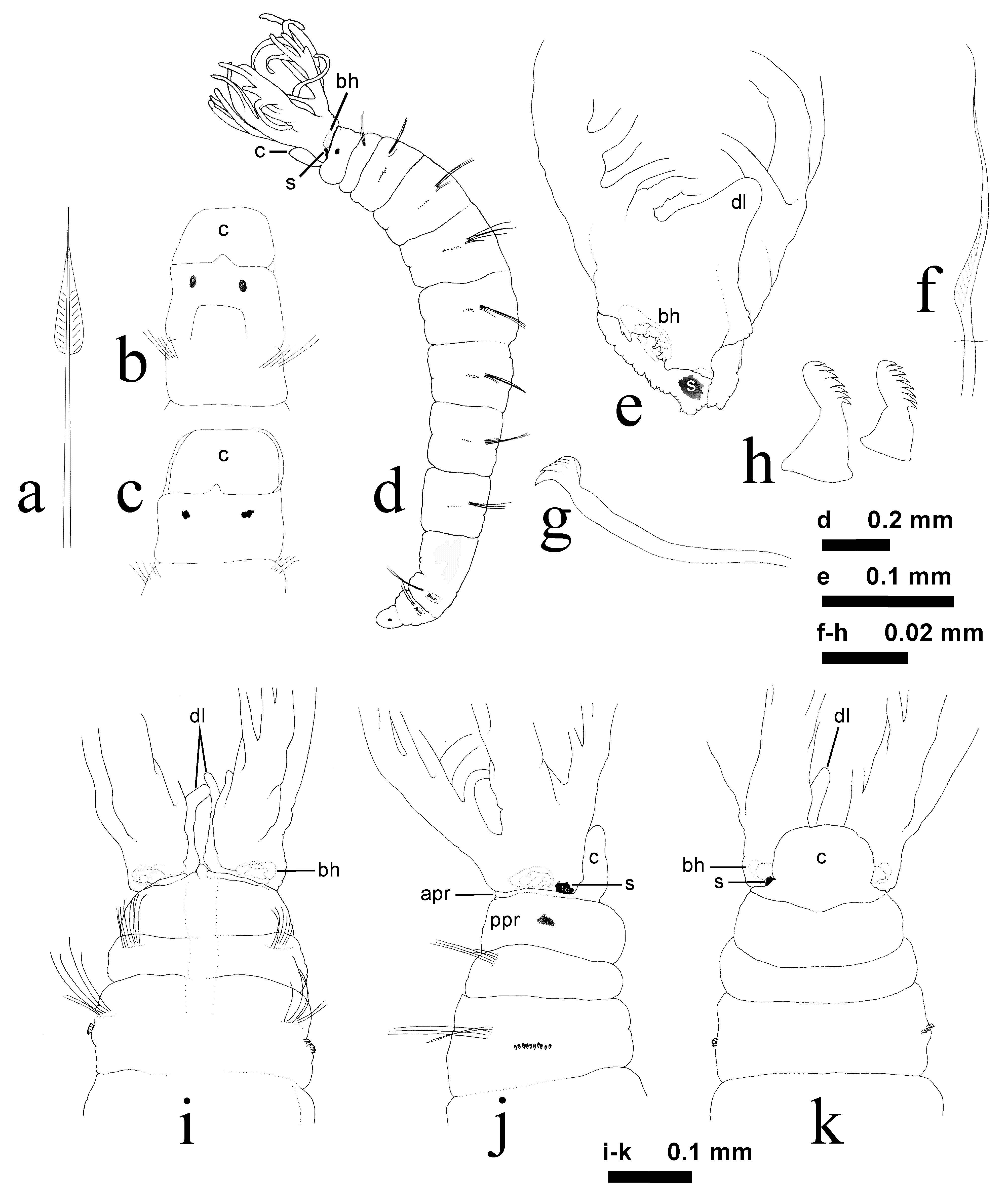
Remarks. Members of Bansella oregonica are generally similar to those of Fabricia stellaris in that both have prominent dorsal lips and the ventral lobe extension of the anterior peristomial ring. Much of the confusion in the past as to whether B. oregonica was part of the F. stellaris - subspecies group or a separate species was probably due to the incomplete comparison of individuals, as suggested by the vague descriptions presented by Hartman (1951) and Banse (1956, 1963, 1979). For instance, there is no indication that comparisons of abdominal uncini were ever made. Banse (1963) recognized the distinct differences in ventral collars in specimens belonging to F. stellaris and B. oregonica, but apparently never compared abdominal uncini. The manubrium of abdominal uncini among members of F. stellaris is 1.5 to two times longer than the dentate region (Banse 1956: fig. 3 d; Fitzhugh 1990 a: fig. 1), whereas the manubrium in B. oregonica is considerably shorter (Fig. 1 h). Relative to members of other Fabriciinae species, there are no features uniquely shared by F. stellaris and B. oregonica. It is, however, interesting to note that in both species spermiogenesis occurs in chaetigers 3 – 8, which might at first suggest an exclusive sister-group relationship. As is shown in the next section, this character is not a synapomorphy. Spermiogenesis in chaetigers 3 – 8 also occurs among members of Pseudofabricia aberrans Cantone, 1972 (pers. obs.), several Fabriciola Friedrich, 1939, species (Rouse 1995 b), Novafabricia labrus Fitzhugh, 1998, and one undescribed species in the unnamed ‘ Genus A’ (sensu Fitzhugh 1989; Rouse 1995 b). The present description does confirm the observations of Hartman (1951), Banse (1956, 1963), and Fitzhugh (1990 a) that the inferior thoracic notochaetae are narrowly hooded in all chaetigers. Banse’s (1956: fig. 8; Fig. 1 a) depiction of an inferior chaeta as having a somewhat “ subspatulate ” appearance is, however, not accurate; these chaetae have a very narrow, elongate hood (Fig. 1 f). The illustrations of the ventral collar lobe presented by Banse (1963; Fig. 1 b) and Hobson & Banse (1981; Fig. 1 c) are fairly accurate in depicting the distinct rectangular shape (see Fig. 1 k). None of the previous descriptions of specimens of Bansella oregonica make reference to branchial crown spermathecae (Fig. 1 d, e, j, k). An examination of the original LACM-AHF sample from which Banse (1956) had taken his syntypes (see Fitzhugh 1990 a) revealed that spermathecae are clearly visible, albeit the specimens are in very poor condition. In addition to B. oregonica, crown spermathecae among Fabriciinae are known among members of the following genera and species: Fabricia stellaris (Rouse 1995 a: fig. 7 – 9), Fabriciola cri Rouse, 1996 (Rouse 1996 a: fig. 7 – 8, 10 – 12), F. l i g u ro n i s Rouse, 1993 (Rouse 1993: fig. 31, 33), F. m i n u t a Rouse, 1996 (Rouse 1996 a: fig. 22 – 14, 26), Manayunkia (Zenkevitsch 1925; Rouse 1995 a: fig. 2 – 3, 1996 a: fig. 33, 37 – 38; Rouse pers. comm.; not yet known in M. polaris Zenkevitsch, 1935), Novafabricia tenuiseta Fitzhugh, 1990 (Rouse 1996 b: fig. 1 – 6), and Parafabricia ventricingulata Fitzhugh, 1992 (Rouse 1992).
Fitzhugh, Kirk (2010): Revised systematics of Fabricia oregonica Banse, 1956 (Polychaeta: Sabellidae: Fabriciinae): an example of the need for a uninomial nomenclatural system. Zootaxa 2647: 35-50, DOI: 10.5281/zenodo.198706

Material examined. Syntypes (numerous specimens), LACM-AHF POLY 2477 [erroneously listed as AHF 3386 by Fitzhugh (1990 a: 12)]. Pacific Ocean, USA, Oregon, South Bay in Coos Bay, rock washings, coll. D. H. Reish, Aug 1950. Other material examined. Pacific Ocean, USA, Washington State, Olympic Coast National Marine Sanctuary. LACM-AHF POLY 2475 (one female, two males), Olympic Coast National Marine Sanctuary NIS-RAS sta. TB 1 - 2, Third Beach, 47 52.586 ' N, 124 35.163 ' W, scrapings of algal turf off exposed rocks in mid-intertidal zone, coll. L. H. Harris, 23 Aug 2001. LACM-AHF POLY 2476 (3 females, 2 males), Olympic Coast National Marine Sanctuary NIS-RAS sta. NRC- 3, about 0.5 miles north of Hoh River, Diamond Rock, 47 45.357 ' N, 124 26.843 ' W, river outwash of boulders, cobble, gravel between and among sea stacks, sand at bases of rhizomes of Polysiphonia sp. turf, coll. L. H. Harris, M. S. Brancato, 23 Aug 2001. Definition. A specific hypothesis, accounting for the presence of an anterior peristomial ring with a ventral margin as a wide, distinctly rectangular lobe among observed individuals. The rectangular lobe condition originated by an unspecified mechanism (s) in a reproductively isolated population of individuals with triangular lobes, subsequent to which the new character became fixed in the population by an unspecified mechanism (s), leading to individuals observed in the present, all with anterior peristomial rings with rectangular ventral lobes. In addition to the rectangular ventral lobe collar, members of Bansella oregonica do have a distinct combination of characters, i. e., prominent dorsal lips, absence of ventral filamentous appendages, and only narrowly hooded inferior notochaetae. Unfortunately, the phylogenetic analysis (see below) does not suggest that any of these additional characters are autapomorphies that can be accounted for in the hypothesis named B. oregonica. Description based on Washington specimens. All specimens complete, with eight thoracic and three abdominal chaetigers. Largest specimen with branchial crown length 0.4 mm, trunk length 1.7 mm, greatest width 0.3 mm at mid-thorax; smallest specimen with crown 0.2 mm and trunk 1.4 mm. Largest specimen a complete female. Trunk slightly tapered anteriorly and posteriorly (Fig. 1 d). Branchial crown with three pairs of radioles; filamentous distal ends, same width as pinnules; pinnules terminate at about same height as radioles or slightly shorter. Dorsalmost radioles with 4 – 5 pairs of pinnules, median and ventral radioles each with four pairs. Dorsal lips erect, triangular, with distally rounded ends (Fig. 1 e, i, k); no associated pinnular or radiolar appendages (see Fitzhugh 2003); margins of branchial lobes ventral to dorsal lips are truncate (i. e., ventral filamentous appendages absent). Bases of ventralmost radioles with slightly raised surfaces adjacent to ventralmost pair of pinnules, but not interpreted as ventral lip-like structures (see Banse 1956: fig. 6 a; Fitzhugh 1990 a). Branchial hearts present. Branchial lobes not fused together mid-dorsally; lobes attached to entire peristomial margin. Females with dark brown spermatheca in ventral half of each branchial lobe (Fig. 1 d, e, j, k). Anterior margin of anterior peristomial ring as low ridge dorsally and laterally (Fig. 1 d, i – k), with narrow mid-dorsal separation; ventral ring margin as wide, rectangular lobe. Anterior peristomial ring distinctly shorter than posterior ring. Dorso-medial lobe above mouth triangular, extending slightly beyond anterior peristomial ring (Fig. 1 i). Anterior peristomial ring distinctly wider than long. Posterior peristomial ring about 2.5 times wider than long, and about 11 times longer than anterior ring (Fig. 1 d, i – k). Annulation between rings visible ventrally and laterally. Mid-dorsum of posterior peristomial ring with shallow, longitudinal depression, extending into chaetiger 2 (Fig. 1 i). Pair of reniform black eyes in posterior peristomial ring. Chaetiger 1 about one-half length of chaetiger 2, wider than long; chaetiger 2 about same length as posterior peristomial ring; chaetiger 3 about one-third longer than 2, with chaetiger 3 – 6 each about same length, slightly wider than long; chaetiger 7 – 8 slightly longer than preceding segments, as long as wide. chaetiger 9 about one-third length of chaetiger 8, with chaetiger 10 – 11 each successively shorter than 9. Pygidium about same length as chaetiger 11, posterior margin broadly tapered, rounded. Pair of round, black pygidial eyes (Fig. 1 d). Superior thoracic notochaetae narrowly hooded, 3 – 5 per fascicle. Inferior thoracic notochaetae in chaetigers 2 – 8 narrowly hooded (Fig. 1 f), distinctly shorter than superior notochaetae; 2 – 3 per fascicle. Abdominal neuropodia of chaetigers 9 – 11 with very elongate, narrowly hooded chaetae, two per fascicle. Thoracic uncini acicular, main fang slender (Fig. 1 g); large tooth offset from mid-line of main fang present, remaining teeth behind main fang slender and slightly decreasing in size away from fang; hood present; 8 – 13 uncini per fascicle in irregular single rows. Abdominal uncini with seven to eight rows of teeth in profile, three teeth per row (Fig. 1 h); manubrium 1.5 times longer to same length as dentate region, expanded proximally to truncate margin; uncini in chaetigers 9 – 11 number 16, 15, and 13, respectively. Females with oocytes in chaetigers 3 – 4; males with developing sperm in chaetigers 3 – 8, spermatids arranged in groups of more than 100, attached to central cytophore. Some specimens with light brown body wall pigmentation along inner margins of branchial lobes, peristomial rings (including collar) and chaetigers 1 – 2; remainder of body cream colored. Tubes not present (but see description by Fitzhugh 1990 a); brooding of young not observed.
Fitzhugh, Kirk (2010): Revised systematics of Fabricia oregonica Banse, 1956 (Polychaeta: Sabellidae: Fabriciinae): an example of the need for a uninomial nomenclatural system. Zootaxa 2647: 35-50, DOI: 10.5281/zenodo.198706

Export occurrence data

Darwin Core Archive (ZIP)

CLASSIFICATION

Taxonomic Classification Tree

MULTIMEDIA

Media Files(1)

FIGURE 1. Bansella oregonica, comb. nov. a, inferior thoracic notochaeta (redrawn from Banse 1956: fig. 8); b – c, anterior end, dorsal view (branchial crown removed), showing rectangular shape of ventral, anterior peristomial ring collar (redrawn from Banse 1963: fig. 3 c, and Hobson & Banse 1981: fig. 25 n, respectively); d, entire specimen, lateral view (left side); e, left half of branchial crown, inner margin; f, inferior thoracic notochaeta, chaetiger 4; g, thoracic uncinus, chaetiger 5; h, abdominal uncini from lower (left) and median (right) region of torus, chaetiger 9; i – k, dorsal, lateral (right side), and ventral views of anterior end, respectively. Abbreviations: apr, anterior peristomial ring; bh, branchial heart; c, anterior peristomial ring collar; dl, dorsal lip; ppr, posterior peristomial ring; s, spermatheca.

Imageimage/png© Fitzhugh, KirkFitzhugh, Kirk

IMAGES

Gallery(1)

See Gallery

Occurrences with images

Source Information

Revised systematics of Fabricia oregonica Banse, 1956 (Polychaeta: Sabellidae: Fabriciinae): an example of the need for a uninomial nomenclatural system

checklist

This dataset contains the digitized treatments in Plazi based on the original journal article Fitzhugh, Kirk (2010): Revised systematics of Fabricia oregonica Banse, 1956 (Polychaeta: Sabellidae: Fabriciinae): an example of the need for a uninomial nomenclatural system. Zootaxa 2647: 35-50, DOI: 10.5281/zenodo.198706

Abstract

Previous descriptions of members of Fabricia oregonica Banse, 1956, have distinguished it by the presence of only narrowly hooded inferior thoracic notochaetae, in contrast to the presence of pseudospatulate chaetae in median chaetigers of the type species, F. stellaris (Müller, 1774). In other respects, past descriptions of specimens to which F. oregonica refers have lacked the necessary detail to clearly determine generic placement, and the type material is in poor condition. Recently collected specimens matching earlier descriptions are used to redescribe members of the species. An exclusive sister-group relationship does not exist between F. stellaris and F. oregonica, precluding the latter species being assigned to Fabricia. Fabricia oregonica is therefore placed in a new genus, Bansella. Under the view that all taxa, whether phylogenetic or specific, are explanatory hypotheses, it is pointed out that the monotypic Bansella cannot be defined as such a hypothesis. While the International Code of Zoological Nomenclature requires that names be defined by way of ‘differentiating characters,’ this approach is at odds with the scientific endeavor of biological systematics to infer explanatory hypotheses, colloquially known as taxa. In addition to only having narrowly hooded inferior notochaetae, members of B. oregonica differ from F. stellaris specimens in having abdominal uncini with a much shorter manubrium. The ventral, lobe-like collar in B. oregonica specimens is also distinctly rectangular as opposed to triangular. Members of the two species are similar in that females have pigmented spermathecae in the bases of branchial lobes and spermiogenesis occurs in males in chaetigers 3–8.

Key words: explanatory hypotheses, ICZN, new genus, phylogenetics, taxa

Fitzhugh K, plazi (2010). Revised systematics of Fabricia oregonica Banse, 1956 (Polychaeta: Sabellidae: Fabriciinae): an example of the need for a uninomial nomenclatural system. Plazi.org taxonomic treatments database. Checklist dataset https://doi.org/10.5281/zenodo.198706 accessed via GBIF.org on 2026-06-14.

CC0Published 12/31/2010View dataset
GBIF Usage Key
119400951
Dataset Key
483b29a5-14c1-4ffc-b7f1-4fdbe37c5945
Origin
source
Backbone Key
2328987
Taxon ID
2C518784FF8EAC16FF09F99EFDE3F939.taxon
Last Crawled
6/11/2026
Last Interpreted
6/11/2026