
AnimaliaNot EvaluatedacceptedspeciesAccepted
Ophryotrocha macrovifera

Ophryotrocha macrovifera

GBIF:119406689

ABOUT

Descriptions(5)

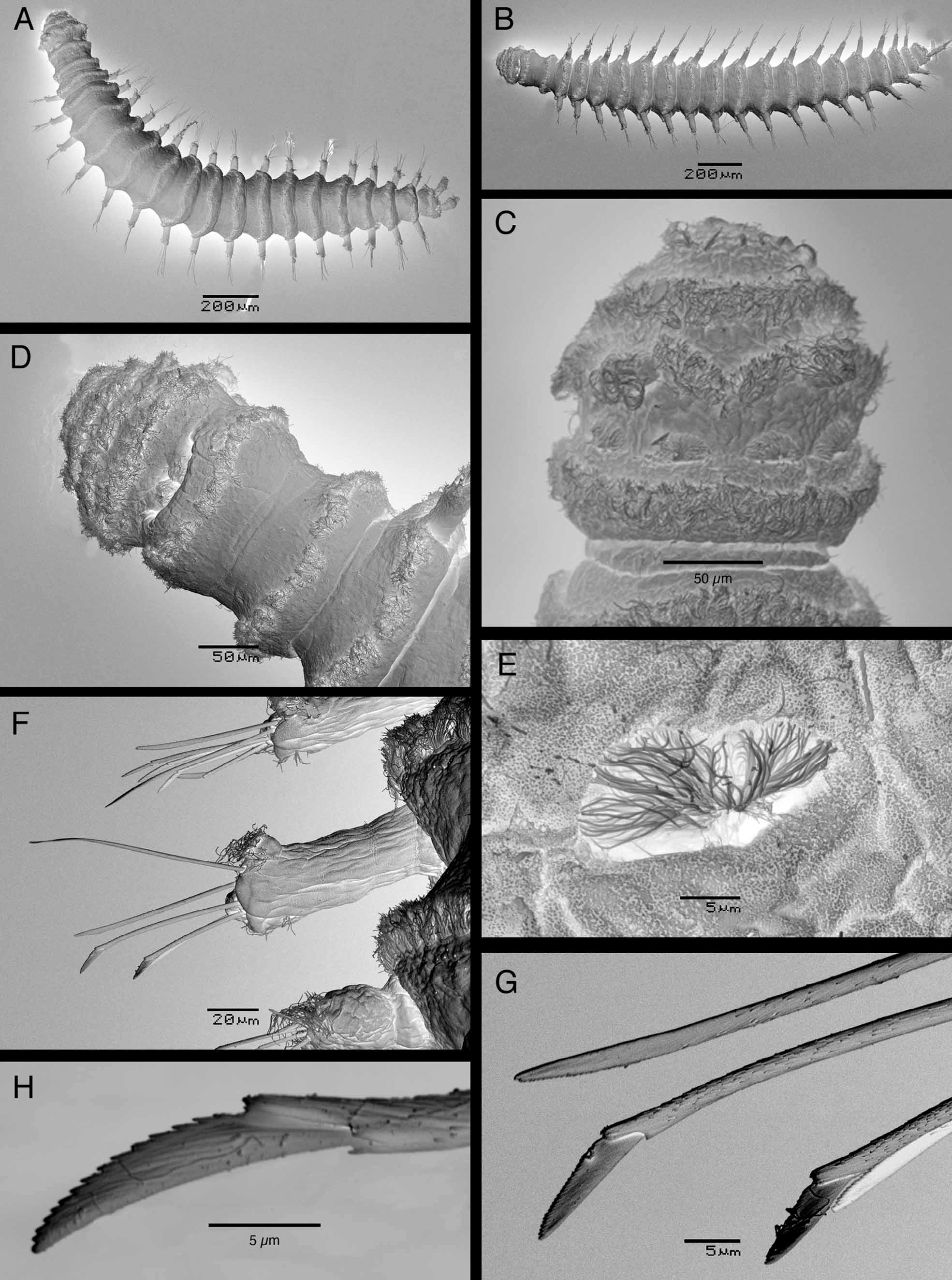
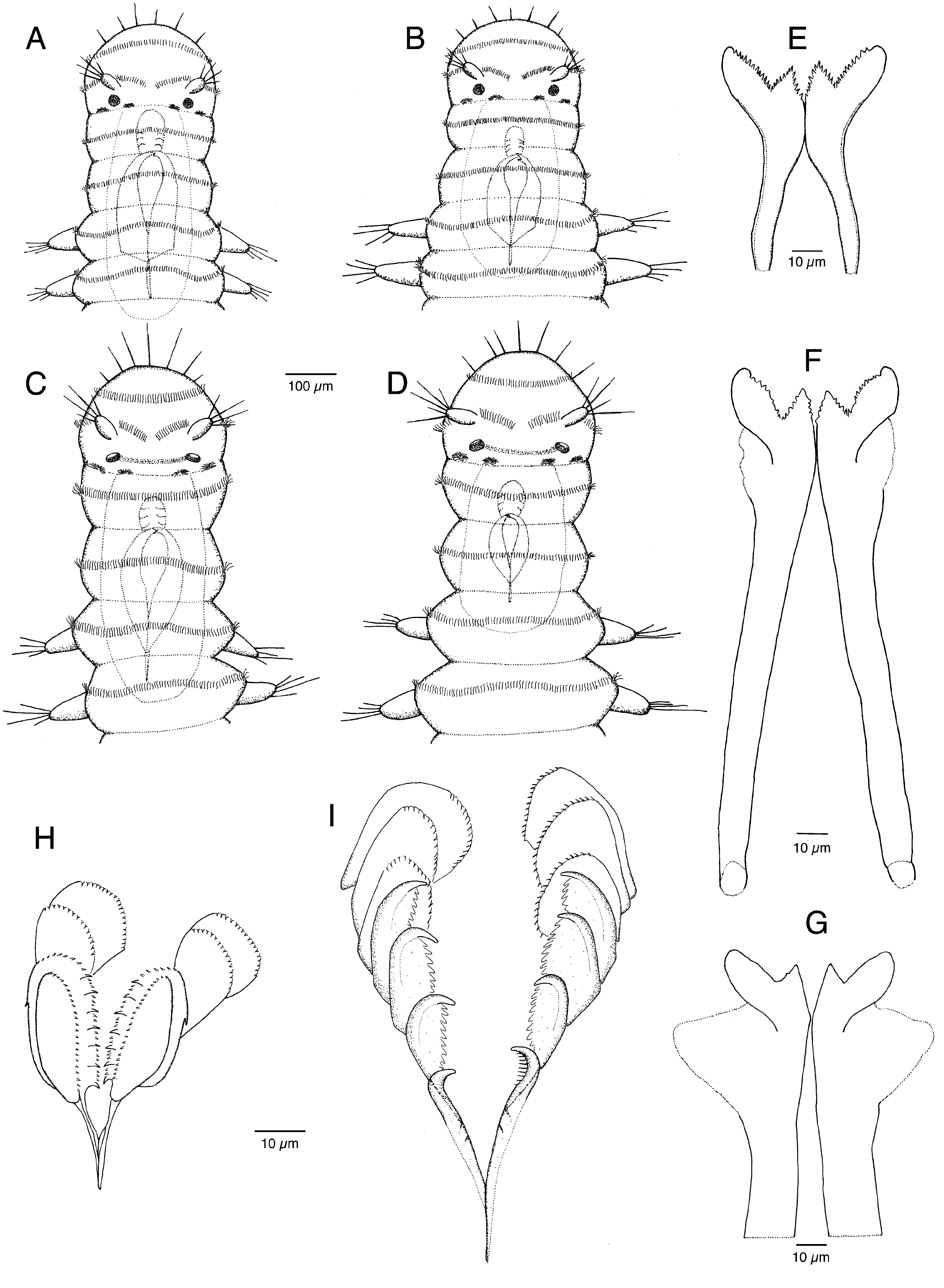
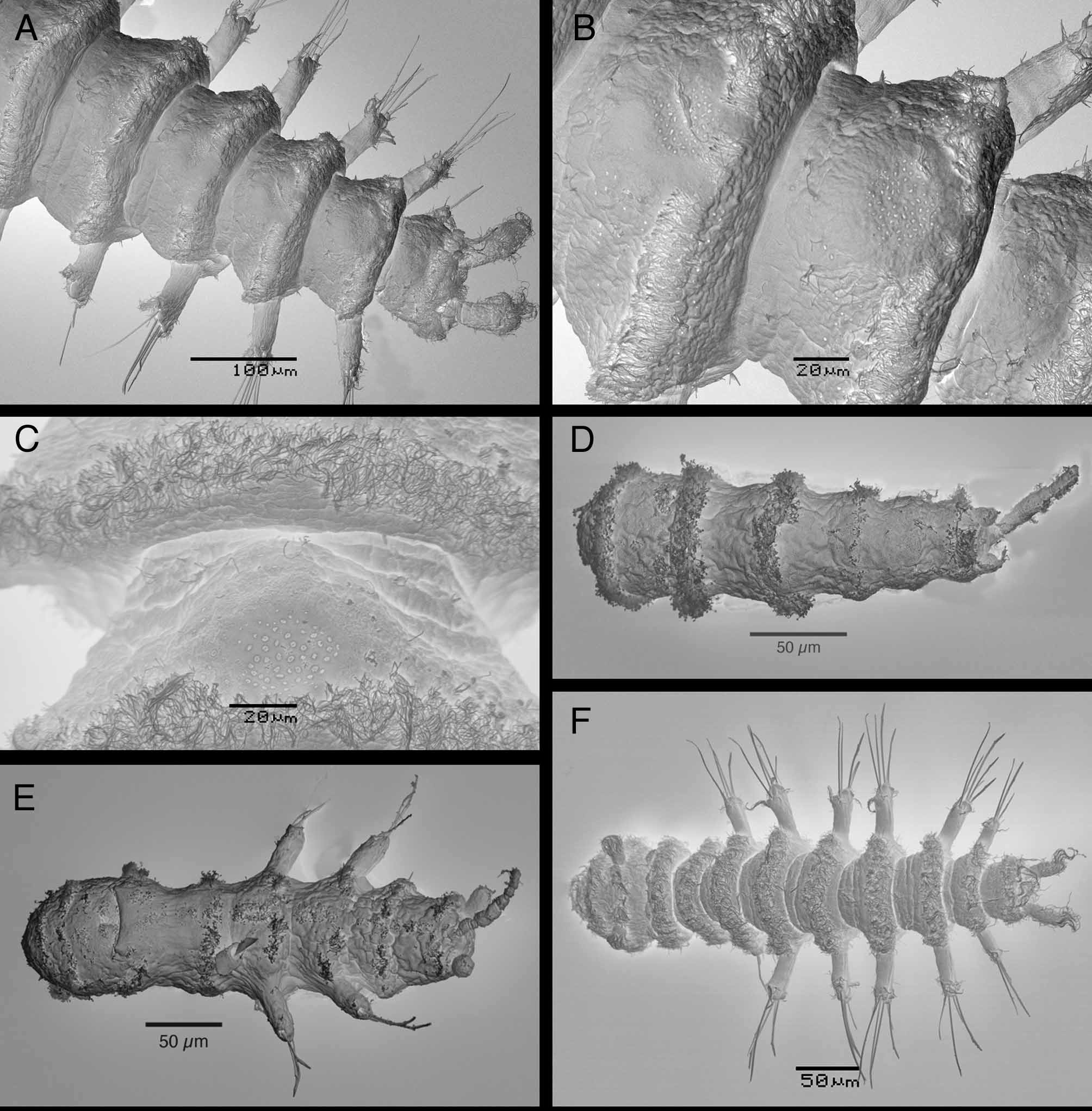
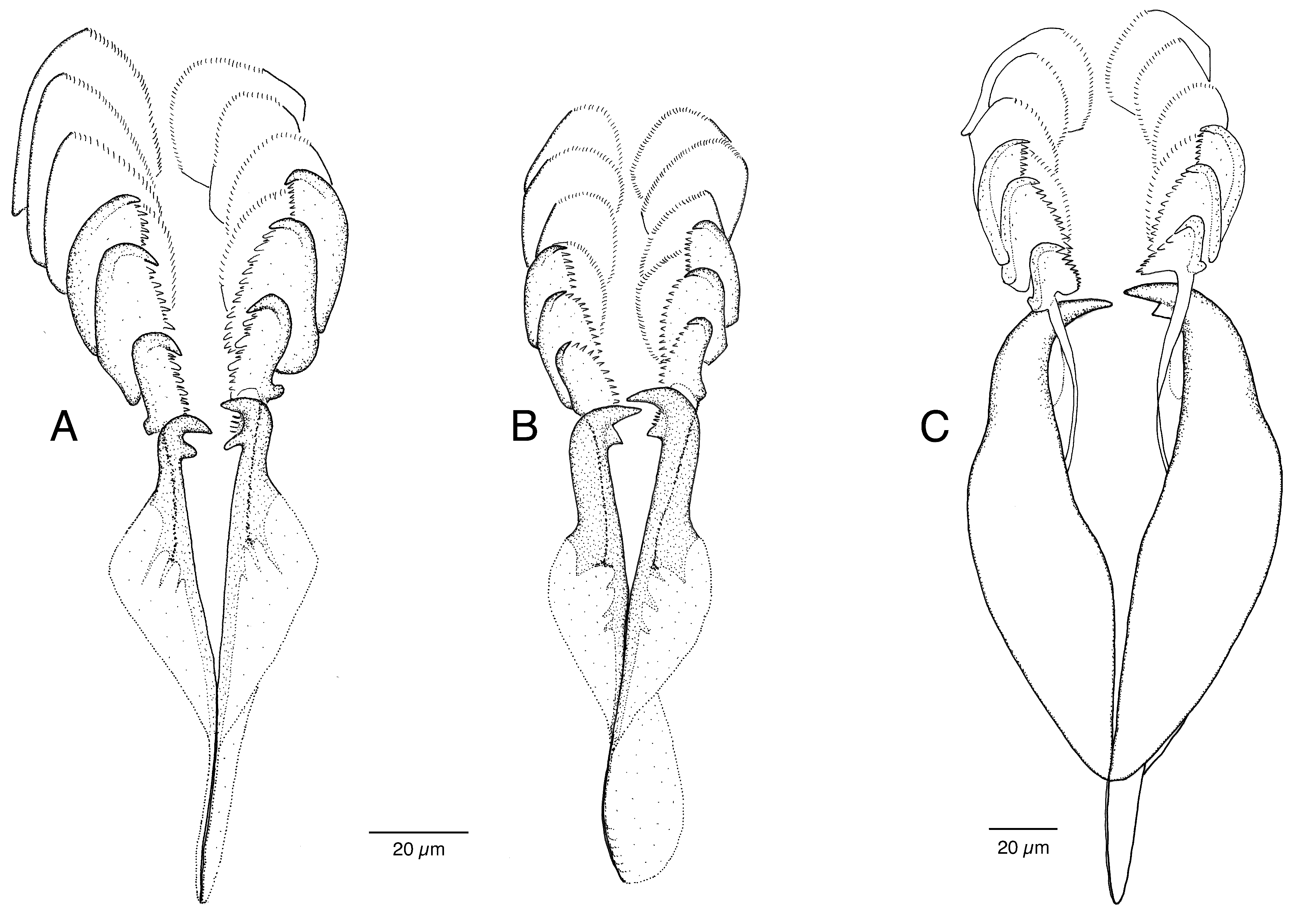
Description. Length of most live adults 3 – 4 mm (14 – 16 chaetigers), maximum length 5 mm (22 chaetigers). Live animals (Fig. 1 C) translucent, preserved opaque white. Pigmentation consisting only of very small lateral red spots on some chaetigers. Prostomium anteriorly rounded, with pair of short, ovate antennae; palps absent (Fig. 2 D); two eyes medially connected (Fig. 3 C, D). Two peristomial achaetous segment-like rings. Parapodia uniramous (Fig. 2 F), lacking dorsal and ventral cirri, with dorsal protrusion, with retractile ventral lobe; 4 – 5 supra-acicular simple chaetae, 4 – 5 subacicular heterogomph falcigers and inferiormost simple chaeta; distal part of simple chaetae and blades of falcigers finely serrated (Fig. 2 G). Pair of pygidial cirri present, pygidial median stylus absent in adults (Fig. 4 A). Rosette glands (Fig. 4 B), one per segment, present mid-dorsally on posteriormost segments of mature animals, up to five in males and females. Mandibles with elongate shafts and bifid cutting plates with 21 – 24 tiny pointed teeth at anterior edge (Fig. 3 E, F). Maxillary apparatus of P- and K-type in both sexes, with larval maxillae (Fig. 3 H), falcate P 1 - forceps (Fig. 3 I), bidentate P 2 - forceps (Fig. 5 A), K-forceps right bidentate, left falcate (Fig. 5 C). Reproduction and development. Gonochoristic; chromosomes 2 n = 6. Diameter of eggs varies from 150 – 180 µm in different populations. Tubular egg masses, released larvae with two chaetigers and short pygidial median stylus.
Paxton, Hannelore, Åkesson, Bertil (2010): The Ophryotrocha labronica group (Annelida: Dorvilleidae) — with the description of seven new species. Zootaxa 2713: 1-24, DOI: 10.5281/zenodo.199650
Remarks. The new species was originally collected from Cyprus, Mediterranean Sea in 1972 and identified as a new species through crossbreeding experiments (Åkesson 1975) which have been confirmed by gene sequence studies (Dahlgren et al. 2001; Heggøy et al. 2007; Wiklund et al. 2009). Ophryotrocha macrovifera is unique among the O. labronica group for the following combination of characters: having medially connected eyes and larvae possessing 2 – 3 pairs of parapodia at hatching.
Paxton, Hannelore, Åkesson, Bertil (2010): The Ophryotrocha labronica group (Annelida: Dorvilleidae) — with the description of seven new species. Zootaxa 2713: 1-24, DOI: 10.5281/zenodo.199650
Distribution. Mediterranean: Cyprus, Genoa, Venice, Italy; Alexandria, Egypt; North Atlantic: Florida, USA, Portugal.
Paxton, Hannelore, Åkesson, Bertil (2010): The Ophryotrocha labronica group (Annelida: Dorvilleidae) — with the description of seven new species. Zootaxa 2713: 1-24, DOI: 10.5281/zenodo.199650
Etymology. The name of the new species refers to its large yolky eggs.
Paxton, Hannelore, Åkesson, Bertil (2010): The Ophryotrocha labronica group (Annelida: Dorvilleidae) — with the description of seven new species. Zootaxa 2713: 1-24, DOI: 10.5281/zenodo.199650
Material examined. Type material: Holotype (AM W 36872), complete female specimen, 3.1 mm long, 0.35 mm wide without parapodia (preserved) for 18 chaetigers; allotype (AM W 36873), complete male specimen, 2.1 mm long, 0.25 mm wide without parapodia (preserved) for 14 chaetigers; 10 paratypes (AM W 36874); 10 paratypes (SMNH T- 8030); cultured from specimens collected at Kyrenia, Cyprus, 1972. Other material: Live cultures from same collection.
Paxton, Hannelore, Åkesson, Bertil (2010): The Ophryotrocha labronica group (Annelida: Dorvilleidae) — with the description of seven new species. Zootaxa 2713: 1-24, DOI: 10.5281/zenodo.199650

Export occurrence data

Darwin Core Archive (ZIP)

CLASSIFICATION

Taxonomic Classification Tree

MULTIMEDIA

Media Files(5)

FIGURE 1. Photographs of live animals, larger animals female, smaller animals male, in dorsal view. A, Ophryotrocha costlowi, sp. nov.; B, Ophryotrocha japonica, sp. nov.; C, Ophryotrocha macrovifera, sp. nov.; D, Ophryotrocha robusta, sp. nov.; E, Ophryotrocha rubra, sp. nov., close-up to show red spots; F, Ophryotrocha vellae, sp. nov., egg tube with large number of larvae ready to be released, jaws of individual larvae appear as black spots, female inside tube, head towards right, male on lower surface of tube, head towards left.
Imageimage/png© Paxton, Hannelore;Åkesson, BertilPaxton, Hannelore;Åkesson, Bertil

FIGURE 2. SEM images. A, Complete female Ophryotrocha labronica labronica, dorsal view; B, same, ventral view; C, anterior end of Ophryotrocha vellae, sp. nov., dorsal view; D, anterior end of Ophryotrocha macrovifera, sp. nov., ventral view; E, nuchal organ of Ophryotrocha vellae, sp. nov.; F, median parapodia of Ophryotrocha macrovifera, sp. nov.; G, chaetae of same; H, falciger of Ophryotrocha labronica labronica.
Imageimage/png© Paxton, Hannelore;Åkesson, BertilPaxton, Hannelore;Åkesson, Bertil

FIGURE 3. Anterior ends, dorsal view (A – D). A, Male Ophryotrocha robusta, sp. nov.; B, female of same; C, male Ophryotrocha macrovifera, sp. nov.; D, female of same. Mandibles, dorsal view (E – G). E, 8 - chaetiger Ophryotrocha macrovifera, sp. nov.; F, 18 - chaetiger female of same; G, 12 - chaetiger Ophryotrocha permanae, sp. nov.. Maxillae, dorsal view (H, I). H, L-maxillae of 2 - chaetiger larva of Ophryotrocha macrovifera, sp. nov., I, P 1 - maxillae of 7 - chaetiger juvenile of same.
Imageimage/png© Paxton, Hannelore;Åkesson, BertilPaxton, Hannelore;Åkesson, Bertil

FIGURE 4. SEM images. A, Posterior end of Ophryotrocha macrovifera, sp. nov., dorsal view; B, enlargement of same to show rosette glands; C, rosette gland of Ophryotrocha vellae, sp. nov.; D, recently released larva of Ophryotrocha labronica labronica, dorsal view; E, 2 - chaetiger larva of same, ventral view; F, 6 - chaetiger juvenile of Ophryotrocha vellae, sp. nov., dorsal view.
Imageimage/png© Paxton, Hannelore;Åkesson, BertilPaxton, Hannelore;Åkesson, Bertil

FIGURE 5. Maxillary apparatuses, dorsal view. A, P 2 - maxillae of 14 - chaetiger Ophryotrocha macrovifera, sp. nov.; B, same of 11 - chaetiger Ophryotrocha robusta, sp. nov.; C, K-maxillae of 18 - chaetiger female Ophryotrocha macrovifera, sp. nov.

Imageimage/png© Paxton, Hannelore;Åkesson, BertilPaxton, Hannelore;Åkesson, Bertil

IMAGES

Gallery(5)

See Gallery

Occurrences with images

Source Information

The Ophryotrocha labronica group (Annelida: Dorvilleidae) — with the description of seven new species

checklist

This dataset contains the digitized treatments in Plazi based on the original journal article Paxton, Hannelore, Åkesson, Bertil (2010): The Ophryotrocha labronica group (Annelida: Dorvilleidae) — with the description of seven new species. Zootaxa 2713: 1-24, DOI: 10.5281/zenodo.199650

Abstract

This paper reviews the group of gonochoristic Ophryotrocha species, known as the “ O. labronica group”. This informal group is chararacterised by its unique maxillary P- and K-forceps and dorsomedian rosette glands. All members of the group are primarily gonochoristic and almost all have the diploid complement of chromosomes of 2n = 6. External morphological differences within the group are very slight. In males and females of all species the P-type maxillae change at maturity to the K-type with the right forceps being bifid. A jaw fossil from the Upper Cretaceous, attributable to the O. labronica group, attests to the long history of the group. As herein defined, the group includes: O. labronica labronica, O. labronica pacifica, O. costlowi sp. nov., O. dimorphica, O. japonica sp. nov., O. macrovifera sp. nov., O. notoglandulata, O. permanae sp. nov., O. robusta sp. nov., O. rubra sp. nov., O. schubravyi, O. vellae sp. nov., O. olympica, nom. nud., O. prolifica, nom. nud., and O. sativa, nom. nud.. Seven species are formally described and diagnoses are provided for all remaining taxa in the taxonomic section. This is followed by an illustrated discussion of the morphology, reproductive traits, and relationships of the members of the informal group.

Key words: Polychaetes, taxonomy, reproduction, development, nutrient-rich waters, crossbreeding, nomina nuda

Paxton H, Åkesson B, plazi (2010). The Ophryotrocha labronica group (Annelida: Dorvilleidae) — with the description of seven new species. Plazi.org taxonomic treatments database. Checklist dataset https://doi.org/10.5281/zenodo.199650 accessed via GBIF.org on 2026-06-15.

CC0Published 12/31/2010View dataset
GBIF Usage Key
119406689
Dataset Key
04935f31-4d00-404d-9016-4831c3313c83
Origin
source
Backbone Key
2321930
Taxon ID
03D50762FFD0FF82DFF8FD04B921A88A.taxon
Last Crawled
6/11/2026
Last Interpreted
6/11/2026