AnimaliaNot EvaluatedacceptedspeciesAccepted
Microhyla mukhlesuri

Microhyla mukhlesuri

GBIF:119412854

0

Synonyms

ABOUT

Descriptions(5)

Description of holotype. Body small (SVL: 17.9) and slightly elongated. Vomerine teeth absent, tongue elliptical. Head length greater than width (HL: 8.1; HW: 6.9), snout rounded. Canthus rostralis steep, lore sloping and weakly concave. Nostril nearer to tip of snout than to eye (S-N: 0.7; N-E: 1.7). Tympanum hidden. Inter-orbital space wider than inter-nostril space and eyelid width (E-E: 2.2; N-N: 1.5 and ELW: 1.1). Fingers slender, free and tips not swollen. Finger length F 1
Hasan, Mahmudul, Islam, Mohammed Mafizul, Kuramoto, Mitsuru, Kurabayashi, Atsushi, Sumida, Masayuki (2014): Description of two new species of Microhyla (Anura: Microhylidae) from Bangladesh. Zootaxa 3755 (5): 401-418, DOI: 10.11646/zootaxa.3755.5.1

Variation. Of the examined 10 specimens from Chittagong, the ratio of males to females was 50 %. Among these 5 males, one individual (IABHU 3879, 10 %) had a distinct black vocal sac, but this characteristic is not prominent in other males. All 5 female (50 %) specimens from Chittagong had a whitish ventral throat along with a few fine speckles along the border of the chin and base of the forelimbs. In addition, all specimens had distinct oblique bars on the hindlimbs, except for two specimens (IABHU 3957 – 8, [n = 2, 20 %]) with dim bars, even the bars were sometimes fragmented. All specimens (n = 10, 100 %), except one (IABHU 3958), had a conspicuous X mark on their back with branching at the end forming an inverse ‘ Y’ shape. However, this stripe was present on only the left side of specimen IABHU 3959, and this stripe became two spots in IABHU 3880. Natural history. Microhyla mukhlesuri was found in the grass near the bank of a pond in a calm, cold environment where soil was wet and slightly loose. Although no other Microhyla sp. were found, many Fejervarya sp. were caught in the same locality (Raozan, Chittagong) at the time of observation.
Hasan, Mahmudul, Islam, Mohammed Mafizul, Kuramoto, Mitsuru, Kurabayashi, Atsushi, Sumida, Masayuki (2014): Description of two new species of Microhyla (Anura: Microhylidae) from Bangladesh. Zootaxa 3755 (5): 401-418, DOI: 10.11646/zootaxa.3755.5.1
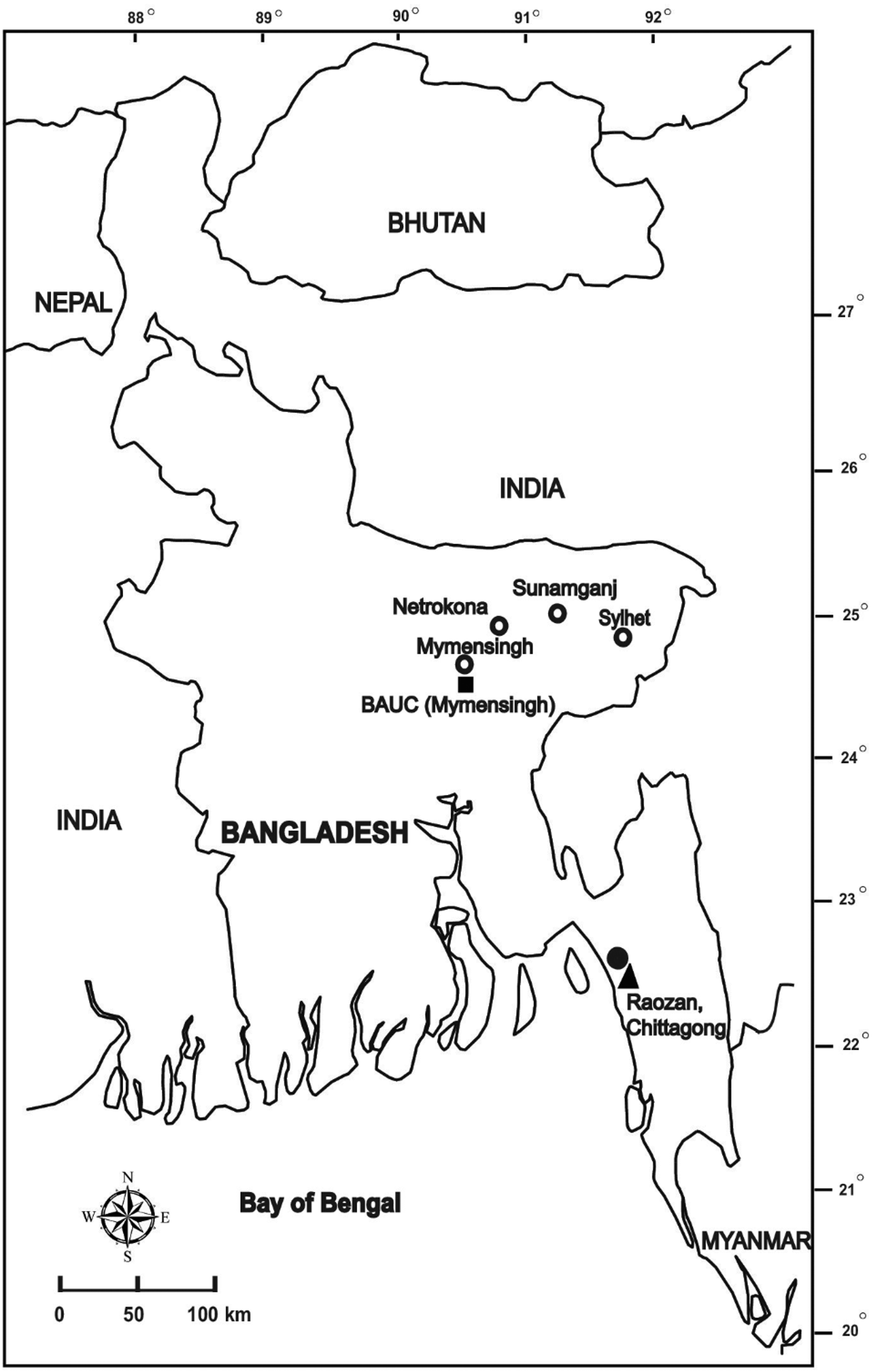
Distribution. The known occurrence of M. mukhlesuri is Raozan, Chittagong District, southeastern corner of Bangladesh (Fig. 1).
Hasan, Mahmudul, Islam, Mohammed Mafizul, Kuramoto, Mitsuru, Kurabayashi, Atsushi, Sumida, Masayuki (2014): Description of two new species of Microhyla (Anura: Microhylidae) from Bangladesh. Zootaxa 3755 (5): 401-418, DOI: 10.11646/zootaxa.3755.5.1
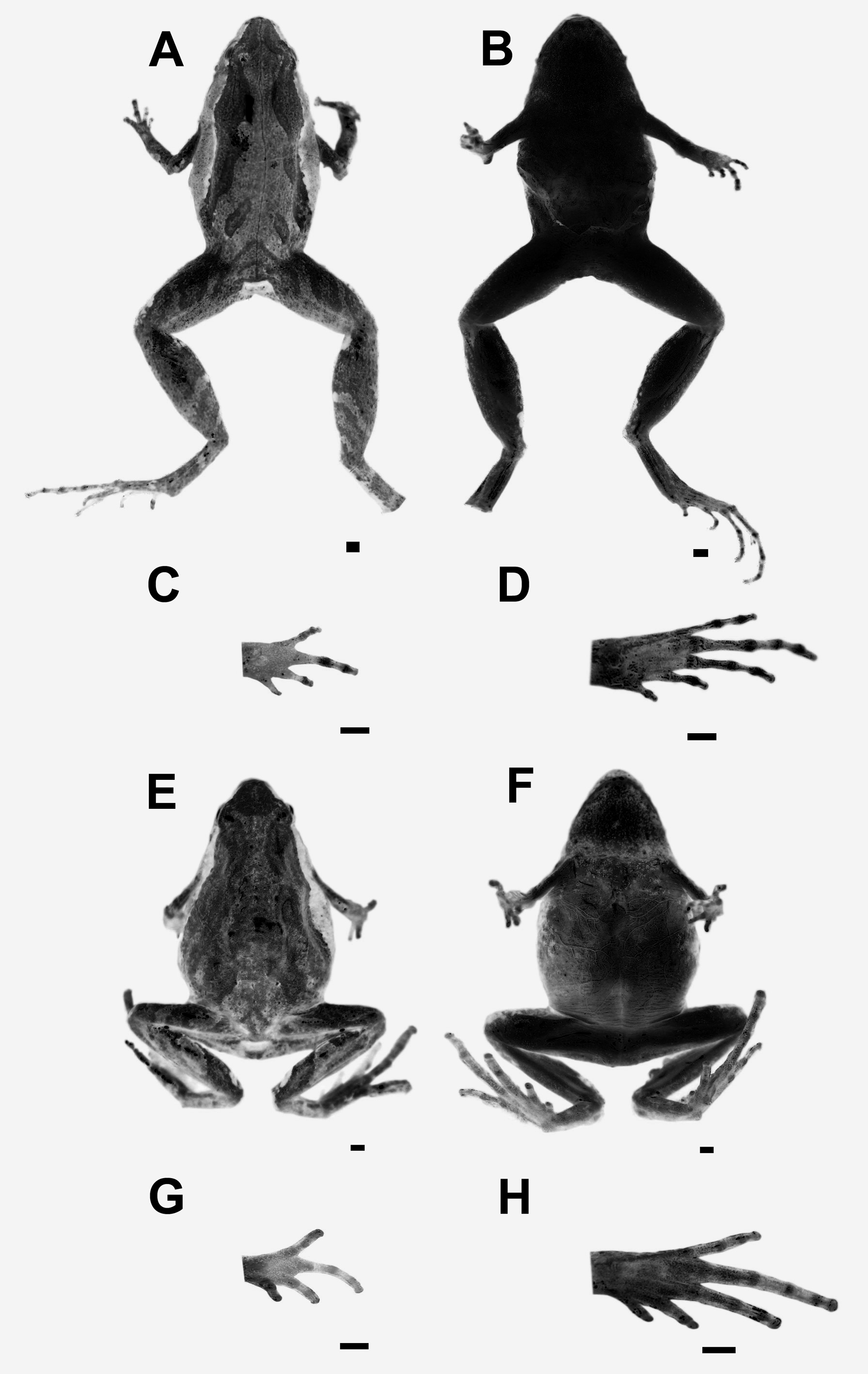
Etymology. We dedicate the species name “ mukhlesuri ” to the late Dr. Md. Mukhlesur Rahman Khan, Professor of the Department of Fisheries Biology & Genetics, Bangladesh Agricultural University (BAU), who significantly contributed to amphibian research in both Bangladesh and the international community by establishing collaborations between BAU, Bangladesh, and the Institute for Amphibian Biology, Hiroshima University, Japan. Microhyla sp. C Microhyla sp. M Microhyla fissipes M. sp. C vs. M. sp. M M. sp. C vs. M. fissipes M. sp. M vs. M. fissipes (n = 10) (n = 24) (n = 15) U P U P U P Diagnosis. The new species M. mukhlesuri is assigned to the genus Microhyla based on smooth or warty skin, absence of vomerine teeth, a narrow and elliptical tongue, hidden tympanum, and molecular phylogenetic relationships (Hasan et al. 2012; Hasan et al. unpublished data). The genus Microhyla comprises 31 species and among them, only three (Microhyla ornata, M. berdmorei and M. rubra), five (M. ornata, M. rubra, M. berdmorei, M. heymonsi and M. butleri) and seven (M. ornata, M. rubra, M. berdmorei, M. heymonsi, M. butleri, M. chakrapanii and M. sholigari) nominal species are known to occur in Bangladesh, Myanmar and India, respectively (Kabir et al. 2009; AmphibiaWeb 2013). After documentation of all available 16 S-rrn and / or cytb sequences of Microhyla species from DDBJ / EMBL / GenBank databases, it became clear that this species (M. mukhlesuri) do not fit with any other previous sequenced species of Microhyla. Further, tibiotarsal articulation and an inverse U-shaped marking on the anus, and a distinct X-shaped marking on the dorsum made it stand out from other Microhyla species. There is no available 16 S-rrn / cytb data of M. chakrapanii and M. sholigari in GenBank, but the new species differentiates from them by the absence of minute tubercle on the dorsal part of tibia and thin forelimbs (Pillai 1977; Chanda 2002) and longitudinal groove dorsally on dilated toe tips, respectively (Dutta & Ray 2000). The new species differs from M. rubra by its tibiotarsal articulation reaching eye to the tip of the snout (vs. tibiotarsal articulation reaching until the orbit in M. rubra), from M. berdmorei with no or rudimentary webbing (vs. fully webbed toes in M. berdmorei) and from M. ornata by the presence of an outer metatarsal tubercle (vs. outer metatarsal tubercle is absence in M. ornata). In addition, the new species differs from M. butleri by the projection of first finger from the palm is narrow (vs. this kind of projection is far in M. butleri) and absence of disc on finger (vs. with disc in M. butleri) (Inger 1966). The new species can be separated from M. heymonsi by the presence of X-shaped marking on the dorsum and smaller size (SVL = 16.5 – 21 mm) (vs. 22 – 26 mm in M. heymonsi) (Chanda 2002). Lastly, the new species can be distinguished from its most near congener M. fissipes by the extension of tibiotarsal articulation until eye to the tip of snout (vs. reached only until eye in M. fissipes). Microhyla inornata (Boulenger 1890) in India currently treated as Micryletta inornata based on a specimen collected by Pillai (1977) from Andaman Islands. Jerdon (1853) described two new spcies i. e. Engystoma malabaricum and E. carnaticum from “ Malabar ” (present Kerala) and “ Caranatic ” (present Karnataka), respectively. Later, Parker (1934) synonymised the former two species as a singles species M. ornata. Despite the unavailability of type specimen, it seems quite untenable to resurrect of the former two Engystoma species from the synonymy of M. ornata due to following reasons: 1) insufficient description of Engystoma species by Jerdon (“ 1853 ” 1854), 2) genetically, our new species has closer affinity with Myanmar “ M. ornata ” (Hasan et al. unpublished data) and evolutionary, its immediate ancestors likely occurred and diverged in East or Southeast Asia rather than India, 3) known occurrence of the new species reveals that the radiation of this species restricted into a particular biogeographical region, i. e. Chittagong area, and ecologically this area has some similarity with Myanmar rather than Kerala and Karnataka (Western Ghats), India. Hence, from a biogeographical point of view, the dispersal of the new species might be extending to the south-western part of Myanmar instead of Kerala and Karnataka, India. Pyxicephalus frithi Theobald (1868) described from Jessore, SW Bangladesh reported to have vinous coloration and recently it became invalid (Frost 2013). Also this nomen does not fit with our new species. Summarizing, the new species is small frog with SVL of 16.5 – 21.0 mm in males and 17.3 – 18.4 mm in females. Head length subequal head width, finger formula 1 <4 <2 <3, toe formula 1 <2 <5 <3 <4, fingers free and slender, tips of fingers and toes not widened, rudimentary web between toes and subarticular tubercles relatively prominent (Figs. 4 A, 4 B). TIL / SVL ratio was 0.54 ± 0.03, whereas this value was 0.57 ± 0.04 in M. mymensinghensis, and 0.50 ± 0.02 in M. fissipes from Taiwan. Tibiotarsal articulation reaches between the eyes to tip of snout, whereas it reaches near the eye in M. fissipes. Phylogenetically, it appears to closer to “ M. ornata ” from Myanmar plus “ M. fissipes ” from Laos and Thailand and to be sister respectively with Taiwanese topotypic M. fiissipes with significant genetic divergences (Hasan et al. 2012; Hasan et al. unpublished data; this study).
Hasan, Mahmudul, Islam, Mohammed Mafizul, Kuramoto, Mitsuru, Kurabayashi, Atsushi, Sumida, Masayuki (2014): Description of two new species of Microhyla (Anura: Microhylidae) from Bangladesh. Zootaxa 3755 (5): 401-418, DOI: 10.11646/zootaxa.3755.5.1
Holotype. IABHU 3956, adult female (SVL: 17.9 mm; if not otherwise specified, the following body parts are measured in mm) collected from Raozan, Chittagong (22 º 35 ′ N, 91 º 55 ′ E,> 9 m asl.), Bangladesh on 14 November 2009 by M. M. Islam (Figs. 4 A, 4 B). Paratypes. IABHU 3878, adult female (SVL: 17.3); IABHU 3879, adult male (SVL: 21.0); IABHU 3880, adult male (SVL: 19.3); IABHU 3881, adult female (SVL: 17.5); IABHU 3882, adult male (SVL: 16.5); IABHU 3957, adult female (SVL: 18.4); IABHU 3958, adult female (SVL: 17.3); IABHU 3959, adult male (SVL: 16.5); and IABHU 3960, adult male (SVL: 16.6) collected from Raozan, Chittagong, Bangladesh on 14 November 2009 by M. M. Islam.
Hasan, Mahmudul, Islam, Mohammed Mafizul, Kuramoto, Mitsuru, Kurabayashi, Atsushi, Sumida, Masayuki (2014): Description of two new species of Microhyla (Anura: Microhylidae) from Bangladesh. Zootaxa 3755 (5): 401-418, DOI: 10.11646/zootaxa.3755.5.1

Export occurrence data

Darwin Core Archive (ZIP)

CLASSIFICATION

Taxonomic Classification Tree

MULTIMEDIA

Media Files(2)

FIGURE 1. Map showing the collection sites and known occurrences of M. sp. C and M. sp. M in Bangladesh, indicated by closed and open circles, respectively. The type locality of holotype IABHU 3956 for M. sp. C and holotype IABHU 4116 for M. sp. M is indicated by closed triangles and squares, respectively.

Imageimage/png© Hasan, Mahmudul;Islam, Mohammed Mafizul;Kuramoto, Mitsuru;Kurabayashi, Atsushi;Sumida, MasayukiHasan, Mahmudul;Islam, Mohammed Mafizul;Kuramoto, Mitsuru;Kurabayashi, Atsushi;Sumida, Masayuki

FIGURE 4. (A) Dorsal view and (B) Ventral view of the holotype of Microhyla mukhlesuri sp. nov (IABHU 3956). Ventral view of right (C) hand and (D) foot of paratype (3960) of M. mukhlesuri sp. nov .. (E) Dorsal view and (F) Ventral view of the holotype of M. mymensinghensis sp. nov (IABHU 4116). Ventral view of right (G) hand and (H) foot of holotype (4116) of M. mymensinghensis sp. nov .. All pictures of specimens were taken after preservation in alcohol. Scale bar = 1 mm.

Imageimage/png© Hasan, Mahmudul;Islam, Mohammed Mafizul;Kuramoto, Mitsuru;Kurabayashi, Atsushi;Sumida, MasayukiHasan, Mahmudul;Islam, Mohammed Mafizul;Kuramoto, Mitsuru;Kurabayashi, Atsushi;Sumida, Masayuki

IMAGES

Gallery(2)

See Gallery

Occurrences with images

Source Information

Description of two new species of Microhyla (Anura: Microhylidae) from Bangladesh

checklist

This dataset contains the digitized treatments in Plazi based on the original journal article Hasan, Mahmudul, Islam, Mohammed Mafizul, Kuramoto, Mitsuru, Kurabayashi, Atsushi, Sumida, Masayuki (2014): Description of two new species of Microhyla (Anura: Microhylidae) from Bangladesh. Zootaxa 3755 (5): 401-418, DOI: 10.11646/zootaxa.3755.5.1

Abstract

Two new frog species belonging to genus Microhyla from the southeast, central and northeast regions of Bangladesh are described. Based on a molecular phylogeny derived from mitochondrial DNA sequences, one of the new species forms a clade with M. fissipes, while the second new species is sister to this clade. The DNA sequences of the mitochondrial cytochrome b gene from these new species are substantially diverged from M. fissipes (8.9 and 10.2% [3.6 and 4.2% for 16S ribosomal RNA gene] uncorrected pairwise divergence, respectively), and the estimated phylogenetic splits from their closest relative is in the Pliocene (3.4 Mya) and middle Miocene (10.5 Mya). The first new species (Microhyla mukhlesuri sp. nov.) can be diagnosed from its nearest congener (M. fissipes) by the following characteristics: SVL: 16.5–21.0 mm, finger length 1 <4 <2 <3, tips of finger and toes not swollen, subarticular tubercles distinct, an inverse U-shaped mark on the anus, and a distinct X-shaped marking on the dorsum. Although the second new species (M. mymensinghensis sp. nov.) shares some morphological characteristics with the first new species, it can be readily diagnosed from its close congeners by its longer hindlimbs (HLL / SVL), tibia (TIL/SVL) and forearm width (FAW /SVL), in addition to a combination of the following characteristics: SVL: 14.2–21.3 mm, snout truncate, a crescent-shaped marking on the anus, and an X-shaped marking on the dorsum. The tibiotarsal articulation extends to the eye in M. fissipes but ranges from the eye to the tip of the snout in the two new species.

Key words: Microhyla mukhlesuri sp. nov., Microhyla mymensinghensis sp. nov., Microhylidae, Mitochondrial DNA, Divergence time, Morphology, Bangladesh

Hasan M, Islam M M, Kuramoto M, Kurabayashi A, Sumida M, plazi (2014). Description of two new species of Microhyla (Anura: Microhylidae) from Bangladesh. Plazi.org taxonomic treatments database. Checklist dataset https://doi.org/10.11646/zootaxa.3755.5.1 accessed via GBIF.org on 2026-06-15.

CC0Published 12/31/2014View dataset
GBIF Usage Key
119412854
Dataset Key
004e46b2-437c-42fb-af76-245a4d8e411c
Origin
source
Backbone Key
8028213
Taxon ID
F3648799FFFEFFAD42D91961FBFE14A7.taxon
Last Crawled
6/11/2026
Last Interpreted
6/11/2026