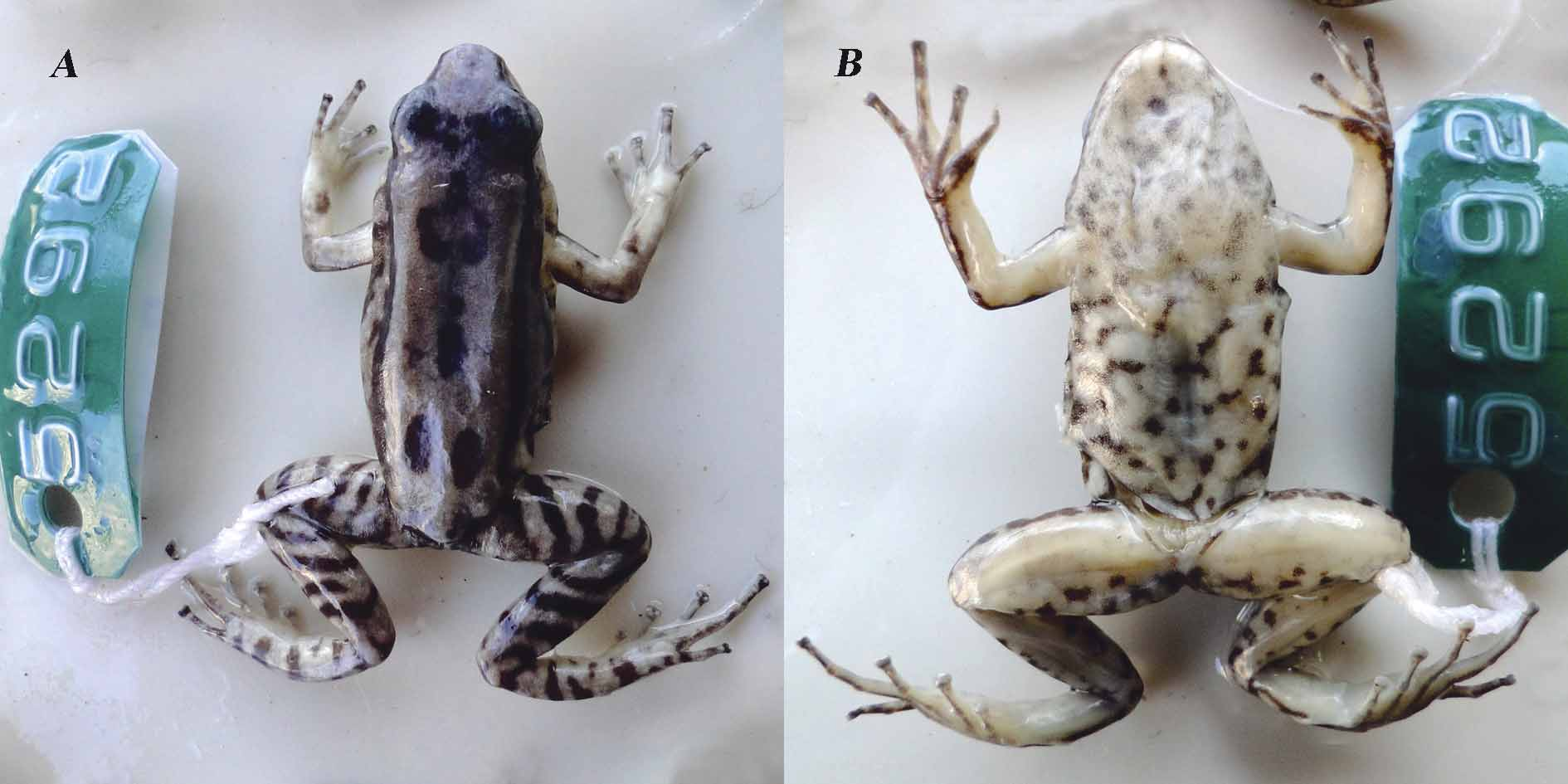
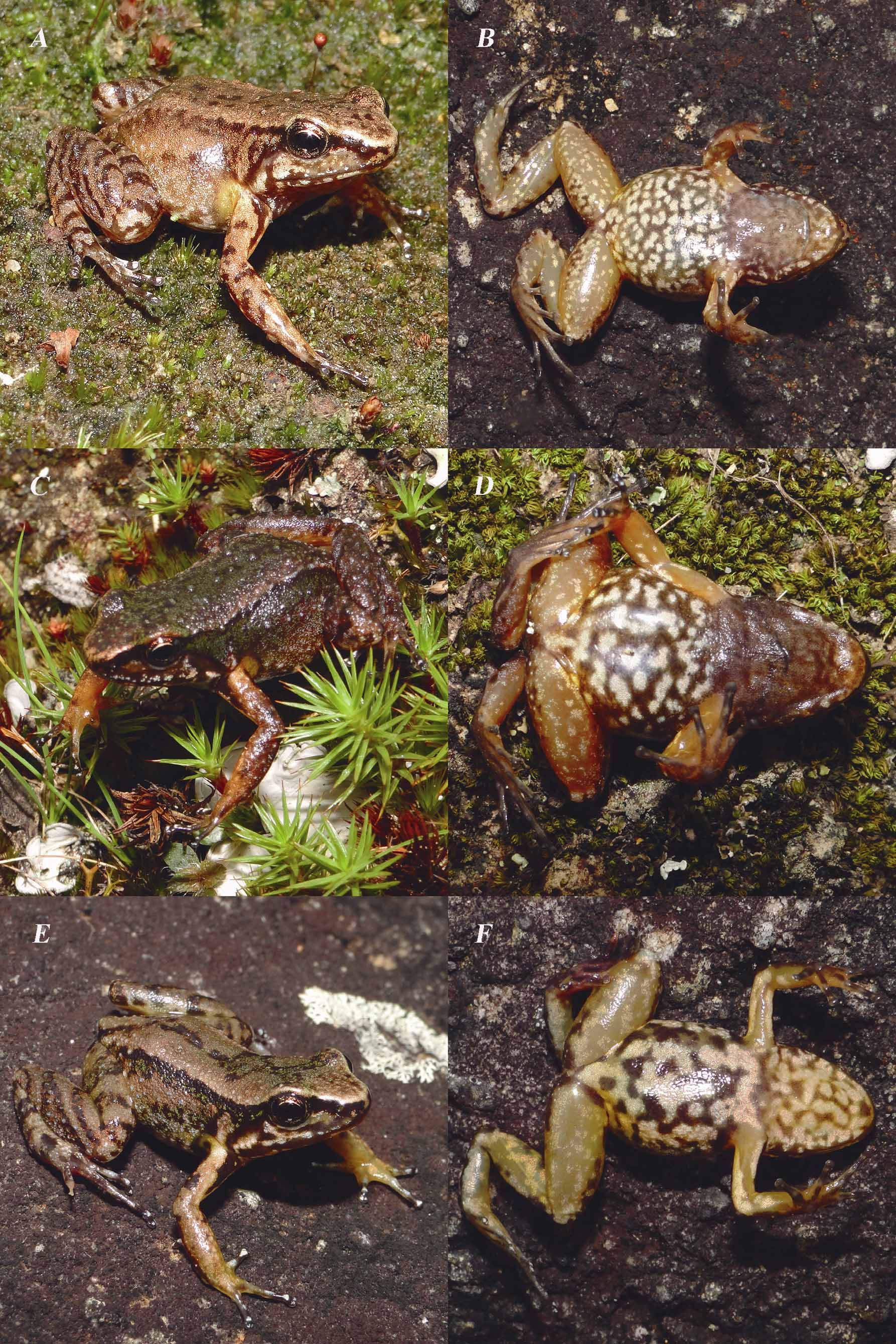
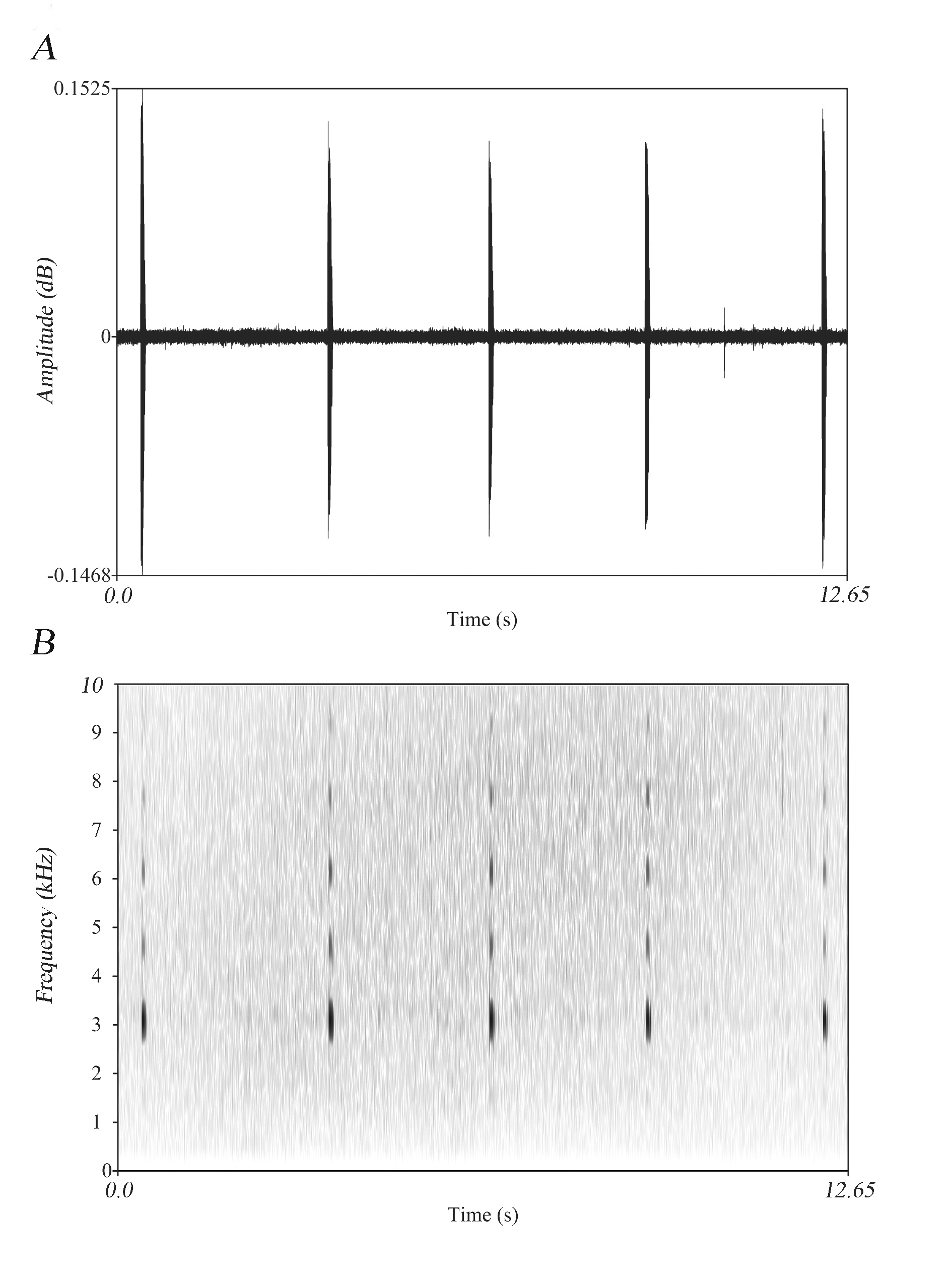
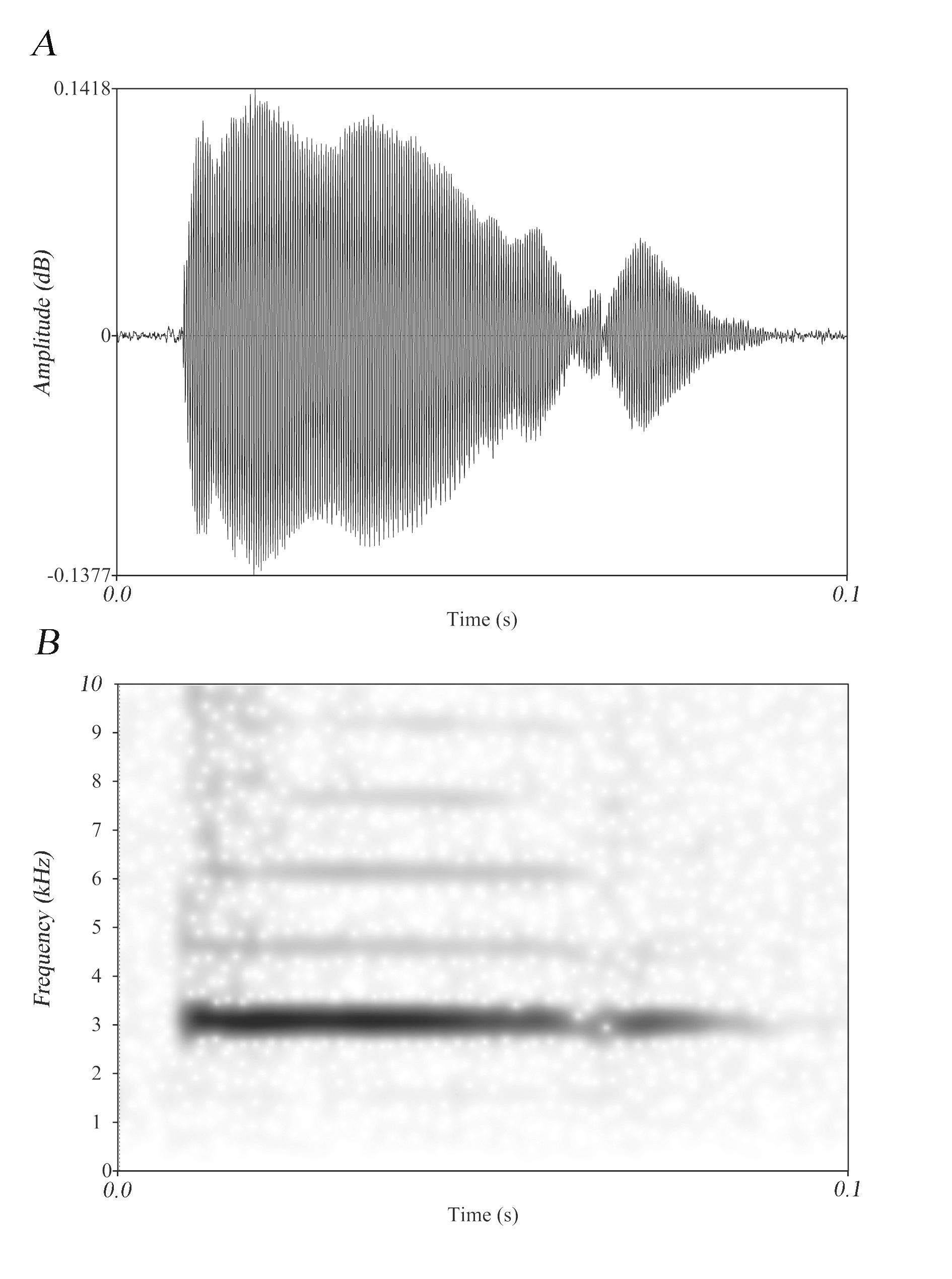
Description of the holotype. The holotype is an adult male of 24.4 mm (SVL): body slender and elongate, rounded in cross-section; dorsal skin, including dorsal surfaces of hind limbs, smooth in preservative (Fig. 2 A); ventral skin smooth (Fig. 2 B); vocal sac extended; head is longer than wide, HeL = 34.8 % of SVL; HW = 30.3 % SVL (Table 1); snout is truncate in profile (Fig. 3 A), rounded in dorsal and ventral view (Fig. 3 B); nares are situated laterally to the tip of snout; narial openings are barely visible when viewing the head from the front, barely visible when viewing dorsally; and not seen when viewing from a ventral aspect; canthus rostralis is rounded, the loreal region is little concave; interorbital region is little wider than the upper eyelid; snout longer than ED; tympanum is inconspicuous, about 2 / 3 of the tympanum is concealed posterodorsally by a low supratympanic bulge formed by the superficial slip of m. depressor mandibulae; tympanum is positioned closely behind eye and lower, close to the angle of jaws; teeth present on maxillary arch; vocal slits large and long, from mid-level of tongue to the angles of jaws; tongue rounded, half free posteriorly. Character Males (n = 8) Females (n = 4) SVL 22.0 ± 2.1 (19.0 – 24.6) 24.8 ± 0.5 (24.2 – 25.5) SL 10.2 ± 0.8 (8.8 – 11.3) 11.4 ± 0.7 (10.5 – 11.1) FL 10.4 ± 1.0 (8.6 – 11.8) 11.4 ± 0.5 (11.2 – 12.1) HeL 8.2 ± 0.5 (7.6 – 9.0) 8.8 ± 0.2 (8.7 – 9.0) HW 7.2 ± 0.6 (6.4 – 8.0) 7.6 ± 0.4 (7.2 – 8.1) ED 2.7 ± 0.2 (2.3 – 2.9) n = 3; 3.0 ± 0.1 (2.9 – 3.1) TD n = 3; 1.0 ± 0.3 (0.7 – 1.2) – F 3 D 0.7 ± 0.1 (0.6 – 0.8) n = 3; 0.9 ± 0.1 (0.8 – 0.9) T 4 D 0.8 ± 0.1 (0.7 – 0.9) n = 3; 1.0 ± 0.2 (0.8 – 1.1) 1 FiL 4.0 ± 0.4 (3.1 – 4.7) n = 3; 4.3 ± 0.1 (4.3 – 4.4) 2 FiL 3.6 ± 0.4 (2.8 – 4.1) n = 3; 3.8 ± 0.3 (3.5 – 4.0) Hand (Fig. 3 C) of moderate size (26.1 % SVL); relative lengths of adpressed fingers are III> I> II> IV; discs of all fingers are slightly expanded, horizontally oval; FIII is barely wider than distal end of adjacent phalanx; the base of palm has a large, nearly triangular palmar tubercle; and on base of FI there is a smaller (approximately 1 / 2 of the palmar tubercle), elliptical thenar tubercle; one or two subarticular tubercles on fingers (one each on FI and FII, two each on FIII and FIV, the distal one of FIV inconspicuous); and all tubercles are flat and round; without supernumerary tubercles. Fringes on fingers are low and indistinct on FII and FIII of right hand (well preserved), and very notable on all fingers of left hand (somewhat dehydrated). FIII is basally swollen on left hand, but not on right hand, possibly also due to a preservation artifact (see Variation). Hind limbs are of moderate length, SL = 43.8 % of SVL; relative lengths of adpressed toes are IV> III> V> II> I; TI is moderately long, the tip reaching the mid-subarticular tubercle of TII; toes are slightly expanded, TIV about 1.4 times wider than distal end of adjacent phalanx; feet (Fig. 3 D) basally webbed; formula only applicable for TII – IV: II 2 – 3 III 3 2 / 3 – 4 IV; fringes on toes absent; one to three non-protuberant, small subarticular tubercles are present (one on TI and TII, two on TIII and TV, three on TIV, proximal one almost indistinct); two metatarsal tubercles present, including a small round outer, and a similar in size oval inner tarsal tubercle; well defined tarsal keel, thick, weakly curved, transverse across tarsus, from proximal edge of inner metatarsal tubercle to midtarsus; cloacal opening at upper level of thighs, with short tube flap or anal sheath. Measurements of holotype (in mm) SVL: 24.4; SL: 10.7; FL: 10.7; HeL: 8.5; HW: 7.4; ETS: 3.9; EN: 1.5; ED: 2.7; TD: 1.2; F 3 D: 0.7; T 4 D: 0.8; 1 FiL: 4.0; 2 FiL: 3.6. Color: In preservative dorsum pale brown with a clear pattern of dark brown marking as follows: interorbital irregular band, one round spot behind the head; two scapular “ comma ” like symmetrical spots; one longitudinal elongate mark; and two symmetrical longitudinally oval sacral spots. There are two symmetrical dark brown dorsolateral stripes (note that the dorsolateral stripes lacking are the pale ones), from the tip of snout through the canthal ridge, supratympanic area to the groin. Oblique lateral and ventrolateral stripes are absent. The flanks are pale brown below the dorsolateral stripes, with irregular dark brown marks that look similar to a dark oblique stripe, but that are part of an irregular reticulation of the flanks. Below this reticulation, the inferior part of the flanks becomes white. Arms are pale brown dorsally, with one irregular spot (oval on the left forearm, elongate on the right one), with dark brown stripes longitudinal anterior and posteriorly along the arm. Hind limbs pale brown, thighs crossed by many dark brown stripes (six on the left leg, five on the right), shanks crossed by four dark bands on each, and tarsi also crossed by many vertical bands. Ventrally the chin, throat, chest and belly are white with irregular dark brown spotting. Thighs white anteriorly, spotted posteriorly. Palms of the hands and soles of the feet are dark brown. Coloration in life. Description is based on two males, CVULA 8351, EBRG 6146 and one female EBRG 6147 (Fig. 4 A, C, E). Background dorsal coloration pale to dark brown, with sometimes contrasting dorsal pattern (CVULA 8351, EBRG 6147), or not (EBRG 6146). The pattern, consisting in small spots or lines, is always dark brown. EBRG 6146 has an important portion of the back and flanks covered by dark green chromatophores (Fig. 4 C). Green chromatophores are also appreciable in EBRG 6147 (Fig. 4 E), but in less proportion; they are emerald green in EBRG 6147. CVULA 8351 lacks any green chromatophores (Fig. 4 A). This species seems the only Aromobates to present some amount of green in the body. EBRG 6146 also shows some pale blue chromatophores on the flanks and along the extremities, but less dense than the green chromatophores (Fig. 4 C). EBRG 6147 has a few pale blue chromatophores on the flanks and shanks (Fig. 4 E). The dark dorsolateral stripes are present in all three specimens, ill-defined in CVULA 8351, little contrasting in EBRG 6146, or very contrasting in EBRG 6147. A dark brown canthal and supratympanic stripes are present and evident in EBRG 6147 (Fig. 4 E). All types of pattern on dorsal surfaces (back marks and limbs crossbars) are always dark brown. The three specimens (CVULA 8351 and EBRG 6146 - 7) have white spots, large or small and irregular on the upper and lower lips. These specimens show axillary and groin marks; on CVULA 8351 and EBRG 6147 are yellow, while on EBRG 6146 are orange. Axillary and groin coloration extends to the ventral surfaces of arms and hind limbs, where it becomes paler. Ventrally, the background color is dark brown on the belly with contrasting white spots, varying from small on CVULA 8351 (Fig. 4 B), to medium sized in EBRG 6146 (Fig. 4 D), to large in EBRG 6147 (Fig. 4 F). The throat color is sexually dimorphic, as the males have a dark brown vocal sac concealed behind the same pattern as on the belly. In the female, throat pattern is contrasting against the belly coloration. Iris coloration is pale to dark copper. Variation. The dorsal pattern (http: // images. morphbank. net /? id = 705231 & imgType = jpeg & sessionId = 26 djv 87 rehd 8 djt 7 t 8 qbkrgj 52) observed in the holotype is similar in 6 specimens (holotype, EBRG 5282, 5288 - 91), while others are more spotted (EBRG 5287, 5293), less spotted or almost plain (EBRG 5285, 5294, 5299). Some specimens also have the cross barred limbs, but they are less evident. Ventrally, the pattern is more obvious on five males of the series: the most contrasting individual is EBRG 5291, while the less patterned is EBRG 5294. This last specimen and EBRG 5287 are subadult males and they are almost white without magnification (http: // images. morphbank. net /? id = 705231 & imgType = jpeg & sessionId = 26 djv 87 rehd 8 djt 7 t 8 qbkrgj 52). Under a microscope, both have the throat and chest with melanophores, but the belly is white in EBRG 5294 while it has some reticulation in EBRG 5287. One female (EBRG 5288) is completely white except for a few irregular spots on the belly, and a few melanophores seen with microscope, scattered across the ventral parts. Two females (EBRG 5289 and 5299) have white throats and chests, but their bellies are reticulated (EBRG 5299) or spotted (EBRG 5289). The female EBRG 5298 is darker and both its throat and belly have a profusion of small and irregular spotting. The anal sheath is evident in the holotype and EBRG 5294, but it is not in the males EBRG 5282, 5291, 5293 or barely evident in EBRG 5285, 5287, and 5290. In females, the anal sheath is less evident that in males as evidenced in all specimens (EBRG 5288 - 89 and 5299). Our observations about the anal sheath agree with Grant et al. (2006), who suggested that the variation in this character might be caused by preservation artifacts. The holotype has a basal swelling on the left hand FIII, but since there is no other specimen showing this character, we assume this might be an artifact. Specifically, the left hand of the holotype was a little dehydrated and thus, the swelling is due to the preservation. We could not find more sexually dimorphic characters other than the little bigger mean size of females (24.8 mm versus 22.0 mm of the males). However, the size range is large and some males are quite big (males up to 24.6 mm, females up to 25.5 mm). The coloration is mostly not sexually dimorphic with the exception of actively calling males, in which the vocal sac becomes dark.
Barrio-Amorós, César L., Rivero, Ramón, Santos, Juan C. (2011): A new striking dendrobatid frog (Dendrobatidae: Aromobatinae, Aromobates) from the Venezuelan Andes. Zootaxa 3063: 39-52, DOI: 10.5281/zenodo.201877