
AnimaliaNot EvaluatedacceptedspeciesAccepted
Tripedalia binata

Tripedalia binata

Moore, 1988

GBIF:119422335

0year

ABOUT

Descriptions(1)

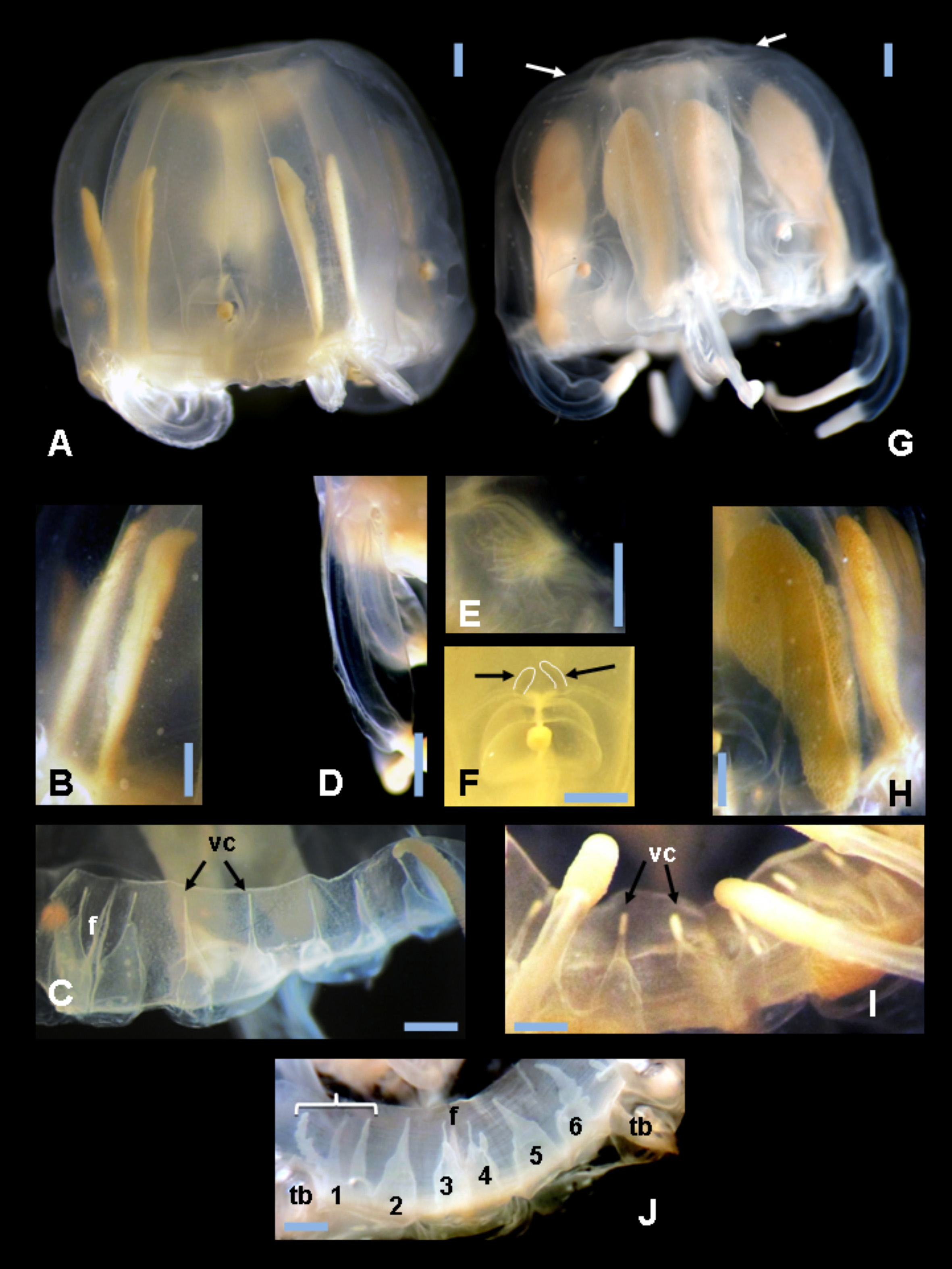
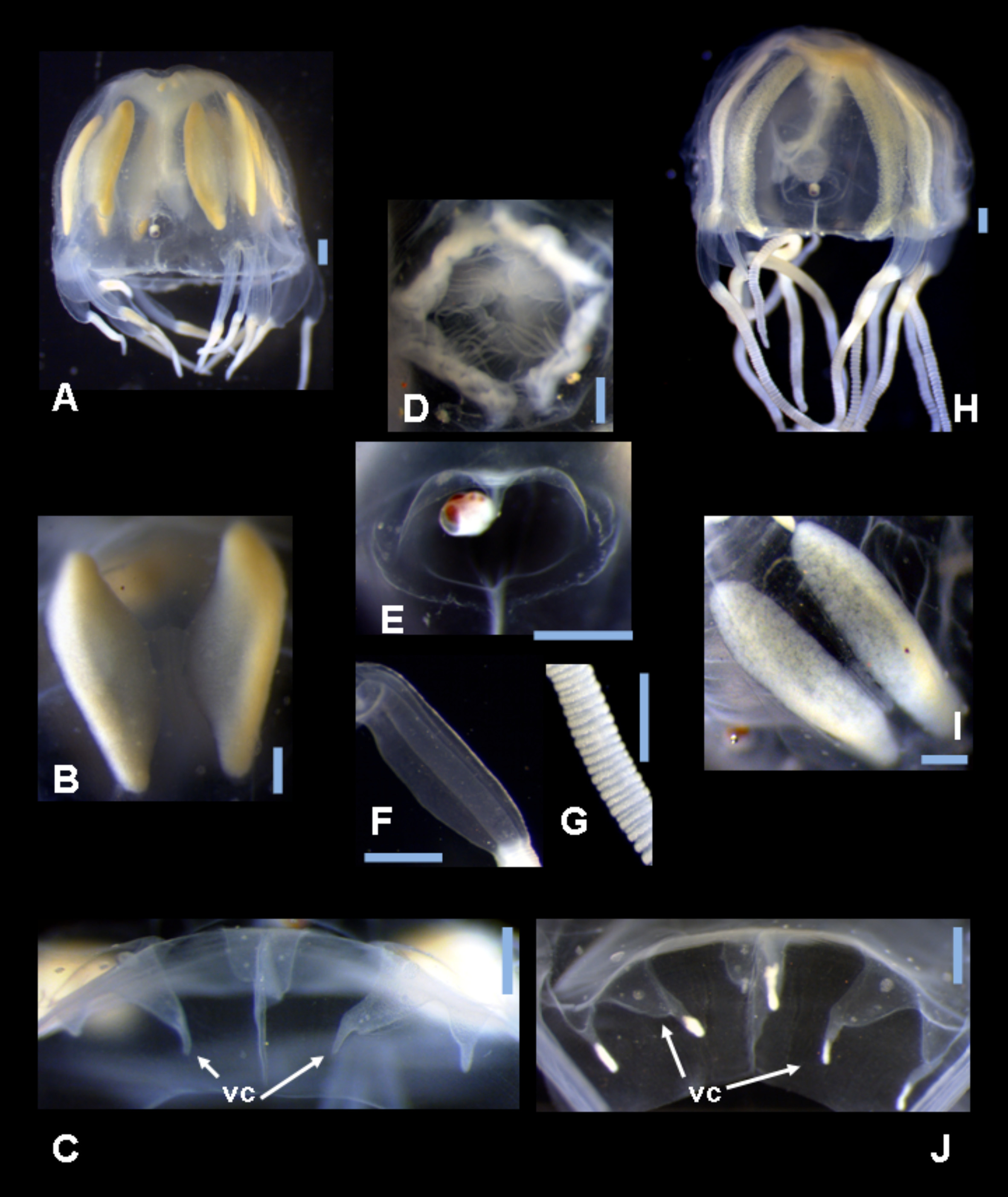
Description and comparison of adult medusae. Both species with cuboid bell, whitish transparent with a yellowish to brownish tinge in colour, with rounded edge (Figures 3 A, G; Figures 4 A, H). In Tripedalia binata, bell sparsely covered with nematocyst warts, in Tripedalia cystophora nematocyst warts frame mainly bell outline from apex edge to velarium; apex of Tripedalia binata flattened with slight horizontal constriction near the top (Figure 3 G, arrows), apex of Tripedalia cystophora slightly arched, no horizontal constriction; in Tripedalia binata bell heights up to 11 mm, bell width up to 14 mm (interpedalia distance), in Tripedalia cystophora bell height up to 12 mm, bell width up to 15 mm (interpedalia distance). Groups of two (Tripedalia binata) or three (Tripedalia cystophora) flattened, slender knife-blade-shaped pedalia with one tentacle each located at interradial corner of bell rim (Figure 3 D; Figure 4 F); pedalia length ca. 1 / 2 – 2 / 3 bell height. In Tripedalia cystophora outer wing keel length lined by nematocyst band. In both species, pedalial canals show slight bend, round knee; tentacles resemble string of beads with white (Tripedalia binata and Tripedalia cystophora) nematocyst batteries in life specimens (Figure 4 G). Rhopalium located inside rhopalial niche cavity on each side of bell, 1 / 3 of bell height up from margin, (Tripedalia binata, Figure 3 F; Tripedalia cystophora, Figure 4 E), niche forms a roof without upper nor lower covering scale. Short, very faint, “ viking helmet-horn ” - like rhopalial horns extend from top of rhopalial niche in Tripedalia binata (Figure 3 F, arrows), no rhopalial horns in Tripedalia cystophora. Velarium, measuring ca. 1 / 5 – 1 / 6 width of bell base, containing 6, sharp-pointed-triangular velarial canals per quadrant in both species (Figures 3 C, I, J; Figures 2 C, J), in Tripedalia binata main canals flanking pedalia and / or frenulae can grow branches or side canals in further development (Figure 3 J). Mature females in both species show stark white coloured velarial canal tips (Figure 3 I; Figure 4 J). In both species, long, four-lobed manubrium, 1 / 2 to 3 / 4 bell height in length; small, flat stomach communicating with 4 gastric pouches leading into velarial canals. Gastric phacellae in both species epaulette-shaped (Figure 3 E; Figure 4 D). Gonads located in gastric pouches, generally butterfly-shaped and separated by interradial septum, centres of gonad “ wings ” attached to septum, canal system connects gonad “ wings ” through septum.
Straehler-Pohl, Ilka, Garm, Anders, Morandini, André C. (2014): Sexual dimorphism in Tripedaliidae (Conant 1897) (Cnidaria, Cubozoa, Carybdeida). Zootaxa 3785 (4): 533-549, DOI: 10.11646/zootaxa.3785.4.3

Export occurrence data

Darwin Core Archive (ZIP)

CLASSIFICATION

Taxonomic Classification Tree

MULTIMEDIA

Media Files(3)

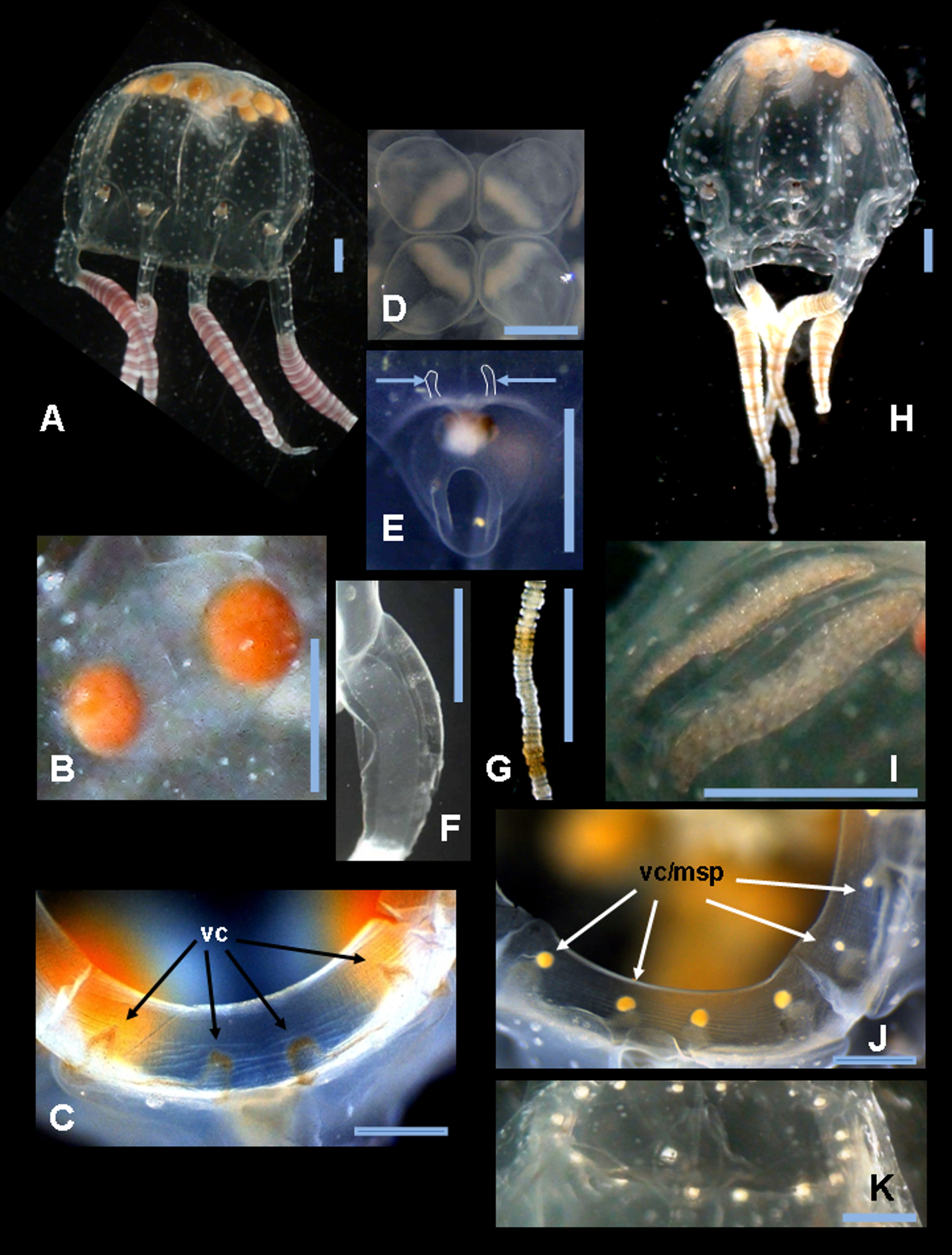
FIGURE 2. Copula sivickisi (scales: 1 mm). A: mature male medusa, note purple tentacle stripes (live specimen). B: mature male gonads (live specimen). C: velarium of mature male medusa (vc = velarial canals). D: adhesive pads on apex (preserved), note ivory coloured gastric phacellae shining through. E: rhopalial niche with keyhole-shaped opening and rhopalial horns (arrows, horn contours outlined by hand). F: pedalium. G: tentacle structure (in life). H: mature female medusa (in life). I: mature female gonads (in life). J: velarium of mature female medusa (preserved) with yellow “ velarial spots ”, colour due to preservation (vc / msp = velarial canals marked as maturity spots). K: velarium of mature female medusa (live specimen) with white “ velarial spots ” (photo provided by Ronald Petie).
Imageimage/png© Straehler-Pohl, Ilka;Garm, Anders;Morandini, André C.Straehler-Pohl, Ilka;Garm, Anders;Morandini, André C.

FIGURE 3. Tripedalia binata (two medusae from paratype material NTM C 2944 a – i; scales: 1 mm). A: mature male medusa. B: mature, stick-shaped, male gonads. C: velarium of mature male medusa (vc = velarial canals). D: pedalium. E: epauletteshaped gastric phacellum. F: rhopalial niche and rhopalial horns (arrows, horn contours outlined by hand). G: mature female medusa, note horizontal constriction near apex (arrows). H: mature, butterfly wing-shaped, female gonads. I: velarium of mature female medusa, note conspicuously white tips of velarial canals (vc / msp = velarial canals). J: velarium of a specimen with further developed canal system giving the impression of more than 6 main canals per quadrant, note main canal 1 shows three, partly lobed branches (bracket encloses three branches), main canals 2 and 3 simple, main canal 4 shows one side branch, main canal 5 simple, main canal 6 shows lobation and the beginning of a second branch (f = frenulum; tb = tentacle base) (photo provided by A. Underwood).
Imageimage/png© Straehler-Pohl, Ilka;Garm, Anders;Morandini, André C.Straehler-Pohl, Ilka;Garm, Anders;Morandini, André C.

FIGURE 4. Tripedalia cystophora (preserved material, scales: 1 mm). A: mature male medusa. B: mature, butterfly wingshaped, male gonads. C: velarium of mature male medusa (vc = velarial canals). D: stomach with epaulette-shaped gastric phacellae. E: rhopalial niche. F: pedalium. G: tentacle structure. H: mature female medusa. I: mature, longish-oval shaped, female gonads. J: velarium of mature female medusa, note conspicuously white tips of velarial canals (vc = velarial canals).

Imageimage/png© Straehler-Pohl, Ilka;Garm, Anders;Morandini, André C.Straehler-Pohl, Ilka;Garm, Anders;Morandini, André C.

IMAGES

Gallery(3)

See Gallery

Occurrences with images

Source Information

Sexual dimorphism in Tripedaliidae (Conant 1897) (Cnidaria, Cubozoa, Carybdeida)

checklist

This dataset contains the digitized treatments in Plazi based on the original journal article Straehler-Pohl, Ilka, Garm, Anders, Morandini, André C. (2014): Sexual dimorphism in Tripedaliidae (Conant 1897) (Cnidaria, Cubozoa, Carybdeida). Zootaxa 3785 (4): 533-549, DOI: 10.11646/zootaxa.3785.4.3

Abstract

The family Tripedaliidae was re-defined and expanded based on a molecular phylogenetic hypothesis by Bentlage et al. (2010, Proceedings of the Royal Society Biological Science, 277: 497). Additionally, Bentlage et al. (2010) proposed that all members of the family Tripedaliidae present dimorphism in gonads and have structures that function as seminal vesicles (at least in males). Until now, no information on Tripedalia binata concerning gonad morphology, sexual dimorphism, spermatophore formation or structures that serve as seminal vesicles or spermathecae were published. We studied mature medusae of both sexes of Tripedalia cystophora, Tripedalia binata and Copula sivickisi in order to compare these structures in their stomach regions. We found sexual dimorphism and spermatophore formation in seminal vesicle-like structures in all three species. In particular, we show that along with the females of Copula sivickisi, the females of Tripedalia cystophora and Tripedalia binata also possess structures that store spermatophores and serve as spermathecae.

The results are in agreement with the morphological synapomorphies for Tripedaliidae outlined in Bentlage et al. (2010), but suggest an adjustment of the diagnosis of Tripedaliidae (underlined): All carybdeids that display sexual dimorphism of the gonads, produce spermatophores and in which males and females possess subgastral sacs, pockets or purses which function as seminal vesicles or spermathecae.

Key words: Copula sivickisi, cubomedusae, gonads, seminal vesicle, spermathecae, spermatophores, Tripedalia binata, Tripedalia cystophora

Straehler-Pohl I, Garm A, Morandini A C, plazi (2014). Sexual dimorphism in Tripedaliidae (Conant 1897) (Cnidaria, Cubozoa, Carybdeida). Plazi.org taxonomic treatments database. Checklist dataset https://doi.org/10.11646/zootaxa.3785.4.3 accessed via GBIF.org on 2026-06-16.

CC0Published 12/31/2014View dataset
GBIF Usage Key
119422335
Dataset Key
02a757e8-6240-4baf-8f17-95a0a1cef56f
Origin
source
Backbone Key
2264708
Taxon ID
A3588669FFAA2128FF2553796D6B105E.taxon
Last Crawled
6/11/2026
Last Interpreted
6/11/2026