
AnimaliaNot EvaluatedacceptedspeciesAccepted
Leiopathes montana

Leiopathes montana

GBIF:119427436

0

Synonyms

ABOUT

Descriptions(6)

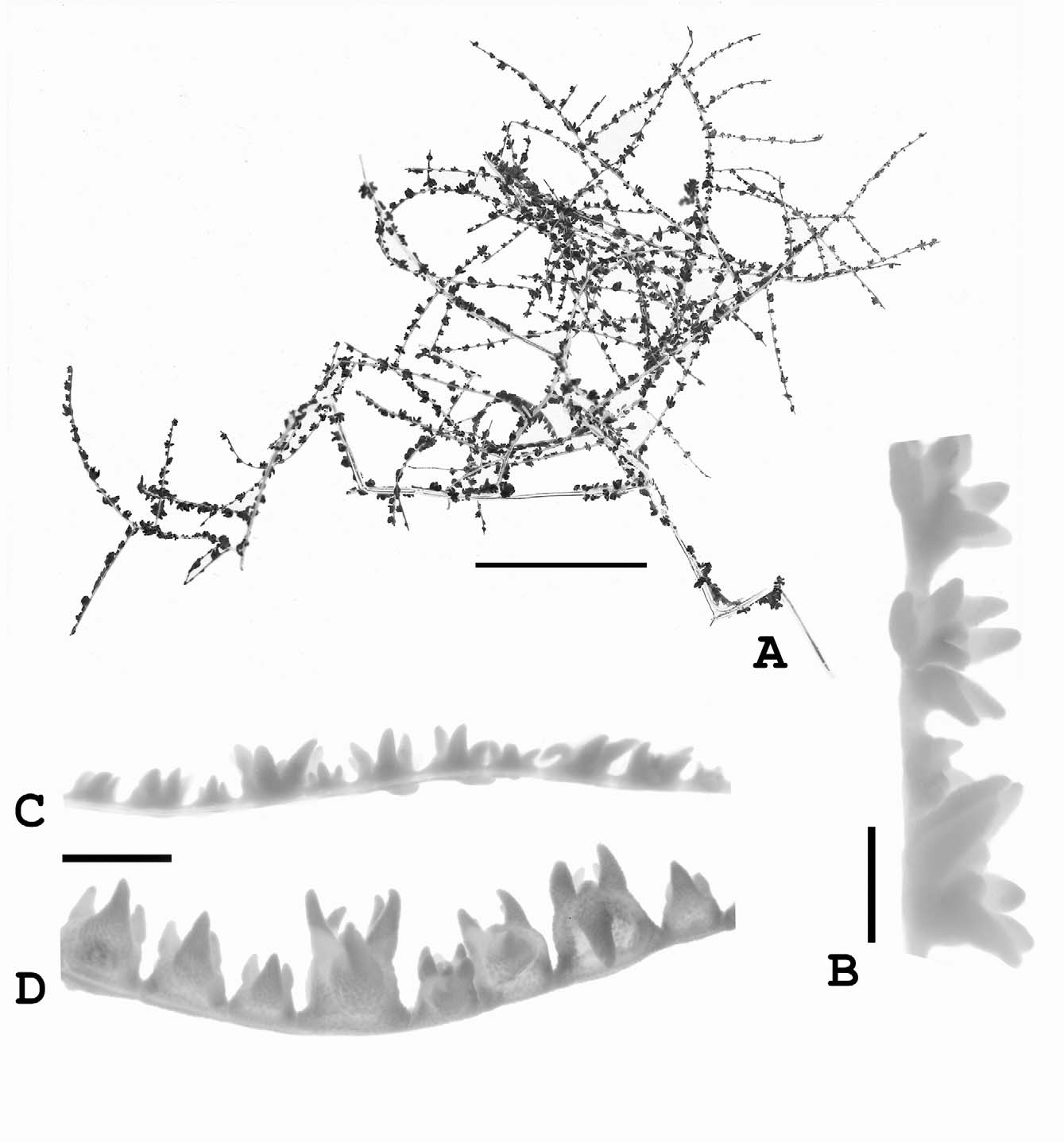
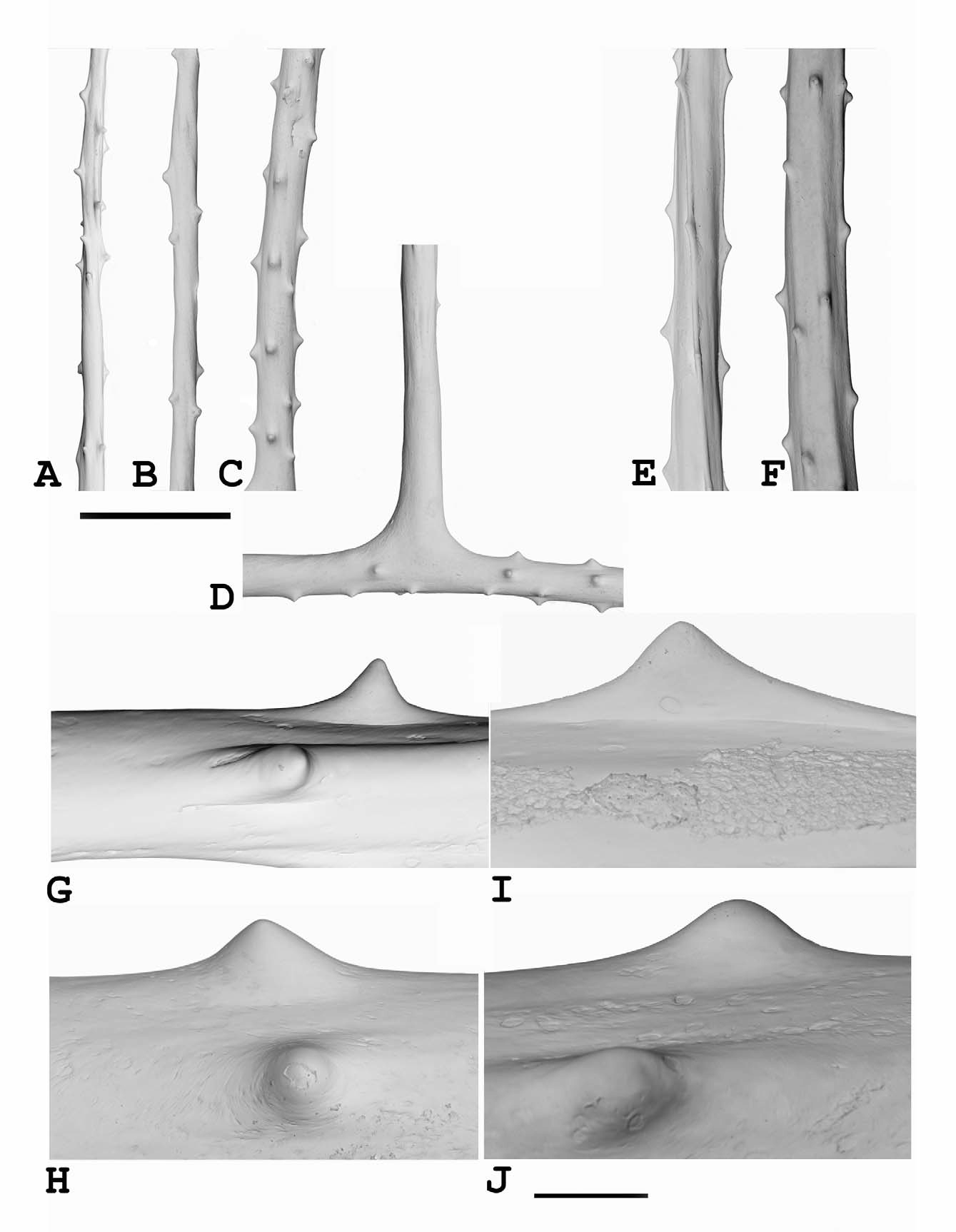
Description of the holotype. Holotype (SMF – 11.987) is full alcohol-preserved colony, attached to piece of limestone. The colony is approximately 45 cm high and about 42 cm wide, with well-preserved polyps (Fig. 2 A). Corallum branched to 8 th – 11 th order. Basal plate is more or less discoidal with prominent centrum and flattened limbus, that has rather irregular outline following uneven surface of substrate (Fig. 2 B). Maximum diameter of the basal plate 25 mm, diameter of prominent convex part of the base 14 mm. Diameter of the stem just above the basal attachment 4.0 mm. Basal part of the stem and major branches are crooked owing to sympodial branching pattern with length of each arc ranging from 25 – 30 to 50 – 60 mm. In the middle and apical part of the colony branches are less crooked. Terminal branchlets arranged bilaterally; if arranged uniserially they always are attached at convex side of lower order branchlet. Branchlets arranged rather laxly with up to 3 branchlets per 1 cm. Distance between adjacent branchlets variable and ranges from 4 to 18 mm, generally from 4 to 8 mm. Most terminal branchlets 1.5 – 2.5 cm long, branchlets of lower order can be up to 4.5 – 5.0 cm long. Basal diameter of terminal branchlets 0.13 – 0.2 mm; diameter gradually diminishes distally and does not exceed 0.06 – 0.08 mm apically. Axial canal rather uniform in diameter (0.05 – 0.06 mm) along branchlet. All branchlets slightly curved that gives colony appearance of weeping birch. Distal angle of branchlets 70 – 90 º. Main stem and thicker branchlets brownish-black. Terminal branchlets and branchlets of lower order yellowish brown. Axial spines (Fig. 4) small, triangular, with smooth surface, 0.02 – 0.03 mm high. Spines at apical part of terminal branchlets (Fig. 4 A – B) are more laterally compressed with wider base and concave distal and proximal sides. Those near the base of branchlets are more conical (Fig. 4 C – D). No difference between spines on polypar and apolypar side of branches. Spines on thicker branchlets conical, measuring about 0.02 – 0.03 mm on branchlet 0.25 mm in diameter. On terminal branchlets, 3 – 4 rows of spines visible from side. Spines in the same row spaced 0.25 – 0.45 mm apart giving 3 – 4 spines per millimeter. Stem and branches> 0.3 mm in diameter completely devoid of spines. Unpreserved polyps light beige in color, subcircular with prominent tentacles. When preserved in alcohol polyps creamy-white. Transverse diameter of polyps 0.5 – 1.2 mm, with smaller polyps scattered between larger ones, resulting in 7 – 9 polyps per centimeter. Interpolypar distance 0.15 – 0.5 mm. Paratype: MNHN [IK – 2007 – 10] Fragment of upper part of colony 8 cm high, 12 cm wide, with well-preserved polyps (Fig. 3 A). Sympodially branched to 5 – 7 orders. Main stem diameter 0.9 mm basally; can be traced only in lower 50 mm of colony, where it disappears between loosely-arranged branchlets. Most terminal branchlets 1 – 2.0 cm long but some reach 2.5 cm and few are longer than 3 cm. Basal diameter of terminal branchlets 0.13 – 0.2 mm. Diameter of branchlets diminishes distally; does not exceed 0.06 – 0.08 mm apically. All branchlets with axial canal, which seems to be rather uniform in diameter (about 0.05 – 0.06 mm) along a branchlet. Branchlets almost straight or only slightly curved. In different parts of colony, terminal branchlets arranged almost bilaterally, placed around the axis of the branchlet of the lower order, or arranged uniserially at convex side of slightly curved branchlet of lower order. Interval between branchlets varying, usually from 2 to 6 mm, with 2 – 4 branchlets per centimeter. Distal angle of branchlets 70 – 90 º, most common 80 – 90 º (Fig. 3 A). Thicker branchlets brownish-black. Terminal branchlets and branchlets of the lower order yellowish-brown. Axial spines (Fig. 5 A – D, G – H) small, triangular, with smooth surface, 0.02 – 0.03 mm high. Those at thinner branchlets 0.06 - 0.08 mm in diameter, triangular with acute apex, laterally compressed with concave distal and proximal sides, slightly inclined distally (Fig. 5 G). Bases of spines are well defined and do not form prominent continuous ridges between spines of the same row as in L. glaberrima (compare Fig. 5 B – C and 5 E). Spines on thicker branchlets conical, about 0.02 – 0.03 mm on branchlet 0.25 mm in diameter. Spines uniformly arranged around axe of branchlet with no difference between spines on polypar and apolypar side; 3 – 4 rows of spines visible from side. Rows of spines spaced 0.22 – 0.55 mm, apart resulting in 3 – 4 spines per millimeter. No spines at base of branchlets (Fig. 5 D) and on branchlets thicker than 0.3 – 0.35 mm in diameter. Polyps preserved in alcohol creamy white, subcircular with well defined tentacles (Fig. 3 B – C) arranged uniserially on thinner branchlets. On larger branchlets and stem polyps arranged rather irregularly around axis. Size of polyps variable; smaller polyps often found between larger ones (Fig. 3 C). Transverse diameter of polyps 0.6 – 1.2 mm. Median pair of tentacles slightly longer then lateral pairs (0.42 – 0.7 vs. 0.35 – 0.42 mm). Space between polyps varying from 0.2 to 1.0 mm, giving 6 – 8 (generally 7 – 8) polyps per centimetre, but on some branchlets as many as 9 polyps per centimeter.
Molodtsova, Tina N. (2011): A new species of Leiopathes (Anthozoa: Antipatharia) from the Great Meteor seamount (North Atlantic). Zootaxa 3138: 52-64, DOI: 10.5281/zenodo.201527
Diagnosis. Corallum irregularly sympodially branched in all directions. Branchlets arranged on all sides of lower-order branch, but some branchlets can arise from one side or bilaterally. The highest-order branchlets 1 – 2.5 cm long but occasionally can reach 4.5 – 5.0 cm and 0.15 – 0.2 mm in diameter (0.2 – 0.3 mm near the base) with axial canal to 0.05 – 0.06 mm, apical diameter of highest order branchlets 0.06 – 0.08 mm. Spines conical to triangular, acute, laterally compressed, smooth, can be slightly inclined distally, no difference in height of spines around axis, can be found on branchlets up to 0.3 mm in diameter. Spines at terminal branchlets typically 0.02 – 0.03 mm high and 0.22 – 0.55 mm apart, resulting in 3 – 4 spines per mm. Spines arranged in axial rows, 4 of them are visible in side view. Polyps variable in size, 0.6 – 1.2 mm in transverse diameter, spaced 0.2 – 0.6 (to 1.0) mm apart. Polyps of smaller branchlets arranged uniserially, 6 – 9 per centimeter. On stem and larger branches polyps can be arranged irregularly around axis with tendency to uniserial arrangement.
Molodtsova, Tina N. (2011): A new species of Leiopathes (Anthozoa: Antipatharia) from the Great Meteor seamount (North Atlantic). Zootaxa 3138: 52-64, DOI: 10.5281/zenodo.201527
Distribution. All hitherto known specimens of the new species were collected on the Great Meteor seamount at depths 300 – 335 m.
Molodtsova, Tina N. (2011): A new species of Leiopathes (Anthozoa: Antipatharia) from the Great Meteor seamount (North Atlantic). Zootaxa 3138: 52-64, DOI: 10.5281/zenodo.201527
Etymology. The specific name is derived from the Latin " montana " (mountain), to indicate the Great Meteor seamount as the type locality.
Molodtsova, Tina N. (2011): A new species of Leiopathes (Anthozoa: Antipatharia) from the Great Meteor seamount (North Atlantic). Zootaxa 3138: 52-64, DOI: 10.5281/zenodo.201527
Additional material. Colonies from stations Seamount 2 CP 144, DE 140, and CP 138 have dried completely and were not included into the type series. Specimens from stations CP 138 and DE 140 are branched to 6 – 7 orders, with traces of polyps. The specimen from station CP 144 consists of several fragments of possibly one colony with traces of polyps. The general pattern of branching in all these colonies agrees with that of the holotype. The terminal branchlets in dried material are withered, making it difficult to measure their length, but photographs of specimens from stations CP 138 and DE 140 show that some terminal branchlets can be approximately 4 – 4.5 cm long, which exceeds the maximum length of terminal branchlets in the holotype, and they also have very thin termination of the branchlets about 0.06 mm in diameter. Branchlets in these colonies are more loosely arrayed, up to 10 – 12 mm apart, and their polyps are less densely set (6 – 7 per centimeter), although this may be an effect of shrinking of dry tissue. The holdfast of the colony from Station CP 138 is not of characteristic domeshaped form as in holotype, it represents overgrowth of calcareous substrata by regenerating branch of larger colony anchored in the substratum. Probably colonization by fragmentation is more common in sessile inhabitants of seamounts than it was assumed. Comparisons. Leiopathes montana sp. nov. can be easily distinguished from L. expansa, L. grimaldii, and L. secunda in being sparsely branched and not forming flabellate fronds (see Table 1). In branching pattern and its long terminal branchlets, L. montana is close to L. glaberrima, L. valdiviae, L. acanthophora, and L. bullosa. The three last species can be distinguished from the new species by larger spines. Leiopathes glaberrima differs from the new species by thicker apical diameter of terminal branchlets (0.08 – 0.1 vs. 0.06 – 0.8 mm in the new species) with wider axial canal, wider base of skeletal spines (Fig. 4, 5 G, H vs. Fig 5 I, J), less densely set spines (2 – 3 vs. 3 – 4 per 1 mm), and larger polyps (0.7 – 2.0 mm vs. 0.6 – 1.2 mm, see Fig. 3 C and Fig. 3 D for comparison).
Molodtsova, Tina N. (2011): A new species of Leiopathes (Anthozoa: Antipatharia) from the Great Meteor seamount (North Atlantic). Zootaxa 3138: 52-64, DOI: 10.5281/zenodo.201527
Holotype. Senkenberg Museum [SMF – 11.987], the Great Meteor seamount: P 397 St 93 – 1. ROV Cherokee- 1000 30 º 04.9748 ’ N, 28 º 29.9912 ’ W, 316 m. Paratype MNHN [IK – 2007 – 10], the Great Meteor seamount - Seamount 2 Sta. CP 177: 29 ° 58.40 ’ N, 28 ° 38.10 ’ W, 315 m. Other material. Ifremer Brest reference collection, no number, Seamount 2 Sta. CP 138: 30 ° 01.90 ’ N, 28 ° 29.00 ’ W, 300 m, dried colony; Ifremer Brest reference collection, no number, Seamount 2 Sta. DE 140: 30 ° 01.10 ’ N, 28 ° 27.70 ’ W, 308 m dried colony; MNHN, no number Seamount 2 Sta. CP 144: 30 ° 09.90 ’ N, 28 ° 29.04 ’ W, 335 m, few dried fragments.
Molodtsova, Tina N. (2011): A new species of Leiopathes (Anthozoa: Antipatharia) from the Great Meteor seamount (North Atlantic). Zootaxa 3138: 52-64, DOI: 10.5281/zenodo.201527

Export occurrence data

Darwin Core Archive (ZIP)

CLASSIFICATION

Taxonomic Classification Tree

MULTIMEDIA

Media Files(5)

FIGURE 2. Leiopathes montana n. sp. Holotype [SMF – 11.987] A—general view of the colony. Scale 5 cm; B—base of the colony. Scale 2 cm; C—fragment of the colony. Scale 2.5 cm.
Imageimage/png© Molodtsova, Tina N.Molodtsova, Tina N.

FIGURE 3. A – C— Leiopathes montana n. sp. Paratype [MNHN IK – 2007 – 10]. D— L. glaberrima [IORAS IV – 9 – Ant – 11 – 001]. A—General view of the colony. Photo Pierre Lozouet. Scale 2 cm; B – D—polyps. Scale B 1 mm, C – D 2 mm.

Imageimage/png© Molodtsova, Tina N.Molodtsova, Tina N.

FIGURE 4. Leiopathes montana n. sp. Holotype [SMF- 11.987]. SEM of spines. A – C terminal branchlet; D—branchlet of lower order. Scale 0.1 mm
Imageimage/png© Molodtsova, Tina N.Molodtsova, Tina N.

FIGURE 5. SEM of spines of Leiopathes spp. A – D, G – H Leiopathes montana n. sp. Paratype [MNHN IK- 2007 - 10]. E – F, I – J: L. glaberrima [IORAS IV – 9 – Ant – 11 – 001]. A – C, E – F spines at terminal branchlet, D—point of insertion of terminal branchlet. Scale 0.5 mm. G – J—closer view of spines, Scale 0.05 mm. G, I—distal part of branchlets, H, J—middle of branchlet.

Imageimage/png© Molodtsova, Tina N.Molodtsova, Tina N.

FIGURE 6. Pont of incertion of terminal branchlet and relative spine size for six known species of Leiopathes, Scale: 1 mm: L. montana n. sp. Holotype [SMF – 11.987]; L. glaberrima [IORAS IV – 9 – Ant – 11 – 001]; L. expansa Johnson, 1899 – Holotype [MADJ]; L. acanthophora Opresko, 1998 Holotype [SAM H 906]; L. secunda Opresko, 1998 Paratype [SAM H 757]; L. grimaldii Roule, 1902 Syntype [MOM coll. n ° 13 4017].

Imageimage/png© Molodtsova, Tina N.Molodtsova, Tina N.

IMAGES

Gallery(5)

See Gallery

Occurrences with images

Source Information

A new species of Leiopathes (Anthozoa: Antipatharia) from the Great Meteor seamount (North Atlantic)

checklist

This dataset contains the digitized treatments in Plazi based on the original journal article Molodtsova, Tina N. (2011): A new species of Leiopathes (Anthozoa: Antipatharia) from the Great Meteor seamount (North Atlantic). Zootaxa 3138: 52-64, DOI: 10.5281/zenodo.201527

Abstract

Leiopathes montana, a new species previously reported as L. glaberrima (Esper), is described from the plateau of the Great Meteor seamount (North Atlantic) at depth 300– 335 m. The new species can be easily distinguished from all other species of the genus by very thin at tips, slightly bended terminal branchlets 0.15–0.2 mm in diameter above the base, rather long in comparison to the size of the colony, small compressed triangular spines 0.02–0.03 mm long and 0.22–0.5 mm apart, and small densely-set polyps (6–9 per centimeter). Eight species assigned to the genus Leiopathes represent two distinct groups: (1) sparsely branched forms with longer terminal branchlets (L. glaberrima, L. valdiviae, L. acanthophora, L. bullosa, L. montana), and (2) forms with sinusoidal stem and branches, and very short branchlets forming flabellate fronds (L. expansa, L. grimaldii, L. secunda). The largest in size syntype of L. grimaldii Roule, 1902 collected off the Azores is proposed here as the lectotype, since it is the only full grown and complete specimen and also the only specimen illustrated and described in detail by Roule.

Key words: Cnidaria, Leiopathidae, Leiopathes montana, new species, Leiopathes valdiviae, new combination, taxonomy

Molodtsova T N, plazi (2011). A new species of Leiopathes (Anthozoa: Antipatharia) from the Great Meteor seamount (North Atlantic). Plazi.org taxonomic treatments database. Checklist dataset https://doi.org/10.5281/zenodo.201527 accessed via GBIF.org on 2026-06-16.

CC0Published 12/31/2011View dataset
GBIF Usage Key
119427436
Dataset Key
2fd25b55-0001-4710-8731-6d718321a551
Origin
source
Backbone Key
7870593
Taxon ID
C0178799FF92FFA3FF37FE575BACD162.taxon
Last Crawled
6/11/2026
Last Interpreted
6/11/2026