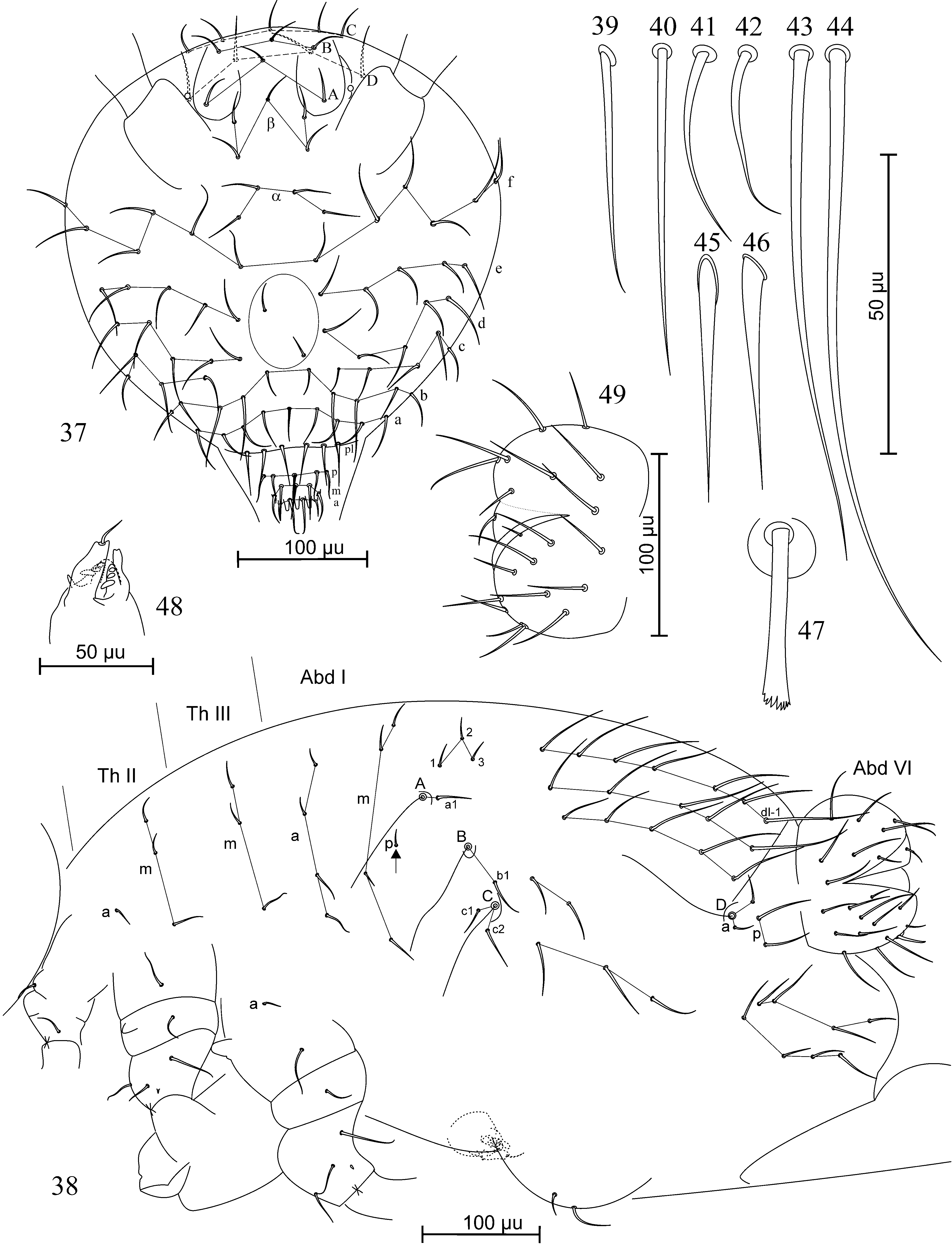
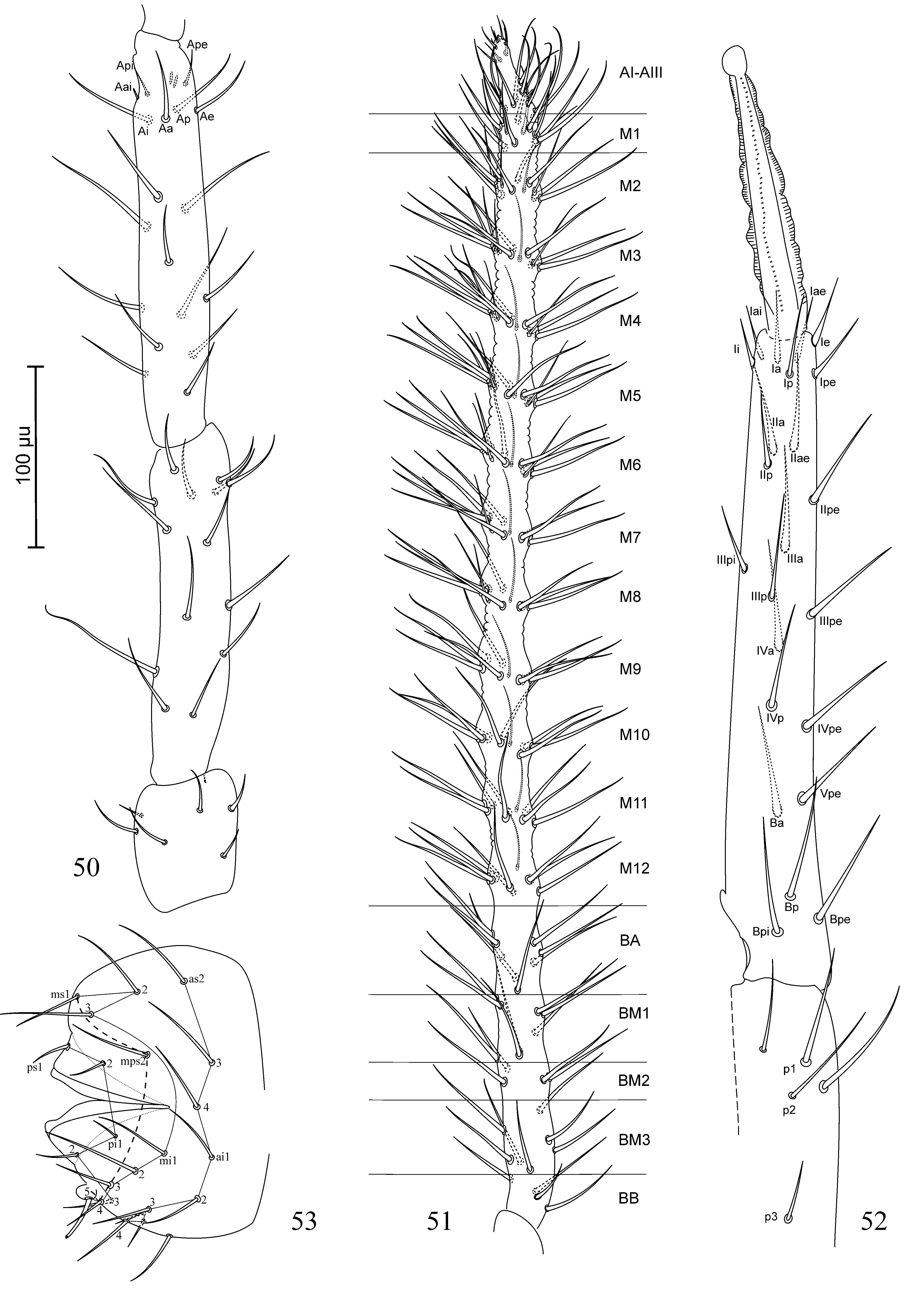
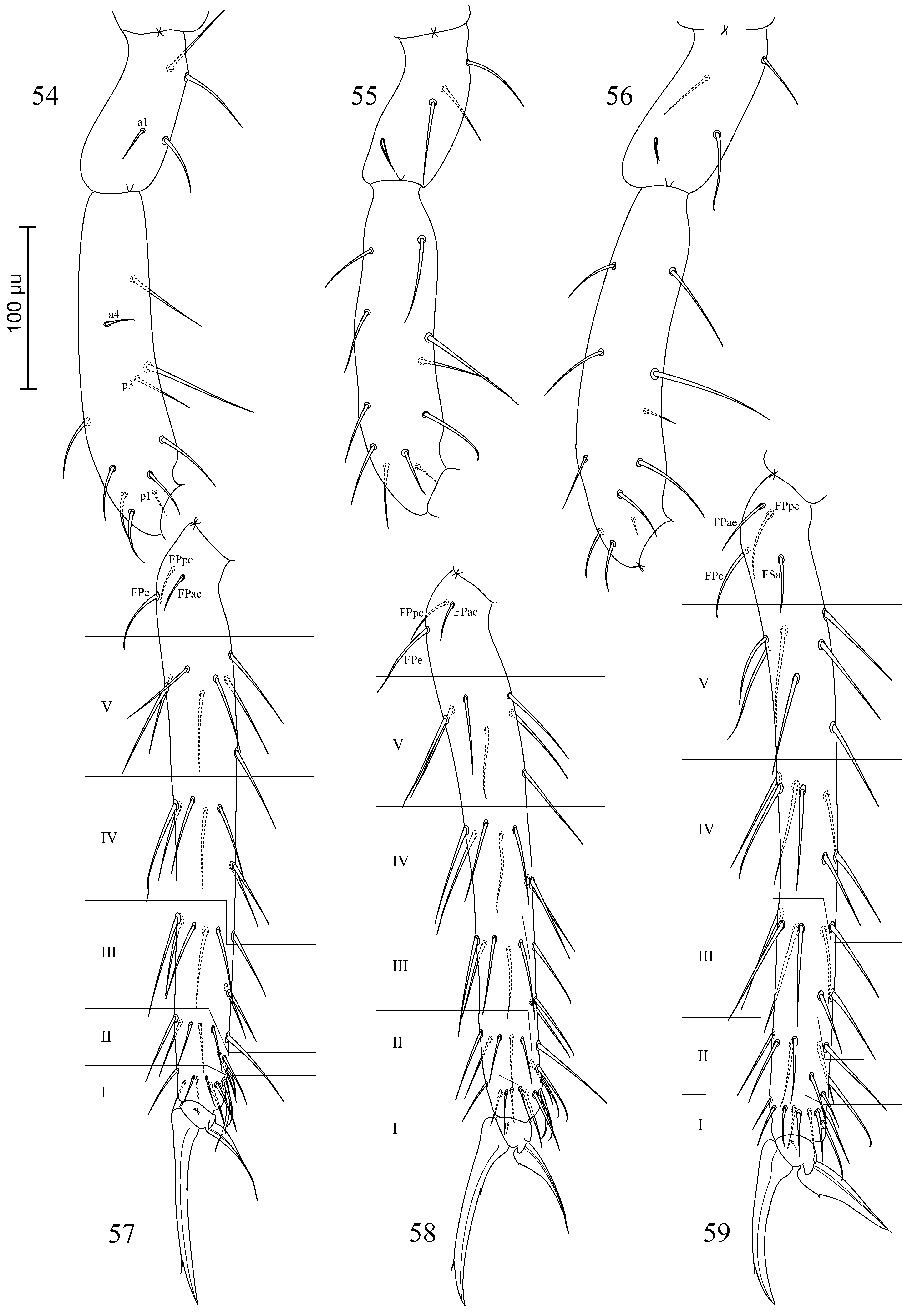
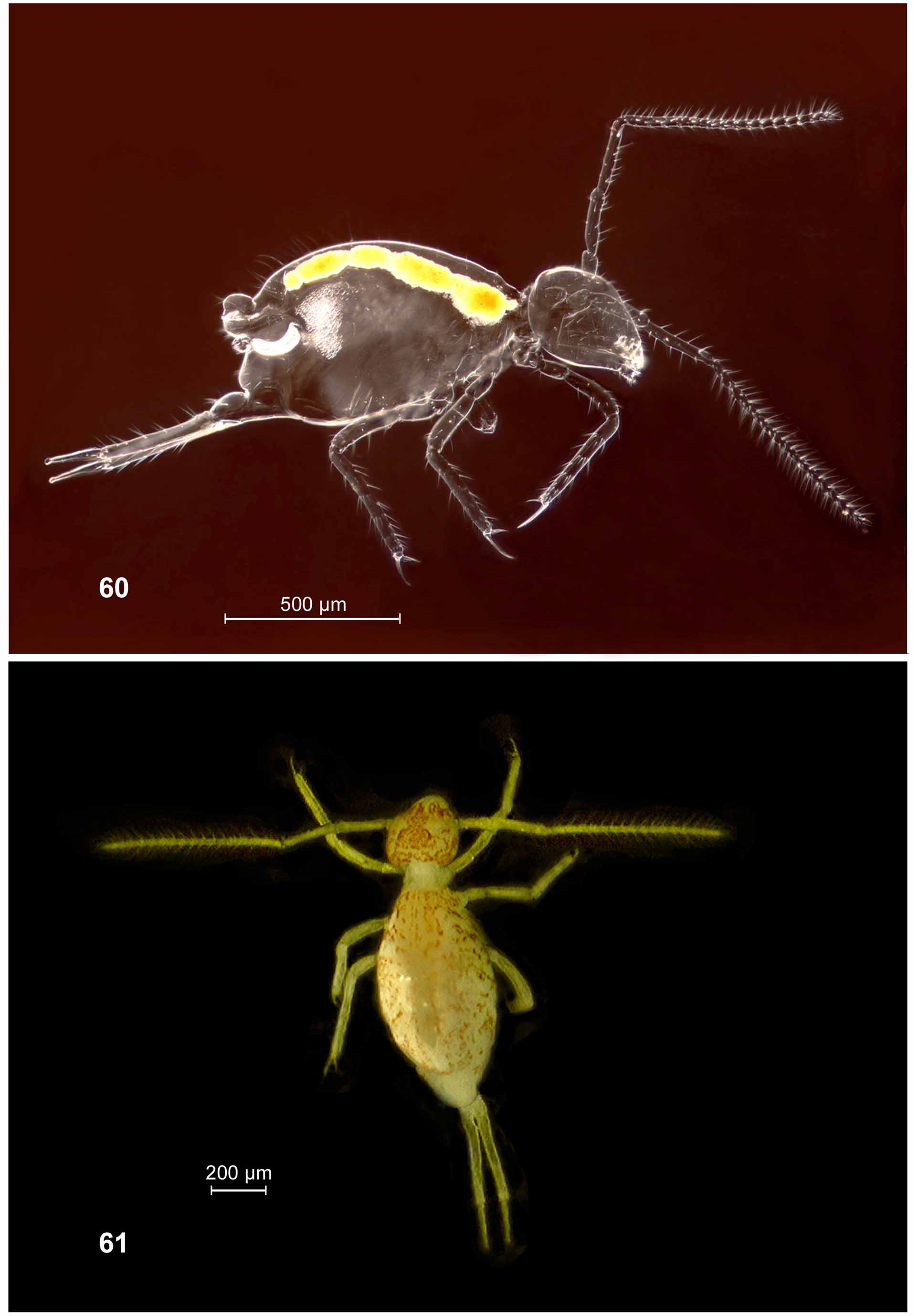
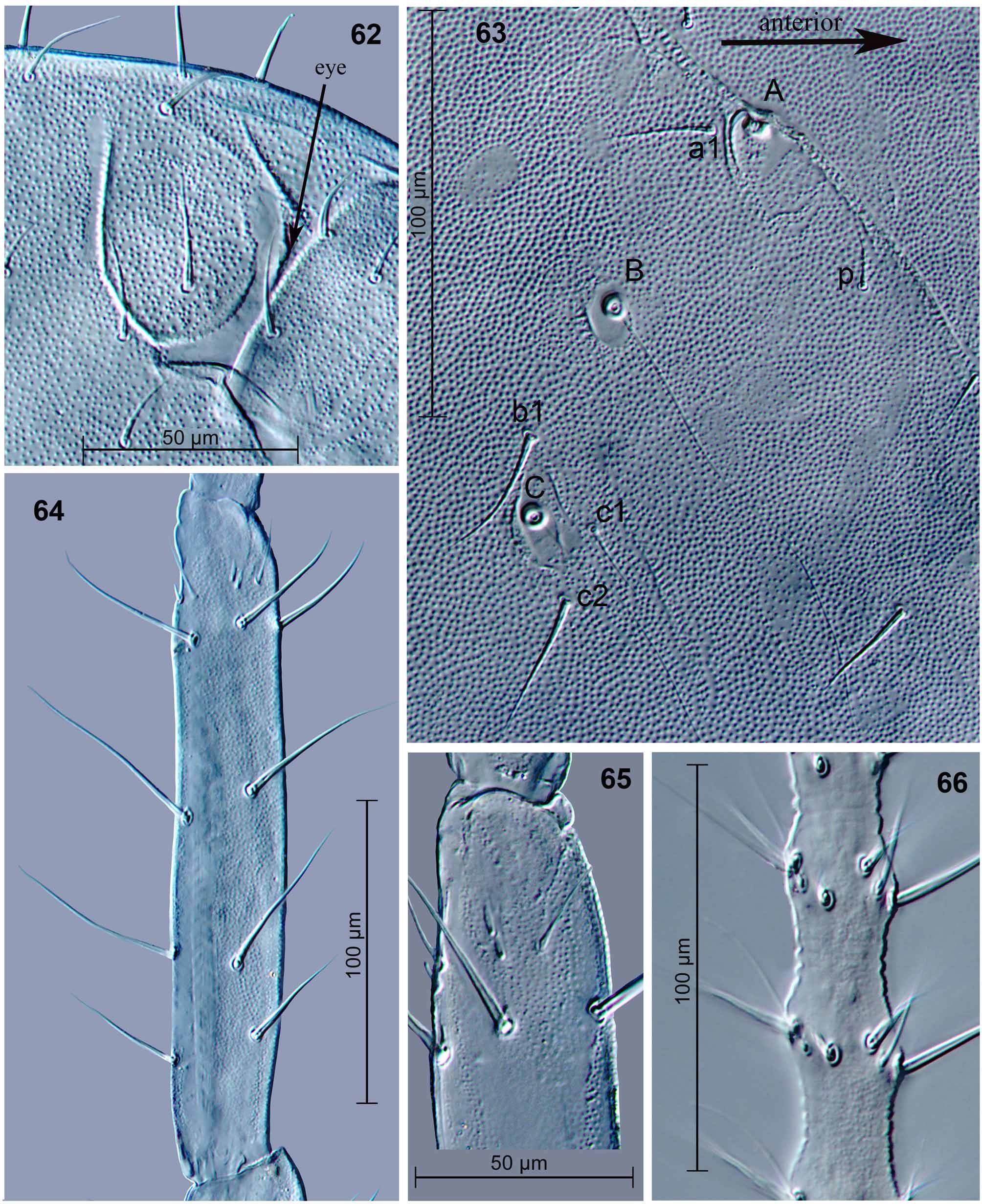
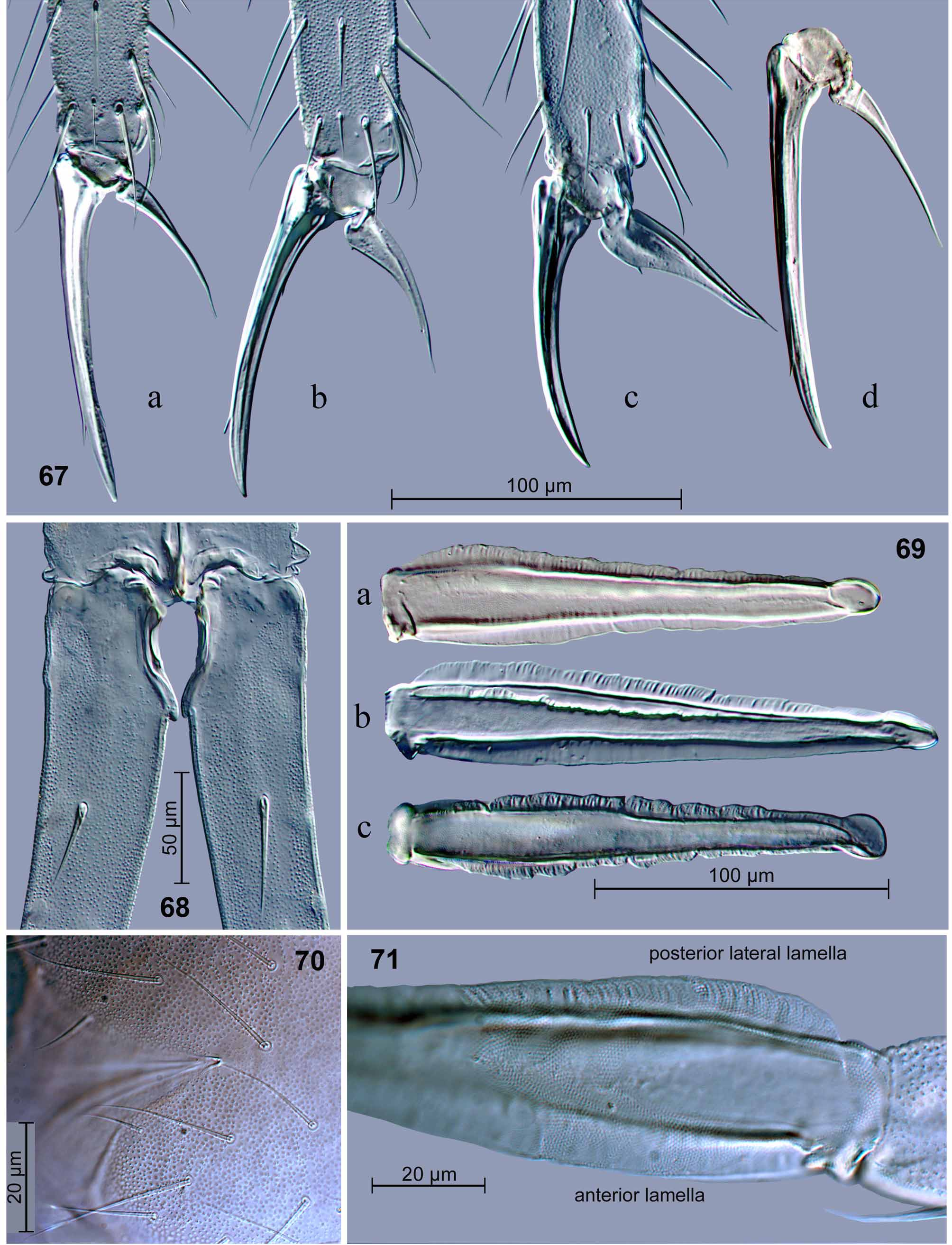
Description. Female: body about 1.4 mm length (holotype 1.49 mm). Coloration (alcohol material): unpigmented or with diffuse reddish-brownish pigmentation on dorsal part of head and great abdomen (Fig. 61). Head (Fig. 37). Eyes 1 + 1 very small, often uncertain to observe (Fig. 62). Labral chaetotaxy a: 4, m: 5, p: 5; prelabral: 6 (= 6 / 554); 2 inner setae of row a are hooked at the apex. Clypeal area with axial seta in row a. Interantennal area: 2 rows (α and β) with axial seta in row β. Dorsal area: 4 rows (from A to D) with 3 axial setae in rows A, B and C; no modified (spine-like) setae (Figs 37, 41). Antennae (Figs 50, 51): length about 3 × (2.7 – 3.1) of head (2.7 in holotype). Mean length ratio of antennal segments I: II: III: IV = 1: 2.9: 3.3: 9.7 (in holotype 1: 3.0: 3.5: 9.9). Ant I with 7 short setae, subapical one is very small. Ant II with 14 setae. Ant III without swelling, with 18 setae and 2 small sense rods in separate pits (7.2 µm in holotype); setae Api and Ape short and thin, seta Aai very small and blunt (Figs 50, 64, 65). Ant IV subdivided into 13 subsegments or pseudosubsegments, usually separated from each other by 2 – 3 (0 – 4) annuli which usually are more distinct in distal part of the segment (Figs 51, 66). (Pseudo) subsegmental formula: 1 + 11 + 1 = (A + M 1) + (M 2 – M 12) + (B). Ant IV bears 20 whorls of setae: 4 on apical subsegment (AI – AIII, M 1), 11 on median subsegments (M 2 – M 12) and 5 on basal subsegment (BA, BM 1 – BM 3, BB). Foreleg: precoxae 1, 2 and coxa with 1, 0, 1 setae respectively (Fig. 38). Trochanter with 3 anterior and 1 posterior setae; femur with 11 setae, a 4 turned perpendicularly to the longitudinal axis of the segment (Fig. 54). Tibiotarsus (Fig. 57) with 44 setae: 3 setae FP present (e, ae, pe); secondary seta FS missing; whorl I with 9 setae among which Ja curved and spine-like; each of whorls II – V with 8 setae; interior setae not much thickened. Pretarsus with 1 anterior and 1 posterior setulae. Foot complex (Figs 57, 67 a). Claw: very long and thin, 2.7 – 3 × shorter than tibiotarsus (2.7 in holotype); with vanishingly small or without inner tooth and with 2 pairs of lateral teeth: small subbasal and sharp thin subapical; without tunica. Empodium: thin, 2 – 2.4 × shorter than claw; without corner tooth. Mid leg: precoxae 1 and 2 with 1, 1 setae respectively, precoxal process present, coxa with 3 setae and microsensilla (Fig. 38). Trochanter with 3 simple setae and anterior trochanteral organ; femur with 11 setae (Fig. 55). Tibiotarsus (Fig. 58): 3 setae FP present, seta FS missing; whorl I with 9 setae among which Ja curved and thickened, whorls II – IV with 8 setae, whorl V with 7 setae. Foot complex (Figs 58, 67 b). Claw: very long and thin, 2.8 – 3.1 × shorter than tibiotarsus (2.81 in holotype); with small inner tooth and with 2 pairs of lateral teeth: small subbasal and sharp thin subapical; without tunica. Empodium: thin, 1.9 – 2.4 × shorter than claw; corner tooth present. Hind leg: precoxae 1 and 2 with 1, 1 setae respectively, process on precoxa 1 present, coxa with 3 setae and microsensilla (Fig. 38). Trochanter with anterior trochanteral organ, only 2 anterior and 1 posterior simple setae; femur with 11 setae (Fig. 56). Tibiotarsus (Fig. 59): 3 setae FP and seta FSa present; whorl I with 9 setae none of which are spine-like, whorls II – IV with 8 setae, whorl V with 7 setae. Foot complex (Figs 59, 67 c). Claw: long and thin, shorter than in fore- and mid leg (Table 1), 3.7 – 4.3 × shorter than tibiotarsus (3.7 in holotype); with vanishingly small or without inner tooth and with 2 pairs of lateral teeth: small subbasal and sharp thin subapical; without tunica. Empodium: broad, 1.5 – 1.6 × shorter than claw; with distinct corner tooth. Mean lengths ratio of tibiotarsi I: II: III = 1: 0.95: 1.14 (same in holotype). Mean ratio head: tibiotarsus I = 1.2. Ventral tube with 1 + 1 subapical setulae. Tenaculum (Fig. 48): each ramus with 3 sclerotic teeth and non sclerotized process; anterior lobe with 1 apical setula; tip of posterior lobe is approximately on one level with tip of anterior lobe. Furca (Fig. 52): manubrium with 5 + 5 setae on posterior side, sete pi 1 and p 2 thin, seta p 3 thin and short. Dens: with subbasal process (like blunt tooth) on interior side (Fig. 68); anterior side with 3, 2, 1, 1, 1 setae, IIa – IVa, Ba and IIae are heavy, Ia not spine-like (Fig. 45). Posterior side without distinct spines, but setae Ie, Ipe and Ii are thickened at the basis and slightly spine-like (Figs 46, 52). Seta IVpi absent. Mucro (Fig. 69 a – c, 71): posterior lamellae with teeth usually accreted together, so that margins look rather wavy; anterior lamella smooth and welldeveloped; tip distinctly broadened: globular or spoon-like. Dens 2 – 2.3 × as long as mucro (2.11 in holotype). Great abdomen (Fig. 38): mesothorax with short somewhat curved and not spine-like dorsal setae (Fig. 42). Row a of Abd I with 4 (not 5 as observed in other Arrhopalitidae) setae. Trichobothria ABC form very obtuse angle (160 – 173 o; 164 o in holotype) and AB is equidistant with BC. Single p seta of p-row of Abd I is located on or a little above the level of trichobothrium B; seta b 1 lies between trichobothria B and C a little posteriorly to the line BC; seta c 1 lies near and c 2 — below trichobothrium C (Fig. 63). Seta c 1 smaller than other setae of the trichobothrial complex (c 1 = 21 – 25 µm; and c 2 = 33 – 45 µm). Posterior lateral complex with 2 + 3 and furca base complex with 8 setae. Central dorsal complex with 3 subequal setae. Posterior dorsal complex with about 17 setae, the longest of which are a little shorter or subequal to hind claw (Figs 43, 44). Ventral complex with 2 or 3 (rarely 1) setae. Fifth abdominal segment (Fig. 38) with 2 setae and trichobothrium D in row a, and 2 setae in row p. Genital field with 4 + 4 setae. Sixth abdominal segment (Fig. 53) without cuticular spines; circumanal setae not thickened (Figs 39, 40, 70). Chaetotaxy reduced: dorsal valve bears 7 + 2 axial + 7 setae; each of lateral valve bears 15 setae (totally 46 setae on Abd VI). Circumanal row with setae mps 1, mps 3, mpi 1 and mpi 2 absent. Appendices anales (27.6 µm in holotype) rod-like, gradually slightly broadened, apically serrated, slightly curved in lateral view, inserted into semiglobular papilla (Fig. 47). Male: about 1.2 mm length, smaller than females (Fig. 60). Chaetotaxy is the same as in females except some details of Abd VI. Dorsal anal valve is exactly as in female with 7 + 2 axial + 7 thin setae, but each of lateral valves bears 12 setae (totally 40 setae on Abd VI versus 46 in female) (Fig. 49). Genital opening is surrounded with about 10 setulae. Variability. Bases of sense rods of AO-III usually lie close together on about one level, but one female has one rod situated much higher than another (Fig. 65). Ventral complex of great abdomen includes 3 or 2 (rarely asymmetrically 1) setae. In one specimen row m of Th II incomplete (2 setae instead of 3). In one female seta a 1 of trichobothrial complex is shifted and lies in the line between trichobothria A and B. Inner tooth of claws I and III hardly noticeable or absent. Seta IIIpi of dens in type specimens usually present, but in one female asymmetrically absent. Upper anal valve usually with 9 setae (7 + 2 axial) per side, one specimen with 10 (odd seta does not belong to circumanal row). Specimens from Tsebeldinskaya Cave differ from type specimens by: relatively longer claws (claw I up to 143 µm in female 1.22 mm: Fig. 67 d) with ratio Tita / claw I, II, III = 2.5, 2.5 and 3.4 respectively; permanent absence of inner tooth on claw I and III; absence of seta IIIpi on dens. This population seems to be a geographic variety of T. stygios, or possibly even an isolated subspecies. Bionomy and distribution. In Nizhnyaya Shakuranskaya Cave (type locality) specimens of the new species were found on the water surface of underground stream in gours and ponds and on calcite flowstones close to the water from 500 to 1000 m from the entrance. The air and water temperature was 11.8 o C and 11.2 – 12.2 o C respectively. In Tsebeldinskaya Cave specimens were sampled from the water surface about 300 m from the entrance. The air and water temperature was 11.2 o C and 12.1 o C respectively. In both caves the new species cohabit with different species from the genus Pygmarrhopalites. Terrestrial sampling and Barber’s traps in the same caves provided other species of Arrhopalitidae but not T. stygios sp. nov. This fact together with specific morphology (long thin claws and mucro with accreted teeth and well-developed anterior lamella) indicates epineustonic and hygropetric mode of life of the new species in subterranean habitat. Distribution of this species is restricted to few caves of Tsebelda Karst Massif, moreover, some differences (geographic variation) between populations exist. The new species most likely is a narrow troglobiont endemic.
Vargovitsh, Robert S. (2012): New troglomorphic Arrhopalitidae (Collembola: Symphypleona) from the Western Caucasus. Zootaxa 3174: 1-21, DOI: 10.5281/zenodo.279882