AnimaliaNot EvaluatedacceptedspeciesAccepted
Polycitorella graphicum

Polycitorella graphicum

GBIF:119508060

ABOUT

Descriptions(1)

Polycitorella graphicum n. sp.

(Figures 23 A,C; 24)

Station. TA 51 (MNHN A3 POL.B 14, holotype).

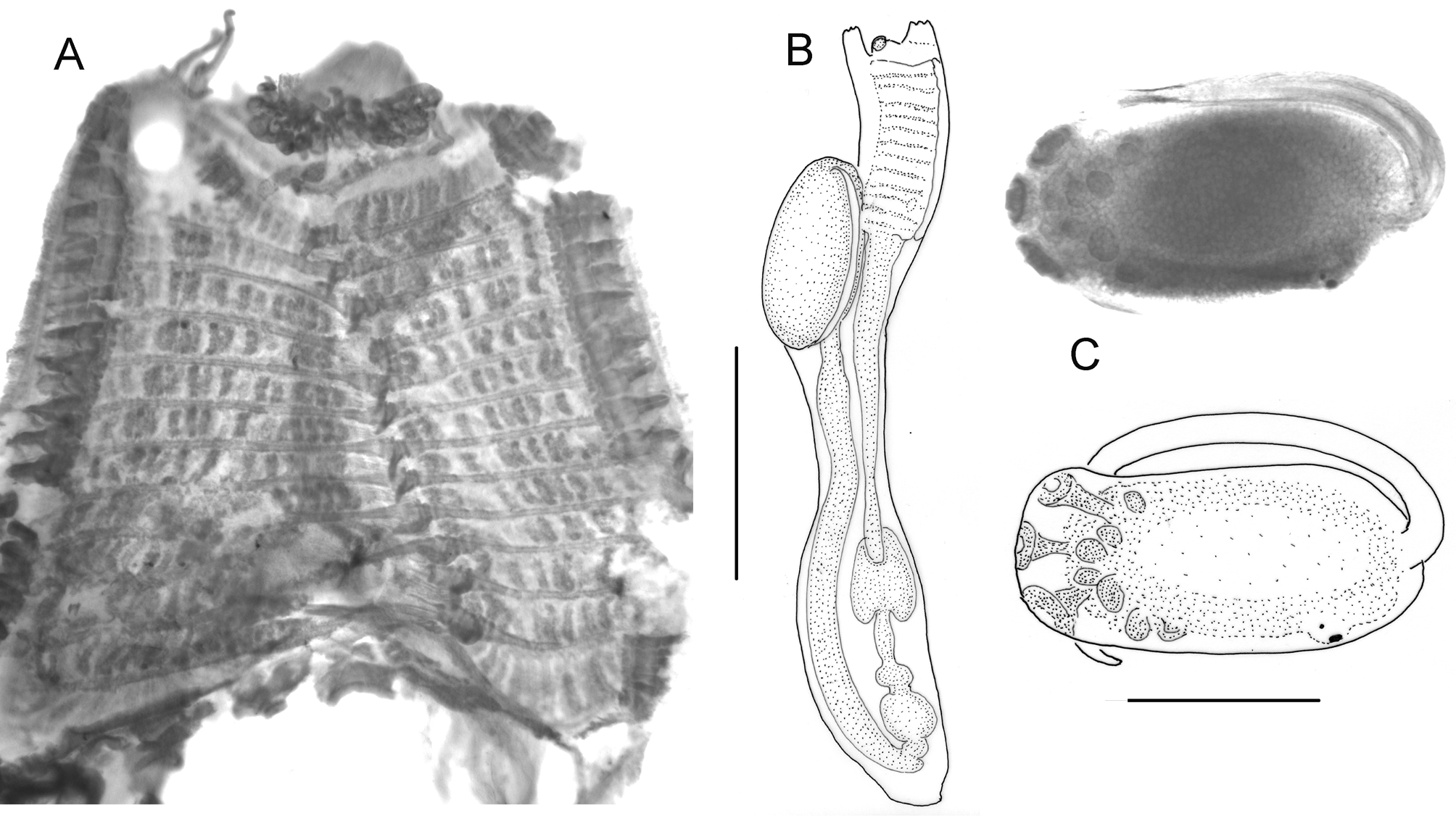
The single colony is a thick crust 6cm in length and 1cm thick (Fig. 23 A). It is made of convoluted lobes protruding from a common base. The walls of the lobes are straight and the surface is flat. The zooids are lined along the outline of the lobes. The oral and atrial openings are projecting with a stellate design above the flat colony surface. The spicules (Fig. 23 C) are dense in the whole colony thickness except a thin layer on the side walls of the lobes. The zooids (Fig. 24 B) are deeply withdrawn into the colony. The largest individuals are 8 to 9mm long. The thoracic musculature is strong extending in 2 ribbons on the abdomen. The branchial sac has 13 rows of stigmata (Fig. 24 A). The stomach has a smooth wall. The intestine shows a bulbous segment before the rectum (Fig. 24 B). The gonads occupy the gut loop. The testis vesicles are poorly developed around a central ovary in this incubatory colony. The larva (Fig. 24 C) 1.9 to 2mm long takes place from the upper part of the abdomen to the basal part of the atrial cavity. It has 3 adhesive papillae and 6 pairs of lateral vesicles. Ocellus and otolith are in a posterior position. The tail encircles the trunk in half a turn. The larval trunk is dense no organs are already differentiated.

The spicules (Fig. 23 C) are stellate but irregular, from 20 to 30µm of diameter few of them reach 50µm.

P. graphicum n. sp. essentially differs from other species of the genus having more than 10 stigmata rows by the linear disposition of the zooids at the periphery of the colony, and by the design of the dark pigment cells. It lacks the thick aspicular tunic layer at the colony surface.

Monniot, Françoise (2012): Some ascidians from the southern coast of Madagascar collected during the “ AtimoVatae ” survey. Zootaxa 3197: 1-42, DOI: 10.5281/zenodo.246182MagnoliaPress via PlaziNo known copyright restrictions apply. See Agosti, D., Egloff, W., 2009. Taxonomic information exchange and copyright: the Plazi approach. BMC Research Notes 2009, 2:53 for further explanation.

Export occurrence data

Darwin Core Archive (ZIP)

CLASSIFICATION

Taxonomic Classification Tree

MULTIMEDIA

Media Files(2)

FIGURE 23. Polycitoralla graphicum n. sp.: A, colony in formalin; C, spicules. Polycitorella peresi: B, colony in formalin, D, spicules. Scale bars A = 1 cm; B = 2 cm, C, D = 10 µm.

Imageimage/png© Monniot, FrançoiseMonniot, Françoise

FIGURE 24. Polycitorella graphicum n. sp.: A, branchial sac; B, zooid; C, larva. Scale bars B = 2 mm; C = 1 mm.

Imageimage/png© Monniot, FrançoiseMonniot, Françoise

IMAGES

Gallery(2)

See Gallery

Occurrences with images

Source Information

Some ascidians from the southern coast of Madagascar collected during the “ AtimoVatae ” survey

checklist

This dataset contains the digitized treatments in Plazi based on the original journal article Monniot, Françoise (2012): Some ascidians from the southern coast of Madagascar collected during the “ AtimoVatae ” survey. Zootaxa 3197: 1-42, DOI: 10.5281/zenodo.246182

Abstract

Surveys of littoral invertebrates along the southern coast of Madagascar have produced the first study of ascidians in this part of the Indian Ocean. Collections were made by SCUBA divers in May and June 2010 down to 25m depth. This region is considered the southern limit for coral reefs but remains diverse biologically. Upwellings and an abundant plankton community particularly favour the abundance of ascidians in this area. Of the 39 species of non-didemnid species described here, eight are new. Ten species are common to South Africa. Other species were for the most part already known from the Mozambique Channel and a few have also been recorded in the western Pacific (either cosmopolitan or introduced).

Key words: Ascidians, Madagascar, systematics, new species

Monniot F, plazi (2012). Some ascidians from the southern coast of Madagascar collected during the “ AtimoVatae ” survey. Plazi.org taxonomic treatments database. Checklist dataset https://doi.org/10.5281/zenodo.246182 accessed via GBIF.org on 2026-06-16.

CC0Published 12/31/2012View dataset
GBIF Usage Key
119508060
Dataset Key
4c036a63-9718-48de-97a2-f29c5976eb99
Origin
source
Backbone Key
6486676
Taxon ID
3055E11FFF8CFF8D71A5CF38FCA46EA7.taxon
Last Crawled
6/11/2026
Last Interpreted
6/11/2026