
AnimaliaNot EvaluatedacceptedspeciesAccepted
Molgula dione

Molgula dione

(Savigny, 1816) Savigny, 1816

GBIF:119508075

0year

0

Synonyms

ABOUT

Descriptions(1)

Molgula dione (Savigny, 1816)

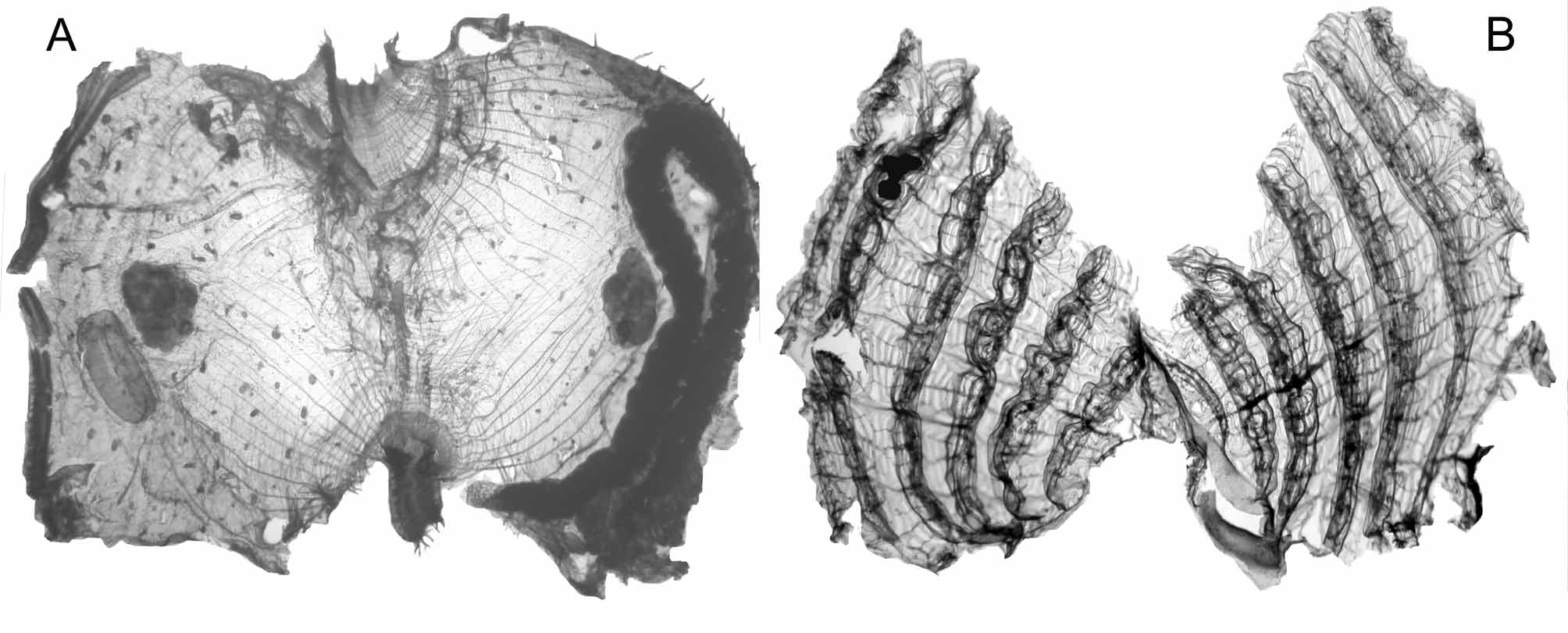
(Figure 35)

Molgula dione Savigny, 1816: 93 153 Pl.7 fig. 1. Monniot C. 2002: 115 fig 38 and synonymy, Yemen, Socotra Station. TA 56 (MNN S3 MOL.A 394)

The single specimen 5mm in diameter is spherical, covered with sand; the siphons are not visible at the surface. Removed from the tunic the edge of the siphons is cut into numerous thread-like lobes. The body wall is thin. The longitudinal muscular fibres issued from each siphon do not extend on the whole body length (Fig. 35 A). The transverse muscles are very thin. A velum is present in both siphons. The oral tentacles are large but poorly branched. The dorsal tubercle opens in a vertical slit; it is located in a deep V of the peripharyngeal band. The dorsal lamina is short. The branchial sac (Fig. 35 B) has 7 folds with the formula: right-E 3-6-5-6-6-5-2-DL-3-4-5-5-5- 4-3E left. The first dorsal fold on each side is very short. The double spirals are obvious at the top of the folds. Parastigmatic vessels are present. The gut is a long closed loop. The hepatic gland in a single lobe has round papillae. There is one gonad on each side (Fig. 35 A); the testis is against the proximal end of the ovary. The ovary is globular with a short oviduct. The sperm duct ends in a short tube protruding on the internal side of the ovary. The renal sac is oval and small.

All characters well correspond to previously collected specimens, the smallest number of branchial folds is attributed to a smaller size of the Madagascar specimens.

The species was previously recorded from the Red Sea and Yemen.

Monniot, Françoise (2012): Some ascidians from the southern coast of Madagascar collected during the “ AtimoVatae ” survey. Zootaxa 3197: 1-42, DOI: 10.5281/zenodo.246182MagnoliaPress via PlaziNo known copyright restrictions apply. See Agosti, D., Egloff, W., 2009. Taxonomic information exchange and copyright: the Plazi approach. BMC Research Notes 2009, 2:53 for further explanation.

Export occurrence data

Darwin Core Archive (ZIP)

CLASSIFICATION

Taxonomic Classification Tree

NOMENCLATURE

Synonyms(1)

MULTIMEDIA

Media Files(1)

FIGURE 35. Molgula dione: A, dissection; B, branchial sac.

Imageimage/png© Monniot, FrançoiseMonniot, Françoise

IMAGES

Gallery(1)

See Gallery

Occurrences with images

Source Information

Some ascidians from the southern coast of Madagascar collected during the “ AtimoVatae ” survey

checklist

This dataset contains the digitized treatments in Plazi based on the original journal article Monniot, Françoise (2012): Some ascidians from the southern coast of Madagascar collected during the “ AtimoVatae ” survey. Zootaxa 3197: 1-42, DOI: 10.5281/zenodo.246182

Abstract

Surveys of littoral invertebrates along the southern coast of Madagascar have produced the first study of ascidians in this part of the Indian Ocean. Collections were made by SCUBA divers in May and June 2010 down to 25m depth. This region is considered the southern limit for coral reefs but remains diverse biologically. Upwellings and an abundant plankton community particularly favour the abundance of ascidians in this area. Of the 39 species of non-didemnid species described here, eight are new. Ten species are common to South Africa. Other species were for the most part already known from the Mozambique Channel and a few have also been recorded in the western Pacific (either cosmopolitan or introduced).

Key words: Ascidians, Madagascar, systematics, new species

Monniot F, plazi (2012). Some ascidians from the southern coast of Madagascar collected during the “ AtimoVatae ” survey. Plazi.org taxonomic treatments database. Checklist dataset https://doi.org/10.5281/zenodo.246182 accessed via GBIF.org on 2026-06-19.

CC0Published 12/31/2012View dataset
GBIF Usage Key
119508075
Dataset Key
4c036a63-9718-48de-97a2-f29c5976eb99
Origin
source
Backbone Key
2331530
Taxon ID
3055E11FFFB6FFB971A5CB21FC076AF1.taxon
Last Crawled
6/11/2026
Last Interpreted
6/11/2026