
Homoeodistoma omasum
Monniot, 1987
GBIF:119508167
ABOUT
Descriptions(1)
Homoeodistoma omasum ? Monniot, 1987
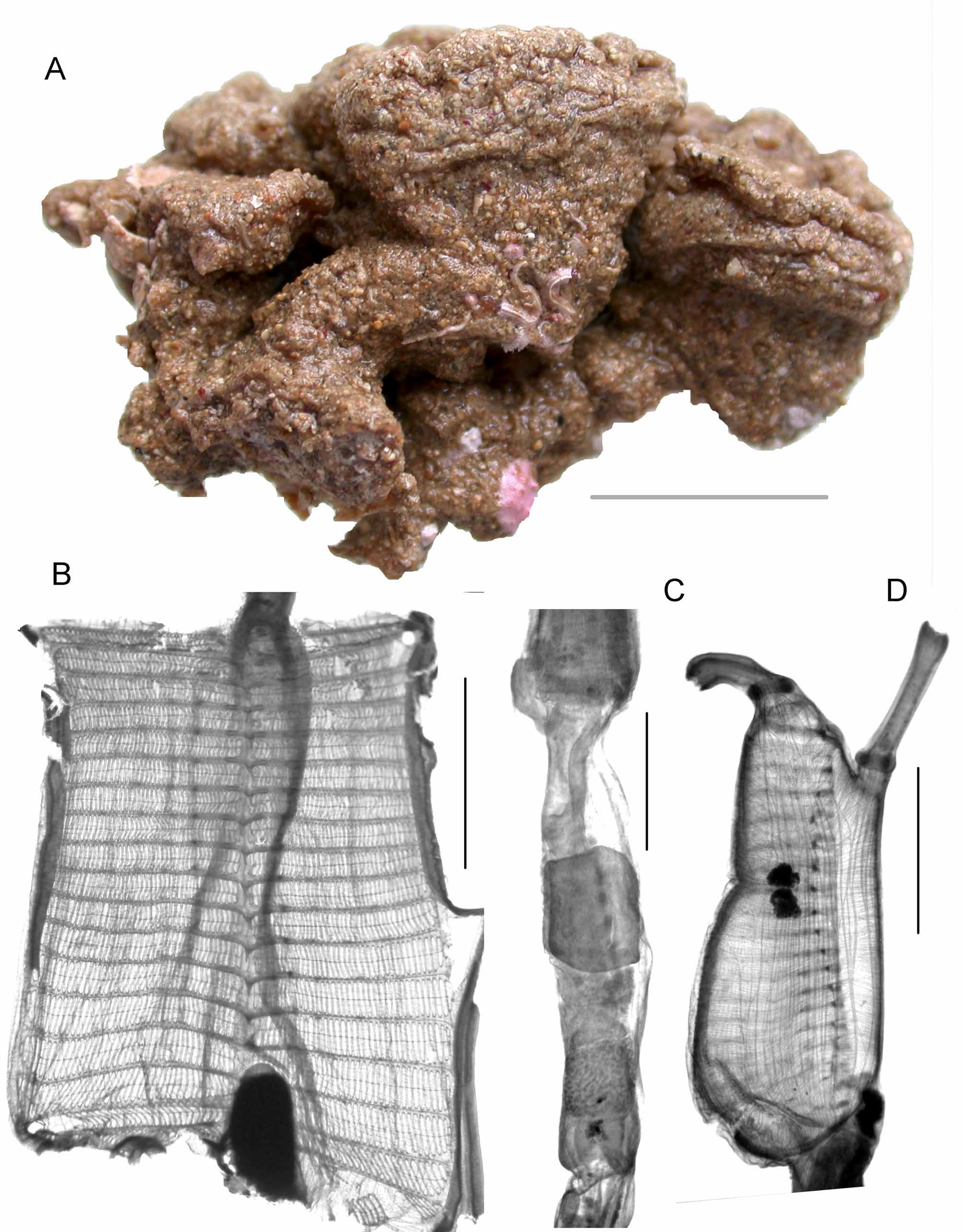
(Figure 17)
Homoeodistoma omasum Monniot F., 1987: 503 fig. 2C–E pl. 1B, New Caledonia. Monniot & Monniot: 2008: 831 figs 45; 76E, New Guinea.
Stations. TR 1 (MNHN: A1 HOM 10). TA 25 (MNHN: A1 HOM 11)
Bellona Island, Salomon Islands, 11° 51.086 S –159° 27.617 E, 10m, 20/04/2002, P. Laboute col. (MNHN: A1 HOM 7)
The colonies are sandy, made of thick lamellae or polygonal lobes united at their base (Fig. 17 A). The zooids apertures are lined on the sides of protruding rims located at the outline of a colony lobe, or along convoluted pads in colonies with several systems. Both siphons are long (Fig. 17 D) with red longitudinal stripes (the colour progressively disappears in formalin).Their rim is dentate and a strong sphincter encircles their base. The musculature of the thorax is dense with thin longitudinal and transverse fibres regularly crossed (Fig. 17 D). The branchial sac (Fig. 17 B) has from 17 to 21 elongated stigmata crossed by parastigmatic vessels. There are no papillae on the transverse vessels. A constriction separates the thorax from the abdomen. The stomach has a smooth wall. It is followed by a narrow segment and farther the intestine widens in a part whose wall shows an areolation (Fig. 17 C) which becomes obvious only after staining. The rectum begins with 2 caeca and is straight until the base of the thorax. The anus has 2 lobes. The post-abdomen is long with an anterior ovary followed by a double line of testis vesicles limited to the first half of the post-abdomen length. The larvae, 1.8mm long, have 3 well divergent adhesive papillae and a very large anterior cap of numerous vesicles on each side.
The morphology of the colonies and zooids is the same as in the type material from New Caledonia and also corresponds to the material from Bellona (Solomon I.). The specimens identified by Monniot & Monniot (2008) from Papua New Guinea differ by the absence of parastigmatic vessels on the branchial sac; all other characters are similar, the larva has the same structure but is a somewhat smaller.
It is likely that several species of Homoeodistoma exist, but no striking characters are obvious allowing to separate them, their particularities are given in Monniot & Monniot (2008). Kott (1992) groups in a new monospecific genus Condominium several species of Homoeodistoma: Placentela areolata Kott, 1963 and Placentela ellistoni Kott 1972 whose type was reexamined (Monniot & Monniot 2008). Kott’s genus is not retained here.
The genus Homoeodistoma is recorded here for the first time from the Indian Ocean.
Export occurrence data
Darwin Core Archive (ZIP)
CLASSIFICATION
Taxonomic Classification Tree

IMAGES