
AnimaliaNot EvaluatedacceptedspeciesAccepted
Polyclinum arenosum

Polyclinum arenosum

Sluiter, 1898

GBIF:119508169

0year

ABOUT

Descriptions(1)

Polyclinum arenosum Sluiter, 1898

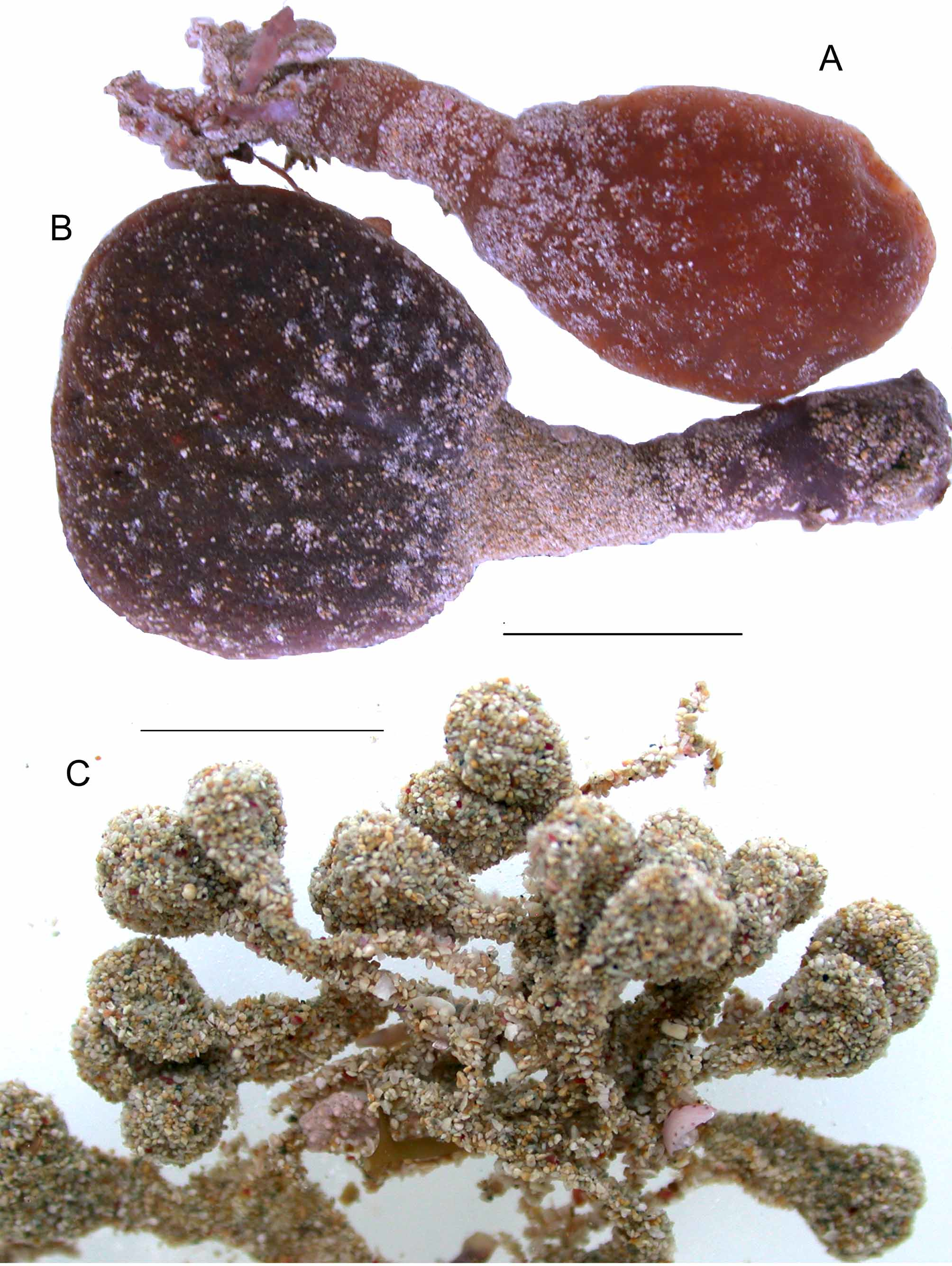
(Figures 12A, 13)

Polyclinum arenosum Sluiter, 1898: 20 pl. 4 Fig. 1–2, South Africa, Isipingo; Millar: 1955: 174; 1962: 135, South Africa, Natal.

Station. TA 12 (MNHN A1 POL.B 103).

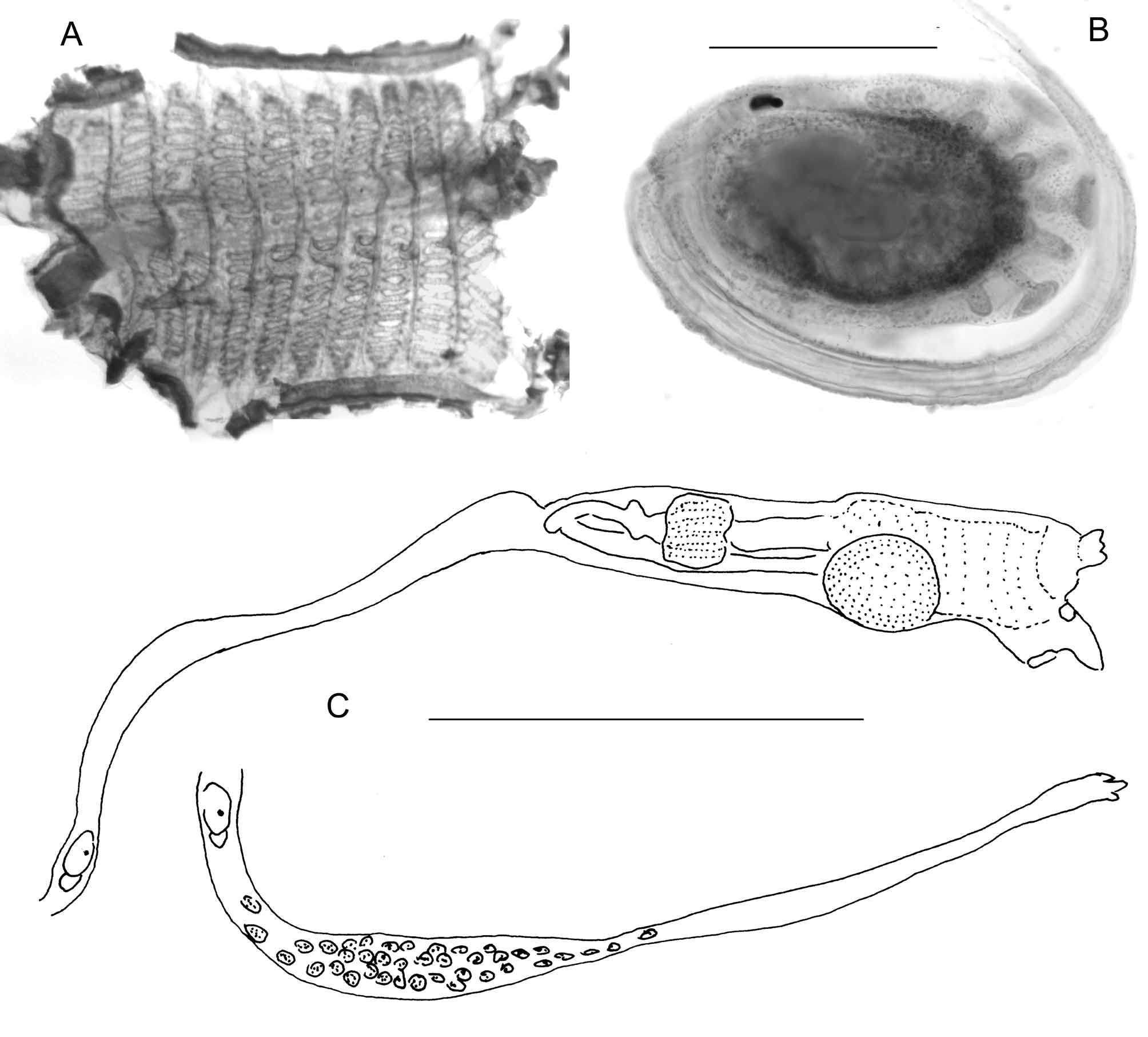
The colony is entirely embedded with sand, in lobes erect on a common base (Fig. 12A). Each lobe contains 8 to 10 zooids. The thoraces are included in the inflated upper part of the lobes 5mm in diameter. The oral siphon has 6 pointed lobes. The rim of the atrial aperture extends in a long languet with a pointed or dented tip (Fig. 13 A). A round button is present behind the atrial siphon. The thoracic musculature is weak with 8 to 10 longitudinal fibres on each side, which do not extend farther than the level of the fourth stigmata row. The branchial sac (Fig. 13 B) has 14–15 rows of stigmata and 15 stigmata in a half row on the right side in the middle of the branchial sac. Fourteen round and short papillae are on a transverse vessel at the same level. The short abdomen and the post-abdomen in shape of a drop have the common shape of the genus (Fig. 13 A). One to 3 larvae are incubated in a pouch hanging at the middle of the thoracic wall. They have 3 adhesive papillae separated by odd vesicles and 4 pairs of lateral round vesicles (Fig. 13 C). The trunk 0.4mm long is circled by the tail in half a turn and contains an oxalate crystal. The colony from the south of Madagascar exactly fits with the descriptions by Sluiter and Millar for specimens from South Africa. The colony shape is unique among the genus.

Monniot, Françoise (2012): Some ascidians from the southern coast of Madagascar collected during the “ AtimoVatae ” survey. Zootaxa 3197: 1-42, DOI: 10.5281/zenodo.246182MagnoliaPress via PlaziNo known copyright restrictions apply. See Agosti, D., Egloff, W., 2009. Taxonomic information exchange and copyright: the Plazi approach. BMC Research Notes 2009, 2:53 for further explanation.

Export occurrence data

Darwin Core Archive (ZIP)

CLASSIFICATION

Taxonomic Classification Tree

MULTIMEDIA

Media Files(4)

FIGURE 1. Aplidium benhami: A, B, in situ colony (photo P. Laboute); C, colony in formalin.
Imageimage/png© Monniot, FrançoiseMonniot, Françoise

FIGURE 2. Aplidium benhami: A, branchial sac; B, larva; C, Zooid. Scale bars: B = 0,4 mm; C = 2 mm.
Imageimage/png© Monniot, FrançoiseMonniot, Françoise

FIGURE 12. A, Aplidiopsis tubiferus. B, Polyclinum pedicellatum n. sp. C, Polyclinum arenosum. Scale bars A, B, C = 2 cm.

Imageimage/png© Monniot, FrançoiseMonniot, Françoise

FIGURE 13. Polyclinum arenosum: A, zooid; B, branchial sac; C, larva. Scale bars A = 1 mm; C = 0.2 mm.

Imageimage/png© Monniot, FrançoiseMonniot, Françoise

IMAGES

Gallery(4)

See Gallery

Occurrences with images

Source Information

Some ascidians from the southern coast of Madagascar collected during the “ AtimoVatae ” survey

checklist

This dataset contains the digitized treatments in Plazi based on the original journal article Monniot, Françoise (2012): Some ascidians from the southern coast of Madagascar collected during the “ AtimoVatae ” survey. Zootaxa 3197: 1-42, DOI: 10.5281/zenodo.246182

Abstract

Surveys of littoral invertebrates along the southern coast of Madagascar have produced the first study of ascidians in this part of the Indian Ocean. Collections were made by SCUBA divers in May and June 2010 down to 25m depth. This region is considered the southern limit for coral reefs but remains diverse biologically. Upwellings and an abundant plankton community particularly favour the abundance of ascidians in this area. Of the 39 species of non-didemnid species described here, eight are new. Ten species are common to South Africa. Other species were for the most part already known from the Mozambique Channel and a few have also been recorded in the western Pacific (either cosmopolitan or introduced).

Key words: Ascidians, Madagascar, systematics, new species

Monniot F, plazi (2012). Some ascidians from the southern coast of Madagascar collected during the “ AtimoVatae ” survey. Plazi.org taxonomic treatments database. Checklist dataset https://doi.org/10.5281/zenodo.246182 accessed via GBIF.org on 2026-06-14.

CC0Published 12/31/2012View dataset
GBIF Usage Key
119508169
Dataset Key
4c036a63-9718-48de-97a2-f29c5976eb99
Origin
source
Backbone Key
5723685
Taxon ID
3055E11FFF9FFF8171A5CE08FCCE693D.taxon
Last Crawled
6/11/2026
Last Interpreted
6/11/2026