
AnimaliaNot EvaluatedacceptedspeciesAccepted
Polyclinum tingens
GBIF:119508170
ABOUT
Descriptions(1)
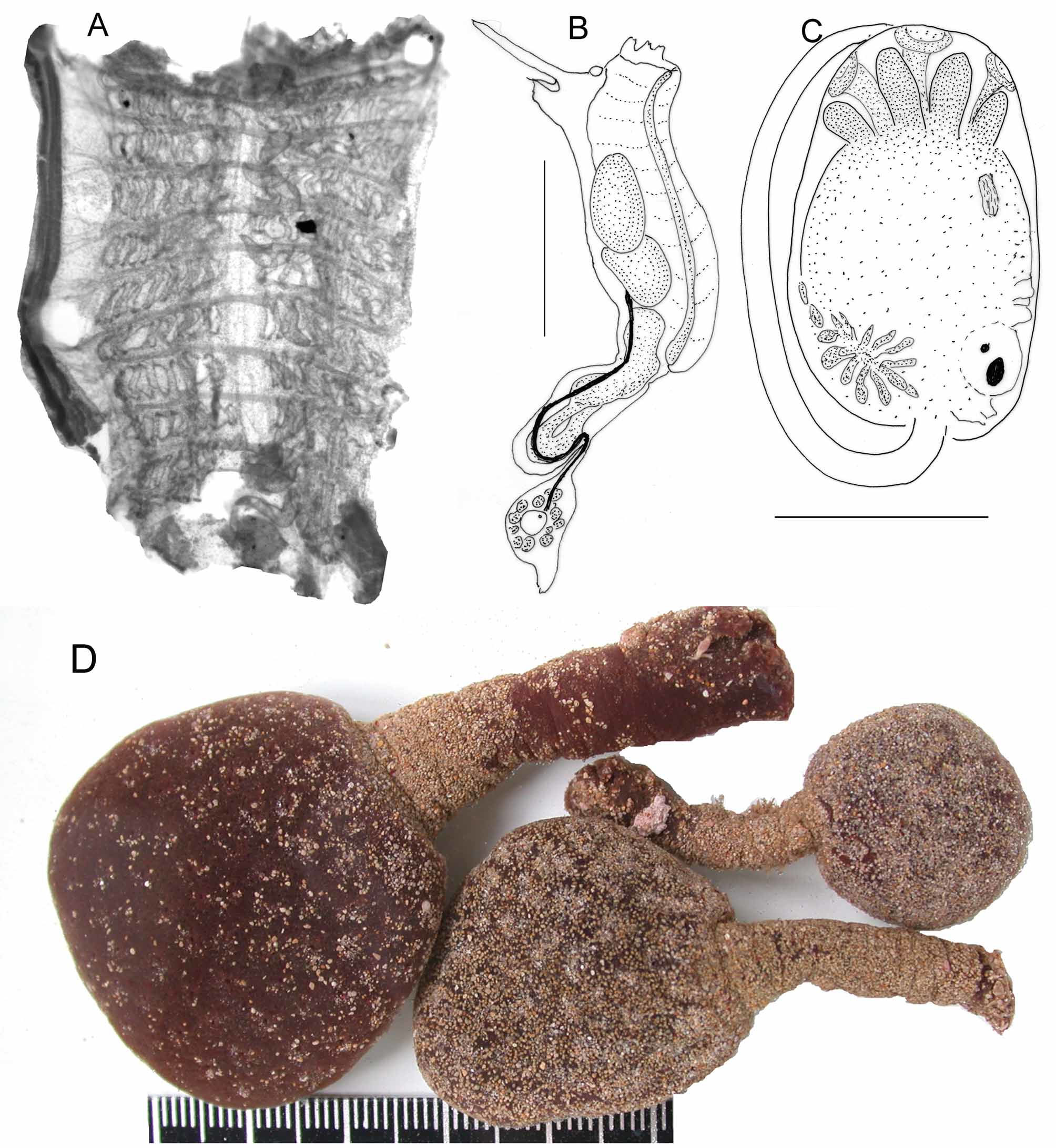
Etymology. latin: tingere = to stain. Stations. TA 12 (MNHN: A 1 POL. B 104, type). TA 26 (MNHN: A 1 POL. B 105). The colonies deeply stain the fixative in red-brown. They are pedunculate (Fig. 15 D). The upper part 3 to 6.5 cm in diameter is holding on a narrower stem 0.5 to 3.5 cm long. The head contains more or less sand at the surface layer but the peduncle is densely incrusted. There is always a groove making an obvious limit between the head and the peduncle even when their diameter is not very different. The tunic in formalin is brown-red and the zooids are of a dark purple. The internal part of the colony is soft with only few sand grains. The zooids are arranged in circular systems. The thoraces are narrow, always contracted. The oral siphon is short with 6 lobes. The atrial siphon, at the level of the first stigmata row, is more or less stretched in a tube prolonged by a long languet (Fig. 15 B). A small button protrudes at the base of the siphon. The musculature is weak in 8 to 10 fibres on each side, only present in the anterior part of the thorax. There are 11 to 14 rows of stigmata and 10 to 12 stigmata in a row. No papillae have been detected on the transverse vessels a character ascertained in zooids of all colonies. The digestive tract has the normal twisted shape of the genus, it is black. The post-abdomen is drop-shaped on a long peduncle. The ovary lies in the centre of a bunch of testis vesicles. The larvae (Fig. 15 C) are incubated in the atrial cavity and do not distend the body wall. The trunk measures 550 µm. The tail coils in ¾ of a turn. The 3 adhesive papillae have 4 round vesicles on each side and a bunch of ampullae are placed laterally and ventrally near the origin of the tail. One or several oxalate crystals are obvious in the visceral mass. This species differs from other Polyclinum species of the Indian Ocean except P. pedunculatum n. sp. by the shape of the colonies with a peduncle clearly delimited from the head of the lobes. The intense pigment diffusing into the fixative is distinctive. The absence of papillae on the transverse vessels would justify placing the species in the genus Aplidiopsis but the twisted gut loop and sperm duct as the thin peduncle of the abdomen allied to the thorax shape are Polyclinum characters
Monniot, Françoise (2012): Some ascidians from the southern coast of Madagascar collected during the “ AtimoVatae ” survey. Zootaxa 3197: 1-42, DOI: 10.5281/zenodo.246182
Export occurrence data
Darwin Core Archive (ZIP)
CLASSIFICATION
Taxonomic Classification Tree

IMAGES