
AnimaliaNot EvaluatedacceptedspeciesAccepted
Pseudochitinopoma amirantensis
GBIF:119528236
ABOUT
Descriptions(5)
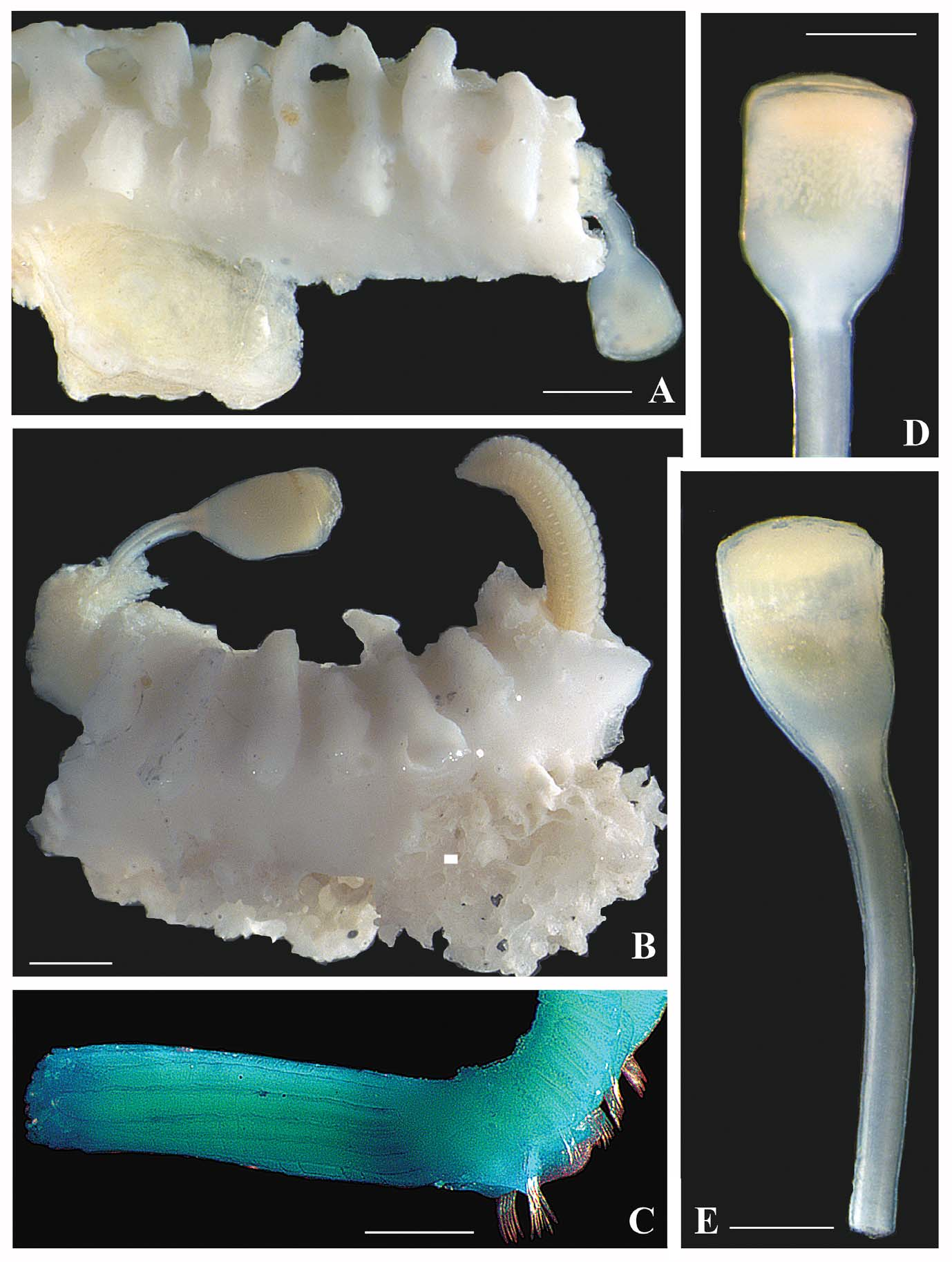
Description. TUBE: white, about 10 mm (up to 0.5 mm wide with lumen of about 0.3 mm). Semicircular to circular in cross-section, attached to substrate throughout its entire length, and bearing more or less regularly spaced sharp straight transverse ridges (Figs 1 A – B, 2 A – B). Hyaline / opaque granular layers absent. BRANCHIAE: each lobe with 5 – 6 radioles, arranged in semicircles to pectinately, not connected by interradiolar membrane. Pinnules with long terminal filaments. Cross-section of radioles subtriangular. Branchial eyes not observed in preserved material. PEDUNCLE: smooth, subtriangular to circular in cross-section, only slightly thicker than radioles, inserted at base of left branchial lobe, in front of first radiole, or almost midway between branchial lobes. Constriction below operculum very faint or absent. OPERCULUM: elongated ampulla terminating in flat or slightly convex, sometimes slightly pointed chitinous cap (Figs 1 D – E, 2 C). Length of the operculum about 1 mm, width 0.3 mm. COLLAR AND THORACIC MEMBRANES: collar shallow, with entire edge, covering bases of branchial lobes; continuous with short rounded thoracic membranes, ending at chaetiger 3 (Figs 1 C, 2 D). THORAX: with collar chaetiger and five uncinigerous chaetigers. Collar chaetae of two types: limbate and finand-blade chaetae, with almost single row of teeth in the basal rounded fin, not separated from the blade (Fig. 2 E). Subsequent chaetae limbate, of two sizes (Fig. 2 F). Apomatus - chaetae absent. Uncini along entire thorax sawshaped, with 9 – 10 curved teeth, with flat, blunt, slightly gouged anterior peg (dental formula P: 1: 1: 1: 1: 1: 1: 1: 1: 1: 1, Fig. 2 H). Scale: A – C – 300 µm, D – E — 200 µm. Scale: A – C — 300 µm, D – 100 µm, E — 10 µm, F — 20 µm, G – J — 5 µm. ABDOMEN: abdominal chaetigers up to 70. Uncini rasp-shaped with 2 – 4 rows of teeth, with flat, blunt, slightly gouged anterior peg and 8 – 9, respectively 9 – 10 teeth in side view (dental formula P: 2: 2: 3: 2: 3: 3: 2: 2, P: 2: 3: 3: 3: 3: 4: 3: 4: 3; respectively P: 3: 4: 4: 3: 3: 3: 3: 3: 3: 3, P: 3: 4: 4: 4: 4: 4: 3: 4: 3, Fig. 2 I – J). Chaetae true trumpetshaped, hollow bordered with two rows of teeth (Fig. 2 G). Capillary chaetae absent in posterior chaetigers. Pygidium bilobed. SIZE: total body length up to 8 mm, generally about 6 mm. Width of thorax 0.3 mm. Branchiae and operculum accounting for 1 / 3 of entire length. COLOUR: Operculum whiteish with yellow glow (cover), peduncle whitish; radioles with white base, hyaline zone and orange tip; abdomen creamish with white dorsal (segmental) areas, presumably sperm storage.
Kupriyanova, Elena K., Ten, Harry A., Nishi, Ejiroh (2012): A taxonomic revision of Pseudochitinopoma Zibrowius, 1969 (Annelida, Serpulidae) with description of two new species. Zootaxa 3507: 57-78, DOI: 10.5281/zenodo.210475
Remarks. Pseudochitinopoma amirantensis sp. nov. has a very distinct tube structure, laterally with sharp straight transverse ridges, the ends of which sometimes fuse mid-dorsally. Transverse ridges, although very different in shape, are also known only for P. beneliahuae sp. nov. (see below). Both P. amirantensis sp. nov. and P. beneliahuae also have only six thoracic chaetigerous segments, unlike the rest of species in the genus that have seven. However, length of collar and thoracic membranes, and especially opercular morphologies, are very different in these two species (see Table 1).
Kupriyanova, Elena K., Ten, Harry A., Nishi, Ejiroh (2012): A taxonomic revision of Pseudochitinopoma Zibrowius, 1969 (Annelida, Serpulidae) with description of two new species. Zootaxa 3507: 57-78, DOI: 10.5281/zenodo.210475
Distribution. Indian Ocean: Seychelles, 160 – 200 m. Reproduction. Unknown.
Kupriyanova, Elena K., Ten, Harry A., Nishi, Ejiroh (2012): A taxonomic revision of Pseudochitinopoma Zibrowius, 1969 (Annelida, Serpulidae) with description of two new species. Zootaxa 3507: 57-78, DOI: 10.5281/zenodo.210475
Etymology. The species is named after the Amirante Islands, where it has been collected.
Kupriyanova, Elena K., Ten, Harry A., Nishi, Ejiroh (2012): A taxonomic revision of Pseudochitinopoma Zibrowius, 1969 (Annelida, Serpulidae) with description of two new species. Zootaxa 3507: 57-78, DOI: 10.5281/zenodo.210475
Material studied. Seychelles, South of Alphonse Atoll, Canal de Mort, 7 º 03 ’ S, 52 º 53 ’ E, 160 – 200 m, coral rubble, shells, Netherlands Indian Ocean Program Stn 785, 3 – 5 January 1993, legit, det. ten Hove Pseudochitinopoma n. sp. (ZMA V. Pol. 4307, Holotype and 13 paratypes; 5 paratypes AM W. 41420, one paratype AM W. 41421 prepared for SEM).
Kupriyanova, Elena K., Ten, Harry A., Nishi, Ejiroh (2012): A taxonomic revision of Pseudochitinopoma Zibrowius, 1969 (Annelida, Serpulidae) with description of two new species. Zootaxa 3507: 57-78, DOI: 10.5281/zenodo.210475
Export occurrence data
Darwin Core Archive (ZIP)
CLASSIFICATION
Taxonomic Classification Tree

MULTIMEDIA
Media Files(2)
FIGURE 1. Pseudochitinopoma amirantensis sp. nov. ZMA V. Pol. 4307, A—paratype in tube, B—holotype in tube, C—lateral view of thorax stained with methyl blue, D, E—opercula.
Imageimage/png© Kupriyanova, Elena K.;Ten, Harry A.;Nishi, EjirohKupriyanova, Elena K.;Ten, Harry A.;Nishi, Ejiroh
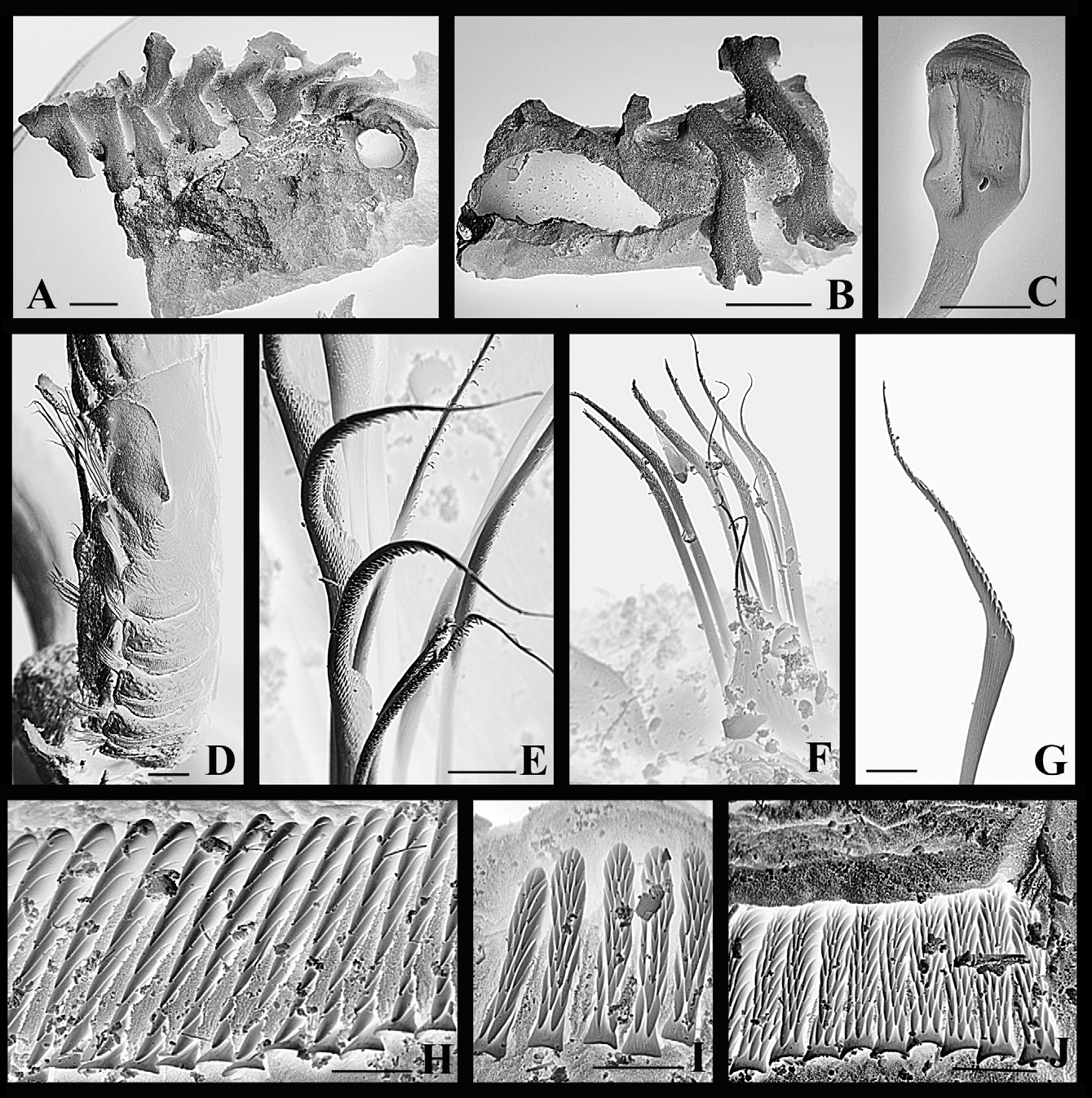
FIGURE 2. Pseudochitinopoma amirantensis sp. nov. AM W 41421 paratype, SEM, A, B—tube fragments with sharp straight longitudinal ridges, C—operculum, D—lateral view of the thorax, E—collar chaetae, F—thoracic chaetae, G—abdominal chaeta, H—anterior thoracic uncini, I—anterior abdominal uncini, J—posterior abdominal uncini.
Imageimage/png© Kupriyanova, Elena K.;Ten, Harry A.;Nishi, EjirohKupriyanova, Elena K.;Ten, Harry A.;Nishi, Ejiroh
IMAGES