
AnimaliaNot EvaluatedacceptedspeciesAccepted
Pseudochitinopoma capensis
(Day, 1961) Day, 1961
GBIF:119528238
0year
0
Synonyms
ABOUT
Descriptions(4)
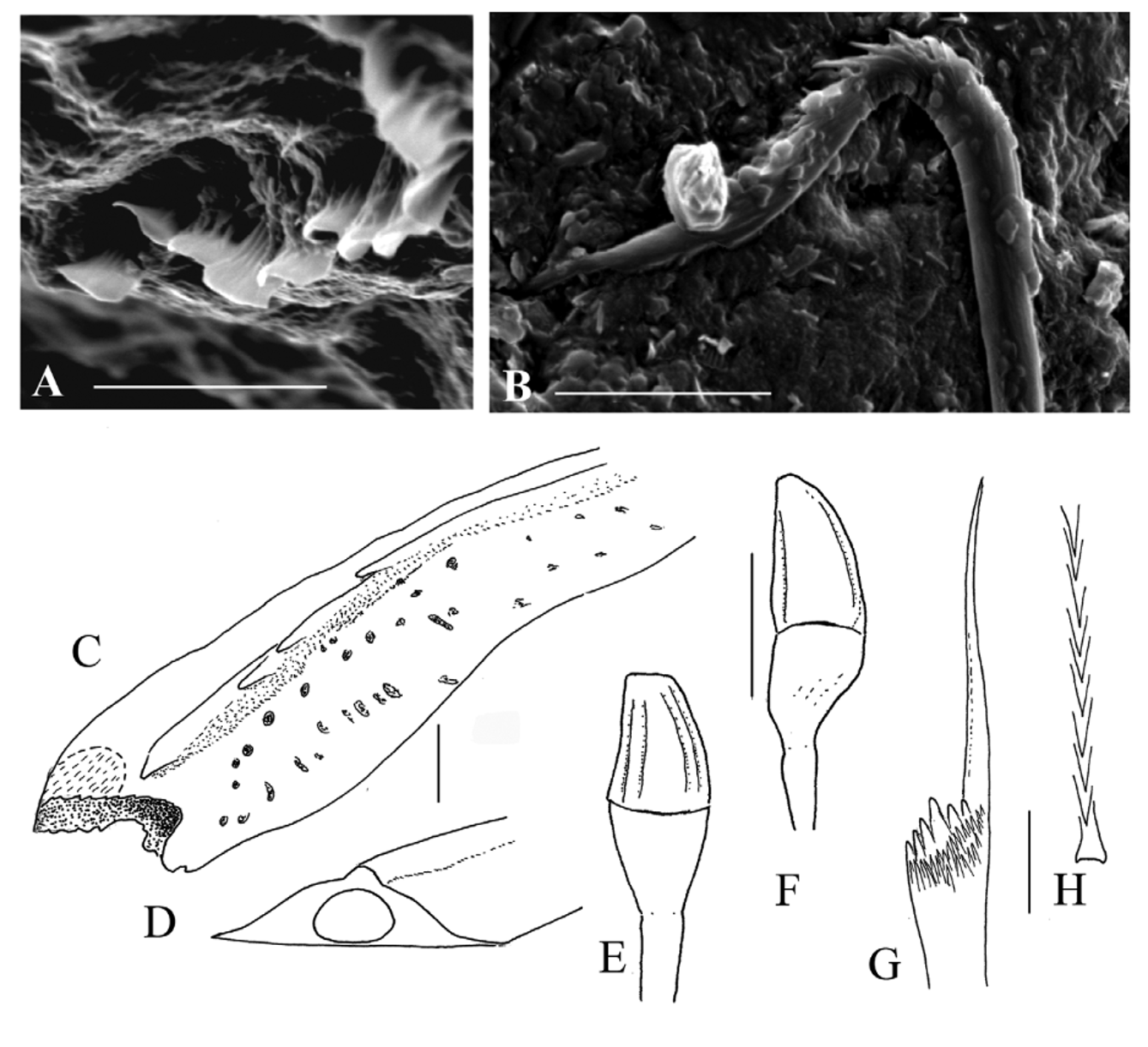
Description. TUBE: white, about 2.2 mm wide, with lumen of about 0.8 mm (Fig. 6 C – D). Triangular in crosssection, without wide flaring collar-like rings, attached throughout its length. Smooth medial keel present, lateral surfaces either rugose or corroded. Outer hyaline granular layer present. BRANCHIAE: each lobe with six radioles, arranged in semicircles to pectinately, not connected by interradiolar membrane. Pinnules increasing in length distally, about 18 pairs; terminal filament projecting beyond pinnules for 0.1 mm only. Section of radiole subtriangular. Mouth structures, prostomial and branchial eyes not observed. PEDUNCLE: smooth, almost circular in cross-section, inserted near medial line. Gradual transition between peduncle and operculum, with only a hint of a constriction. OPERCULUM: globular ampulla with a distal elongated convex endplate (Fig. 6 E – F). This distal cup chitinous, with faint longitudinal grooves, without internal partitions. Length of the operculum (ampulla + cap) about 1.5 mm, chitinous cap 1 mm, width 0.7 mm. COLLAR AND THORACIC MEMBRANES: collar low, with laciniate edge, probably artifact of preservation in tube; continuous with thoracic membranes, ending at chaetiger 3. THORAX: with collar chaetiger, and six uncinigerous chaetigers. Collar chaetae of two types: fin-and-blade (basal fin with 3 – 5 stout teeth at base of serrated blade, Fig. 6 G) and limbate. Subsequent chaetae limbate, of two sizes. Capillaries exceptionally small, 1 / 5 th – 1 / 10 th the size of the limbate ones. Apomatus - chaetae absent. Uncini along entire thorax saw-shaped, with 10 curved teeth above gouged, apparently bifurcated (likely gouged) peg (dental formula P: 1: 1: 1: 1: 1: 1: 1: 1: 1: 1, Fig. 6 H). Thoracic tori of similar size along thorax, triangular depression absent. ABDOMEN: abdominal chaetigers 70. Uncini not very well known, examination by SEM (Fig. 6 A) was only partially successful. Mid-abdominal uncini rasp-shaped, dental formulae P: 3: 2: 1: 2: 2:?:? :::, P: 3: 1: 2: 2: 2:?:? ::::, P: 3: 2: 2: 1:?:? :::: to saw-shaped apically (all apices obscured by epidermal fold and represented by:?:? :::: in the formulae), with flat peg, gouged underneath, and about 10 teeth. Chaetae trumpet-shaped, hollow, bordered with two rows of teeth, narrow and smoothly bent (Fig. 6 B). Capillary chaetae absent posteriorly. Pygidium bilobed. SIZE: length up to 14 mm. Width of thorax 0.6 mm. Branchiae and operculum 4 mm long. COLOUR: no records.
Kupriyanova, Elena K., Ten, Harry A., Nishi, Ejiroh (2012): A taxonomic revision of Pseudochitinopoma Zibrowius, 1969 (Annelida, Serpulidae) with description of two new species. Zootaxa 3507: 57-78, DOI: 10.5281/zenodo.210475
Remarks. According to ten Hove & Weerdenburg (1978: 101), this taxon does not belong in Ficopomatus, but rather in Chitinopoma, Chitinopomoides, or Pseudochitinopoma. Ten Hove & Kupriyanova (2009: 32) tentatively placed it in Chitinopoma. The actual material could not be located at the time, it only was re-found very recently (February 2011) in the collections of the Iziko South African Museum, Cape Town. Being common practice, Day removed a number of chaetigers from one side of the animal to enable his description: collar chaetae, about thoracic segments 3 – 5, and some abdominal chaetigers. Unfortunately, most of the other thoracic chaetae were broken too, but a total mount in glycerin of the animal did not reveal Apomatus chaetae in the posterior thoracic chaetigers. We may safely assume that they are absent. The above re-description, especially characteristic collar chaetae, hollow narrowly geniculate (true trumpet-shaped) abdominal chaetae and saw-shaped thoracic uncini with broad gouged peg, places this taxon clearly in the genus Pseudochitinopoma. The description agrees with those given by Day (1961: 552 – 553; 1967: 810 – 812) except for minor meristic differences: six pairs of radioles (Day mentioned seven), 70 abdominal chaetigers (Day: 64), 10 uncinal teeth (Day: 8).
Kupriyanova, Elena K., Ten, Harry A., Nishi, Ejiroh (2012): A taxonomic revision of Pseudochitinopoma Zibrowius, 1969 (Annelida, Serpulidae) with description of two new species. Zootaxa 3507: 57-78, DOI: 10.5281/zenodo.210475
Distribution. South Africa. Reproduction. Unknown.
Kupriyanova, Elena K., Ten, Harry A., Nishi, Ejiroh (2012): A taxonomic revision of Pseudochitinopoma Zibrowius, 1969 (Annelida, Serpulidae) with description of two new species. Zootaxa 3507: 57-78, DOI: 10.5281/zenodo.210475
Material studied. South Africa, Agulhas Bank, 34 ° 24 ' S, 21 ° 46 ' E, 18 m, dredge, UCT Ecological Survey, South Coast Dredging SCD 18, 14 February 1960, det. J. H. Day [manuscript name Ovopomatus capensis, see Marska (2004)] (IMCT 20901, Holotype). Scale: A, B — 10 µm, C, D — 1 mm, E, F — 0.5 mm, G, H — 10 µm.
Kupriyanova, Elena K., Ten, Harry A., Nishi, Ejiroh (2012): A taxonomic revision of Pseudochitinopoma Zibrowius, 1969 (Annelida, Serpulidae) with description of two new species. Zootaxa 3507: 57-78, DOI: 10.5281/zenodo.210475
Export occurrence data
Darwin Core Archive (ZIP)
CLASSIFICATION
Taxonomic Classification Tree

NOMENCLATURE
Synonyms(1)
MULTIMEDIA
Media Files(1)
FIGURE 6. Pseudochitinopoma capensis, holotype, IMCT 20901, A—SEM of abdominal uncini, anterior peg, B—SEM of abdominal chaeta, C—tube, from above, showing longitudinal keel and rugose or corroded flanges; orifice damaged, D—tube, reconstruction of cross-section, E—operculum, dorsal view; flattened dorsal area flanked by longitudinal grooves, F—operculum, right lateral view, G—fin-and-blade collar chaeta; 6 larger teeth and many long teeth, almost rasp-like, H—scheme of thoracic uncinus, frontal view.
Imageimage/png© Kupriyanova, Elena K.;Ten, Harry A.;Nishi, EjirohKupriyanova, Elena K.;Ten, Harry A.;Nishi, Ejiroh
IMAGES