
AnimaliaNot EvaluatedacceptedspeciesAccepted
Pseudochitinopoma pavimentata
Nishi, 1999
GBIF:119528244
0year
ABOUT
Descriptions(4)
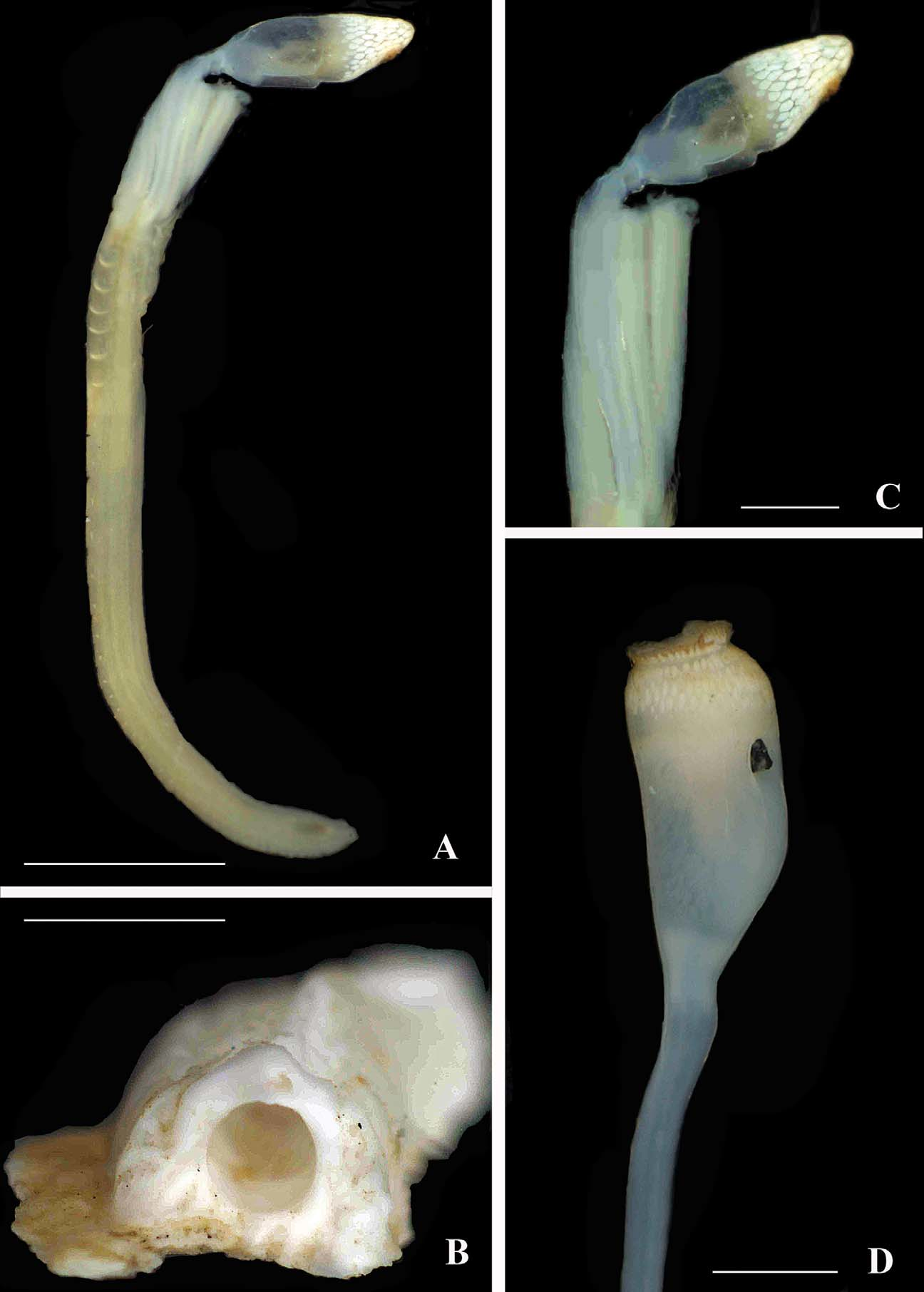
Description. TUBE: up to 16 mm long, 1.6 mm wide, with lumen of about 0.4 mm (max. 0.6 mm). Tube attached to substratum over its entire length, lacking wide flaring peristomes. Anterior part of subtriangular in cross-section, with more or less conspicuous non-denticulate keel (Fig. 9 B) forming sharp tooth above aperture; made of two layers: inner layer white and tough, outer layer thin, semi-transparent, and fragile, usually with shallow pits on upper lateral tube parts (see Nishi 1999, fig. 9 B). Middle to posterior part of tube without ornamentation and keel made of a single white solid layer. In specimen from Taiwan Strait, tube surface shiny with glassy hyaline layer. BRANCHIAE: each lobe short, with up to 10 radioles arranged in semicircles to pectinately, not connected by interradiolar membrane. Pinnules ending with filamentous tips. Branchial eyes not observed. PEDUNCLE: smooth, circular in cross-section, inserted just below left branchial lobe, covered by thick transparent cuticle. Faint constriction just below operculum. OPERCULUM: elongated ampulla with more or less conical distal cap covered with a thicker, brown colored cuticle and having sub-dermal (not showing under SEM) layer of whitish granules or flakes arranged like stones in cobblestone pavement (Fig. 9 A, C – D). Opercular ampulla with a central cavity visible through the wall. Length of the operculum up to 1 mm, width up to 0.5 mm. COLLAR AND THORACIC MEMBRANES: collar low, divided into large median lobe and pair of laterodorsal ones of equal length, continuing to chaetiger 3. THORAX: with collar chaetiger and six uncinigerous chaetigers (Fig. 9 A). Collar chaetae of two types: special fin-and-blade chaetae with proximal denticulate fin not separated from distal limbate blade (Fig. 10 E – F) and fine limbate, almost capillary. Subsequent chaetae limbate, of two sizes. Apomatus - chaetae absent. Uncini along entire thorax saw-shaped, with 10 – 11 curved teeth with gouged flat peg (dental formula P: 1: 1: 1: 1: 1: 1: 1: 1: 1, Fig. 10 A, G, H). Number of uncini in a torus increasing posteriorly. ABDOMEN: up to 40 abdominal chaetigers. Chaetae true trumpet-shaped with about 10 pairs of teeth arranged in two rows (Fig. 10 B – C, I – J). Capillary chaetae present in posterior chaetigers. Pygidium bilobed. Anterior uncini saw-shaped or saw-to-rasp shaped (dental formulae P: 1: 1: 1: 1: 1: 1: 1: 1: 1, P: 2: 1: 1: 1: 1: 1: 1: 1: 1, Fig. 10 D), posterior rasp-shaped, with 3 – 4 rows of teeth and 9 – 10 teeth in profile view. SIZE: length up to 12 mm (holotype), generally 6 – 12 mm. Branchiae and operculum about 2 mm long. COLOUR: preserved specimen semi-transparent white, alive red.
Kupriyanova, Elena K., Ten, Harry A., Nishi, Ejiroh (2012): A taxonomic revision of Pseudochitinopoma Zibrowius, 1969 (Annelida, Serpulidae) with description of two new species. Zootaxa 3507: 57-78, DOI: 10.5281/zenodo.210475
Remarks. Nishi (1999) distinguished P. pavimentata from P. occidentalis, the only Pseudochitinopoma species known at that time, by the characteristic cobblestone pavement-like ornamentation of the operculum. FIGURE 10. Pseudochitinopoma pavimentata, SAM E 3660, SEM, A — uncini of 2 nd thoracic segment, B — abdominal chaeta, C — close-up view of the hollow part of the abdominal chaeta, D — anterior abdominal uncini; paratype CBM - ZW- 51: E, F — collar chaetae, G, H — anterior abdominal uncini, I — abdominal chaeta, J — close-up view of the hollow part of the abdominal chaeta. Scale: A, B — 10 µm, C — 1 µm, D, F — 10 µm, G — 5 µm, H — 10 µm, I — 10 µm, J — 2 µm.
Kupriyanova, Elena K., Ten, Harry A., Nishi, Ejiroh (2012): A taxonomic revision of Pseudochitinopoma Zibrowius, 1969 (Annelida, Serpulidae) with description of two new species. Zootaxa 3507: 57-78, DOI: 10.5281/zenodo.210475
Distribution. North-Western Pacific Ocean: Central Japan; Formosa Strait, South China Sea; Indonesia. Reproduction. Unknown.
Kupriyanova, Elena K., Ten, Harry A., Nishi, Ejiroh (2012): A taxonomic revision of Pseudochitinopoma Zibrowius, 1969 (Annelida, Serpulidae) with description of two new species. Zootaxa 3507: 57-78, DOI: 10.5281/zenodo.210475
Material studied. Japan, Tokyo Bay, off Tateyama, Okinoyama, 34 ° 59 ' N, 139 ° 39 ' E, 105 – 113 m, dredged, R / V “ Tansei-Maru ” of University of Tokyo, legit T. Komai (CBM - ZW- 50, holotype, complete specimen; CBM - ZM- 51, paratype, incomplete specimen without a tube on SEM stub; CBM - ZM- 51, paratype, complete specimen without tube); Tokyo Bay, off Kanaya, Uchibo, approximately 35 ° 10 ' N, 139 ° 46 ' E, 200 m, gill netting by-catch, legit E. Kupriyanova and E. Nishi 19 March 2007 (SAM E 3660, 3 specs, including 1 on SEM stub); Sagaminada, Okinoyama, 34 ˚ 54 ’ N, 139 ˚ 39 ’ E, 105 – 113 m, legit T. Komai 21 April 1995, don., det. E. Nishi 1995, redet. H. A. ten Hove 1997 (ZMA V. Pol. 4018, 2 specs). South China Sea, Taiwan (Formosa) Strait, 23 ˚ 15 ’ N, 117 ˚ 40 ’ E, legit H. Christiansen 26 July 1912, det. H. A. ten Hove 1988 Pseudochitinopoma spec.? (ZMUC - POL- 2155, 1 spec.). Indonesia, Aru Island, Wokam, River Waskai, near to Sungi Manumbai, approximately 6 ° N, 134 ° E, legit H. Merton 16 March 1908, det. H. A. ten Hove 1997 Pseudochitinopoma spec. (SMF 5751, 1 spec.).
Kupriyanova, Elena K., Ten, Harry A., Nishi, Ejiroh (2012): A taxonomic revision of Pseudochitinopoma Zibrowius, 1969 (Annelida, Serpulidae) with description of two new species. Zootaxa 3507: 57-78, DOI: 10.5281/zenodo.210475
Export occurrence data
Darwin Core Archive (ZIP)
CLASSIFICATION
Taxonomic Classification Tree

MULTIMEDIA
Media Files(1)
FIGURE 9. Pseudochitinopoma pavimentata, CBM - ZW- 50, A—lateral view of the holotype, B—anterior part of the holotype tube, C—radiolar crown and operculum of the holotype, CBM - ZW- 52, D—operculum of the paratype. Scale: A, B— 1 mm, C, D— 0.5 mm.
Imageimage/png© Kupriyanova, Elena K.;Ten, Harry A.;Nishi, EjirohKupriyanova, Elena K.;Ten, Harry A.;Nishi, Ejiroh
IMAGES