
AnimaliaNot EvaluatedacceptedspeciesAccepted
Dysponetus populonectens
GBIF:119528268
ABOUT
Descriptions(1)
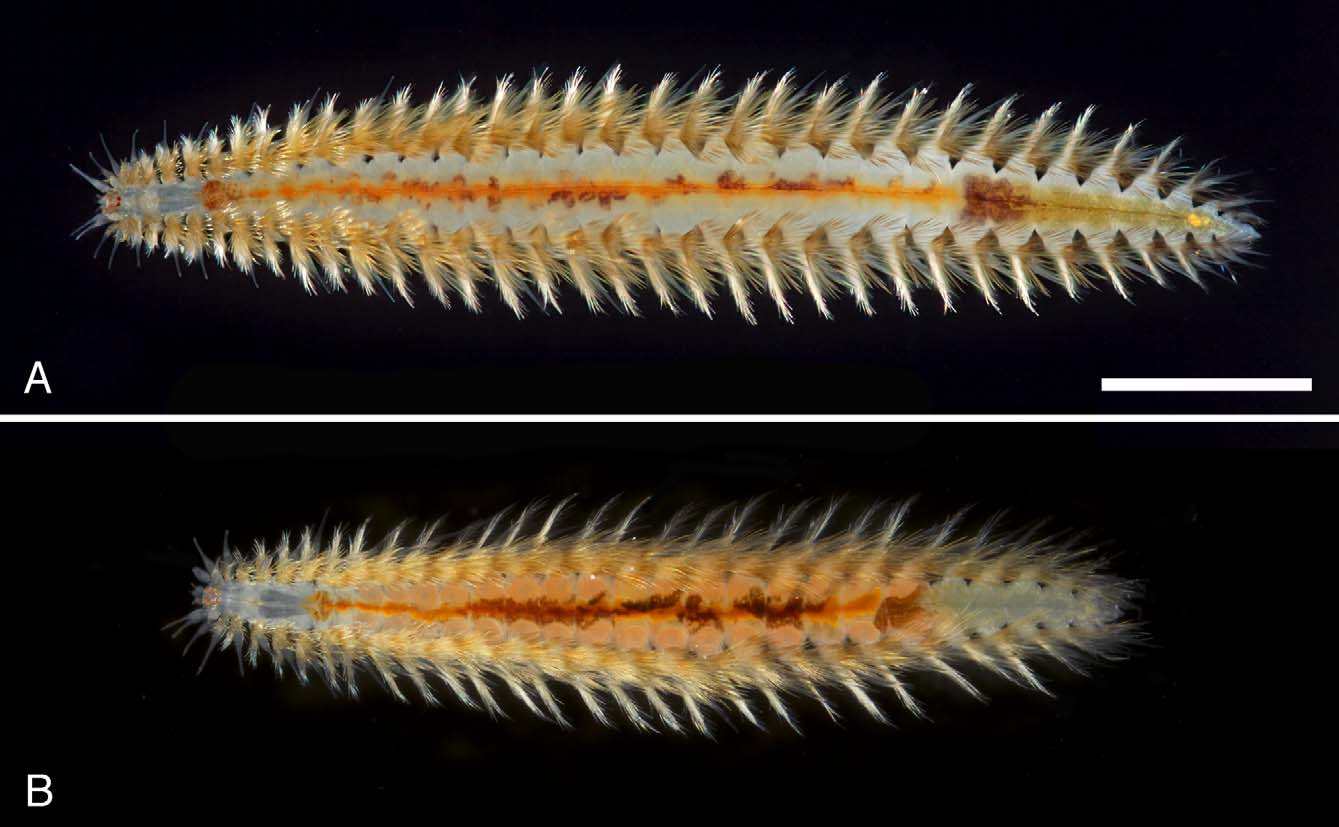
Type material: Holotype (in two pieces) SIO-BIC A 2583, paratypes SIO-BIC A 2584, SIO-BIC A 2585, SIO-BIC A 2586, SIO-BIC A 2587, SIO-BIC A 2588, SIO-BIC A 2589, SIO-BIC A 2590, SIO-BIC A 2591, SIO-BIC A 2592, SIO-BIC A 2593, SIO-BIC A 2594. Material examined: California. Holotype (SIO-BIC A 2583), male, initially entire but broken during preservation, preserved in formaldehyde, La Jolla, off La Jolla Cove, 32 ° 50.713 ’ N, 117 ° 17.058 ’ W, 12 m depth, Macrocystis pyrifera holdfasts, SCUBA, colls FP and GWR 29 Aug 2007; 2 entire spms preserved in RNALater, same collection data, (in GWR collection); 2 entire spms preserved in osmium tetroxide for SEM, same collection data, destroyed; 1 entire spm preserved in ethanol, same collection data, destroyed for DNA sequencing, 1 paratype (SIO-BIC A 2584), posteriorly incomplete female preserved in formaldehyde, same collection data; 2 paratypes (SIO-BIC A 2585), entire spms preserved in formaldehyde (larger spm male), same collection data; 1 paratype (SIO-BIC A 2586), entire female preserved in ethanol, La Jolla, Bird’s Rock, 32 ° 48.367 ’ N, 117 ° 17.181 ’ W, 18 m depth, Macrocystis pyrifera holdfast, coll. Eddie Kisfaludy 2 Feb 2010; 1 paratype (SIO-BIC A 2587, SIO-BIC A 2588), entire female, anterior end preserved in formaldehyde, posterior end preserved in ethanol, same collection data; 1 paratype (SIO-BIC A 2589, SIO-BIC A 2590), posteriorly incomplete male, anterior end preserved in formaldehyde, posterior part preserved in ethanol, same collection data; 2 paratypes (SIO-BIC A 2591), 1 entire male and 1 entire female preserved in ethanol, 32 ° 50.26 ’ N, 117 ° 17.11 ’ W, 15 m depth, Macrocystis pyrifera holdfasts, SCUBA, colls GWR & Phil Zerofski 15 Oct 2010; 2 paratypes (SIO-BIC A 2592), 1 entire male and 1 entire female preserved in ethanol, same collection data; 3 paratypes (SIO-BIC A 2593), 2 entire males and 1 entire female preserved in ethanol, same collection data; 1 paratype (SIO-BIC A 2594), entire female preserved in ethanol, same collection data. Description: Up to 5.5 mm long for 36 segments. Live specimens transparent yellowish orange, males opaque white (Fig. 1 A), females with orange eggs (Fig. 1 B). Mid-dorsal blood vessel broad and distinct, red. Eyes bright red. Preserved specimens whitish. Body in dorsal view symmetrically tapering towards both ends (Fig. 1 A, B), venter flattened. Prostomium rounded quadrangular in dorsal view. Palps elongated cylindrical with tapering ends, palpophores absent (Fig. 2 A, B). Paired antennae as long as palps, with rounded basal parts and long, fine tapering ends (Fig. 2 A). Median antenna similar to paired antennae but with shorter tip, inserted frontally on prostomium (Fig. 2 A, B). Eyes large, rounded, anterior and posterior pairs of equal size. Nuchal organs not observed. Everted proboscis not observed, internally with single pair of lateral stylet-shaped jaws. Ventral mouth flap cone-shaped (Fig. 2 A, B). Segment 1 with dorsal and ventral cirri only, segment 2 with dorsal cirri, notopodial lobes with notochaetae and ventral cirri but no neuropdial lobes or neurochaetae; segment 3 with dorsal cirri, notopodial lobes with notochaetae, neuropodial lobes with neurochaetae, but no ventral cirri. Segment 4 similar to remaining segments. All anterior dorsal and ventral cirri of similar shape to following ones. Dorsal cirri of median segments inserted postero-ventrally to notochaetal bundle, with small cirrophores, with inflated basal part and long tapering tips (Fig. 2 D). Notopodial lobes with small, conical postchaetal extension. Notochaetae about 25 (Fig. 2 C), all curved with two rows of teeth, internally chambered, with distinct diaphragms but without visible longitudinal canals in LM. Neuropodial lobes conical. Neurochaetae all compounds except for single accessory simple chaeta (similar to notochaetae but smaller, positioned antero-dorsally in chaetal bundle), compounds about 25 (Fig. 2 D), shafts with distinct internal longitudinal canals and diaphragms, blades with well developed teeth and very fine, bidentate tips. Blades of median and dorsal compound chaetae about 2.5 times longer than those of ventral ones. Noto- and neuroaciculae single, internally with longitudinal canals but no distinct diaphragms. Ventral cirri with small cirrophores, inserted subdistally on underside of neuropodium, similar in shape to dorsal cirri but smaller (Fig. 2 E). Pygidium forming pointed cone, without cirri (Fig. 2 F). Egg size in mature females ca. 100 µm. Etymology: “ populonectens ” is Latin for “ connecting people ”, the motto of Nokia USA, San Diego in acknowledgement of their support for the Scripps Institution of Oceanography Collection Endowment. Habitat: Only known from holdfasts of Macrocystis pyrifera at 12 – 18 m depth. Remarks: Mature specimens collected both in February, August and October, indicating that breeding may be continuous throughout the year. In the present material the mature males tend to be of larger size than the females. There are nine species previously referred to Dysponetus (Dahlgren 1996). Among these, D. caecus (Langerhans, 1879) from Madeira, D. gracile Hartman, 1965 from off New England, D. paleophorus Hartmann- Schröder, 1974 from Skagerrak, and D. pygmaeus Levinsen, 1879 from Greenland, all differ from D. populonectens n. sp. in lacking eyes. Dysponetus hebes (Webster & Benedict, 1887) from Maine has a single pair of eyes, sphaerical palpostyles and double mouth appendages (Dahlgren 1996), D. bidentatus Day, 1954 from Tristan da Cunha lacks ventral cirri on both segment 2 and 3 (Dahlgren 1996), whereas these are present on segment 3 in D. populonectens n. sp., the Mediterranean D. bipapillatus Dahlgren, 1996 is very small and has few segments (maximum observed size 11.1 mm long for 13 segments, mature specimens), minute eyes and, probably, males with external genital organs on segment 8 (Dahlgren 1996), and D. macroculatus Dahlgren, 1996 from Papua New Guinea differs from D. populonectens n. sp. in having both noto- and neurochaetae on segment 2, whereas D. populonectens n. sp. only has notochaetae on this segment.
Pleijel, Fredrik, Aguado, Maria Teresa, Rouse, Greg W. (2012): New and lesser known species of Chrysopetalidae, Phyllodocidae and Syllidae from south California (Phyllodocida, Aciculata, Annelida). Zootaxa 3506: 1-25, DOI: 10.5281/zenodo.211061
Export occurrence data
Darwin Core Archive (ZIP)
CLASSIFICATION
Taxonomic Classification Tree

MULTIMEDIA
Media Files(2)
FIGURE 1. Micrographs of live, relaxed specimens of Dysponetus populonectens, new species. A, male (holotype SIO-BIC A 2583). Scale bar 1 mm. B, female (paratype SIO-BIC A 2586). Same scale.
Imageimage/png© Pleijel, Fredrik;Aguado, Maria Teresa;Rouse, Greg W.Pleijel, Fredrik;Aguado, Maria Teresa;Rouse, Greg W.

FIGURE 2. SEM micrographs of Dysponetus populonectens, new species (specimens in GWR collection). Note that the anterior cirri on the left side are regenerating. A, anterior end, ventral view. B, anterior end, ventrolateral view. C, Median segments, left side. D, Median segments, right side. E, Median parapodia, left side, ventral view. F, Posterior end, ventral view. Scale bars A, B, F 100 µm, C – E 250 µm.
Imageimage/png© Pleijel, Fredrik;Aguado, Maria Teresa;Rouse, Greg W.Pleijel, Fredrik;Aguado, Maria Teresa;Rouse, Greg W.
IMAGES