
AnimaliaNot EvaluatedacceptedspeciesAccepted
Eulalia gracilior
(Chamberlin, 1919) Chamberlin, 1919
GBIF:119528274
0year
0
Synonyms
ABOUT
Descriptions(1)
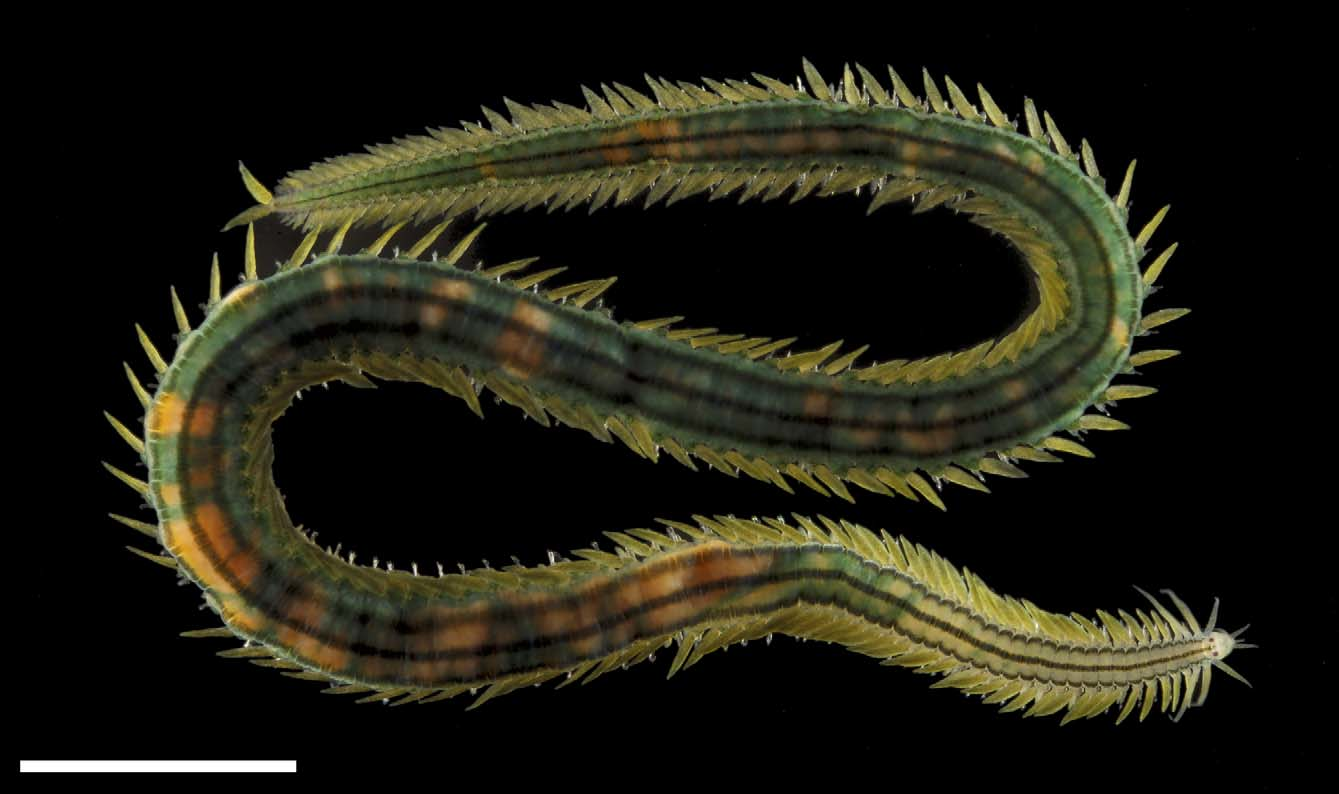
Type material: Holotype (MCZ 2144). Material examined: California. Holotype female with eggs (MCZ 2144), Laguna Beach, coll. W. A. Hillton; 1 spm, in ethanol (SIO-BIC A 2598), pilons of Scripps Pier, 32 ° 52.024 ’ N, 117 ° 15.437 ’ W, 6 m depth, SCUBA, colls FP and GWR 21 Aug 2007; 1 spm, preserved in formaldehyde (SIO-BIC A 2599), pilons of Scripps Pier, 32 ° 52.024 ’ N, 117 ° 15.437 ’ W, 6 m depth, SCUBA, colls FP and GWR 25 Aug 2007; 1 mature male, preserved in ethanol (SIO-BIC A 2600), La Jolla, off La Jolla Cove, 32 ° 50.713 ’ N, 117 ° 17.058 ’ W, holdfasts of Macrocystis pyrifera, 12 m depth, colls FP and GWR 29 Aug 2007; 1 spm, preserved in ethanol (SIO-BIC A 2601), same collection data; 1 spm, preserved in ethanol (SIO-BIC A 2602), same collection data; 1 spm, preserved in formaldehyde (SIO-BIC A 2603), same collection data; 1 female with eggs, preserved in formaldehyde (SIO-BIC A 2605), same collection data; 1 female with eggs, preserved in formaldehyde (SIO-BIC A 2604), same collection data; 2 spms, preserved in ethanol (SIO-BIC A 2606), La Jolla, pilons of Scripps’ Pier, 32 ° 52.020 ’ N, 117 ° 15.425 ’ W, 6 m depth, SCUBA, coll. GWR 17 Oct 2010; 1 spm, La Jolla, off Windansea Beach, 32 ° 50.26 ’ N, 117 ° 17.11 ’ W, holdfasts of Macrocystis pyrifera, 15 m depth, colls GWR & Phil Zerofski 15 Oct 2010, destroyed for DNA sequencing. Description: Entire specimen 25 mm long for 135 segments (maturing female, SIO-BIC A A 2603). Live specimens semi-transparent with three brown to green longitudinal lines along dorsum, one median and one on each side just above parapodia (Fig. 5). Eyes ruby-red. Preserved specimen yellowish white, longitudinal lines weaker but retained. Body elongated cylindrical with truncate anterior and tapering posterior end (Fig. 5), venter flattened. Prostomium rounded triangular, about as wide as long (Fig. 5). Palps and paired antennae tapering to fine tips, inserted on distinct prostomial protuberance. Median antenna similar to paired antennae and palps but slightly smaller, inserted slightly closer to frontal margin than to eyes. Eyes rounded, medium-sized. Nuchal organs not observed. Everted proboscis with scattered micropapillae, terminal ring with about 20 smooth papillae. Segment 1 dorsally fully developed. Cirri of segment 1 reaching segment 5, dorsal cirri of segment 2 reaching 7 – 8, ventral cirri of segment 2 reaching segment 5, flattened with small ventral wing (Fig. 6 A), dorsal cirri of segment 3 reaching 8 – 9. Chaetae from segment 3. Dorsal cirri of median segments flattened, lanceolate, asymmetrical around longitudinal axis, with pointed ends (Fig. 6 B). Supraacicular lobes slightly larger than subacicular lobes (Fig. 6 C). Chaetae ca. 15. Rostrum of chaetal shafts with two larger teeth bending towards each other, followed by series of teeth of decreasing size (Fig. 6 D). Blades short, pointed, with serrated dorsal side. Ventral cirri flattened, with rounded ends, reaching further than parapodial lobes. Pygidial cirri similar in shape to median dorsal cirri but not flattened (Fig. 5). Median pygidial papilla absent. Eggs emerald green, about 70 µm in diameter. Habitat: In his original description, Chamberlin made no mention of habitat or depth, but the newly collected specimens are from 6 – 15 m depth from the pilons of Scripps pier and holdfasts of Macrocystis pyrifera. Remarks: In his original description, Chamberlin (1919) referred this species to Steggoa. Steggoa was synonymized with Eulalia by Pleijel (1987), but Chamberlin’s species was considered to be of uncertain generic affinity in Pleijel (1991). The examination of the holotype and the collection of new specimens now permit assigning this species to Eulalia. Chamberlin (1919) appears to have based his description on a single specimen and this now lacks both anterior and posterior ends. Although the specimen is not in very good condition, the three dorsal longitudinal lines are still clearly distinct and, together with the shape of the dorsal cirri, leaves no doubt that the newly collected specimens from La Jolla are conspecific. Hartman’s (1961, 1968) records of this species differ in several ways from Chamberlin’s holotype and the description above. In 1961 she noted that live specimens were green but without mention of any longitudinal stripes; in both studies she described it as lacking eyes, and in 1968 she described the median antenna as posteriorly inserted. At present, no shallow-water species of Eulalia is known to lack eyes; she possibly based her report on a specimen with the prostomium partly withdrawn in the first segments, which would also explain the unusual position of the median antenna. This species was also reported by Méndez (2006) from the Gulf of California at 1,244 m depth; however, since all other known specimens are from shallow waters this record needs confirmation. The sequence generated for COI for Eulalia gracilior (GenBank accession number JQ 623500) shows a closest BLAST match (maximum identity of 85 %) to the phyllodocid Sige sp. THS- 2005 (AY 894320) and Eumida sp. THS- 2005 (AY 894311), both from Point Sur, California (Struck et al. 2005), and interestingly these two sequences are virtually identical. Other available COI sequences on GenBank for Eulalia species are for Eulalia mustela Pleijel 1987 (GAY 996123) and several for Eulalia viridis (Linnaeus, 1767) (e. g., AY 996122 GU 672585). These show an uncorrected pairwise distance from Eulalia gracilior of ~ 17 %. Based on morphology, E. gracilior within Eulalia belongs to the E. viridis group (Kato et al. 2001), having a comparatively fusiform body shape, lanceolate and slightly asymmetrical dorsal cirri and similar pygidial cirri. Among Californian species of Eulalia it has a unique pigmentation pattern with the three longitudinal bands.
Pleijel, Fredrik, Aguado, Maria Teresa, Rouse, Greg W. (2012): New and lesser known species of Chrysopetalidae, Phyllodocidae and Syllidae from south California (Phyllodocida, Aciculata, Annelida). Zootaxa 3506: 1-25, DOI: 10.5281/zenodo.211061
Export occurrence data
Darwin Core Archive (ZIP)
CLASSIFICATION
Taxonomic Classification Tree

NOMENCLATURE
Synonyms(1)
MULTIMEDIA
Media Files(2)
FIGURE 5. Micrograph of live, relaxed specimen of Eulalia gracilior, new combination (SIO-BIC A 2603). Mature female with emerald green eggs. Scale bar 2.5 mm.
Imageimage/png© Pleijel, Fredrik;Aguado, Maria Teresa;Rouse, Greg W.Pleijel, Fredrik;Aguado, Maria Teresa;Rouse, Greg W.
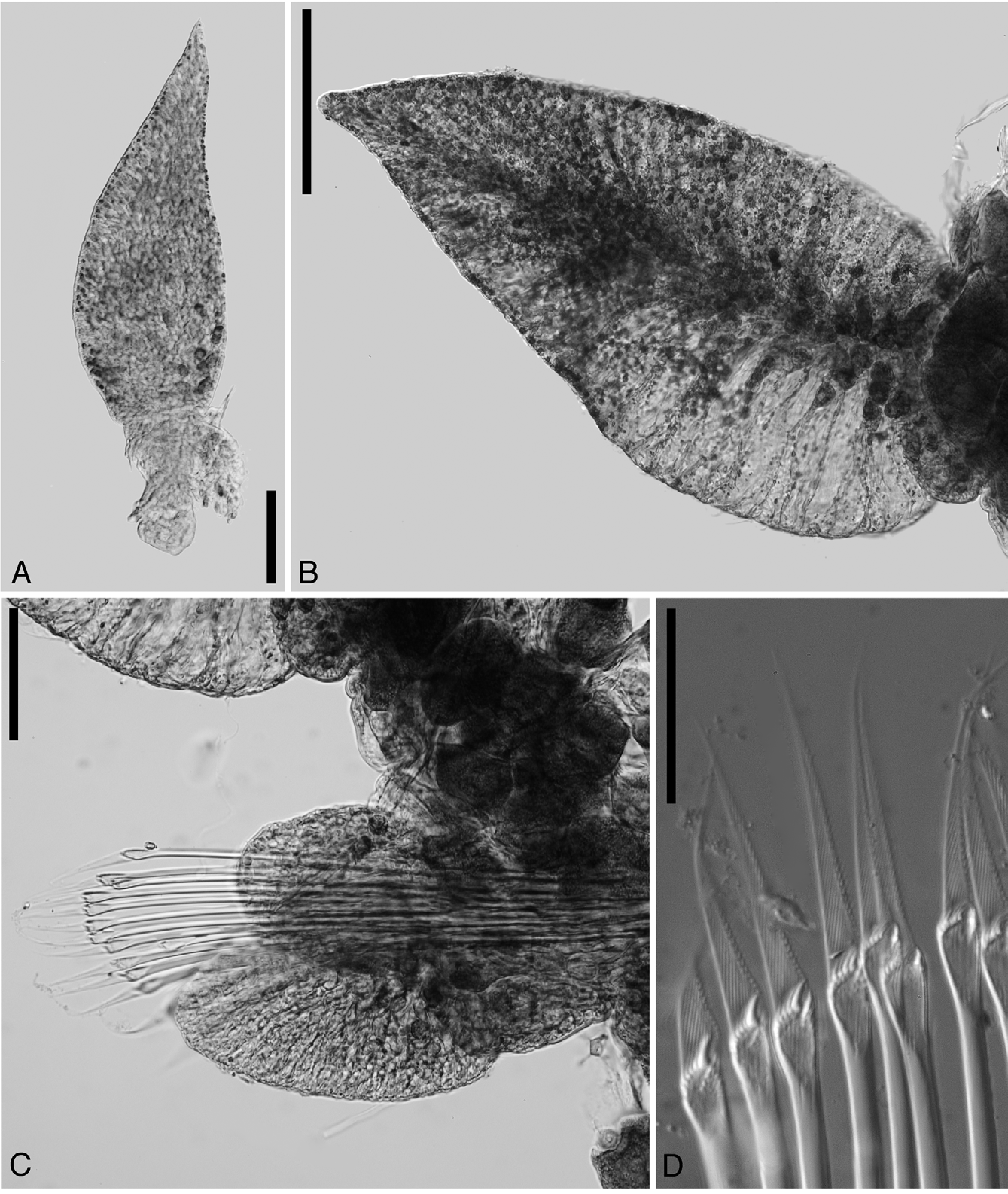
FIGURE 6. LM micrographs of Eulalia gracilior, new combination (SIO-BIC A 2603). A, ventral cirrus segment 2. B, dorsal cirrus from median segment. C, parapodial lobe and ventral cirrus of median segment. D, chaetae from median segment. Scale bars A – C 100 µm, D 25 µm.
Imageimage/png© Pleijel, Fredrik;Aguado, Maria Teresa;Rouse, Greg W.Pleijel, Fredrik;Aguado, Maria Teresa;Rouse, Greg W.
IMAGES